Claude 3.5 Sonnet: A Deep Dive Into Its Next-Generation Features and Performance
Introduction: The New AI Powerhouse for the Digital Age
The landscape of large language models 2024 is shifting faster than ever. Just when we thought we had defined the state-of-the-art, Anthropic released Claude 3.5 Sonnet, decisively resetting expectations for mid-tier AI models.
No longer satisfied with incremental upgrades, Anthropic’s newest offering is a seismic event in the world of generative AI updates. It doesn’t just replace the older Sonnet; it surpasses its former flagship, Claude 3 Opus, across nearly all key intelligence benchmarks while delivering the speed and efficiency necessary for mass adoption. This positions the Anthropic Claude 3.5 family not just as an OpenAI competitor, but as a potential market leader in several domains.
The sheer speed, combined with dramatic improvements in reasoning and vision, makes the question of “what is Claude 3.5 Sonnet” crucial for every developer, business analyst, and professional content creator.
What You Will Learn in This Guide
In this definitive Claude 3.5 Sonnet review, we will dissect the core technological advancements that define this model. You’ll gain detailed insights into:
- The groundbreaking Claude Artifacts feature and how it revolutionizes workflow.
- Head-to-head performance analysis, including definitive AI model benchmarks 2024.
- A pragmatic comparison: Claude 3.5 vs GPT-4o—is Claude 3.5 better than GPT-4o for your specific needs?
- Detailed access options, including Claude 3.5 Sonnet pricing and API functionality.
Prepare to explore the next frontier in intelligent chat models and productivity tools.
The New Standard: Understanding Claude 3.5 Sonnet’s Core Upgrade
Claude 3.5 Sonnet is a testament to Anthropic’s rapid development cycle. While the ‘Sonnet’ moniker typically implies the middle tier of their model family (above Haiku, below Opus), this version exhibits performance characteristics that place it squarely in the ‘flagship’ category of next-generation AI tools.
The model is built on a fundamental architectural shift that prioritizes both intelligence and efficiency. The goal was to deliver the high-level reasoning previously reserved for the costly and slow Opus model, but at the speed and scale of a practical, daily-use tool.
Performance Benchmarks: Intelligence and Reasoning
When assessing an AI model’s authority, we look at objective AI model benchmarks 2024 across MMLU (Massive Multitask Language Understanding), GPQA (Graduate-level general knowledge), and HumanEval (Coding ability).
Claude 3.5 Sonnet consistently sets new standards, outperforming Claude 3 Opus and rival models like GPT-4o in several critical areas:
- Coding Assistance (HumanEval): Claude 3.5 shows marked improvement in its ability to generate, debug, and understand complex code snippets. For AI for coding assistance, this means more reliable and efficient code completion, making it the best AI for developers focused on rapid iteration.
- Multistep Reasoning (GPQA): The model demonstrates superior capability in handling complex, multi-layered queries that require logical chaining and synthesis of diverse information. This is critical for high-level research and strategic planning tasks.
- Mathematical and Scientific Precision: Its accuracy in quantitative reasoning tasks has been significantly enhanced, making it a stronger tool for engineering and scientific applications.
This upgrade means the model excels at tasks requiring deep concentration, such as auditing large datasets, reviewing contracts, or complex technical documentation.
Speed and Efficiency: Claude 3.5 Sonnet Speed Test
One of the most noticeable improvements—and a key differentiator from the often slower Opus models—is speed. Claude 3.5 Sonnet is exceptionally fast, especially in generating complex, long-form outputs.
This focus on swift delivery is vital for real-world applications. A chatbot that thinks for 30 seconds before responding disrupts the user flow. By optimizing its inference speed, Anthropic has made Claude 3.5 Sonnet suitable for high-volume, low-latency applications, from powering internal knowledge bases to handling customer service interactions.
The model is roughly twice as fast as Claude 3 Opus, allowing users to move through projects quicker without sacrificing the quality of the intellectual output.
Introducing Claude Artifacts: The Game-Changing Feature
While the performance gains are essential under the hood, the most visible and potentially disruptive new feature is Claude Artifacts. This innovative user interface enhancement moves the interaction beyond a simple chatbox to a dynamic, collaborative workspace.
How Artifacts Streamlines Workflow for Developers and Creatives
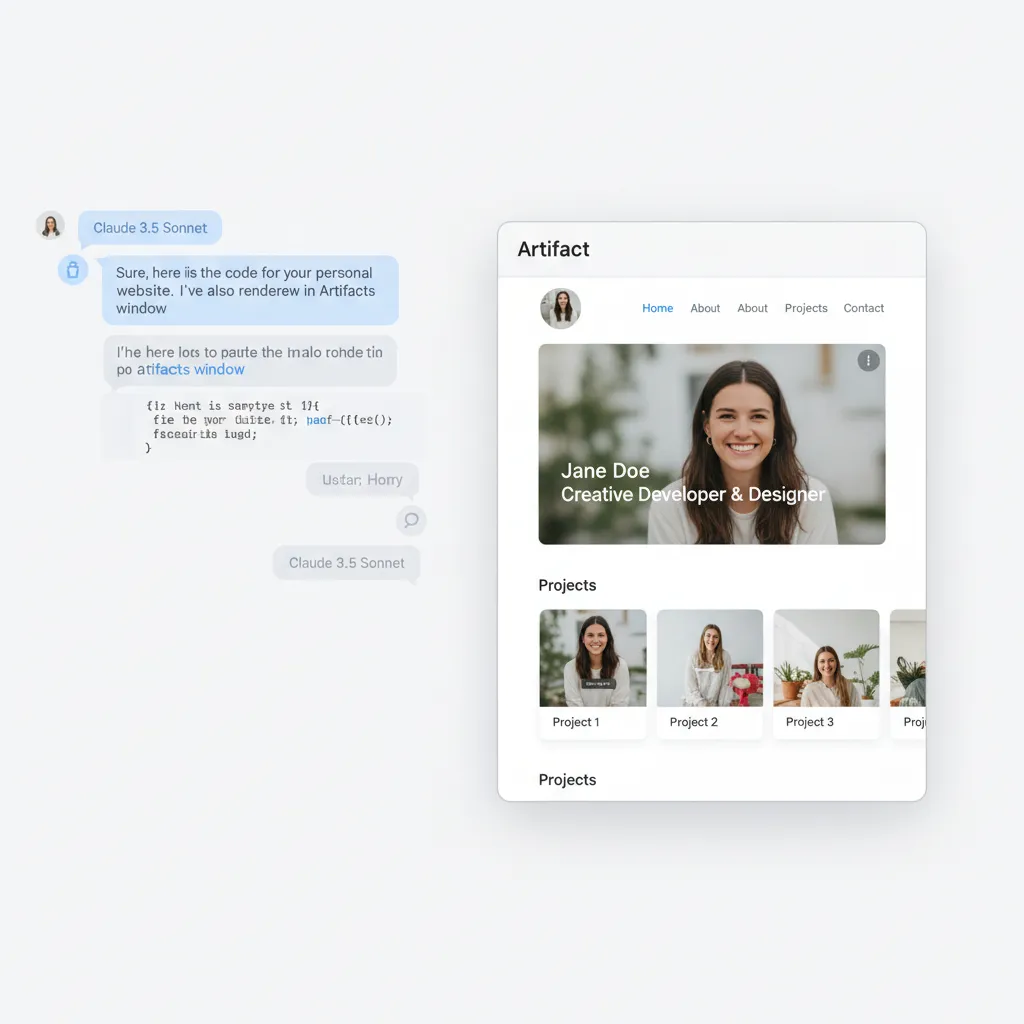
The concept behind Artifacts is simple yet profound: instead of the AI’s output (like code, a document, or a design) being trapped within the chat transcript, it pops out into a dedicated, live window next to the conversation.
This separate window is the “Artifact,” and it allows users to see, interact with, and directly edit the AI-generated output in real-time. This transforms Claude from a conversational partner into a true co-creator.
For instance, if you ask Claude 3.5 to “build a minimalist HTML landing page for a coffee shop,” the HTML and CSS will appear instantly in the Artifact window, rendering the actual webpage. You can then ask the model to “change the color palette to deep blues and golds,” and the Artifact updates instantly.
This seamless loop is revolutionary for efficiency, especially for tasks that require multiple iterations.
| Task | Traditional LLM Workflow | Claude Artifacts Workflow |
|---|---|---|
| Code Generation | Generate code in chat -> Copy code -> Paste into IDE -> Test -> Return to chat for debugging. | Generate code in chat -> Code appears in live Artifact window -> Test and iterate directly in the artifact or reference it side-by-side with chat. |
| Document Editing | Generate draft -> Copy/paste into Word/Google Docs -> Review -> Copy sections back to chat for revisions. | Generate draft in chat -> Document appears in Artifact -> Ask Claude for specific revisions (e.g., “Make this section more formal”), see changes immediately. |
| Data Visualization | Generate Python/JS code for a chart -> Copy/paste code into a separate tool to render. | Generate chart code -> Chart renders visually in the Artifact window, allowing for real-time adjustments. |
The Claude Artifacts feature positions Anthropic as a leader not just in model intelligence, but in user experience design, addressing a common pain point of developers and designers using AI development tools.
[Related: https://hyperdaily.one/blog/ai-career-mastering-future-job-market/]
Using Artifacts for Live Code Editing and Document Generation
The practical application of Artifacts is immediate and impactful.
- Live Debugging: When encountering an error, you can simply paste the error log and the problematic code snippet into Claude. The code appears in the Artifact, and the model can provide targeted fixes that you see applied instantly, dramatically reducing the time spent copying and pasting between interfaces.
- Design Mockups: While Claude is not a dedicated design tool, its ability to render static elements and mockups in the Artifact window means that initial wireframing and front-end development can be streamlined, making it a powerful component of an integrated workflow.
- Database Query Generation: For analysts, generating complex SQL queries or scripts is often tedious. With Artifacts, the query is generated, and the model can iteratively refine it based on real-time feedback, ensuring the Claude 3.5 JSON mode or similar structured outputs are correct and validated before execution. This is a massive boost for best AI for data analysis.
The Enhanced Eye: Claude 3.5’s Vision Capabilities
Beyond text and code, Claude 3.5 vision capabilities have received a significant overhaul, making it a state-of-the-art multimodal model that rivals or exceeds its competitors.
Anthropic claims 3.5 Sonnet has a superior visual understanding compared to previous models, specifically excelling at tasks requiring complex visual reasoning. This means the model doesn’t just recognize objects; it understands the relationship between them and the context they represent.
Superior Image and Chart Analysis
For professionals dealing with large volumes of visual data, 3.5 Sonnet is a breakthrough.
- Financial and Scientific Charts: The model can analyze complex scatter plots, bar charts, and line graphs—even poorly rendered or low-resolution ones—with greater precision than earlier models. It can extrapolate data points, identify trends, and summarize the key findings in natural language. This is particularly useful for extracting insights from presentation slides or large reports.
- Data Table Interpretation: Claude 3.5 can accurately transcribe and interpret tabular data embedded in images, even when the formatting is unconventional, making it a powerful tool for converting messy documentation into structured data formats.
- UX/UI Feedback: A designer can upload a screenshot of a website or app interface and ask Claude for specific feedback: “What are three immediate accessibility concerns with this color scheme?” or “Write CSS to fix the alignment issue on the footer.” The model responds with actionable, technical solutions.

[Related: https://hyperdaily.one/blog/personalized-wellness-tech-custom-path-optimal-health/]
Vision Use Cases: From OCR to UX Design Feedback
The enhanced vision model unlocks several critical business use cases:
- Automated Quality Control: In manufacturing or logistics, images of damaged goods can be uploaded, and Claude can categorize the damage type, severity, and recommend next steps based on visual input.
- Accessibility Audits: Uploading images of digital documents or webpages allows the model to identify potential accessibility issues (low contrast, missing alt text recommendations, unclear visual hierarchy) far faster than manual human review.
- Historical Document Analysis: Researchers can upload images of older, handwritten, or degraded texts. The improved vision capabilities aid in accurate Optical Character Recognition (OCR), helping to digitize difficult archival material.
This multimodal excellence ensures that Anthropic’s new AI model is not limited to text-in, text-out scenarios, significantly broadening its applicability across industries.
The Battle of the Giants: Claude 3.5 Sonnet vs. GPT-4o
When a major new model is released, the first question on everyone’s mind is the competitive comparison. For the current generation, that comparison is inevitably Claude 3.5 vs GPT-4o. Both models are recent, highly optimized, and represent the cutting edge of consumer and professional AI.
The rivalry between Anthropic and OpenAI drives innovation, resulting in remarkably similar performance ceilings, but with critical differences in philosophy, features, and utility.
Head-to-Head Benchmarks: Speed, Price, and Intelligence
While specific benchmarks often trade places depending on the specific test suite, the general consensus is that Claude 3.5 Sonnet performs at or above the level of GPT-4o on most high-level reasoning tasks (MMLU, GPQA).
| Feature | Claude 3.5 Sonnet | OpenAI GPT-4o | Key Advantage |
|---|---|---|---|
| Intelligence | Top-tier; excels in deep reasoning and complex coding. | Top-tier; excels in general knowledge and creative generation. | Reasoning/Coding edge for Claude. |
| Speed | Very fast (significantly faster than Opus). | Extremely fast (market leader in speed). | GPT-4o is marginally faster in high-latency scenarios. |
| Multimodality (Vision) | Excellent; superior chart and data analysis. | Excellent; strong general image recognition and low latency. | Claude 3.5 for detailed best AI for data analysis. |
| Unique Feature | Artifacts (dynamic, interactive workspace). | Native Voice Mode (low-latency, expressive audio interaction). | Artifacts offers a crucial workflow advantage. |
| Pricing (API) | Highly competitive, often more cost-effective for large volumes than GPT-4. | Highly optimized pricing for high speed. | Claude often offers better price-to-performance for heavy-duty reasoning tasks. |
| Context Window | Large (standard for high-end models). | Large. | Both handle massive inputs well. |
Semantic SEO: Is Claude 3.5 Better Than GPT-4o?
The answer to whether is Claude 3.5 better than GPT-4o depends entirely on your primary use case. Neither model is definitively “better” across the board; rather, they are optimized for different types of work.
Choose Claude 3.5 Sonnet if:
- You are a developer or analyst: The superior performance in coding benchmarks (HumanEval) and the revolutionary Artifacts feature provide a direct, streamlined workflow for writing, testing, and iterating on code and structured data.
- You require complex data analysis: If your work involves interpreting financial reports, technical diagrams, or scientific charts, Claude’s enhanced vision capabilities offer a quantifiable edge.
- You prioritize efficiency and cost: For many business use cases, the balance of high intelligence and relatively optimized Claude 3.5 Sonnet pricing makes it the more economical choice for large-scale deployments.
Choose GPT-4o if:
- You require real-time, low-latency conversational use: GPT-4o’s speed is unmatched, particularly in voice-to-voice or high-speed chatbot applications.
- You prioritize creative breadth: While both are strong, many users still find OpenAI models marginally better for broad, highly imaginative, or consumer-facing creative content.
For most power users and businesses seeking the highest levels of reasoning for problem-solving, code generation, and strategic thinking, Claude 3.5 performance makes a compelling case for a switch.
[Related: https://hyperdaily.one/blog/google-ai-overviews-future-of-search-and-seo/]
Competitive Edge: When to Choose Anthropic’s Model
Anthropic’s core philosophy, centered on constitutional AI and safety, often translates into a more measured and reliable output for sensitive or high-stakes business tasks. The model is typically praised for its:
- Long-Context Reliability: Handling massive prompts (like entire books or long legal documents) while maintaining coherence and factual accuracy across the entire text.
- Less Tendency to “Hallucinate”: While no LLM is perfect, Anthropic models are often tuned to be more cautious and less prone to speculative answers, which is crucial for Claude 3.5 Sonnet for business applications where factual accuracy is paramount.
- Structured Output Excellence: Its superior handling of complex requests for JSON, YAML, and other structured formats confirms its place as a robust back-end tool for AI development tools.
Practical Access and Pricing for Claude 3.5 Sonnet
Understanding how to use Claude 3.5 Sonnet involves navigating Anthropic’s access tiers. A major advantage of this release is its accessibility.
How to Access: Free Tier vs. Claude Pro and Team Plans
Claude 3.5 Sonnet is available across the entire user base, making its advanced capabilities accessible immediately:
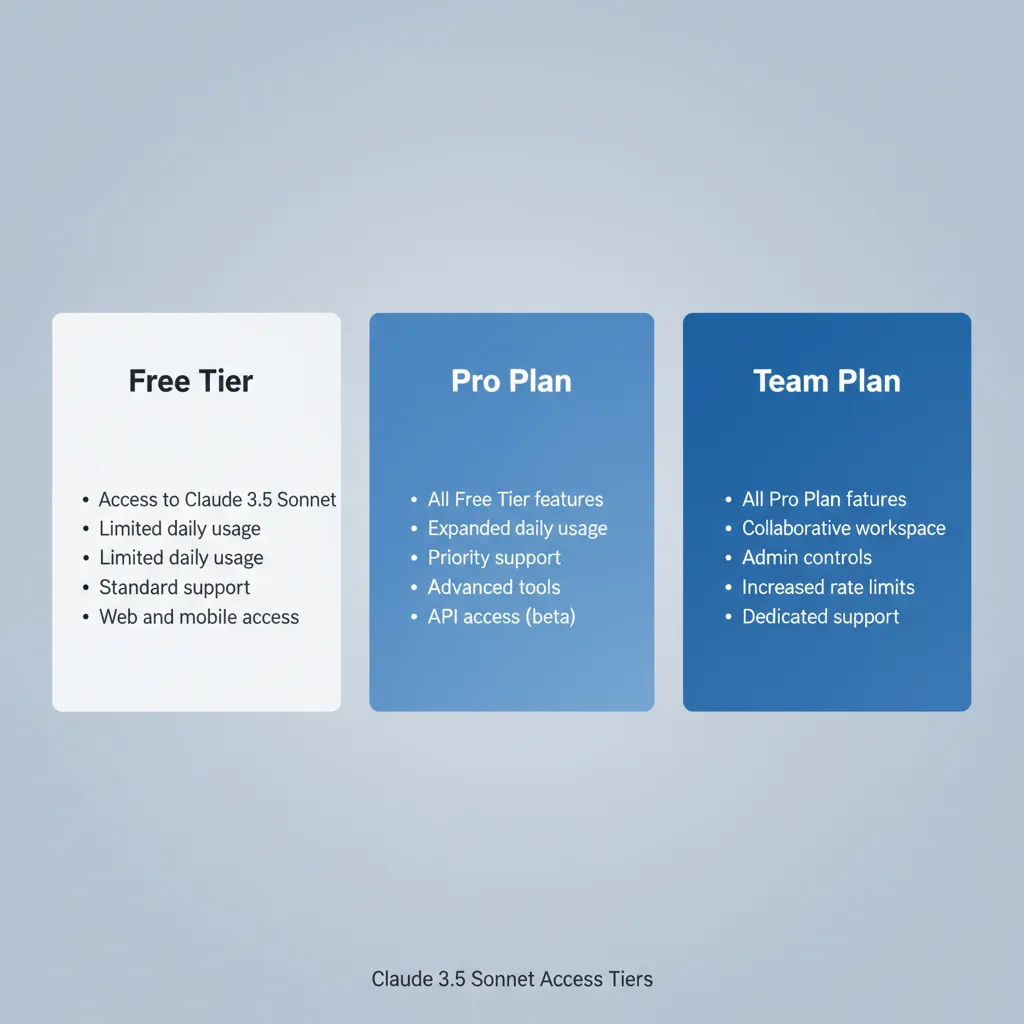
- Free Tier: Users can access Claude 3.5 Sonnet for free, though with daily usage limits that refresh regularly. This is a fantastic way for individuals to test the model’s intelligence and the new Artifacts feature.
- Claude Pro Features: For serious individual users, the Claude Pro features subscription offers significantly higher usage limits, priority access to new models like 3.5 Sonnet, and faster response times, even during peak hours.
- Claude Team Plan: Designed for businesses and collaborative teams, the Claude Team plan provides shared usage credits, enhanced security and administration features, and a dedicated workspace. This plan is essential for enterprises looking to deploy intelligent chat models internally.
Claude 3.5 Sonnet API for Developers
For integration into custom applications, the Claude 3.5 Sonnet API is the primary channel. Anthropic has priced the 3.5 Sonnet model aggressively to encourage adoption, placing it in a powerful sweet spot: performance that outclasses the costliest previous models (like Opus) but at a price point closer to mid-tier offerings.
Developers benefit from:
- Reliable Throughput: The increased speed of 3.5 Sonnet translates directly into lower latency and better throughput for high-volume API calls.
- Enhanced JSON Mode: The model’s ability to adhere strictly to requested output formats via Claude 3.5 JSON mode is a crucial technical detail for developers building reliable, scalable applications that require structured data exchange. This is especially valuable for creating robust back-end integrations, making it the best AI for developers prioritizing consistent output quality.
[Related: https://hyperdaily.one/blog/ai-revolutionizing-mental-wellness/]
Detailed Look at Use Cases in the Modern Workplace
The combination of the Artifacts feature, superior vision, and raw intelligence means Claude 3.5 Sonnet delivers profound value across diverse professional fields.
Streamlining Software Development and Debugging
The improvements in the HumanEval benchmark directly address the needs of software engineers.
- Refactoring Legacy Code: Developers can feed large blocks of old, poorly documented code to Claude 3.5, asking it to refactor the code for modern standards, enhance security, or improve efficiency. The results, visualized instantly in Artifacts, allow for immediate verification and implementation.
- Test Case Generation: For complex applications, generating comprehensive unit and integration tests is time-consuming. Claude 3.5 excels at reading application logic and generating robust test suites, significantly accelerating the QA cycle.
- Handling Exotic Languages: The model’s general reasoning improvement means it can better assist with less common programming languages or proprietary scripting languages, where online resources might be scarce.
Boosting Business Strategy and Data Synthesis
For non-technical professionals, Claude 3.5 Sonnet offers enhanced capacity for high-level analytical work.
- Competitive Intelligence: Feeding annual reports, market research graphs, and competitor product documentation into Claude 3.5 allows it to synthesize and summarize key strategic takeaways, comparing multiple data sources efficiently.
- Legal and Compliance Review: Uploading contracts or regulatory documents and using the model to identify specific clauses, discrepancies, or risk factors has become faster and more accurate due to its deep reasoning and attention to detail.
- Creative Content and Marketing: While sometimes overshadowed by its technical prowess, the model’s linguistic ability remains top-tier. It can draft high-quality long-form articles, marketing copy, and scripts, ensuring consistency in tone and adherence to brand guidelines across vast amounts of output.
This model is a strong candidate for being the central intelligence hub for organizations utilizing sophisticated large language models 2024.
Looking Ahead: The Future of Anthropic’s AI Roadmap
The release of 3.5 Sonnet is just one step in Anthropic’s ambitious journey. By placing this “mid-tier” model at the top of the performance charts, Anthropic signals its commitment to democratizing advanced AI and continuously raising the bar for its competitors.
The upcoming Claude 3.5 vs Opus comparison will be fascinating. Given that 3.5 Sonnet has already surpassed the older Opus, the next planned model release, potentially a new “Opus” successor, promises even more radical leaps in multimodal performance and general intelligence. This relentless pursuit of optimization ensures the field of AI model release news remains the most dynamic area in technology.
Anthropic is focusing heavily on making AI not just smarter, but safer and more integrated into human workflows—a trend highlighted perfectly by the Artifacts feature. As this evolution continues, we expect even more seamless integrations and features that blur the line between human effort and AI assistance.
Conclusion: The New Benchmark in Generative AI
Claude 3.5 Sonnet is not merely an iteration; it represents a significant generational leap. By combining the speed of previous Sonnet models with the deep reasoning power previously reserved for flagships, Anthropic has created a model that is both highly intelligent and immensely practical for daily professional use.
The introduction of Claude Artifacts provides a powerful new paradigm for human-AI collaboration, turning static chat output into a dynamic workspace. Coupled with state-of-the-art Claude 3.5 vision capabilities and its leading performance in AI for coding assistance, this model is a serious contender for the title of the best overall LLM available today.
Whether you are a developer looking for the best AI for developers, a business strategist synthesizing market data, or a creative professional seeking an interactive co-pilot, Anthropic Claude 3.5 offers compelling reasons to integrate it into your workflow.
Try the free version today to experience the future of generative AI—the efficiency gains could redefine your productivity limits.
[Related: https://hyperdaily.one/blog/future-of-work-ai-impact-jobs-careers/]
FAQs
Q1. What is Claude 3.5 Sonnet and why is its release important?
Claude 3.5 Sonnet is Anthropic’s newest, mid-tier large language model (LLM), released in 2024. Its importance lies in its performance: it surpassed Anthropic’s own previous flagship, Claude 3 Opus, on key industry benchmarks (including coding, reasoning, and knowledge), setting a new standard for intelligence, speed, and cost-efficiency in the AI sector.
Q2. What is the Claude Artifacts feature and how does it benefit users?
The Claude Artifacts feature is a new user interface element that creates a dynamic, dedicated workspace next to the main chat window. When the model generates certain outputs (like code, documents, or data visualizations), they appear in this Artifact window, allowing users to see, interact with, and iteratively refine the output in real-time, greatly accelerating workflow for developers and designers.
Q3. How does Claude 3.5 Sonnet compare to GPT-4o?
Claude 3.5 vs GPT-4o shows a tight competition. While GPT-4o often retains an edge in speed and low-latency interaction, Claude 3.5 Sonnet generally performs better on deep reasoning tasks, complex coding benchmarks (HumanEval), and detailed chart analysis due to its superior Claude 3.5 vision capabilities. Claude’s unique Artifacts feature also provides a distinct workflow advantage.
Q4. How can I access Claude 3.5 Sonnet and what is the pricing structure?
You can access Claude 3.5 Sonnet through Anthropic’s main web interface (claude.ai) in three tiers: a free plan (with usage limits), a Pro subscription (Claude Pro features) for individuals with higher limits, and the Claude Team plan for business collaboration. API access for developers is also available, with Claude 3.5 Sonnet pricing designed to be highly competitive for large-scale production use.
Q5. Is Claude 3.5 Sonnet better for coding than its previous models?
Yes. Claude 3.5 Sonnet shows significant improvements in the HumanEval and other coding benchmarks. It is specifically optimized for tasks requiring complex problem-solving, debugging, and generation of high-quality, maintainable code, establishing itself as a top choice for AI for coding assistance.
Q6. Does Claude 3.5 Sonnet support structured data output like JSON?
Yes, the model provides highly reliable output control through features like Claude 3.5 JSON mode. This allows developers using the Claude 3.5 Sonnet API to request and receive structured data (like JSON or YAML) with a very high degree of accuracy and format adherence, which is essential for building robust AI development tools.
Q7. What are the key business benefits of adopting Claude 3.5 Sonnet?
For businesses, the key benefits include superior speed and reliability (enhanced Claude 3.5 performance), advanced data synthesis capabilities (best AI for data analysis), and the streamlined team workflow offered by the Claude Team plan and the Artifacts feature. This combination leads to faster project completion, reduced reliance on manual data interpretation, and more reliable code generation, making it ideal for Claude 3.5 Sonnet for business deployment.
Q8. What is the difference between Claude 3.5 Sonnet and Claude 3 Opus?
Despite being the “Sonnet” tier, Claude 3.5 Sonnet is demonstrably more intelligent and faster than the older Claude 3 Opus model. Anthropic effectively replaced Opus’s performance crown with the more efficient and accessible Sonnet model, making 3.5 Sonnet the current performance flagship across most standard intelligence benchmarks.