AI Biometrics: The Future of Secure Identity & Access

Introduction
Remember the last time you frantically typed in password variations, hoping to guess the right one before getting locked out? Or the subtle anxiety that follows a “data breach” notification from a service you use? In our increasingly digital world, the humble password has become the weakest link in our security chain—a fragile barrier easily broken, stolen, or simply forgotten.
For years, biometrics offered a compelling alternative. Using what you are (your fingerprint, your face, your voice) instead of what you know (a password) was a leap forward. But early biometric systems had their own flaws. They could be slow, occasionally inaccurate, and vulnerable to sophisticated “spoofing” attacks.
Enter Artificial Intelligence. The fusion of AI with biometrics isn’t just an incremental upgrade; it’s a revolutionary paradigm shift. AI biometric authentication is creating a future of security that is not only stronger but also smarter, faster, and remarkably intuitive. This technology is the engine behind the push for a truly passwordless login experience and the cornerstone of next-gen authentication.
In this deep dive, we’ll explore the transformative world of AI biometrics. You’ll learn exactly how AI enhances biometrics, discover the incredible technologies at play from facial recognition AI to behavioral biometrics, and see how these systems are reshaping everything from enterprise biometric security to your daily consumer experiences. Get ready to understand the real future of security.
What is Biometric Security? The Foundation of Identity
Before diving into AI’s role, let’s establish the baseline: what is biometric security? At its core, it’s a security process that relies on the unique biological, physical, or behavioral characteristics of an individual to verify their identity.
Traditionally, these systems fall into two main categories:
-
Physical Biometrics: This involves traits that are anatomically unique to you. Think of the classics:
- Fingerprints: The unique patterns of ridges and valleys on your fingertips.
- Facial Features: The specific geometry of your face, like the distance between your eyes or the shape of your nose.
- Iris and Retina Patterns: The intricate, colored patterns in your iris or the unique map of blood vessels in your retina.
- Voice Patterns: The distinct frequencies and cadences that make up your voice.
-
Behavioral Biometrics: This category focuses on patterns in how you do things. These traits are developed over time and are unique to your habits:
- Typing Rhythm (Keystroke Dynamics): The speed and pressure with which you type.
- Gait Analysis: The specific way you walk.
- Mouse Movements: How you navigate a cursor across a screen.
- Signature Dynamics: The speed, pressure, and flow of your handwritten signature.
Traditional biometric systems work by capturing one of these traits, creating a digital template, and then matching that template against future scans for verification. It’s effective, but it’s a static, one-to-one comparison. This is where AI completely changes the game.
The Game-Changer: How AI Enhances Biometrics
AI doesn’t just make biometrics faster; it gives them a brain. Instead of simply matching static templates, AI introduces dynamic learning, context, and predictive capabilities. This is the core of the AI in identity management revolution.
From Static Matching to Dynamic Learning
A traditional system might fail if your fingerprint is smudged or if you’re wearing glasses during a facial scan. AI-powered systems, built on machine learning and neural networks, learn from every interaction. They can account for subtle changes—aging, facial hair growth, different lighting conditions, or a minor cut on a finger. The system becomes more accurate and resilient over time, creating a robust and secure digital identity.
Unprecedented Accuracy and Fraud Prevention
AI algorithms can analyze dozens of unique vectors in a biometric sample that are invisible to the naked eye or simpler programs. This dramatically reduces the chance of both:
- False Rejection Rate (FRR): Mistakenly denying access to an authorized user.
- False Acceptance Rate (FAR): Incorrectly granting access to an unauthorized user.
This precision is critical for preventing fraud with AI biometrics.
Liveness Detection and Anti-Spoofing
One of the biggest vulnerabilities of older biometric systems was spoofing—tricking the sensor with a fake sample, like a high-resolution photo for facial recognition or a gelatin mold of a fingerprint.
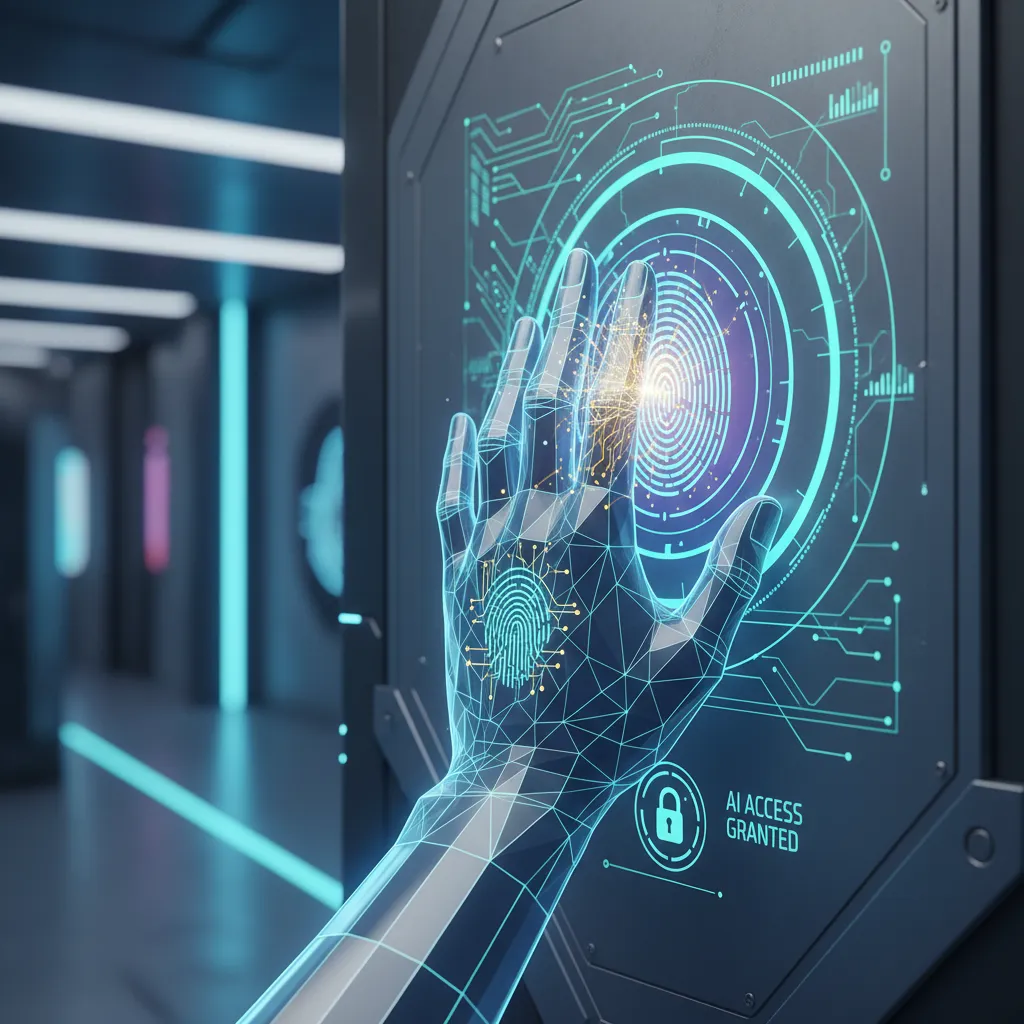
AI introduces sophisticated “liveness detection.” An AI model can analyze micro-expressions, skin texture, pupil dilation, blood flow, and other subtle cues to determine if it’s looking at a live person or a fake. It can tell the difference between a real voice and a recording, making voice recognition security far more reliable. This capability is a cornerstone of modern biometric security solutions.
Adaptive and Context-Aware Security
This is where AI biometrics feels like science fiction. Adaptive biometric systems create a truly seamless authentication experience. Instead of a single, all-or-nothing security checkpoint, the system continuously and passively assesses risk based on context.
For example, if you’re logging into your banking app from your home Wi-Fi on your usual device, a quick facial scan might suffice. But if a login attempt occurs from an unrecognized device in a different country, the system might adapt, requiring an additional factor, like a voice print or an iris scan. This is a key part of the multi-factor authentication AI strategy, providing robust security without inconveniencing the user.
The Core Technologies: A Closer Look at AI-Driven Biometrics
AI is supercharging every form of biometric identification. Let’s look at the key technologies leading the charge.
Facial Recognition AI
This is arguably the most common form of AI biometrics, thanks to smartphones. But its applications go far beyond unlocking your device. AI has elevated facial recognition AI to be a powerful tool for access control systems in airports, corporate buildings, and secure facilities. AI models can accurately identify individuals in a crowd, even with partial facial obstruction, poor lighting, or different camera angles—a feat impossible for older systems. Related: Apple Intelligence: A Deep Dive into the Top AI Features of iOS 18
Next-Generation Fingerprint Authentication
While fingerprint authentication is a mature technology, AI is breathing new life into it. AI algorithms can reconstruct and match partial or degraded fingerprints, a massive benefit for law enforcement and forensics. For consumer and enterprise use, AI enhances the speed and reliability of under-display sensors on smartphones and laptops, ensuring quick and secure access every time.
Iris Scanning Technology
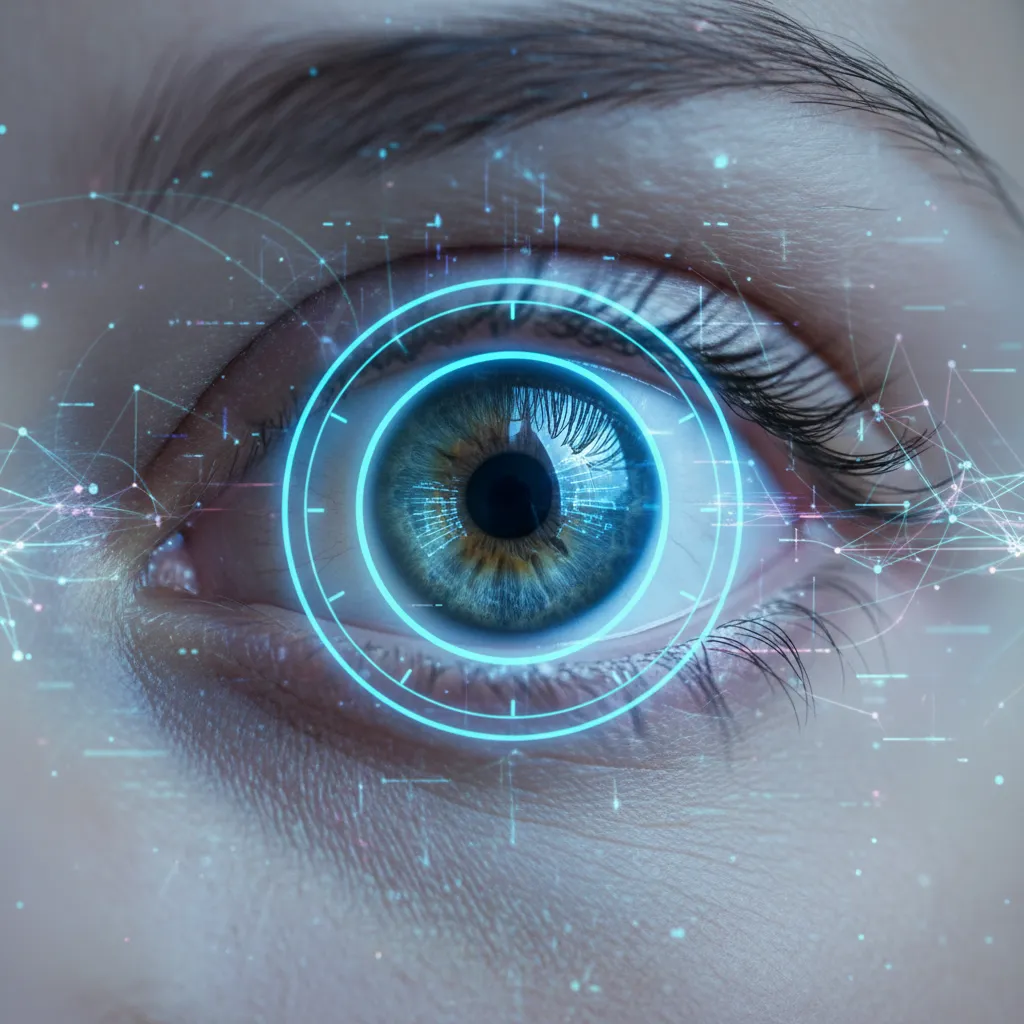
The iris is one of the most unique and stable human identifiers, making iris scanning technology incredibly secure. The challenge has always been the scanning process. AI has enabled faster, non-intrusive iris scanners that can perform real-time biometric verification from a distance. These systems are being deployed in high-security environments like data centers, airports, and national border crossings.
The Rise of Behavioral Biometrics
This is one of the most exciting frontiers in AI biometric authentication. Behavioral biometrics offers a continuous and invisible layer of security. Your bank’s application could be running an AI model in the background that analyzes how you type, hold your phone, and move your mouse.
If a fraudster gains access to your credentials and logs in, the AI will almost instantly detect that the behavioral patterns don’t match yours and can flag the session, request step-up authentication, or lock the account. This continuous authentication is a game-changer for AI for fraud detection. Related: Boost Your Mind: Top AI Mental Wellness Tools & Apps for a Calmer You
Real-World Applications: Where AI Biometrics is Making an Impact
The applications for AI-enhanced biometrics are expanding rapidly across every industry, driven by major cybersecurity trends 2024.
Enterprise Security and AI-Driven Access Control
Companies are moving beyond keycards to create truly intelligent buildings. With an AI-driven access control system, employees can walk through entry points without breaking stride as a camera verifies their identity. Access to sensitive areas, like server rooms, can be controlled with multi-factor biometrics (e.g., face and voice). This improves security and operational efficiency. Related: AI to Supercharge & Automate Your Workflow for a Boost in Productivity
Consumer Biometric Trends: Securing Your Digital Life
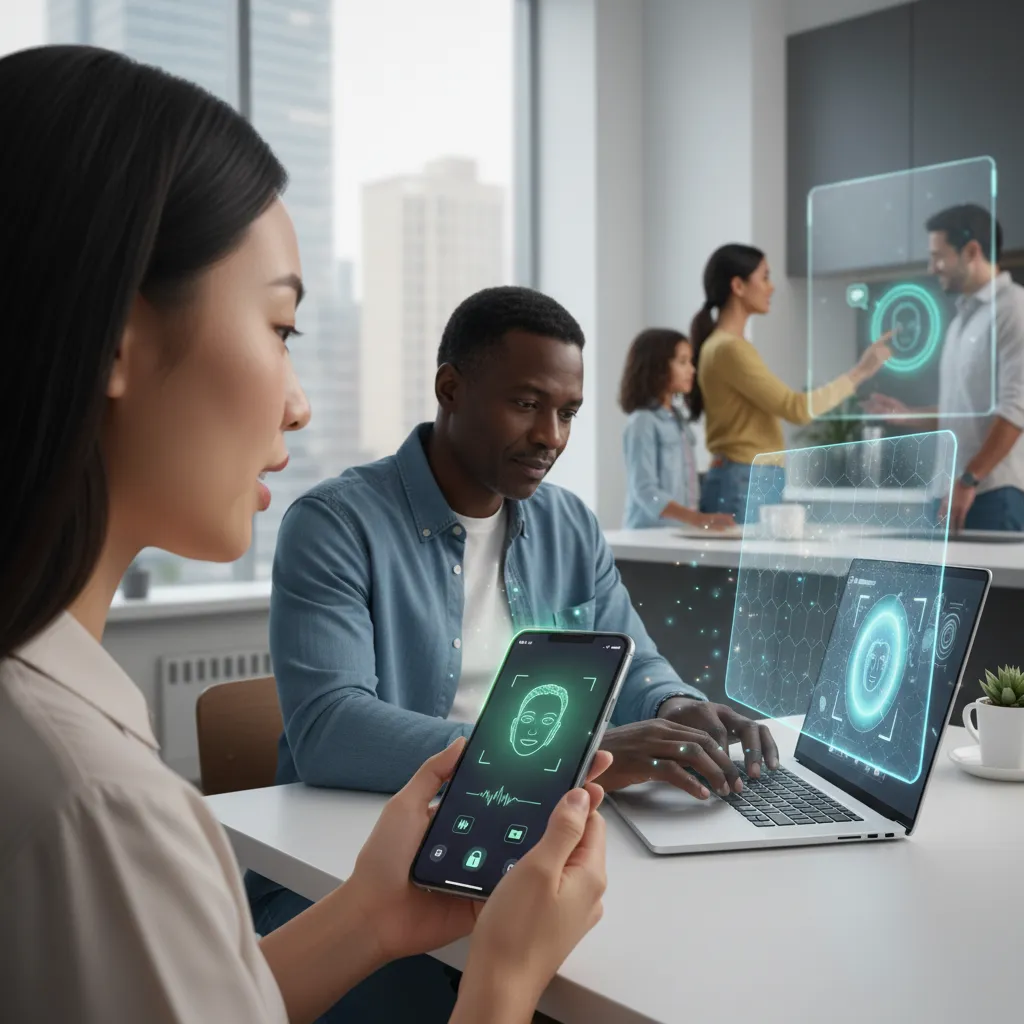
This is where most of us interact with AI biometrics daily. From unlocking phones and laptops to authorizing payments with Apple Pay or Google Pay, these systems have made strong security incredibly convenient. The ultimate goal for consumer biometric trends is a widespread passwordless login ecosystem, where your face or fingerprint is your master key to all your digital accounts.
Banking and FinTech: A New Era of Fraud Prevention
The financial industry is a major adopter. Banks use AI biometrics for:
- Secure Onboarding (KYC): Verifying a new customer’s identity by matching their face to a government-issued ID.
- Transaction Authorization: Using voice or facial recognition to approve large transfers.
- Real-Time Fraud Detection: Leveraging behavioral biometrics to spot account takeovers instantly.
This proactive approach is crucial for building trust and protecting assets in the digital banking world. Related: AI is Revolutionizing Customer Service: Boosting Satisfaction and Efficiency
Navigating the Challenges: Data Privacy and Ethical AI Biometrics
For all its benefits, the rise of AI biometrics brings significant challenges and ethical questions that must be addressed responsibly. The power of this technology demands an equal measure of caution and oversight.

The Critical Issue of Data Privacy Biometrics
Your biometric data is the most personal data you have; it cannot be changed like a password if it’s compromised. The primary concern revolves around storage and protection. Where are these biometric templates stored? Who has access? The industry is moving toward standards where raw biometric data never leaves the user’s device. Instead, it’s converted into an encrypted template, and only that template is used for matching. Regulations like GDPR and CCPA are setting strict rules for how organizations must handle data privacy biometrics.
The Risk of Bias and Inaccuracy
An AI model is only as good as the data it’s trained on. If a facial recognition algorithm is trained primarily on data from one demographic group, it may exhibit lower accuracy for others. This can lead to significant real-world consequences, from unfair denial of access to false accusations. The push for ethical AI biometrics requires developers to use diverse, representative datasets and to be transparent about their systems’ accuracy rates across all demographics.
The Spectre of Surveillance
The potential for misuse, particularly by governments for mass surveillance, is a legitimate and pressing concern. The debate over ethical AI biometrics centers on finding a balance between security and personal freedom. This requires clear legislation, public debate, and robust oversight to prevent the creation of a surveillance state where individuals’ movements and identities are tracked without their consent. Related: What Are AI Agents? Your Guide to the Next Tech Frontier
The Biometric Technology Future: What’s Next?
The evolution of AI biometrics is far from over. The biometric technology future promises even more integrated, intelligent, and invisible security solutions.
Multi-Modal Biometrics
Why rely on one identifier when you can use several? Multi-modal systems will become the standard for high-security applications. A system might simultaneously verify your face, the sound of your voice, and your typing rhythm to grant access. This layered approach, a core principle of multi-factor authentication AI, makes a breach practically impossible.
The Era of Passwordless Everything
The momentum is undeniable. Tech giants like Apple, Google, and Microsoft are championing the FIDO Alliance and Passkeys, which use device-based biometrics to eliminate passwords entirely. Soon, logging into your favorite websites and apps will be as simple as looking at your screen or touching a sensor, marking the true arrival of the passwordless login.
Hyper-Personalization and Continuous Authentication
The future of security is not a single gate but a continuous, adaptive process. Future systems will build a dynamic profile of you, learning your habits and context. The authentication process will fade into the background, creating a truly seamless authentication experience that only becomes visible when an anomaly is detected. Related: The Future is Now: Human-Robot Collaboration & AI’s Next Frontier
Conclusion
AI biometrics is more than just a technological trend; it is the fundamental evolution of digital identity. By infusing biometric systems with the power of artificial intelligence, we are moving away from the fragile, forgettable password and toward a future where our unique human traits are the keys to our digital lives.
This technology offers a powerful trifecta of benefits: superior security that can detect and prevent sophisticated fraud, a frictionless user experience that removes the burden of remembering complex credentials, and intelligent, adaptive systems that provide the right level of security at the right time.
However, the path forward requires mindful navigation. We must continue to champion robust data protection, demand transparency and fairness from AI models, and establish clear ethical guidelines to prevent misuse.
The integration of AI in identity management is creating a safer, more efficient, and more intuitive digital world. The journey to a truly secure and seamless future has begun, and AI biometrics is lighting the way.
Frequently Asked Questions (FAQs)
Q1. What is AI biometrics?
AI biometrics is the integration of artificial intelligence and machine learning with biometric identification systems. AI enhances traditional biometrics by enabling systems to learn and adapt, improving accuracy, detecting “liveness” to prevent spoofing, and analyzing complex behavioral patterns for continuous authentication.
Q2. What are the advantages of AI in biometrics?
The main advantages include vastly improved security through higher accuracy and anti-spoofing capabilities, a better user experience with faster and more seamless verification, and proactive fraud detection. AI also allows for adaptive security that can adjust requirements based on risk, making systems both stronger and more convenient.
Q3. How does AI improve facial recognition?
AI improves facial recognition by using deep learning neural networks to analyze thousands of facial vectors. This allows the system to accurately identify individuals despite variations in lighting, angle, age, or accessories like glasses. AI also powers liveness detection to ensure the system isn’t being fooled by a photo or video.
Q4. What is the difference between biometrics and AI biometrics?
Traditional biometrics typically involves a simple one-to-one template matching process (e.g., does this fingerprint scan match the one on file?). AI biometrics is a dynamic system that learns from data, recognizes complex patterns, understands context, and can distinguish between a live user and a fake sample, making it significantly more intelligent and secure.
Q5. Is AI biometric data safe?
The safety of biometric data depends entirely on how it is stored and managed. Modern best practices, enforced by regulations like GDPR, involve on-device storage and end-to-end encryption. The raw biometric data is converted into an encrypted template (a process called tokenization), so the actual image of your face or fingerprint is never stored on a central server where it could be breached.
Q6. What are behavioral biometrics?
Behavioral biometrics are identifiers based on your unique patterns of action rather than physical traits. This includes how you type on a keyboard (keystroke dynamics), move a mouse, hold your phone, or even the rhythm of your gait. AI is essential for analyzing these subtle patterns for continuous, passive authentication.
Q7. What is an example of an adaptive biometric system?
An adaptive biometric system adjusts its security level based on context. For example, logging into your email from your personal laptop at home might only require a quick fingerprint scan. However, if you try to log in from a new computer in a different country, the system might recognize the anomaly and “step-up” the authentication, requiring an additional biometric factor like a voice print to confirm your identity.