Quantum Machine Learning: Revolutionizing AI with Unseen Power
Introduction
We’re living through an AI renaissance. From generative art to predictive text, machine learning has woven itself into the fabric of our digital lives. But as we push the boundaries of what classical computers can do, a new horizon is emerging—one that operates on the very principles of reality itself. Welcome to the world of Quantum Machine Learning (QML), the groundbreaking fusion of quantum computing and artificial intelligence.
This isn’t just a minor upgrade; it’s a fundamental paradigm shift. QML promises to tackle problems currently deemed “unsolvable,” unlocking a new era of AI innovation and scientific discovery. It represents the next evolutionary step in the future of machine learning, a leap that could redefine industries from healthcare to finance.
In this deep dive, we’ll demystify the core concepts of Quantum AI, explore how it differs from the machine learning we know today, and uncover the incredible quantum computing applications that are poised to change our world. Get ready to explore the unseen power that will drive the next generation of transformative AI.
The Quantum Leap: What Makes QML Fundamentally Different?
To understand QML, we first need to appreciate the limitations of the computers we use every day. Classical computers, from your smartphone to the most powerful supercomputers, process information using “bits.” A bit is a simple binary switch, representing either a 0 or a 1. All the complexity of modern software is built upon this simple foundation.
Quantum computing throws this binary rulebook out the window. It harnesses the strange and wonderful principles of quantum mechanics to process information in ways that are fundamentally more powerful.
The Power of Qubits: Superposition and Entanglement
The heart of a quantum computer is the “qubit.” Unlike a bit, which can only be a 0 or a 1, a qubit can exist in a state of superposition—meaning it can be both 0 and 1 at the same time. Think of it like a spinning coin. While it’s in the air, it’s neither heads nor tails; it’s a probabilistic blend of both. Only when it lands (or is “measured”) does it settle into a definite state.
This ability to hold multiple values simultaneously allows quantum computers to explore a vast number of possibilities at once. But the magic doesn’t stop there. Qubits can also become entangled. When two qubits are entangled, their fates are linked, no matter how far apart they are. Measuring the state of one instantly influences the state of the other. Einstein famously called this “spooky action at a distance,” and it creates complex correlations that allow quantum computers to perform calculations far beyond the reach of their classical counterparts.

The Promise of Quantum Parallelism
By leveraging superposition and entanglement, a quantum computer with just a few hundred qubits can represent and process more information than there are atoms in the known universe. This massive computational space is the source of “quantum parallelism.” It allows a QML model to evaluate an enormous landscape of potential solutions simultaneously, offering a significant speedup for certain types of problems.
This is the driving force behind the quest for Quantum supremacy (performing a task a classical computer practically cannot) and, more pragmatically, Quantum advantage (outperforming classical computers on real-world problems).
The Architecture of Quantum AI: How Does QML Work?
While the thought of purely quantum AI is exciting, the reality today is more collaborative. We are currently in the era of NISQ technology, which stands for “Noisy Intermediate-Scale Quantum.” Today’s quantum processors are powerful but also delicate and prone to errors (or “noise”).
Because of this, the most promising path forward is Hybrid Quantum-Classical Computing.
Hybrid Quantum-Classical Computing: The Best of Both Worlds
A hybrid model is exactly what it sounds like: a powerful partnership. A classical computer handles the overall structure of a machine learning task—managing data, setting parameters, and interpreting results. When it encounters a computationally brutal part of the problem, like a complex optimization or feature-mapping task, it offloads that specific calculation to a specialized Quantum Processing Unit (QPU).
The QPU crunches the impossibly complex numbers and sends the result back to the classical computer. This workflow leverages the strengths of both architectures, making QML a practical reality even with today’s NISQ hardware. Many of the most important quantum algorithms being developed today are designed for this hybrid approach. Related: The XAI Revolution: Demystifying AI Decisions for Trust and Transparency
A Glimpse into Quantum Algorithms
The instructions that run on a quantum computer are called quantum algorithms. These are designed from the ground up to exploit the principles of quantum mechanics. A major class of algorithms used in QML are Variational Quantum Algorithms (VQAs).
In a VQA, the hybrid loop is crucial. The classical computer tunes the parameters of a quantum circuit, the QPU runs the calculation, and the classical computer evaluates the result and suggests new parameters to try. This iterative process “trains” the quantum algorithm, much like how we train a classical neural network, to find the optimal solution to a problem.

The QML Toolkit: Types of Quantum Machine Learning Models
Just as classical machine learning is divided into different categories, QML models can be structured to tackle various tasks. The goal is to see where quantum mechanics can provide a distinct advantage.
Supervised QML: Enhanced Pattern Recognition
In supervised learning, we train a model on labeled data to make predictions. Supervised QML takes this to the next level. Quantum algorithms can map data into incredibly high-dimensional spaces, revealing intricate patterns and correlations that are completely invisible to classical algorithms.
One example is the Quantum Support Vector Machine (QSVM), which has the potential to create far more sophisticated decision boundaries for classification tasks. This could lead to massive machine learning breakthroughs in areas like medical diagnosis and financial fraud detection.
Unsupervised QML: Discovering Hidden Structures
Unsupervised learning is about finding hidden patterns in unlabeled data. Unsupervised QML can excel at tasks like clustering and dimensionality reduction. By processing all data points in superposition, a quantum computer could identify subtle groupings and relationships within massive, complex datasets, which is a core task in quantum data science. Related: AI Privacy On Your Device: Securing Your Data in the Age of On-Device Intelligence
Quantum Neural Networks (QNNs): The Next Generation of Deep Learning?
The concept of Quantum Neural Networks (QNNs) is one of the most exciting AI research trends. A QNN replaces classical neurons with qubits and linear algebra with unitary transformations. The result is a model that could have exponentially greater capacity and efficiency. While still in early development, QNNs could one day power AI models that are orders of magnitude more powerful than today’s deep learning architectures.
Racing Towards Quantum Advantage: The Speed and Power of QML
So, what does all this theoretical power translate to in practice? The goal of the entire quantum computing ecosystem is to achieve a demonstrable “quantum advantage”—solving meaningful problems faster or more accurately than the best-known classical methods.

Solving the Unsolvable: Quantum Optimization
Many of the world’s most challenging problems are optimization problems: finding the best possible solution from a near-infinite set of options. This includes logistics (the “Traveling Salesperson Problem”), financial modeling, and drug discovery. Classical computers often have to rely on approximations for these tasks.
Quantum optimization algorithms, like the Quantum Approximate Optimization Algorithm (QAOA) and quantum annealing (a specialty of D-Wave quantum machine learning), can explore the entire solution space at once to find the true global optimum. This is one of the most promising near-term applications of QML.
The Data Revolution: Quantum Data Science
We’re generating data at an explosive rate. QML offers tools to make sense of it all. By performing operations like Fourier transforms exponentially faster, quantum computers can revolutionize signal processing and data analysis. This enhancement of quantum data science will be critical as we navigate the age of big data and beyond. Related: Edge AI Explained: Powering Smart Devices with Real-Time Intelligence
Real-World Applications: Where QML Will Change Everything
The true test of any technology is its real-world impact. QML is moving from theoretical research into practical application across a range of critical industries.
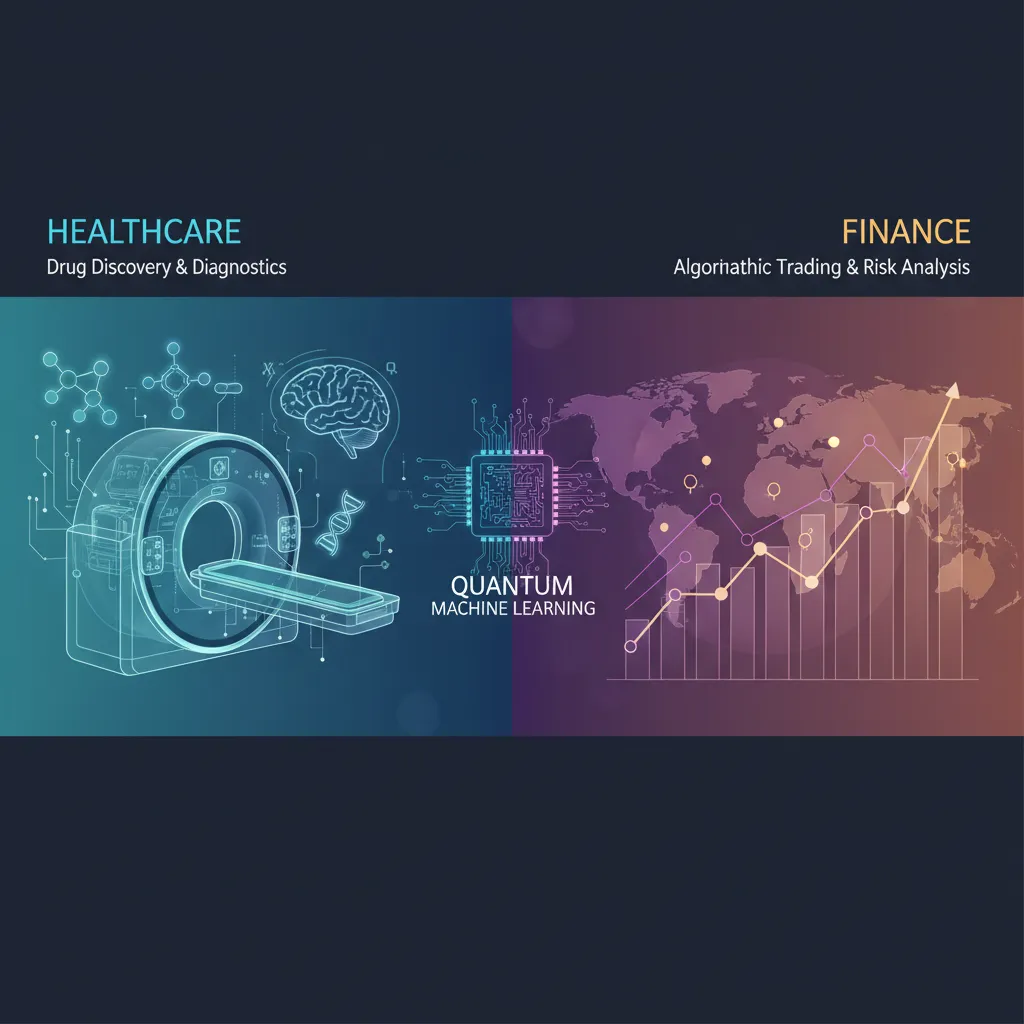
Quantum Computing in Healthcare and Drug Discovery
This is perhaps the most profound area for QML’s impact. Designing a new drug involves understanding how a molecule will interact with proteins in the body—a massively complex quantum-mechanical problem.
- QML for Drug Discovery: Classical computers can only approximate these simulations. Quantum computers can simulate them with perfect accuracy, drastically accelerating the design of new, more effective drugs and personalized medicines.
- Genomic Analysis: QML can analyze complex genomic data to identify genes associated with diseases, paving the way for hyper-personalized treatments.
Related: AI Revolutionizes Science: From Material Discovery to Personalized Medicine
Transforming Finance and Global Markets
The financial world is built on complex models and high-stakes optimization. Quantum computing in finance is poised to be a multi-billion dollar revolution.
- Portfolio Optimization: QML can analyze countless variables to construct investment portfolios with the ideal balance of risk and reward, far surpassing classical methods.
- Risk Analysis: Quantum models can run Monte Carlo simulations with incredible speed, providing a much clearer picture of market risks.
- Fraud Detection: By identifying subtle patterns in transaction data, QML can build more robust systems for detecting financial crime.
Breakthroughs in Materials Science and Manufacturing
The quest for new materials—for better batteries, more efficient solar cells, or room-temperature superconductors—is limited by our ability to simulate atomic interactions.
- QML for Materials Science: Just as with drug discovery, quantum computers can precisely simulate molecular behavior, allowing scientists to design novel materials with specific, desirable properties from the ground up. This could unlock energy and manufacturing revolutions.
The Future of Quantum Cybersecurity
With immense power comes a new kind of threat. Quantum computers will one day be powerful enough to break the encryption that secures our entire digital world. However, the same technology provides the solution.
- Quantum-Resistant Cryptography: QML is being used to develop new encryption algorithms that are secure against both classical and quantum attacks.
- Quantum Key Distribution (QKD): This uses the principles of quantum mechanics to create unhackable communication channels, representing the future of quantum cybersecurity.
The Quantum Ecosystem: Tools, Players, and Challenges
The journey toward full-scale quantum computing is a global effort involving tech giants, startups, and academic institutions.
The Major Players: Who is Leading the Quantum Race?
The quantum computing ecosystem is buzzing with activity. Giants like Google, IBM, and Microsoft are investing billions in building quantum hardware and cloud platforms. They are joined by specialized companies like Rigetti, IonQ, and D-Wave Systems, each pursuing different approaches to building a stable, scalable quantum computer.
Quantum Software and Programming
Building applications for these new machines requires a new software stack. Quantum software platforms like IBM’s Qiskit, Google’s Cirq, and Microsoft’s Azure Quantum provide tools and simulators that allow developers to start learning quantum programming. These open-source initiatives are crucial for building a community and accelerating AI research trends.
Overcoming the Hurdles: Decoherence, Noise, and Scalability
The path to quantum advantage is not without significant challenges. Qubits are incredibly fragile. The slightest interaction with their environment—a stray vibration or temperature fluctuation—can destroy their delicate quantum state in a process called “decoherence.” This “noise” is the primary obstacle that NISQ technology faces.
Engineers are developing sophisticated error-correction techniques and building better hardware to combat this, but scaling up to the thousands or millions of stable qubits needed for fault-tolerant quantum computing remains a monumental engineering challenge.
Conclusion
Quantum Machine Learning is not science fiction. It’s a nascent but rapidly advancing field that stands to redefine the limits of computation and artificial intelligence. While we are still in the early days of the NISQ era, the hybrid quantum-classical approach is already delivering promising results and paving the way for future breakthroughs.
From designing life-saving drugs and creating new materials to revolutionizing finance and securing our digital future, the potential of Quantum AI is immense. It represents a fundamental shift in how we solve problems, offering a powerful new tool in our quest for knowledge and progress. The future of machine learning is quantum, and the revolution is just getting started. The only question left is: what will we build with this unseen power?
Frequently Asked Questions
What is the main goal of quantum machine learning?
The primary goal of Quantum Machine Learning (QML) is to leverage the principles of quantum mechanics, such as superposition and entanglement, to solve complex machine learning problems that are intractable for classical computers. It aims to achieve a “quantum advantage” by providing significant speedups or more accurate solutions for tasks in optimization, classification, and data analysis.
What are the advantages of quantum machine learning?
QML offers several key advantages over classical ML. These include the ability to process information in vast computational spaces, analyze highly complex patterns in data, and solve large-scale optimization problems much more efficiently. This leads to breakthroughs in areas like QML for drug discovery, finance, and materials science.
Is quantum machine learning the future of AI?
Many experts believe QML represents a critical component of the AI future. While it won’t replace all classical machine learning, it will be a specialized and incredibly powerful tool for a certain class of problems. The long-term vision is a hybrid AI ecosystem where classical and quantum processors work together, each tackling the tasks they are best suited for.
What are some examples of quantum machine learning?
Practical examples include optimizing investment portfolios in finance, simulating molecular structures to design new drugs and materials, enhancing pattern recognition for medical image analysis, and developing new algorithms for quantum cybersecurity. Companies are already using quantum annealers, like those from D-Wave, for real-world quantum optimization tasks.
How is quantum computing used in machine learning?
Quantum computing is used in machine learning by running parts of an algorithm on a quantum processor (QPU). This is often done in a hybrid quantum-classical model. For example, a quantum circuit can be used to map data into a high-dimensional feature space, after which a classical algorithm performs the final classification, combining the strengths of both systems.
Is QML better than classical ML?
QML is not universally “better” but is “different and more powerful” for specific tasks. For many everyday machine learning problems, classical algorithms are still more practical and efficient. QML’s strength lies in problems with a specific mathematical structure that maps well to quantum mechanics, such as certain optimization and simulation problems.
What are the biggest challenges for QML today?
The most significant challenges are hardware limitations and “noise.” Current quantum computers (NISQ-era devices) have a limited number of qubits and are highly susceptible to errors from environmental disturbances (decoherence). Developing robust quantum error correction and scaling up the number of stable, high-quality qubits are the primary hurdles the quantum computing ecosystem is working to overcome.