The DePIN Revolution: How Decentralized Networks Power Tomorrow’s Infrastructure

Have you ever wondered who owns the internet? Not the websites or the content, but the actual physical hardware—the servers, the fiber optic cables, the Wi-Fi hotspots, and the cell towers. For decades, this critical infrastructure has been the exclusive domain of a handful of corporate giants. This centralization has led to high costs, censorship, and single points of failure. But what if we could build a new foundation for the digital world, one owned and operated by its users?
This is the promise of the DePIN revolution.
DePIN, which stands for Decentralized Physical Infrastructure Networks, is one of the most exciting and practical applications of Web3 technology. It’s a movement that uses blockchain and crypto tokens to incentivize a global community of individuals to build, maintain, and operate real-world infrastructure. From decentralized internet access to cloud storage and even global mapping, DePIN is creating a more resilient, open, and equitable physical layer for the next generation internet.
In this deep dive, we’ll explain what DePIN is, how it works, explore groundbreaking projects leading the charge, and analyze the profound impact of DePIN on Web3 and our digital future.
What is DePIN? Unpacking the Physical Layer of Web3
At its core, DePIN is a simple but powerful idea: using a blockchain to coordinate and reward people for deploying hardware that provides a real-world service. Think of it as the Uber or Airbnb for physical infrastructure. Instead of a single company owning all the cars or properties, DePIN creates a marketplace where individuals can contribute their resources (like hard drive space or a wireless hotspot) to a collective network and earn rewards for it.
These networks solve a critical problem that has long plagued our digital lives: the over-reliance on centralized providers like Amazon Web Services (AWS), Google Cloud, and major telecom companies. While these companies have provided incredible services, their dominance creates several issues:
- High Costs: Lack of competition allows them to set high prices for essential services like data storage and computing.
- Single Points of Failure: When a major AWS server center goes down, a huge portion of the internet goes down with it.
- Censorship and Control: Centralized entities can censor data or deny access to their services at will.
- Lack of Ownership: Users have little to no control or ownership over the infrastructure they rely on daily.
DePIN flips this model on its head. By creating token incentivized networks, it empowers a global, permissionless community to build secure physical infrastructure from the ground up. This is the true essence of the decentralized internet—an internet built by the people, for the people.
How DePIN Works: The Flywheel of Token Incentives
The magic behind any successful DePIN project is its economic model, often called the “flywheel.” This model creates a self-sustaining loop that bootstraps the network from zero to global scale. It revolves around two key groups of participants and one crucial ingredient: crypto tokens.
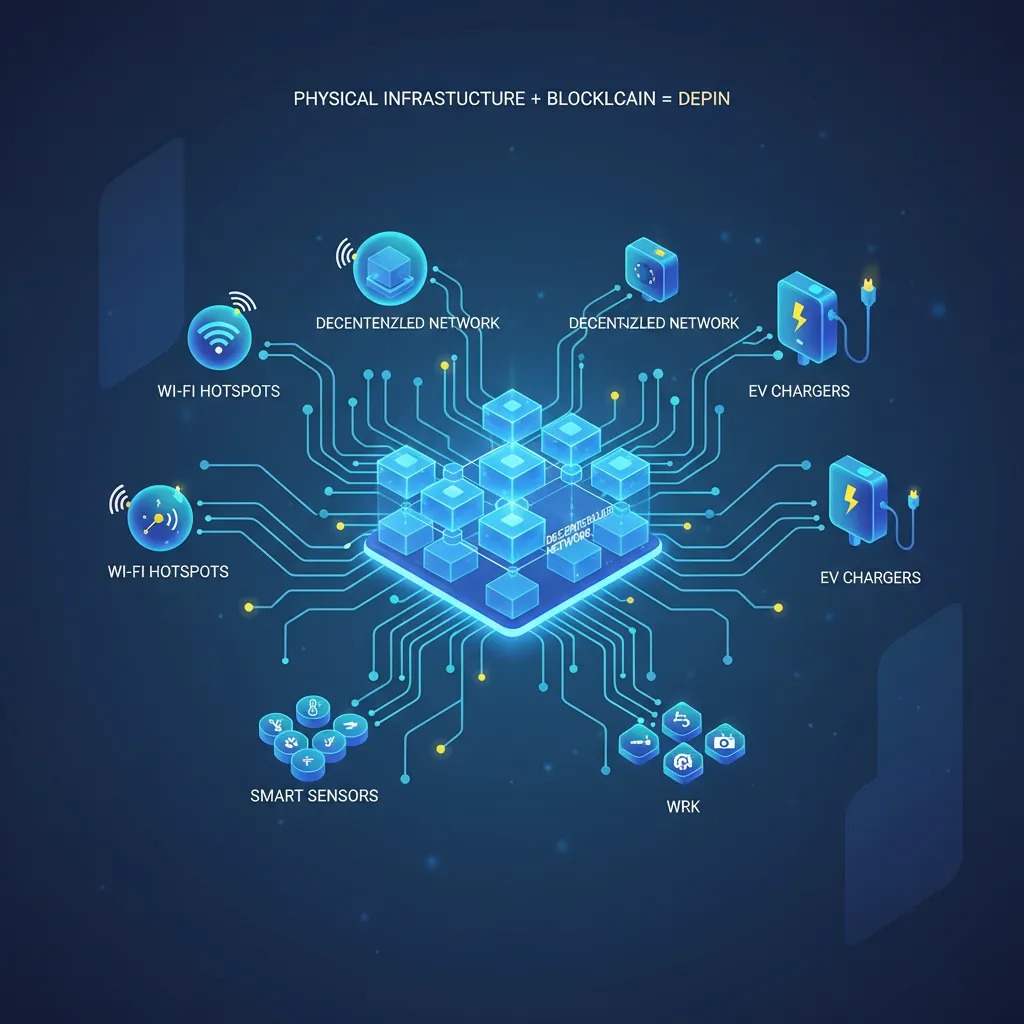
The Two Sides of the Network
- The Supply Side (Contributors): These are the individuals and businesses who purchase and deploy physical hardware devices. They might set up a 5G hotspot, install a smart-road camera, or dedicate unused server space to the network. They are the builders, laying the physical foundation of the service.
- The Demand Side (Users): These are the customers who use the infrastructure’s service. They could be developers renting decentralized cloud storage, businesses using a sensor network’s data, or individuals connecting to a community-owned Wi-Fi network.
The Crypto-Token Flywheel
So, how do you convince thousands of people worldwide to spend their own money on hardware to build a network that doesn’t have any users yet? This is the classic “chicken-and-egg” problem that DePIN blockchain technology elegantly solves with token incentives.
Here’s how the flywheel gets spinning:
- Bootstrap with Tokens: In the early days, contributors are rewarded with the project’s native crypto token for deploying hardware and providing coverage, even if there’s no user demand yet. This initial incentive encourages early adopters to build out the supply side of the network.
- Network Growth: As more contributors join, the network’s capacity and geographic coverage expand. A decentralized wireless network gets more hotspots; a storage network gets more terabytes of space. This makes the network more useful and attractive.
- Attract Users: With a robust and widespread network, the demand side starts to take notice. Businesses and individuals begin using the service, often at a lower cost and with greater efficiency than centralized alternatives. They pay for these services using the network’s native token (or a stablecoin, which is then used to buy and burn the native token).
- Drive Token Value: This real, utility-driven demand for the token increases its value. As the token price appreciates, the rewards for supply-side contributors become more valuable.
- Accelerate Growth: Higher rewards create a powerful incentive for new contributors to join and for existing ones to expand their hardware footprint. This further improves the network’s coverage and capacity, attracting even more users, and the flywheel spins faster and faster.
This elegant model, powered by blockchain data networks, creates a powerful, community-driven engine for growth that centralized companies struggle to compete with.
The DePIN Ecosystem: Real-World Examples in Action
DePIN isn’t just a theoretical concept; it’s a rapidly growing ecosystem of innovative projects that are already disrupting multi-trillion dollar industries. These DePIN use cases span across various sectors, demonstrating the model’s incredible versatility.
H3: Decentralized Wireless (DeWi)
Perhaps the most well-known DePIN category, DeWi aims to build people-powered mobile and IoT networks.
- Helium (HNT): The poster child of DePIN, Helium incentivized users to deploy hundreds of thousands of hotspots worldwide, creating the largest LoRaWAN (Long-Range Wide-Area Network) for IoT devices on the planet. They are now replicating this model for 5G with Helium Mobile, challenging traditional telecom giants.
- Pollen Mobile: Focused specifically on building a decentralized 5G mobile network, Pollen allows users to set up their own “Flowers” (radio cells) and “Bumblebees” (connectivity managers) to earn PCN tokens.
H3: Decentralized Data Storage Solutions
This sector takes on cloud storage behemoths like Amazon S3 and Google Drive, offering cheaper, more secure, and censorship-resistant alternatives.
- Filecoin (FIL): Filecoin creates a decentralized marketplace for data storage. Anyone with spare hard drive space can become a storage provider and earn FIL tokens. It’s designed for robust, long-term storage and is already used by major institutions.
- Arweave (AR): Arweave offers a unique proposition: permanent data storage. Users pay a one-time fee to store data forever. This “permaweb” is ideal for archiving historical records, academic papers, and NFTs. Related: Google AI Overviews Ultimate SEO Guide (2024)
H3: Decentralized Computing & GPU Networks
The rise of AI has created an insatiable demand for computing power, particularly from high-end GPUs. DePIN projects are pooling global resources to meet this demand.

- Akash Network (AKT): Often called the “Airbnb for Cloud Compute,” Akash allows users to deploy applications in a decentralized cloud environment, often at a fraction of the cost of AWS or Azure. It’s a vital piece of Web3 infrastructure.
- Render Network (RNDR): This network connects artists and studios needing to render 3D graphics with a global network of idle GPUs. It dramatically speeds up rendering times and lowers costs for creators.
H4: Data and Sensor Networks
These projects incentivize the collection of real-world data that was previously difficult or expensive to obtain. This is real world data decentralization in action.
- Hivemapper (HONEY): Challenging Google Street View, Hivemapper pays contributors to install a dashcam in their car and map the world’s roads. The collected imagery creates a constantly updated, high-resolution global map.
- DIMO (DIMO): DIMO allows car owners to connect their vehicles to a network, collect telematics data (like mileage, battery health), and monetize it themselves. It shifts Web3 data ownership from manufacturers to the vehicle owners.
Why DePIN Matters: The Impact on Web3 and Our Digital Future
DePIN is more than just a new crypto vertical; it represents a fundamental paradigm shift in how we build and interact with the physical world. Its impact will be felt far beyond the crypto-native community.

Breaking Free from Big Tech Monopolies
For too long, innovation in physical infrastructure has been stifled by the immense capital required to compete with incumbents. The DePIN flywheel model democratizes this process, allowing community-driven networks to challenge monopolies in telecom, cloud computing, and data collection. This fosters healthy competition, ultimately leading to lower prices and better services for everyone.
Empowering True Web3 Data Ownership
The core principle of Web3 is user sovereignty—the idea that you should own and control your own data and digital assets. DePIN extends this principle into the physical world. With projects like DIMO, you own your car’s data. With decentralized storage, you truly own your files without a third party’s permission. This is a crucial step towards realizing the full vision of a user-centric decentralized internet. Related: GPT-4o: What Is It And Why It Matters For The Future Of AI
Building Resilient and Secure Physical Infrastructure
A network spread across thousands of geographically diverse, independently owned nodes is inherently more resilient than a centralized one. There is no single point of failure. A power outage in one region or a technical issue at one data center won’t bring down the entire network. This distributed nature also makes the network more resistant to censorship and targeted attacks.
The Convergence of Crypto and Real-World Assets
DePIN is a primary catalyst for bringing real world assets (RWA) into the crypto ecosystem. Each piece of hardware—every hotspot, server, and dashcam—is a productive, real-world asset that generates value. By representing the utility of these assets with tokens, DePIN creates a direct bridge between the digital economy and tangible physical infrastructure, unlocking immense value. These are true tokenized infrastructure assets.
The Challenges and Future of DePIN
Despite its immense potential, the road ahead for DePIN is not without obstacles. Widespread adoption depends on overcoming several key challenges.
Navigating the Hurdles
- User Experience (UX): For DePIN services to compete with their Web2 counterparts, they must be seamless and easy to use for the average person, not just crypto natives.
- Hardware and Logistics: The upfront cost of hardware and the complexities of shipping and installation can be a barrier for potential contributors.
- Scalability: As these networks grow, they must prove they can handle mainstream levels of demand without compromising performance or security.
- Regulatory Uncertainty: The evolving regulatory landscape for cryptocurrencies and decentralized networks remains a significant challenge for projects operating globally.

The Road Ahead: The Future of Web3 Infrastructure
The DePIN ecosystem growth is just beginning. According to research firm Messari, the DePIN sector has the potential to reach over $10 trillion in the next decade. The demand for decentralized, permissionless, and cost-effective infrastructure is exploding, particularly with the rise of AI, which requires colossal amounts of computing power.
We are moving towards a future where smart cities, autonomous vehicles, and the Internet of Things will rely on a vast mesh of interconnected devices. DePIN is perfectly positioned to provide the foundational Web3 physical layer for this interconnected world, powering everything from environmental monitoring sensors to autonomous drone delivery networks. Related: The Rise of AI PCs: Your Guide to the 2024 Game-Changer
For those interested in the space, investing in DePIN can be approached in multiple ways—from buying project tokens to actively participating as a hardware contributor. As always, thorough research is essential. Related: DePIN Investing Guide: Your Path to Decentralized Infrastructure Wealth
Conclusion: Building Tomorrow, Together
The DePIN revolution is a quiet but powerful movement that is fundamentally rewiring the relationship between technology, ownership, and community. It is the most tangible and compelling expression of the Web3 vision yet—a vision where networks are not controlled by corporations but are built and owned by their users.
By transforming everyday devices into nodes of a global, decentralized network, DePIN is laying the groundwork for a more open, resilient, and equitable digital future. It’s more than just a new crypto narrative; it’s a practical roadmap for building tomorrow’s infrastructure, together. The next time you connect to a network, you might be connecting to one built by your neighbor, powered by the people.
What are your thoughts on the DePIN revolution? Are you participating in any projects? Share your insights in the comments below!
Frequently Asked Questions (FAQs)
Q1. What exactly is DePIN?
DePIN stands for Decentralized Physical Infrastructure Networks. It refers to blockchain-based protocols that use crypto tokens to incentivize individuals and communities to build and operate real-world physical infrastructure, such as wireless networks, data storage servers, or sensor networks.
Q2. What is a real-world example of a DePIN project?
Helium is a classic example. It successfully incentivized people worldwide to set up hundreds of thousands of wireless hotspots, creating a massive, decentralized IoT network. Another great example is Filecoin, which created a global, decentralized market for data storage by paying users to rent out their unused hard drive space.
Q3. How do DePIN networks make money?
DePIN networks generate value through a two-sided economic model. Users (the demand side) pay fees to use the network’s services (e.g., for data transfer or storage). These fees are used to reward the hardware operators (the supply side) and often to buy back and burn the network’s native token, creating economic value for all token holders.
Q4. Is investing in DePIN risky?
Yes, like any investment in the cryptocurrency space, investing in DePIN projects carries significant risk. Risks include token price volatility, technological hurdles, competition, and regulatory uncertainty. It’s crucial to do thorough research and understand that you could lose your entire investment.
Q5. What is the difference between DePIN and DeFi?
DeFi (Decentralized Finance) focuses on recreating traditional financial systems (like lending, borrowing, and trading) on the blockchain. DePIN (Decentralized Physical Infrastructure), on the other hand, focuses on building and managing real-world physical infrastructure. While DeFi deals with financial assets, DePIN deals with physical hardware and the services it provides.
Q6. How can I participate in a DePIN network?
There are two primary ways to participate. You can be a contributor by purchasing and running the required hardware for a specific network to earn token rewards. Alternatively, you can be a user by utilizing the network’s services, often at a lower cost than centralized alternatives. You can also participate by simply buying and holding a project’s token.