What is GPT-4o? OpenAI’s New Model Explained

Introduction: Decoding the “Omni” Revolution
The world of Artificial Intelligence moves at a breathtaking pace, but every so often, a release fundamentally shifts the goalposts. OpenAI’s announcement of GPT-4o during its Spring Update was one of those moments. This isn’t just an iterative update; it represents a foundational redesign of how large language models interact with the world.
So, what is GPT-4o?
In simple terms, GPT-4o is OpenAI’s flagship, next-generation multimodal AI model—an engine designed not just for text, but for natively processing and generating content across text, audio, and vision simultaneously. The ‘o’ in GPT-4o stands for “omni,” reflecting its all-encompassing, unified approach to sensory data.
For years, AI interaction required pipelines: audio input was transcribed into text, processed by the model (like GPT-4), and then the text output was converted back to synthesized speech. GPT-4o eliminates these intermediate steps. It processes the raw audio, visual, and textual inputs all at once, leading to performance leaps that make previous models feel sluggish.
In this comprehensive guide, we’ll dive deep into the OpenAI new model, exploring the GPT-4o features, assessing the critical difference between GPT-4o vs GPT-4, and explaining precisely how to use GPT-4o to unlock unprecedented levels of natural, real-time AI assistance.
The Dawn of the Omni Model: Why GPT-4o Changes Everything
The term GPT-4 omni is not just marketing—it defines a new technical architecture. Before GPT-4o, when you spoke to an AI assistant, three separate models often handled the request:
- A speech-to-text model transcribed your words.
- A large language model processed the text and formulated a response.
- A text-to-speech model synthesized the answer.
This sequential approach inherently introduced latency and lost nuance. If your tone conveyed sarcasm or urgency, the text transcription often missed it, and the LLM couldn’t factor it into its reasoning.
GPT-4o changes the paradigm. It was trained from the ground up as a single, native omni model AI that can perceive, understand, and generate output in all three modalities—text, audio, and vision—in real-time.
What Does the ‘O’ in GPT-4o Stand For?
As mentioned, the ‘o’ stands for “omni,” meaning all. This designation signals the model’s ability to seamlessly handle all major data types with equal efficiency and expertise, making it a true real-time AI assistant.
This unified approach results in stunning improvements in speed and emotional intelligence, particularly in voice interactions. Latency for audio responses is dramatically reduced, averaging just 232 milliseconds (ms), with the fastest responses clocking in at 110ms—near human conversational speed. This is a game-changer for conversational AI, blurring the line between talking to a machine and talking to a highly intelligent human being.
Core GPT-4o Features and Capabilities
The GPT-4o capabilities extend far beyond just faster voice response. They unlock truly interactive and sophisticated interactions that were previously science fiction.
1. Real-Time Multimodal Communication (The Voice Revolution)
The most immediate and impressive feature demonstrated during the OpenAI announcements was the voice interaction. GPT-4o can:
- Detect Emotion and Tone: The model doesn’t just process what you say, but how you say it. If a user sounds stressed or excited, GPT-4o can adapt its response, offering comforting or celebratory language.
- Generate Expressive Voices: Its output voices sound more natural, expressive, and even melodic than standard text-to-speech engines. Crucially, it can adopt different emotional tones (e.g., sounding like a dramatic narrator or a friendly helper).
- Handle Interruptions: Like a human, GPT-4o can be interrupted mid-sentence without losing its train of thought, seamlessly integrating the new input into its ongoing process.
- Real-Time Translation: The model can listen to a conversation in two different languages and translate in real-time between them, making it an unprecedented tool for international business and travel.
2. Advanced Computer Vision AI
GPT-4o elevates computer vision AI beyond simple image captioning. Because the model processes vision natively, it can perform complex tasks:
- Live Object Analysis: If you point your phone camera at a complex mathematical equation or a financial report, GPT-4o can analyze the visual data live, explaining the steps or summarizing the key findings in real-time.
- Interactive Tutoring: Imagine holding your phone up to a geometry problem. GPT-4o can not only solve it but guide you step-by-step using visual cues, circling parts of the image and providing spoken instruction.
- Environmental Understanding: Pointing the camera at a physical object, like a piece of furniture, allows the model to instantly identify it, suggest assembly instructions, or even link to reviews.
3. Unprecedented Speed and Performance
Even in purely text-based tasks, GPT-4o offers a significant uplift in performance:
- Increased Speed: It is twice as fast as GPT-4 Turbo across text generation tasks.
- Global Language Support: The model exhibits exceptional performance across non-English languages, drastically improving quality and speed for users worldwide.
- Broader Context Window: While retaining a large context window (often 128k tokens, similar to GPT-4 Turbo), the efficiency of processing this information is enhanced.
This makes the best features of GPT-4o not just about new modalities, but about making existing interactions snappier, more reliable, and more accessible.
GPT-4o vs GPT-4: Quantifying the Generational Leap
The primary question for current ChatGPT Plus subscribers and developers is: is GPT-4o better than GPT-4? The answer is an emphatic yes. GPT-4o is demonstrably superior across speed, cost, and native capabilities.
Here is a simplified comparison demonstrating why GPT-4o is the next generation AI.
| Feature | GPT-4 Turbo | GPT-4o (Omni Model) | Impact & Improvement |
|---|---|---|---|
| Modality Integration | Pipelined (separate models for text, vision, audio) | Native (single model processes all simultaneously) | Foundational. Enables true real-time, emotional responses. |
| Audio Latency | Average 5.4 seconds | Average 232 milliseconds (ms) | 40x Faster. Near-human conversational speed. |
| Speed (Text Tasks) | Standard | 2x Faster than GPT-4 Turbo | Significant productivity boost. |
| Vision Performance | Highly capable, but slower processing | State-of-the-art, real-time image analysis | Essential for interactive tutoring and live vision tasks. |
| Cost (API Pricing) | Standard GPT-4/Turbo Pricing | 50% Cheaper than GPT-4 Turbo | Massive cost reduction for developers (GPT-4o pricing). |
| Access (Free Tier) | Limited GPT-4 access for free users | Free access to GPT-4o (with usage limits) | Democratizes advanced AI capabilities (free GPT-4o access). |
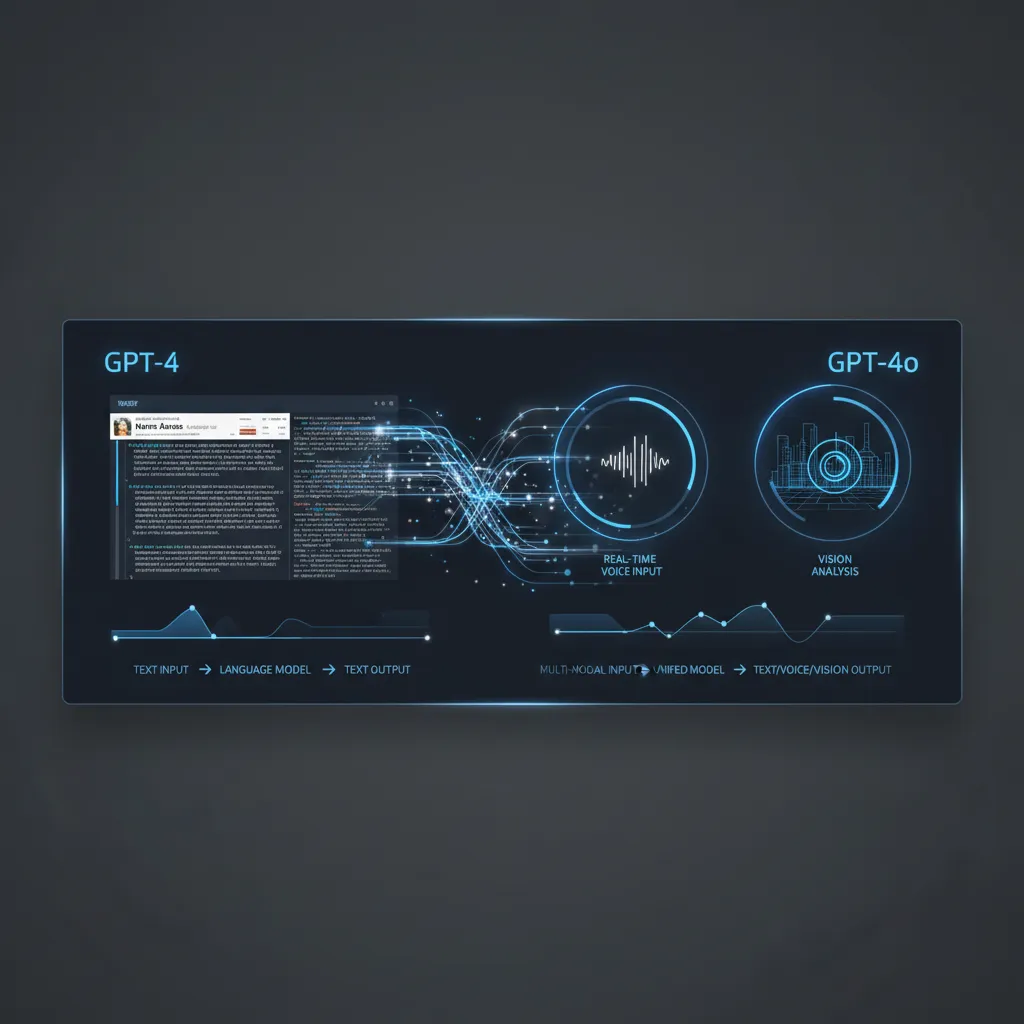 Side-by-side comparison of GPT-4 and GPT-4o model capabilities shown on a futuristic dashboard.
This comparison highlights that GPT-4o is not just faster; it’s cheaper and structurally more sophisticated. For users, this means dramatically better experiences in voice mode. For developers, the 50% reduction in GPT-4o API cost makes building cutting-edge applications far more economical and scalable.
[Related: The Quantum AI Revolution: Unprecedented Computing Power]
Accessing and Using GPT-4o: The ChatGPT New Version
One of the most exciting announcements of the AI model announcement 2024 was how widely available GPT-4o would be, integrating into the core ChatGPT new version experience.
How to Use GPT-4o
Access to GPT-4o is tiered, designed to bring advanced capabilities to the largest possible user base:
1. Free Access (The Democratization of AI)
OpenAI has committed to making GPT-4o widely available on its free tier, albeit with usage limits.
- Web and App Access: Free users gain access to GPT-4o through the standard ChatGPT interface (web and mobile app). This includes the ability to use its general intelligence, text summaries, and vision analysis features.
- Usage Caps: Free users benefit from GPT-4o’s superior intelligence, but once their daily quota runs out, the interface typically reverts to the less powerful GPT-3.5 model. This strategy introduces a wide audience to the power of the omnimodel.
 A person accessing the new GPT-4o model through the OpenAI website on their laptop.
2. Paid Access (ChatGPT Plus and Team Users)
Subscribers to ChatGPT Plus, Team, and Enterprise receive significantly higher usage caps, ensuring they can rely on GPT-4o for heavy workloads.
- Priority Access: Paid users often get early and priority access to new features and higher usage limits.
- The Voice/Video Assistant Rollout: The highly publicized, low-latency, real-time voice and vision capabilities—the true essence of the GPT-4o demo—are typically rolled out first to paying users. This feature transforms the ChatGPT mobile app into a sophisticated, hands-free personal assistant.
GPT-4o Tutorial: Engaging the Real-Time Assistant
To fully utilize the AI voice assistant capabilities, you must use the mobile application:
- Launch the App: Open the ChatGPT mobile app (iOS or Android).
- Activate Voice Mode: Tap the headphone icon (or voice icon).
- Start Speaking: Begin your conversation naturally.
- Engage Multimodality: You can pause your speech and hold your phone up to something—a foreign menu, a graph, or an object—and ask, “What is this? How do I translate it?” or “Explain this data point.” GPT-4o will process the visual and audio input together, providing an integrated response.
This ease of use, coupled with its unprecedented speed, is what makes GPT-4o a standout in the latest AI trends.
The Impact of GPT-4o for Developers and the API Ecosystem
While consumer features grab headlines, the release of GPT-4o has profound implications for developers using the GPT-4o API.
1. Cost Efficiency and Scalability
The most tangible benefit for businesses building on OpenAI’s platform is cost. GPT-4o is half the price of GPT-4 Turbo for the input tokens and significantly cheaper for output tokens. This immediately makes large-scale deployments of intelligent applications more financially viable.
2. Unified Multimodal API Endpoint
The GPT-4o API offers a single, streamlined endpoint for handling text, vision, and audio. Developers no longer need to stitch together multiple services for a fully multimodal application.
- Simplified Workflows: Integrating voice commands, image analysis, and text generation into a single user flow becomes dramatically simpler and more robust.
- New Applications: This simplifies the creation of sophisticated AI tutors, customer service bots that can analyze images (e.g., troubleshooting a router by looking at its lights), and real-time translators.
3. Boosting Accessibility and Education
For non-English speakers, the improved language performance is massive. GPT-4o’s native understanding of dozens of global languages means developers can build localized applications with higher accuracy and less reliance on external translation services.
Education is another key area. The ability for the model to analyze handwritten notes and diagrams in real-time, offering verbal feedback, positions GPT-4o for developers to build truly adaptive and interactive learning platforms.
[Related: AI Content Powerup: Speed and Quality Today]
Deep Dive: Use Cases and Real-World Applications
The theoretical power of GPT-4o translates into transformative real-world applications across various sectors.
A. Professional and Creative Fields
- Real-Time Design Feedback: A graphic designer could show a draft logo to the model and ask, “What are the three weakest elements in terms of color theory?” GPT-4o analyzes the image and provides instant, nuanced textual and audio critiques.
- Coding and Debugging: A developer can share a screenshot of an error log and verbally ask the model, “Why is this function returning null, and how can I fix it in Python?” The model processes the visual code and provides an immediate fix and explanation.
- Marketing and Strategy: Asking GPT-4o to analyze a market trend graph (image input) and simultaneously generate a headline draft (text output) for a related campaign saves valuable time.
B. Education and Accessibility
- Language Coaching: Users can practice speaking a new language, receiving immediate, natural-sounding feedback on pronunciation, grammar, and tone.
- Accessibility Aid: For visually impaired users, the model can look at the world through the camera and describe it in a conversational, helpful manner, reading signs or instructions on command.
- Complex Problem Solving: Holding a document up to the camera and asking for a summary or cross-referencing information within the text stream creates an invaluable research tool.
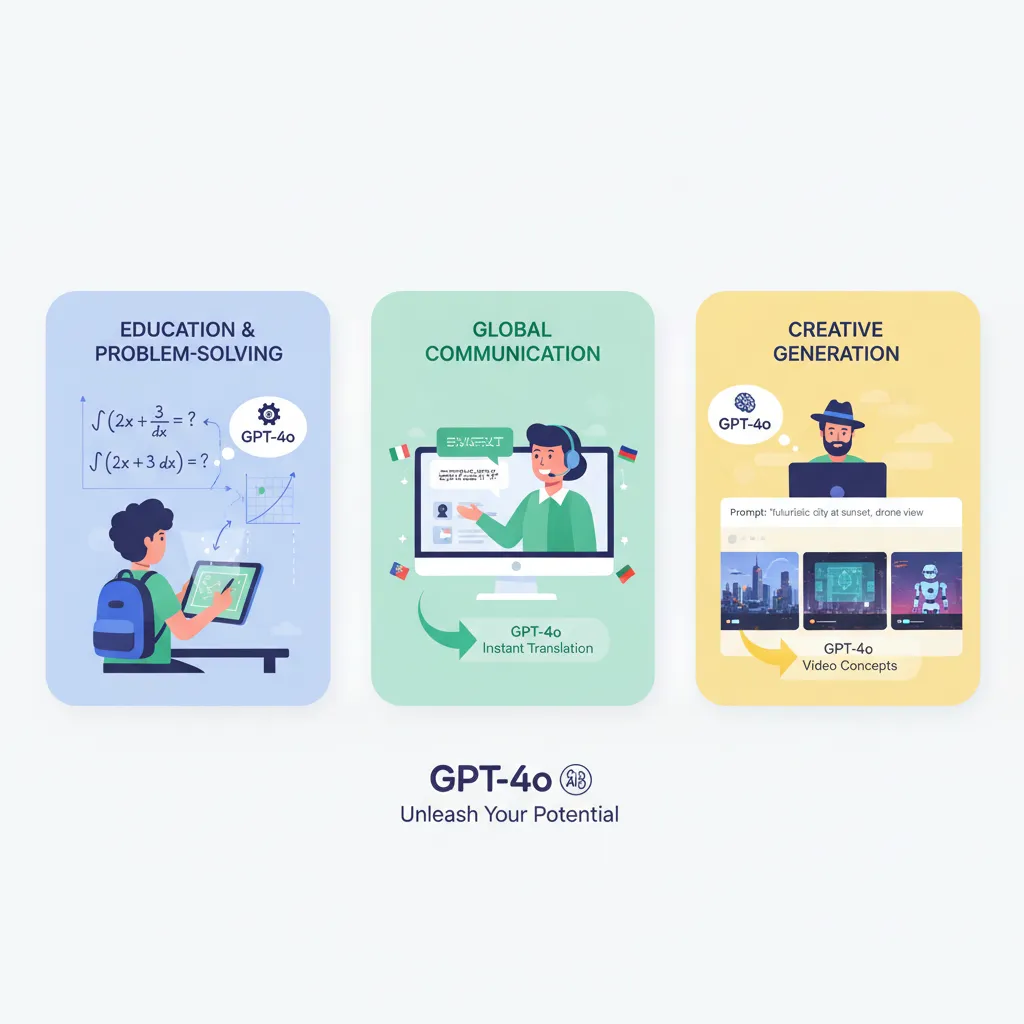 A graphic showing various use cases for GPT-4o, including education, customer service, and content creation.
C. Personal Productivity and Daily Life
- Advanced Smart Home Integration: Integrating GPT-4o could mean a smart assistant that truly understands context. If you say, “I’m stressed,” it can discern your tone, assess the time of day, and suggest a personalized meditation or light adjustment, instead of just running a pre-programmed routine.
- Troubleshooting: Pointing your camera at a blinking light on your router or dishwasher and asking, “What does this mean?” allows for instant diagnostics without having to search through manuals.
[Related: AI Travel: Plan Your Dream Trip Faster]
The Ethical Considerations of the Next Generation AI
As the capabilities of models like GPT-4o grow, so does the discussion around ethics and safety. OpenAI has publicly acknowledged that the speed and realism of GPT-4o’s voice output raise new safety concerns, particularly regarding deepfakes, phishing, and impersonation.
To address these risks, several safeguards are in place:
- Watermarking and Digital Signatures: Efforts are being made to digitally watermark AI-generated content (audio and image) to denote its origin.
- Voice Limitations: Initially, the most advanced, highly expressive voice modes are heavily restricted in who can access them and what they can be used for, ensuring no voice clone can be used for malicious activities without strict verification.
- Policy Enforcement: Enhanced policies prohibit the use of the model for generating deceptive content or engaging in harmful real-time interactions.
The deployment of such a powerful next generation AI requires vigilant monitoring and constant refinement of these safety protocols to ensure its benefits outweigh potential harms.
Conclusion: The New Standard for Intelligent Interaction
The release of GPT-4o is more than just another milestone in the AI timeline; it marks the definitive arrival of the multimodal AI model—the GPT-4 omni. By natively integrating text, vision, and audio processing, OpenAI has not only drastically improved performance but has also lowered the cost and accessibility barriers.
From making the highest-tier intelligence available to free GPT-4o access users to slashing prices for the GPT-4o API, the company has set a new standard for what a real-time AI assistant should be. The future is conversational, instantaneous, and deeply integrated with our sensory world. If you want a comprehensive GPT-4o review, the verdict is clear: it’s the model that fundamentally changes how we interact with technology, moving us closer than ever to truly human-like digital companionship.
Explore the best features of GPT-4o today—whether you’re a developer looking for unparalleled efficiency or an everyday user curious about the power of the new ChatGPT new version.
FAQs (People Also Ask)
Q1. What does the ‘o’ in GPT-4o stand for?
The ‘o’ in GPT-4o stands for “omni,” signifying the model’s “all-encompassing” ability to natively process and generate information across all modalities: text, audio, and vision, simultaneously and seamlessly. This unified architecture enables real-time, emotional intelligence in interactions.
Q2. Is GPT-4o free to use, and how do I access it?
Yes, GPT-4o is available to free users through the ChatGPT web interface and mobile application, making it the first time OpenAI’s flagship model is widely accessible at no cost. Free users have usage limits, after which the system may revert to GPT-3.5. ChatGPT Plus subscribers receive significantly higher usage limits and priority access to new features like the low-latency voice and video interaction.
Q3. How much faster is GPT-4o compared to GPT-4?
In terms of pure text and code generation, GPT-4o is approximately twice as fast as GPT-4 Turbo. The most dramatic speed improvement is in audio latency; GPT-4o can respond to voice queries in as little as 110 milliseconds, averaging 232ms, which is roughly 40 times faster than the previous pipeline approach used by GPT-4.
Q4. What makes GPT-4o a “multimodal AI model” instead of just a large language model (LLM)?
While all modern models handle text, GPT-4o is multimodal because it was trained and designed as a single neural network that processes text, audio, and images as native inputs and outputs. Older models required separate transcription and synthesis models, creating latency. GPT-4o’s unified approach allows it to analyze your tone, facial expression (via video), and text input all in the same processing step.
Q5. What are the key new GPT-4o features announced at the OpenAI Spring Update?
The key GPT-4o features include near-human speed in voice response (low latency), the ability to detect and respond to emotional tone in a user’s voice, real-time simultaneous translation, and advanced computer vision AI capable of live, interactive analysis of images and video streams.
Q6. Is the GPT-4o API cheaper than the GPT-4 API for developers?
Yes, one of the significant features of GPT-4o pricing is its affordability for developers. GPT-4o is priced at half the cost of GPT-4 Turbo for input tokens and is also considerably cheaper for output tokens, making it a much more economical and scalable choice for building sophisticated applications.
Q7. When was the GPT-4o release date?
GPT-4o was officially announced by OpenAI on May 13, 2024, during the OpenAI Spring Update. The model began rolling out immediately to both free and paying users of ChatGPT and to developers via the API in the days following the AI model announcement 2024.