What Is GPT-4o? OpenAI’s New AI Model Explained

Introduction: The Dawn of Omni-Modal AI
The landscape of artificial intelligence is defined by exponential leaps, but few events feel as genuinely transformative as the OpenAI new announcement during their spring update. The reveal of GPT-4o, the next evolution of their flagship large language model, wasn’t just another incremental upgrade; it signaled a profound shift in how humans interact with AI.
If you’ve been asking “what is GPT-4o?” or wondering how this new ChatGPT model will change your workflow, you’ve come to the right place. GPT-4o—where the “o” stands for “omni”—is not simply a faster version of its predecessor; it’s a multimodal AI model built natively to process and generate content across text, audio, and vision, simultaneously and in real-time.
For years, AI interactions often felt segmented. If you wanted the AI to see an image, you uploaded it. If you wanted to talk to it, a separate voice model transcribed the audio, sent it to the LLM, and then another synthesis model read the response. This layering added friction and latency.
GPT-4o shatters this paradigm. It marks OpenAI’s push toward creating a seamless, natural, and truly assistive conversational AI. This article will deep-dive into the architectural changes, explore the groundbreaking GPT-4o features, compare it directly against GPT-4 Turbo, and explain the revolutionary promise of free GPT-4o access for the masses, fulfilling the vision of AI for everyone.
Decoding GPT-4o: The ‘Omni’ Revolution
At its core, OpenAI GPT-4o is designed to eliminate the latency barriers that plagued previous AI assistants, making the interaction feel less like talking to a machine and more like speaking to a highly articulate and intuitive peer.
The key to understanding the sheer magnitude of this upgrade lies in the ‘Omni’ designation. Previously, models like GPT-4, while powerful, handled different modalities sequentially. For a voice conversation, the system relied on three distinct models chained together:
- An audio-to-text model.
- The LLM (GPT-4) for processing and generating the answer.
- A text-to-speech model for generating the voice response.
This pipeline introduced noticeable lags, often resulting in responses that took several seconds.
Architectural Shift: The End-to-End Difference
The defining characteristic of the GPT-4 omni model is that it was trained end-to-end across text, audio, and vision. This means a single, unified neural network processes all input and generates all output.
When a user speaks, the model hears the raw audio, immediately understands the language, tone, and emotion, and generates an appropriate spoken response, all in one pass. This unified architecture provides several game-changing benefits of GPT-4o:
- Native Understanding of Nuance: Because the model handles the voice input directly, it maintains context about inflections, emotional state, and even background noise, allowing for a much more nuanced interaction.
- Speed and Efficiency: By eliminating the need to pass data between three separate specialized models, the overall processing time drops dramatically.
- Integrated Multimodality: If you show the AI a physical object while asking a question about it, the text, audio, and visual data are fused together seamlessly inside the model simultaneously, leading to richer and more coherent responses.
This technical achievement is what truly separates the new ChatGPT model from everything that came before, positioning it as the ultimate foundation for the next generation of personal computing.
Key Performance Metrics: Speed and Latency
The most immediately apparent improvement in the GPT-4o demo was its speed. In real-world testing, GPT-4o can respond to audio inputs in as little as 232 milliseconds (ms), with an average response time of 320 ms. For context, the average human conversational response time is around 400 ms. This places the model firmly within the realm of true real-time AI assistant capabilities.
| Metric | GPT-4 Turbo | GPT-4o (Omni) |
|---|---|---|
| Audio Response Latency | 5.4 seconds average | 0.32 seconds average |
| Max Token Rate (Input/Output) | High | Doubled (Significantly Higher) |
| Multimodal Integration | Chained models (vision separate) | Native (unified) |
| Cost (API) | Standard GPT-4 Pricing | 50% Cheaper than GPT-4 Turbo |
This immense leap in GPT-4o performance allows for genuine interruption and dynamic conversation flow, something previous AI assistants simply couldn’t handle without stuttering or losing context.
The Defining GPT-4o Features: Voice, Vision, and Emotion
The capabilities baked into GPT-4o are vast, touching upon every aspect of human-computer interaction. It’s not just fast; it’s vastly more capable and perceptive across every sensory domain.
Real-Time Conversational AI: A True AI Voice Assistant
The conversational fluency of GPT-4o is arguably its most captivating feature. The model demonstrates the ability to manage complex, overlapping requests and switch tones on command.
For example, a user could ask the model to analyze a complex business document, and while the analysis is ongoing, the user could interrupt and ask, “Wait, can you say that last part in a dramatic, movie-trailer voice?” and the model can instantly comply, adjusting its voice tone and cadence without losing the thread of the original technical analysis.
This functionality transforms the AI voice assistant from a simple command processor into a sophisticated partner capable of:
- Dynamic Role-Playing: Practicing a job interview, rehearsing a presentation, or acting as a debate partner.
- Emotional Reading: Detecting frustration, confusion, or excitement in the user’s voice and adjusting its own response to be empathetic or encouraging.
- Interruption Handling: Responding fluidly when interrupted, proving its conversational intelligence is on par with a human counterpart.
This breakthrough in latency and emotional processing is what makes the GPT-4o review overwhelmingly positive regarding its potential for daily productivity and companionship.
[Related: deep-work-mastery-unlock-focus-boost-productivity-distracted-world/]
Advanced Vision Capabilities AI: Interpreting the World
The integration of vision capabilities AI within GPT-4o allows the model to see and understand the world in real-time. Where previous models could only analyze a static image after it was uploaded, GPT-4o can process live video feeds or screen shares rapidly, providing instant feedback.
Imagine the practical applications:
- Live Technical Support: Show the model a confusing router setup, and it can instantly identify the ports and wiring mistakes, guiding you step-by-step through the process verbally and visually.
- Multilingual Translation: Hold up a sign in a foreign language; the model can read the text, translate it verbally in real-time, and even interpret the context of the sign (e.g., “That sign indicates a temporary road closure ahead”).
- Educational Guidance: A student could show the model a complex math problem written on a whiteboard, and the personal AI assistant could instantly recognize the handwriting, solve the equation, and then explain the methodology in an encouraging tone.
GPT-4o leverages its unified architecture to ensure the visual data informs the textual and verbal responses immediately, eliminating the awkward pauses previously associated with multimodal tasks.
Multilingual Mastery
While previous models excelled in certain languages, GPT-4o has significantly boosted its capability across multiple languages. It now offers improved quality and speed in over 50 languages, making it a powerful tool for global communication and enterprise. This enhanced multilingual ability is crucial for deploying AI tools across diverse international markets, fulfilling the goal of making AI for everyone truly global.
GPT-4o vs GPT-4 Turbo: The Definitive Comparison
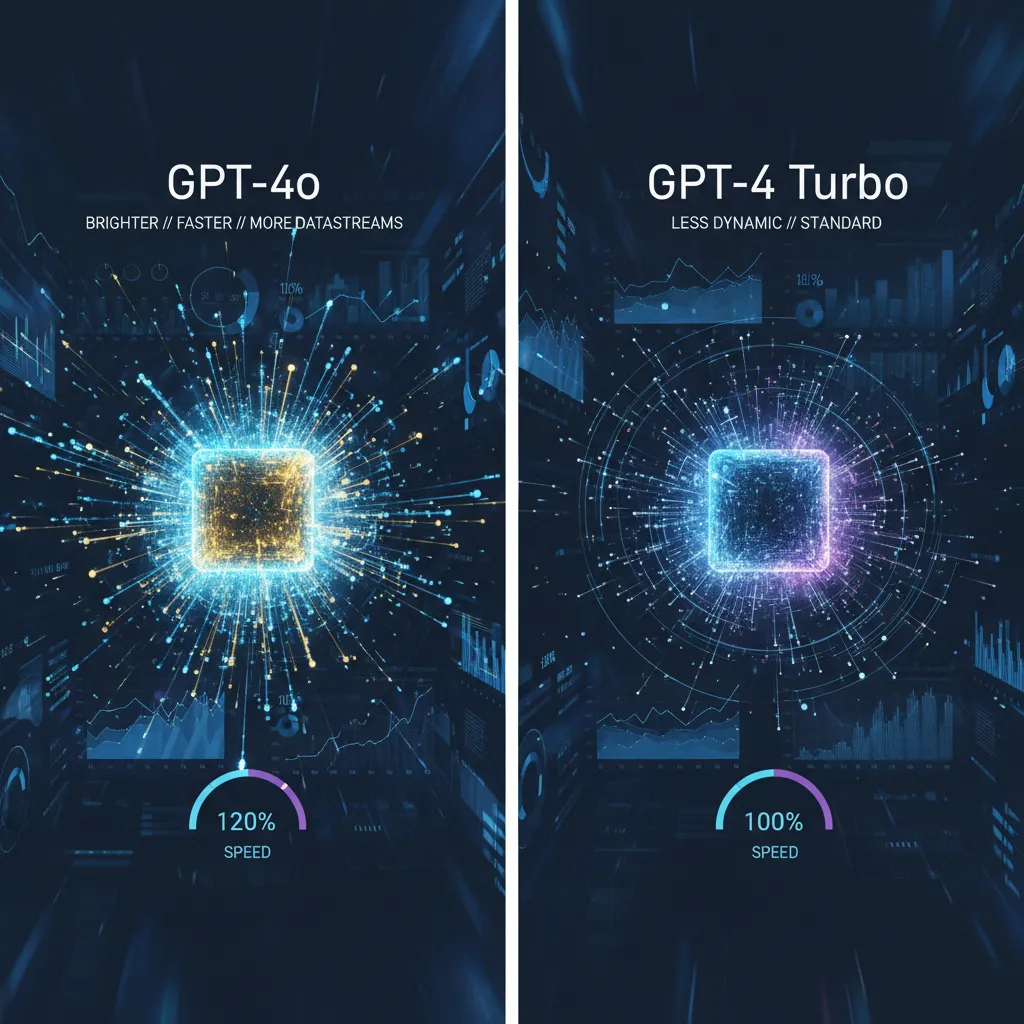
When discussing the merits of the new ChatGPT model, the most common question revolves around performance relative to the immediate predecessor, GPT-4 Turbo. While GPT-4 Turbo (often called GPT-4-T) was a massive leap from GPT-4, GPT-4o moves the goalposts entirely.
The comparison is less about raw intelligence (GPT-4 and GPT-4o maintain similarly high levels of core reasoning) and more about efficiency, speed, and modality fusion.
Speed and Efficiency Benchmarks
As established, GPT-4o is dramatically faster in handling multimodal inputs. However, it also shows significant improvements in text-only tasks:
- Text Processing: GPT-4o is roughly twice as fast as GPT-4 Turbo on average, handling large volumes of tokens with greater throughput. This means tasks like summarizing massive documents or analyzing complex code are completed in half the time.
- API Cost: For developers utilizing the model via the API, GPT-4o is priced at half the cost of GPT-4 Turbo. This massive reduction in cost democratizes access for startups, individual developers, and large enterprises alike, dramatically lowering the economic barrier to running highly sophisticated large language model applications.
Consistency and Reliability
In the realm of AI model comparison, reliability is paramount. Early user testing and the GPT-4o review confirmed that the model maintains the high reasoning capabilities established by GPT-4, meaning the increased speed does not come at the expense of quality.
GPT-4o delivers results that are equally, if not more, accurate than GPT-4 Turbo, especially in complex, multi-step prompts. This consistency is essential for high-stakes applications like coding assistance, financial analysis, and personalized education.
| Feature Area | GPT-4 Turbo | GPT-4o (Omni) | Advantage |
|---|---|---|---|
| End-to-End Multimodality | No (Relies on chained models) | Yes (Unified architecture) | GPT-4o |
| Input/Output Speed | Fast (Text); Slow (Voice/Vision) | Extremely Fast (All modalities) | GPT-4o |
| API Pricing | Standard (High) | Half the price of GPT-4 Turbo | GPT-4o |
| Vision Capabilities AI | Strong (via API), slower response | Excellent, real-time response | GPT-4o |
| Core Reasoning | High | Equally High, enhanced by speed | Tie |
| Emotional Detection | Limited | High degree of detection and generation | GPT-4o |
The outcome of the AI model comparison is clear: GPT-4o represents a superior architecture that addresses the primary friction points of modern AI interaction—latency and cost—while retaining the intelligence of its predecessor.
Accessibility for Everyone: Free GPT-4o Access and Availability
One of the most revolutionary aspects of the OpenAI spring update was the announcement regarding accessibility. OpenAI committed to offering free GPT-4o access to all ChatGPT users, significantly broadening the reach of state-of-the-art AI technology.
This strategic move is central to the mission of achieving AI for everyone. By providing top-tier models for free, OpenAI rapidly accelerates global familiarity and integration of advanced AI capabilities.
Tiered Access: What Free Users Get
While the full power of GPT-4o, including higher usage limits and unrestricted access to data analysis and advanced vision tools, remains available to paying subscribers (ChatGPT Plus, Team, and Enterprise), free users gain substantial access:
- Core GPT-4o Capabilities: Free users now primarily use GPT-4o. This means faster responses and access to the improved intelligence over the older default models (like GPT-3.5).
- Limited Multimodal Use: Free users can use the text and image inputs of GPT-4o, though there may be limits on the complexity or volume of these requests compared to Plus users.
- Usage Caps: Free users will have usage limits. When they hit their cap on GPT-4o, their account automatically falls back to the still-capable, but less advanced, GPT-3.5. Plus subscribers maintain 5x higher usage caps for GPT-4o.
This tiered system ensures that the most sophisticated model remains the default experience for all, while still providing incentive for users who require heavy, consistent, or enterprise-level use to subscribe.
How to Use GPT-4o Today
If you are a ChatGPT user, accessing the benefits of GPT-4o is straightforward:
- Log In: Ensure you are logged into your ChatGPT account.
- Check Model Selection: In the web interface or mobile app, the default model selection should be set to “GPT-4o.”
- Start Interacting: Begin typing or uploading images. If you are a Plus user, you should see the option to use the full range of advanced features, including data analysis and vision.
The full real-time AI assistant features, especially the ultra-low-latency voice mode shown in the GPT-4o demo, will roll out incrementally to all users across the mobile and desktop applications.

Practical Applications and GPT-4o Capabilities in the Real World
The architectural advancements of GPT-4o are interesting on a technical level, but their true impact is measured by the new GPT-4o capabilities they unlock for productivity, creativity, and daily life.
The New Personal AI Assistant: Beyond Simple Tasks
GPT-4o elevates the concept of a personal AI assistant far beyond setting reminders or checking the weather. Its ability to process voice and vision in real-time makes it indispensable for cognitive load reduction.
Example Use Case: Real-Time Coding Debugging A developer is stuck on a difficult bug. Instead of copy-pasting code into a prompt, they can share their screen with GPT-4o. The AI watches the code in real-time, listens to the developer describe the problem, and can simultaneously point out errors on the screen, explain the necessary fix verbally, and even generate corrected code snippets. This level of simultaneous sensory input dramatically speeds up the debugging process, integrating the large language model directly into the human workflow.
[Related: ai-unleashed-revolutionizing-money-smart-personal-finance/]
Revolutionizing Education and Creative Work
The blend of high speed and superior multimodal understanding positions GPT-4o as a massive disruptor in both education and the creative industry.
- Customized Learning: A student can use GPT-4o to read a dense textbook (vision input), ask questions about complex topics (text input), and receive a highly customized, verbally explained answer that adjusts its tone and pace based on the student’s reaction (audio feedback). This provides truly dynamic and personalized tutoring.
- Creative Collaboration: Writers, designers, and artists can use GPT-4o as an instant brainstorming partner. A designer could sketch a rough logo concept on paper, show it to the AI, and verbally ask, “How would this look in a minimalist style, and what colors would evoke trust?” The AI responds immediately with textual suggestions and even visual mock-ups if integrated with external tools.
This symbiotic relationship fosters greater creativity and reduces the time from concept to execution.
[Related: ai-in-gaming-revolutionizing-worlds-players-and-development/]
Transforming Customer Service and Enterprise
In the enterprise world, GPT-4o explained cost efficiency and scalability will drive rapid adoption.
- Advanced Call Centers: Imagine a customer service line where the AI can understand frustration (via tone detection) and automatically escalate the call based on emotional indicators before the customer even explicitly requests a supervisor. This leads to higher customer satisfaction.
- Real-Time Data Analysis: Business analysts can feed streams of data visualizations or dashboards into GPT-4o and ask complex, natural-language questions about trends and anomalies, receiving instant, accurate insights.
The reduction in latency and the increase in natural interaction make human-AI collaboration more fluid across all business processes.
[Related: future-sustainable-travel-eco-conscious-adventures-tech-innovations/]
The Future of AI Interaction: A GPT-4o Review
The launch of GPT-4o is more than just a software update; it is a preview of the future of AI. It represents the critical inflection point where AI moves from being a helpful, but segmented, digital tool to becoming an integrated, perceptive partner.
This is the age of ambient intelligence, where the personal AI assistant is always available, always listening (permissibly), and always ready to engage with the world through all our human sensory channels.
Bridging the Human-Computer Interaction Gap
Previous iterations of AI required us to learn its language (precise prompts, specific inputs). GPT-4o learns ours. The sub-human delay and the ability to detect emotion allow the AI to respond authentically, making the interaction feel less like programming and more like conversing.
This enhanced fluency will drive new artificial intelligence trends where the AI integrates into hardware and applications in ways we currently only imagine. The distinction between an operating system and a general intelligence layer will begin to blur.
Ethical Considerations and the Future of Work
With the power of GPT-4o capabilities comes the responsibility to manage them ethically. The ability for the AI to detect emotion and mimic human conversational nuance raises critical questions about transparency and authenticity. Users must always be aware that they are interacting with an AI.
OpenAI has taken steps to address security and bias, particularly in the vision and audio domains, but the sheer power of this model means that discussions around governance and responsible deployment—core to all artificial intelligence trends—must intensify.
The increased productivity offered by the real-time AI assistant will inevitably reshape jobs. However, by offloading cognitive burden and providing instant, intelligent assistance, GPT-4o is poised to act as a multiplier for human creativity and specialized labor, rather than simply a replacement.
[Related: navigating-ai-ethics-governance-bias-trust-ai-era/]

Conclusion: Embracing the New ChatGPT Model
GPT-4o explained in its simplest form is the most human-like and capable large language model released to date. It delivers not just superior performance but also a fundamentally different, more intuitive user experience thanks to its unified, end-to-end multimodal architecture.
By offering free GPT-4o access, OpenAI has ensured that this technology becomes instantly accessible to millions, pushing the boundaries of what is possible in personal and professional computing. The OpenAI spring update didn’t just announce a new product; it unveiled the foundation for the next decade of seamless human-AI collaboration.
Whether you are a developer, a student, a creative professional, or simply curious about the future of AI, understanding what is GPT-4o and its profound GPT-4o capabilities is essential. Dive into the new ChatGPT model today, explore its real-time voice and vision, and experience the next generation of intelligence first-hand.
[Related: the-quantum-ai-revolution-unprecedented-computing-power/] [Related: ai-personalized-health-future-wellness/] [Related: ai-powered-personalized-travel-planning/] [Related: impact-investing-grow-money-make-difference/] [Related: eco-friendly-gadgets-sustainable-living-tech/]
FAQs
Q1. What does the “o” in GPT-4o stand for?
The “o” in GPT-4o stands for “omni,” reflecting the model’s multimodal AI model design. This signifies its capability to natively process and generate outputs across text, audio, and vision within a single neural network, unlike older models that relied on chaining separate specialized models.
Q2. Is GPT-4o completely free to use, or do I need a subscription?
OpenAI provides extensive free GPT-4o access to all ChatGPT users. Free users benefit from the speed and intelligence of the model, though they may face usage caps. Paying subscribers (Plus, Team, Enterprise) receive much higher usage limits, enabling heavy, consistent access to the model’s full suite of features.
Q3. How much better is GPT-4o vs GPT-4 Turbo in terms of speed?
GPT-4o performance is significantly better than GPT-4 Turbo, particularly in real-time interactions. For audio responses, GPT-4o averages about 320 milliseconds—near human response time—while GPT-4 Turbo often took several seconds due to the layered processing of different models. For text-only tasks, GPT-4o is typically twice as fast.
Q4. Can the GPT-4o model understand and respond to emotion?
Yes, one of the standout GPT-4o features is its advanced ability to detect and respond to human emotion and tone in audio inputs. Because the model processes the raw audio directly, it can perceive nuances like pitch, volume, and cadence, allowing it to generate responses that are appropriately empathetic, encouraging, or neutral.
Q5. What are the main vision capabilities AI features included in GPT-4o?
The vision capabilities AI in GPT-4o allow it to process and interpret visual inputs, including uploaded images and real-time video feeds (when available through the app). It can perform complex visual analysis, such as reading text in images, recognizing physical objects, interpreting charts, and providing live guidance based on what it sees.
Q6. Is GPT-4o replacing the current GPT-4 model entirely?
For most users, especially those using ChatGPT directly, GPT-4o is becoming the default new ChatGPT model, effectively superseding the older GPT-4 architecture due to its superior speed, efficiency, and multimodal capabilities. Developers accessing the API are strongly encouraged to migrate to GPT-4o due to its lower cost and higher performance.
Q7. What are the cost implications for developers using the GPT-4o API?
The release of the OpenAI GPT-4o model includes a significant pricing incentive for developers: the API is priced at 50% less than the GPT-4 Turbo model, while offering substantially higher rate limits and speed. This makes utilizing this advanced large language model more economically viable for a broader range of applications.
Q8. Does GPT-4o support real-time conversational AI in multiple languages?
Absolutely. As a true real-time AI assistant, GPT-4o has enhanced multilingual support, offering high-quality translation and conversation capabilities in over 50 languages, often performing translation and interpretation with lower latency than previous models.