What Are AI Agents? Guide to the Next Tech Frontier

Introduction: The Shift from LLMs to Autonomous AI
We’ve all experienced the power of Large Language Models (LLMs) like GPT-4o, Claude 3.5, and Gemini. They are incredible tools for generating text, summarizing data, and answering complex questions. But these LLMs are fundamentally reactive—they wait for your prompt and then respond.
The next seismic shift in technology isn’t just about smarter models; it’s about making those models autonomous. This is the world of AI agents.
AI agents are the realization of goal-driven AI. Unlike simple chatbots, an agent can observe its environment, formulate a plan, execute complex tasks using external tools, and reflect on its results to correct errors, all without continuous human oversight. They represent the true promise of AI automation, moving us beyond mere code generation and into the realm of self-governing software entities.
If the last few years were about AI writing the response, the coming years are about AI agents completing the entire project.
In this comprehensive guide, we will unpack the concept of intelligent agents, explore the crucial components of their architecture, examine leading examples like Devin AI and Auto-GPT, and provide a clear roadmap for understanding the future of AI agents in business and daily life.
The Core Concept: What Exactly is an AI Agent?
An AI agent—often referred to as an autonomous agent or cognitive agent AI—is a software entity that operates independently to achieve a specified goal. This independence is what fundamentally distinguishes it from a simple API call or a static script.
Historically, the concept comes from artificial intelligence research, defining agents as anything that can perceive its environment and act upon that environment. Today, the term is synonymous with sophisticated programs leveraging Large Language Models (LLMs) to handle complex, multi-step operations.
Defining Intelligent Agents and the Agentic Loop
The power of modern AI agents lies in their iterative operational cycle, known as the Agentic Loop. This loop replaces a single, linear prompt-response cycle with a continuous cycle of thought and action.
A typical AI agent workflow involves four primary stages:
- Perception (Observation): The agent takes in information from its environment (e.g., reads an email, checks a database, receives an error message).
- Planning (Reasoning): Using the underlying LLM, the agent breaks the main goal into smaller, executable sub-tasks, often creating a “thought log” or internal monologue to rationalize its steps.
- Action (Execution): The agent uses its specialized tools (APIs, web browsers, code execution environments) to perform the planned steps.
- Reflection (Self-Correction): The agent analyzes the results of its action. Did it succeed? If not, it updates its memory and goes back to the planning stage to revise the plan.
This reflective capability is the secret sauce. It allows agents to handle novel situations, recover from errors, and navigate ambiguity—traits previously reserved only for human workers.
The Agentic Architecture: Components of Autonomy
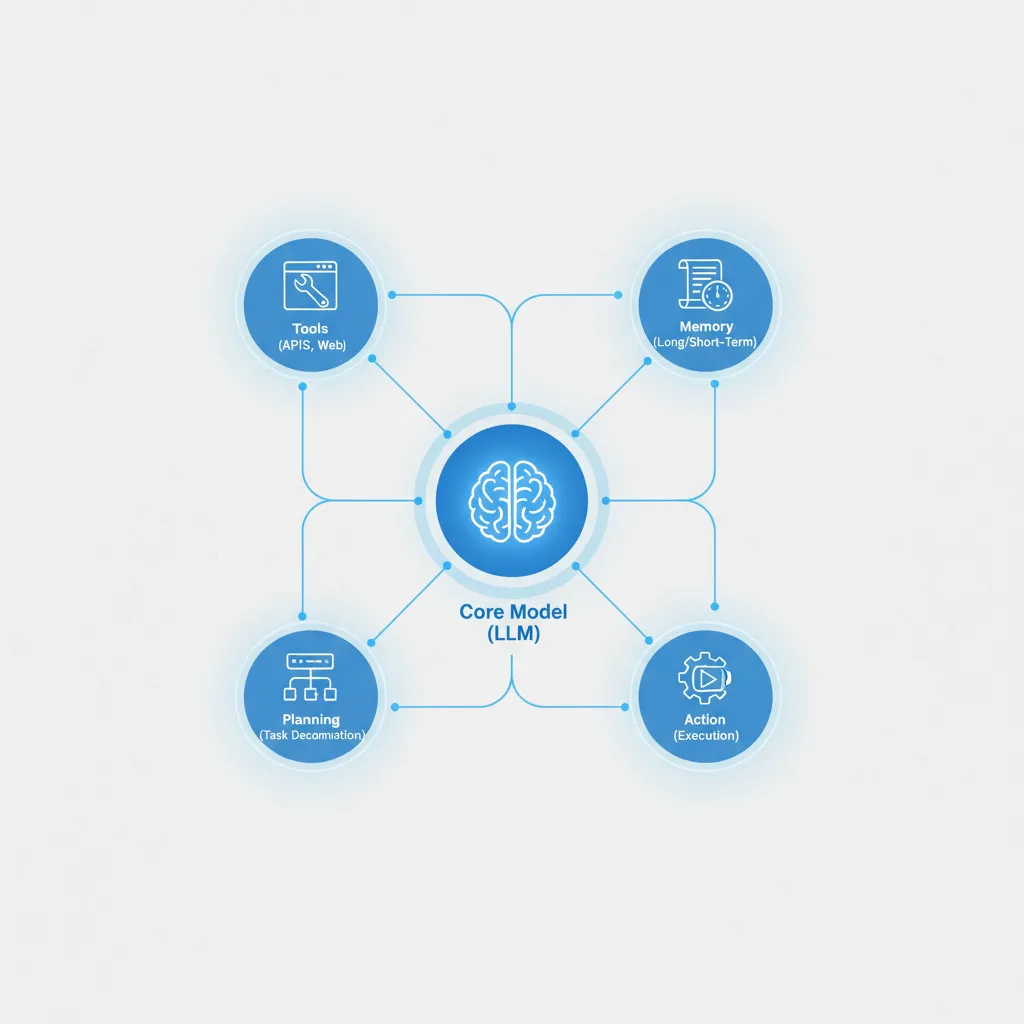
To execute the Agentic Loop effectively, an AI agent architecture requires several key components layered on top of the foundational LLM.
The Four Pillars of AI Agent Architecture
| Component | Function | Example |
|---|---|---|
| Model (The Brain) | The foundational LLM (e.g., GPT-4o, Claude 3.5) that handles reasoning, planning, and natural language understanding. | Determines the logical sequence of steps to book a flight. |
| Memory (The Experience) | Stores past interactions, successful plans, user preferences, and intermediate results. Includes short-term (context window) and long-term (vector database) memory. | Remembers the user’s preferred airline and seating type from last month’s trip. |
| Tools (The Hands) | External software interfaces, APIs, or functions the agent can call to interact with the real world (e.g., web scraping, executing code, sending emails). | Uses a ‘search_web’ tool to find current flight prices and a ‘send_email’ tool to notify the user. |
| Planning/Control Module | Directs the workflow, manages tool selection, structures the reasoning process, and facilitates the critical self-reflection stage. | Checks if the booked flight adheres to the budget constraints and re-plans if necessary. |
This robust architecture allows the agent to move beyond simple question answering and perform sophisticated, multi-step tasks.
Frameworks Driving the Agentic AI Wave
The rise of autonomous AI has been accelerated by robust, open-source frameworks that provide the scaffolding necessary to connect an LLM brain to external tools and structured memory systems. These AI agent frameworks abstract away much of the complexity, making it easier for developers to build powerful, customized agents.
LangChain Agents: The Foundational Toolkit
LangChain agents are perhaps the most widely recognized starting point for building sophisticated LLM applications. LangChain is not an agent itself, but rather a modular framework designed to chain together different components—models, prompts, retrieval, and agents.
LangChain provides pre-built logic chains that allow the LLM to decide which tool to use and when, facilitating complex AI agent workflow. It’s the essential toolkit for developers venturing into the AI agent tutorial space, providing the necessary glue to connect an LLM to external data (RAG) and actions (tools).
CrewAI: Orchestrating Multi-Agent Systems
While LangChain is excellent for single-agent systems, the most powerful real-world applications often require multi-agent systems—a team of specialized AI agents working collaboratively. This is where frameworks like CrewAI shine.
CrewAI allows developers to define a “crew” of intelligent agents, each assigned a specific role, goal, and set of tools. For example, a marketing campaign might involve a “Strategist Agent” that plans the content, a “Writer Agent” that drafts the copy, and an “Editor Agent” that reviews and refines the final output.
The framework manages the delegation, communication, and synchronization between these agents, allowing for highly complex, end-to-end projects driven entirely by agentic AI. This collaborative approach is critical for scaling task automation with AI.
[Related: what-is-gpt-4o-ultimate-guide-to-real-time-ai/]
The Rise of Open Source AI Agents
The community interest in autonomous agents led to a rapid proliferation of open source AI agents and experimental projects. The collaborative environment helps democratize access to the technology and accelerate development. By using open-source tools, organizations can tailor the agent’s behavior precisely to their needs while maintaining transparency and control over their data.
Iconic AI Agent Examples: Auto-GPT and Devin AI
To truly understand the capabilities of modern agents, we must look at the groundbreaking examples that brought the concept of self-driving software into the mainstream consciousness.
Auto-GPT: The Early Blueprint
Auto-GPT emerged in 2023 as one of the first widely recognized applications demonstrating a truly autonomous AI loop. It was designed to achieve any goal given by the user, breaking it down into sub-tasks, using Google Search or other tools, and writing the results to memory.
While often experimental and resource-intensive, Auto-GPT cemented the idea of a self-prompting system that didn’t require constant human intervention. It showed the world that an LLM could manage its own iterative decision-making process, laying the groundwork for more sophisticated AI agent frameworks.
Devin AI: The AI Software Engineer
Perhaps the most compelling example of a specialized agent is Devin AI, the first AI software engineer. Developed by Cognition, Devin is an agent trained to handle entire software development projects autonomously.
Devin can:
- Write and debug code in its own sandboxed environment.
- Search documentation, find bugs, and apply fixes.
- Set up a complete development environment and deploy applications.
- Collaborate with human developers, taking high-level instructions and implementing them.
Devin is a clear demonstration of goal-driven AI in a high-stakes, technical domain, validating the transformative potential of AI automation for complex professional tasks.
Generative Agents: Simulating Human Behavior
Beyond practical engineering, research into generative agents (pioneered by Stanford and Google researchers) showed that AI agents could convincingly simulate complex human social behavior. These agents were placed in virtual towns and given specific identities and memories.
The result? The agents developed relationships, gossiped, organized parties, and adapted their behavior based on their social environment and memory. This research validated the potential of the agent-based model not only for automation but also for simulating societies, planning urban development, and understanding human interactions at scale.

AI Agents in the Real World: Use Cases Across Industries
The transition from theoretical research to practical application is accelerating, with AI agent use cases spanning every major industry, from finance to supply chain management.
AI in Business Process Automation (BPA)
AI agents are rapidly replacing traditional scripting and manual workflows in business. Unlike rigid scripts, an agent can adapt to non-standard data inputs and unexpected errors, making it far more robust for BPA.
Practical Examples:
- Sales Intelligence: An agent monitors social media, news feeds, and competitor websites. When it detects a key trigger (e.g., a company announcing a large funding round), it automatically researches the key players, summarizes their technology stack, drafts a personalized outreach email, and schedules it in the CRM—all without human input.
- Financial Reconciliation: An agent monitors multiple bank accounts and invoicing systems. If it detects a discrepancy, it autonomously generates a detailed report, searches for the missing transaction ID across connected systems, and flags only the transactions it cannot resolve.
- Customer Service: Advanced agents can triage complex support tickets, search internal knowledge bases, access CRM data, and execute standard troubleshooting steps before escalating only novel or highly emotional issues to a human agent.
[Related: the-fintech-revolution-mastering-money-innovative-personal-finance-tools/]
Robotic Process Automation vs AI Agents (RPA vs. Agentic AI)
For years, Robotic Process Automation (RPA) tools have automated repetitive, rule-based digital tasks. But the arrival of AI agents marks a distinct paradigm shift.
| Feature | Robotic Process Automation (RPA) | AI Agents (Agentic AI) |
|---|---|---|
| Cognitive Ability | Low. Follows rigid, predefined rules (If X, then Y). | High. Uses LLMs for reasoning, planning, and goal-setting. |
| Adaptability | Low. Breaks easily if the interface or process changes. | High. Can self-correct, re-plan, and handle ambiguity or unexpected data formats. |
| Goal Management | Task-focused (completes one specific, scripted action). | Goal-focused (achieves a high-level outcome through multiple steps). |
| Memory | None (stateless execution). | Robust, external long-term memory (vector databases). |
In essence, RPA tools are the highly efficient clerks of the digital world, while AI agents are the adaptable, strategic managers. Many companies are now integrating RPA tools as tools for their overarching AI agents to command.

Developing Your AI Personal Assistant
One of the most immediate and accessible AI agent use cases is the development of a highly personalized digital companion. Far surpassing standard voice assistants, an advanced AI personal assistant uses long-term memory to understand context, preferences, and personal goals.
This assistant could autonomously manage your calendar by proactively identifying meeting conflicts, drafting rejection emails based on your professional tone, organizing your travel itinerary, and managing your digital clutter—all while learning your habits to become more efficient over time.
How to Build an AI Agent: A High-Level Tutorial
Building a modern AI agent requires more than just calling an LLM API; it involves structuring the agent’s components so the LLM can leverage tools and memory effectively. This high-level AI agent tutorial outlines the essential steps.
1. Define the Goal and Environment
Before writing any code, define the agent’s singular, measurable goal. The goal must be precise and specify the environment the agent will operate within.
- Poor Goal: “Manage my social media.”
- Good Goal: “Create and schedule one LinkedIn post per day summarizing tech news, ensuring each post includes three relevant hashtags and a call-to-action link.”
The environment defines the tools the agent will need (e.g., access to LinkedIn API, a news scraping tool, a scheduling API).
2. Select the LLM and Framework
Choose a powerful LLM (like GPT-4, Claude 3, or Gemini) that offers robust reasoning capabilities, as the agent’s planning module relies heavily on this. Then, select your AI agent frameworks:
- Single Agent (Simple Tasks): Use a basic LangChain structure.
- Multi-Agent (Complex Collaboration): Use a framework like CrewAI or LangGraph.
3. Implement Memory and Tools
Tools: The most critical step is defining the external functions (tools) the agent can use. These might be Python functions, external APIs, or database connectors. The LLM must be able to understand the tool’s description to decide when to call it.
Memory: Integrate a vector database (e.g., Chroma, Pinecone) for long-term memory. This allows the agent to store and retrieve past successful plans, feedback, and learned facts, feeding its self-reflection loop.
4. Structure the Agent Workflow (The Prompting)
The prompt is the agent’s constitution. It must clearly outline its role, its goal, the tools available, and, crucially, the format for its thought process (e.g., “Always output your reasoning in a ‘Thought:’ block before executing a ‘Tool Call:’”).
This structured prompting is essential for enabling the agent’s capacity for self-reflection and goal-driven AI.
5. Test, Iterate, and Refine
AI agents are prone to hallucinations and tool misuse, especially early on. Rigorous testing is mandatory. Observe the agent’s thought logs. Why did it fail? Adjust the tool descriptions, refine the planning prompt, and iterate. This continuous refinement cycle is what transitions a simple script into a truly robust, cognitive agent AI.
The Future of AI Agents: The Next Tech Frontier
The current generation of AI agents is already demonstrating capability far beyond what was thought possible just a few years ago. But this is just the beginning. The future of AI agents hinges on a few key areas of development that will deepen their autonomy and integration into our physical and digital lives.
Hyper-Personalization and Digital Delegation
As agents become better at retaining long-term, context-rich memories, they will function less like a helpful script and more like a dedicated, deeply knowledgeable human delegate.
Imagine an agent managing all aspects of your financial life: finding investment opportunities, comparing sustainable investment options, managing tax documents, and coordinating with your accountant. This level of delegation will free up significant cognitive load for professionals and individuals alike.
[Related: sustainable-finance-invest-responsibly-grow-green-portfolio/]
Complex Multi-Agent Systems and DAO-like Structures
The focus will shift from single agents performing linear tasks to interconnected multi-agent systems collaborating on massive projects. These systems will not only communicate but will self-organize, delegating sub-goals across a network of specialized agents. This could lead to decentralized autonomous organizations (DAOs) being managed by highly sophisticated, self-governing AI crews, executing market strategies or even building new infrastructure.

Ethical and Security Implications
With greater autonomy comes greater responsibility. The more control an agent has over real-world actions (sending money, executing code, controlling physical systems), the more critical security and ethics become.
Future development must focus on:
- Guardrails and Alignment: Ensuring agents strictly adhere to human-defined ethical constraints and safety protocols.
- Auditability: Providing transparent thought logs and decision paths so humans can debug and verify the agent’s choices, especially in critical processes.
- Controllability: Developing mechanisms for human intervention and override—the “kill switch” for rogue processes.
The development of the agent-based model is inherently intertwined with establishing robust ethical frameworks to ensure that this vast power remains aligned with human values.
Conclusion: Mastering the Agentic Future
The transition to agentic AI is arguably the most significant technological development since the popularization of the internet. We are moving past the era of static software and entering a world populated by dynamic, self-governing software entities capable of achieving complex, high-level goals.
Understanding what are AI agents and how their architecture functions is no longer a niche research topic—it is a mandatory piece of knowledge for any modern technologist or business leader. From small businesses using AI automation to manage inventory, to massive corporations deploying multi-agent systems for advanced supply chain optimization, the impact is pervasive.
[Related: streamlining-supply-chains-ai-revolutionizing-logistics-efficiency/]
The AI agent workflow promises to redefine productivity, transforming the role of the human operator from the executor of tasks to the strategic director of powerful, autonomous AI teams. The next frontier is here; the only task remaining is learning how to command it.
FAQs: Frequently Asked Questions About AI Agents
Q1. What is the difference between an AI agent and a Large Language Model (LLM)?
An LLM is the core “brain” of the agent, providing reasoning and language understanding. An AI agent is the entire system, which includes the LLM brain plus additional components like external memory, planning modules, and a toolkit of external actions (APIs, web browsers). The agent uses the LLM to decide how to use its tools autonomously to achieve a goal.
Q2. How is AI automation using agents different from traditional Robotic Process Automation (RPA)?
Robotic Process Automation (RPA) relies on rigid, pre-scripted rules to automate repetitive digital tasks. If the workflow changes, the RPA bot breaks. AI agents (or agentic AI) use their underlying LLM for flexible reasoning and goal-driven AI. They can adapt to unexpected inputs, self-correct errors, and formulate new plans on the fly, making them ideal for complex, ambiguous, or dynamic processes.
Q3. What is a multi-agent system, and why is it important?
A multi-agent system is an environment where multiple specialized AI agents collaborate to solve a single, larger problem. Each agent has a distinct role (e.g., planner, researcher, executor), specific tools, and a defined scope. This system is crucial for complex projects because it allows for specialization and parallel processing, vastly improving efficiency and capability compared to a single, monolithic agent. Frameworks like CrewAI are designed to manage these collaborative systems.
Q4. What is the “Agentic Loop”?
The Agentic Loop describes the continuous, iterative process that defines an autonomous agent. It consists of four core steps: Perception (observing the environment), Planning (breaking the goal into steps), Action (executing a step using tools), and Reflection (evaluating the outcome and revising the plan if necessary). This loop allows the agent to sustain long-term work and correct its own mistakes without human guidance.
Q5. What is the role of memory in AI agent architecture?
Memory is a vital component of AI agent architecture. It enables the agent to maintain context, learn from past actions, and avoid repeating mistakes. It usually includes:
- Short-term memory: The active context window for the current task.
- Long-term memory: Stored in vector databases, allowing the agent to retrieve past experiences, preferences, or established facts relevant to the ongoing task.
Q6. Can I build my own AI agent? What tools are needed?
Yes, you can build your own AI agents. You need a strong understanding of Python and access to an LLM provider (e.g., OpenAI or Anthropic). You would use AI agent frameworks like LangChain agents or CrewAI to manage the connection between the LLM, external tools, and memory systems (like vector databases). Many free AI agent tutorial resources are available online to guide beginners through the process of defining roles, selecting tools, and structuring the agentic workflow.
Q7. How does Devin AI differ from early models like Auto-GPT?
Auto-GPT was an early experimental model focused on the generalized concept of self-prompting. While groundbreaking, it often struggled with complex, multi-step tasks. Devin AI is a highly specialized, proprietary autonomous agent specifically trained to excel in the software engineering domain. Devin operates in a persistent shell environment, can debug its own code, and collaborates with human peers, demonstrating a level of reliability and domain expertise far beyond its experimental predecessors.
Q8. What does “cognitive agents AI” mean?
Cognitive agents AI refers to intelligent agents designed to mimic human cognitive processes, specifically reasoning, planning, and learning. These agents go beyond simple reactive behavior and are capable of forming complex mental models, using self-reflection, and applying sophisticated decision-making processes to achieve long-term, abstract goals. This term is often used interchangeably with intelligent agents or autonomous agents.