Beyond Smartwatches: How Wearable AI is Reshaping Productivity and Daily Life

For the past decade, the smartwatch has been the undisputed champion of wearable technology. It brought notifications, fitness tracking, and apps to our wrists, creating a new digital touchpoint. But we’re now standing at the edge of a monumental shift, a move beyond the reactive pings and taps of smartwatches into a proactive, intelligent future. This is the era of wearable AI devices, a new category of technology designed not just to show you information, but to understand your context, anticipate your needs, and seamlessly integrate into your life.
Forget constantly glancing at a screen. The future is about hands-free AI that whispers translations in your ear, smart glasses that overlay critical data onto your world, and discreet rings that control your environment with a gesture. This isn’t science fiction; it’s the next evolution in human-computer interaction wearables.
In this deep dive, we’ll explore how this new wave of intelligent wearables is fundamentally reshaping personal productivity and daily routines. We’ll unpack the technology, examine the practical applications for AI at work, and look ahead to the future of wearable tech—a future where your technology works for you, often without you even having to ask.
The Evolution: From Data Trackers to Intelligent Companions
To understand where we’re going, we need to appreciate where we’ve been. The journey of wearable tech has been a rapid and fascinating evolution.
- Phase 1: The Data Collectors (2010s). Early devices like the Fitbit and Pebble were revolutionary for their time. They were primarily passive data collectors, tracking our steps, sleep, and heart rate. They made us aware of our personal data but required us to interpret it.
- Phase 2: The Wrist-Mounted Smartphone (Mid-2010s). The Apple Watch and its competitors ushered in the era of the smartwatch. These devices became extensions of our phones, delivering notifications, running mini-apps, and offering more active health monitoring. They were powerful but largely reactive, demanding our attention and input for every task.
- Phase 3: The Proactive AI Assistant (Today and Beyond). We are now entering the third and most transformative phase. True wearable AI is defined by its proactivity. Powered by advanced on-device processing and large language models (LLMs), these next-gen smart devices aim to operate in the background, creating a layer of ambient intelligence. They don’t wait for your command; they learn your patterns and offer assistance contextually.
The key difference is the shift from a device you use to a companion that assists. This leap is powered by the convergence of miniaturized hardware, efficient AI models, and a vision for more seamless AI integration into the fabric of our lives.
The New Form Factors: Discreet, Powerful, and Always-On
The new wave of wearable AI is breaking free from the wrist. Innovators are embedding intelligence into more natural, and often more discreet, form factors that align with how we already interact with the world.
Smart Glasses: The Augmented Reality Productivity Powerhouse
Once a symbol of a clunky, dystopian future, smart glasses have re-emerged with sleek designs and powerful capabilities. Devices like the Ray-Ban Meta Smart Glasses blend style with function, offering a glimpse into the potential of augmented reality glasses productivity.
Imagine a mechanic viewing a schematic overlaid directly onto an engine, a surgeon seeing a patient’s vitals without looking away from the operating table, or a professional receiving discreet talking points during a presentation. This is the promise of smart glasses for work. They provide a heads-up, hands-free interface to your digital world, reducing the need to pull out a phone and break your flow. For busy professionals, they can filter notifications, record first-person video for documentation, and provide real-time language translation, making them one of the most compelling smart devices for efficiency.

AI Earbuds: Your Conversational AI and Audio Co-pilot
Your earbuds are no longer just for music and podcasts. They are evolving into powerful AI earbuds and a primary interface for AI voice assistants wearable. With sophisticated microphones and on-board AI, they can become a personal co-pilot for your brain.
Consider these use cases:
- Live Translation: Engage in a conversation with someone speaking another language, with real-time translation whispered directly into your ear.
- Meeting Assistant: Your earbuds can listen to a meeting, generate a transcript, and provide a concise summary of action items moments after it ends.
- Focused Learning: While on a run or commute, you can ask your AI assistant to summarize a complex topic, effectively turning downtime into learning time.
- Active Noise Cancellation Plus: Advanced AI can selectively filter sounds, blocking out a noisy café while still allowing you to hear when someone says your name.
These conversational AI devices leverage the power of voice—our most natural communication method—to create a frictionless AI experience. Related: What is GPT-4o? The Ultimate Guide to Real-Time AI

Smart Rings: The Subtle Art of Discreet AI Tech
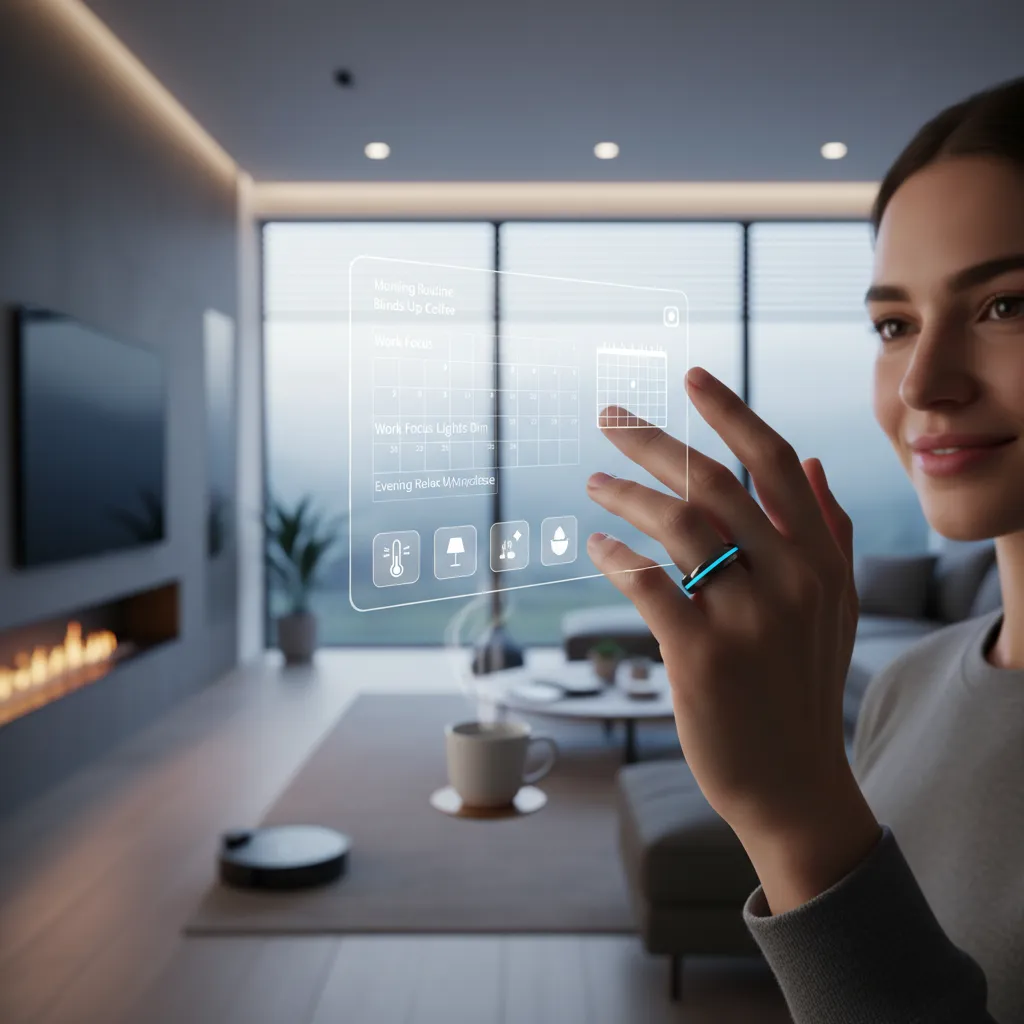
For those who find glasses or earbuds too intrusive, the smart ring offers the ultimate in discreet AI tech. Devices like the Oura Ring and Ultrahuman Ring Air have already popularized the form factor for health tracking. The next step is integrating proactive AI assistance.
The power of smart rings AI lies in its subtlety. A simple gesture could dismiss a notification, a tap could trigger a smart home routine, and a gentle haptic buzz could be a private, prioritized alert. They are perfect for situations where pulling out a phone or talking to an assistant is socially awkward. Imagine controlling a presentation with a flick of your finger or paying for coffee with a tap of your hand. This is where the smart ring’s potential as a control hub for your personal ecosystem truly shines.
AI Pins and Pendants: The Unattached Personal AI Assistant
A truly radical rethinking of the personal computer, devices like the Humane Ai Pin represent a bold vision for screenless, ambient intelligence devices. These gadgets are designed to be an unattached personal AI assistant, using a combination of voice commands, computer vision, and a laser projector to interact with the world.
While early versions have faced criticism, they are important pioneers pushing the boundaries of what a personal computing device can be. They champion a future where technology is a background utility, summoned only when needed, allowing us to stay more present and engaged with our physical surroundings. Related: On-Device AI: The Next Revolution in Tech
How Wearable AI is Redefining “Productivity”
The ultimate goal of these AI productivity tools isn’t just to help you do more tasks, but to help you do the right tasks with less friction and mental load. Here’s how they enhance productivity AI.
Taming the Digital Deluge: Context-Aware Filtering
One of the biggest productivity killers is the constant barrage of notifications. Wearable AI acts as an intelligent gatekeeper. It learns which people, keywords, and apps are important to you. It can silently handle low-priority emails but deliver a gentle haptic buzz on your smart ring for a message from your boss. It can summarize a long chain of chat messages into a single, actionable sentence, saving you from the scroll. This intelligent filtering is a core wearable AI benefit.
Seamless Integration into Daily Routines and Workflows
The true power of AI in daily routines is unlocked when the technology fades into the background. It’s about creating AI efficiency solutions that don’t require a new set of habits.
Consider a day in the life of an AI for busy professionals:
- Morning Commute: Your AI earbuds brief you on your first meeting, highlighting key attendees and summarizing recent email exchanges on the topic.
- In the Office: While walking to the meeting, your smart glasses display the room number and directions.
- During the Meeting: Your glasses discreetly show you real-time data relevant to the discussion, pulled from your company’s dashboard. You can ask your AI pin to take a note without ever looking at a screen.
- Post-Meeting: Before you’re even back at your desk, a summary and list of action items are already drafted and waiting for your review.
This level of seamless AI integration reduces context switching and keeps you in a state of flow. Related: Apple Intelligence & iOS 18: A Deep Dive into the New AI Features

Proactive Assistance: The AI That’s Always One Step Ahead
The most significant leap forward is the move to proactive assistance. Your smart personal assistant devices will begin to anticipate your needs based on your calendar, location, and habits.
- It might automatically put your phone on silent when it detects you’ve entered a movie theater.
- It could analyze traffic and send a subtle notification to your wrist to leave 10 minutes early for your next appointment.
- It can help with AI for personal organization by noticing you’ve scheduled three back-to-back meetings and suggesting you block off 30 minutes for lunch afterward.
This proactive support reduces cognitive load, freeing up your mental energy to focus on high-value creative and strategic work.
The Broader Impact: Reshaping Our Lifestyle and Interactions
The influence of wearable AI extends far beyond the office. It’s poised to create a more connected and responsive AI-powered lifestyle.
Health, Learning, and Connectivity
Beyond simple step counting, intelligent wearables will offer 24/7 biometric analysis, providing early warnings for potential health issues and offering personalized coaching on everything from diet to stress management. For learning, they break down barriers. Imagine touring a foreign city with your AI earbuds providing historical context for the buildings you’re looking at, or your smart glasses translating street signs in real-time. Related: The Rise of AI Companions: Enhancing Daily Life & Emotional Well-being
The Business Case: Wearable Tech for Business Transformation
The enterprise applications are vast. In logistics, workers can get hands-free picking instructions through smart glasses. In manufacturing, an expert can remotely guide a junior technician through a complex repair from thousands of miles away. Wearable tech for business is not just about personal productivity; it’s about creating safer, more efficient, and more connected workforces.
Navigating the Challenges: Privacy, Ethics, and Adoption
This hyper-connected future is not without its challenges. The “always-on, always-aware” nature of these devices raises critical questions about privacy. Who owns the vast amounts of personal and environmental data these devices collect? How is it secured? Related: Guardians of the Digital Frontier: How AI is Revolutionizing Cybersecurity
We must also consider the ethical implications of algorithms that mediate our reality and the potential for a new digital divide. For mass adoption, these devices must overcome hurdles like battery life, cost, and ensuring they are socially acceptable and not intrusive.
The Future of Wearable Tech: What’s Next?
We are at the very beginning of this technological revolution. The future tech daily life will likely involve even more seamless integrations.
- Haptic Integration: Imagine feeling navigational cues as gentle pulses on your wrist, or the “texture” of a digital object. Related: Haptic AI: Feeling the Future of Immersive Digital Experiences
- Brain-Computer Interfaces (BCIs): Though still in early development, non-invasive BCIs could one day allow for thought-based control of our devices.
- An Interconnected Ecosystem: The true power will be unlocked when your smart ring, earbuds, and glasses work together as a single, cohesive AI system that understands your complete context.
The ultimate vision is for the technology to disappear completely, creating a world of true ambient intelligence where our digital and physical realities are perfectly intertwined.
Conclusion: The Dawn of Ambient Computing
We are moving decisively beyond the era of the smartwatch. The next generation of wearable AI devices promises a future where technology is more personal, intuitive, and integrated than ever before. Smart glasses, AI-powered earbuds, and intelligent rings are not just new gadgets; they represent a new philosophy of human-computer interaction.
By offering proactive assistance, filtering out digital noise, and providing hands-free access to information and AI, these innovative wearable AI platforms are set to fundamentally redefine our productivity and enrich our daily lives. The journey is just beginning, but one thing is clear: the future isn’t on your screen; it’s all around you.
Frequently Asked Questions (FAQs)
Q1. What is an example of a wearable AI device?
An example of a wearable AI device is a pair of smart glasses like the Ray-Ban Meta Smart Glasses, which integrate a camera and AI to understand your surroundings, or AI-powered earbuds that can provide real-time language translation and meeting summaries. Smart rings like the Oura Ring are also evolving to include more AI-driven proactive features.
Q2. What is the main purpose of AI wearables?
The main purpose of AI wearables is to provide proactive, context-aware assistance in a hands-free and seamless manner. Unlike smartwatches that primarily react to commands, AI wearables aim to anticipate user needs, filter digital noise, and integrate AI-powered tools directly into a user’s daily workflow and environment.
Q3. How do AI wearables improve productivity?
AI wearables improve productivity by minimizing distractions, reducing context-switching, and automating routine tasks. They can filter notifications, provide hands-free access to information, generate summaries of meetings, translate languages in real-time, and offer proactive reminders, freeing up a user’s mental energy for more complex and creative work.
Q4. Are smartwatches considered wearable AI?
While modern smartwatches use AI for features like health tracking, workout detection, and voice assistants, the emerging category of “wearable AI” refers to devices more focused on proactive, ambient intelligence. The key difference is the shift from a screen-based, app-centric interface to a more seamless, often hands-free, and anticipatory user experience.
Q5. What are the privacy concerns with wearable AI?
The primary privacy concerns with wearable AI revolve around the constant collection of personal and environmental data by always-on sensors like microphones and cameras. Questions about where this data is stored, who has access to it, how it’s secured from breaches, and the potential for surveillance are critical challenges that manufacturers and users must address.
Q6. What is ambient intelligence?
Ambient Intelligence (AmI) is a vision of the future where technology is seamlessly and invisibly embedded into our environment and devices. In an AmI world, technology is context-aware, personalized, adaptive, and anticipatory. Wearable AI devices are a key step toward achieving this vision, making computing a background utility rather than a destination you must actively engage with.