Unlocking New Realities: The Power of AI in Spatial Computing
Introduction
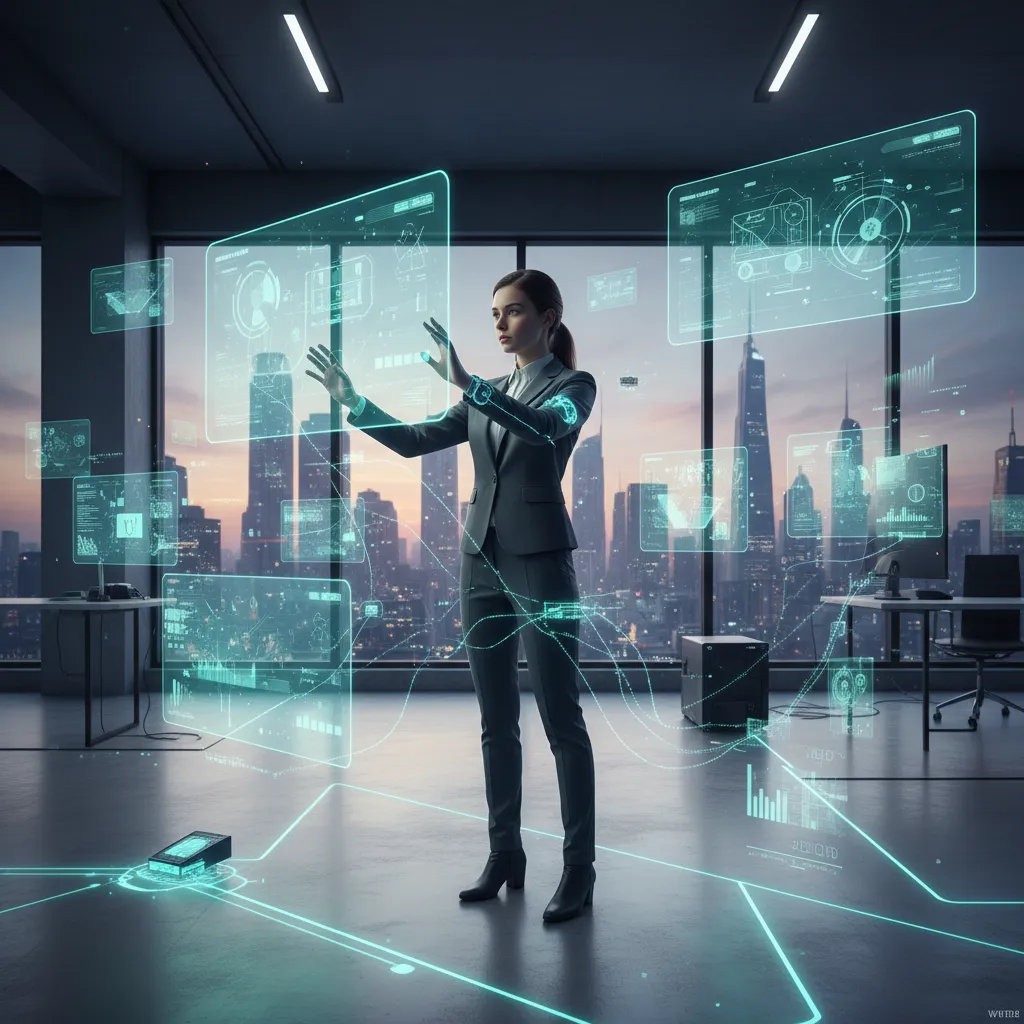
Imagine a world where the digital seamlessly blends with the physical, where your environment isn’t just a static backdrop but an interactive canvas, intelligently responding to your presence and needs. This isn’t science fiction; it’s the promise of spatial computing, an evolving paradigm that bridges the gap between our physical world and digital information. At the heart of this transformative shift lies Artificial Intelligence (AI), acting as the crucial engine that unlocks unprecedented levels of immersion, interaction, and intelligence.
AI spatial computing is more than just a buzzword; it represents a fundamental re-imagining of how we perceive, interact with, and create our digital realities. From enhanced augmented reality AI experiences that layer information onto our world, to virtual reality AI that crafts fully immersive digital realms, and mixed reality AI that masterfully merges both, AI is the catalyst. This article will delve into the profound impact of AI on spatial computing, exploring its core mechanisms, diverse applications, and the exciting future it heralds for everything from enterprise spatial AI solutions to groundbreaking consumer spatial computing experiences. Prepare to journey into new realities, where intelligence and immersion converge to redefine our digital existence.
What is Spatial Computing? A Foundation for Future Interactions
Before we can fully appreciate the role of AI, it’s essential to grasp the concept of spatial computing. At its core, spatial computing refers to a set of technologies that enable computers to understand and interact with the physical world in a three-dimensional, spatial context. Unlike traditional computing, which primarily operates on 2D screens, spatial computing liberates digital information, allowing it to exist and be manipulated within our physical environment.
Defining the Digital-Physical Blend
This discipline is the foundation for various immersive technologies often grouped under the umbrella term Extended Reality (XR), which includes Augmented Reality (AR), Virtual Reality (VR), and Mixed Reality (MR).
- Augmented Reality (AR): Overlays digital information onto the real world, enhancing our perception of it. Think of navigating with digital arrows projected onto the street in front of you, or seeing virtual furniture placed in your living room.
- Virtual Reality (VR): Creates a completely immersive, simulated environment that can be entirely different from the real world. Users wear headsets that transport them to digital worlds for gaming, training, or social interaction.
- Mixed Reality (MR): Represents the convergence of AR and VR, allowing digital objects to interact with the real world in a way that feels truly integrated. MR systems can blend virtual content so seamlessly that it appears to coexist with physical objects, responding to environmental cues.
The Core Pillars: Perception, Understanding, Interaction
For spatial computing to function effectively, it relies on several key capabilities:
- Perception: Devices must be able to “see” and map the physical environment. This involves advanced sensors, cameras, and depth-sensing technologies.
- Understanding: Once perceived, the system needs to interpret the environment—identifying objects, understanding surfaces, tracking user movements, and comprehending the context.
- Interaction: Users must be able to naturally interact with digital content within this spatial context, using gestures, voice, gaze, or haptic feedback.
Without AI, spatial computing would be a collection of sophisticated sensors and displays. With AI, it becomes intelligent, adaptive, and truly transformative, pushing the boundaries of what’s possible in human-computer interaction spatial environments.
The Synergistic Power of AI in Spatial Computing
AI isn’t merely an add-on to spatial computing; it’s the fundamental intelligence that breathes life into these new realities. By providing cognitive capabilities to spatial systems, AI transforms passive digital overlays into dynamic, responsive, and truly immersive experiences. This synergy is what defines AI spatial computing and drives much of the spatial computing innovation we see today.
Enhanced Spatial Awareness and Perception
One of the most critical contributions of AI to spatial computing is its ability to elevate AI spatial awareness. Traditional computer vision techniques can map environments, but AI takes this a step further by enabling systems to understand those environments.
- Object Recognition and Segmentation: AI algorithms can instantly identify and categorize objects within a user’s physical space, allowing digital content to interact with them realistically. For instance, an AR application could “know” there’s a table in front of you and place a virtual object on it, not just floating through it.
- Environmental Understanding: AI allows spatial systems to discern room layouts, identify open spaces, understand lighting conditions, and even detect human presence and activity. This fuels
real-time spatial AI, enabling dynamic adjustments to virtual content based on the immediate surroundings. - 3D Reconstruction and Mapping: AI-powered simultaneous localization and mapping (SLAM) algorithms rapidly build highly accurate 3D models of environments from sensor data. This is crucial for anchoring digital content stably and consistently within the physical world, creating seamless AI and 3D environments. This sophisticated mapping is also foundational for the development of digital twins.
Intelligent Environment Understanding
Beyond mere perception, AI enables spatial systems to develop a deeper understanding of the context and semantics of an environment. This leads to more intuitive and proactive AI-powered immersive experiences.
- Contextual Intelligence: AI can infer user intent and environmental context. For example, if you’re looking at a broken appliance, an AR system could automatically pull up repair instructions or call a technician, understanding the “problem” context.
- Predictive Modeling: By analyzing user behavior and environmental data, AI can predict future actions or needs, allowing spatial applications to pre-emptively offer relevant information or tools. This proactive approach significantly enhances usability and immersion.
- Semantic Scene Understanding: AI helps systems not just see what is there, but what it is for. Recognizing a “kitchen” versus a “bedroom” allows applications to adapt their functionality, offering cooking recipes in one and relaxation guides in the other. This deep understanding is vital for advanced AI for digital twins, creating highly intelligent virtual replicas that mirror and predict their physical counterparts.
Predictive Analytics and Adaptive Experiences
The true power of AI in spatial computing shines in its ability to deliver personalized and adaptive experiences. Leveraging vast datasets and machine learning, AI can tailor interactions to individual users and dynamically adjust to changing conditions.
- Personalization: AI algorithms learn user preferences, interaction styles, and even emotional states, adapting the spatial experience to be more engaging and relevant for each individual.
- Dynamic Content Adjustment: Whether it’s adjusting the size and position of virtual objects based on a user’s proximity, or modifying the complexity of information presented, AI ensures that AI-powered immersive experiences are always optimized.
- Real-time Feedback Loops: AI continuously analyzes user input and system performance, providing immediate feedback and making instant adjustments to maintain a fluid and natural interaction. This is where
real-time spatial AIbecomes critical, processing complex data streams on the fly to deliver instantaneous responses.
Generative AI for Spatial Content Creation
Perhaps one of the most exciting recent developments is the emergence of generative AI for spatial computing. This goes beyond merely understanding environments; it enables the creation of new spatial content and experiences from simple prompts or existing data.
- Procedural Generation of 3D Assets: Generative AI can create complex 3D models, textures, and environments rapidly, significantly accelerating content creation for VR worlds, AR experiences, and even AI-driven virtual worlds.
- Dynamic Scene Generation: Imagine a spatial application where you describe a scene, and AI instantly generates a plausible 3D environment, complete with lighting, objects, and textures. This drastically reduces the manual effort in building immersive spaces.
- AI-Assisted Design: Designers can collaborate with AI in real-time within mixed reality environments, using natural language or gestural inputs to sculpt, modify, and iterate on 3D designs. This innovation promises to revolutionize design workflows across industries.
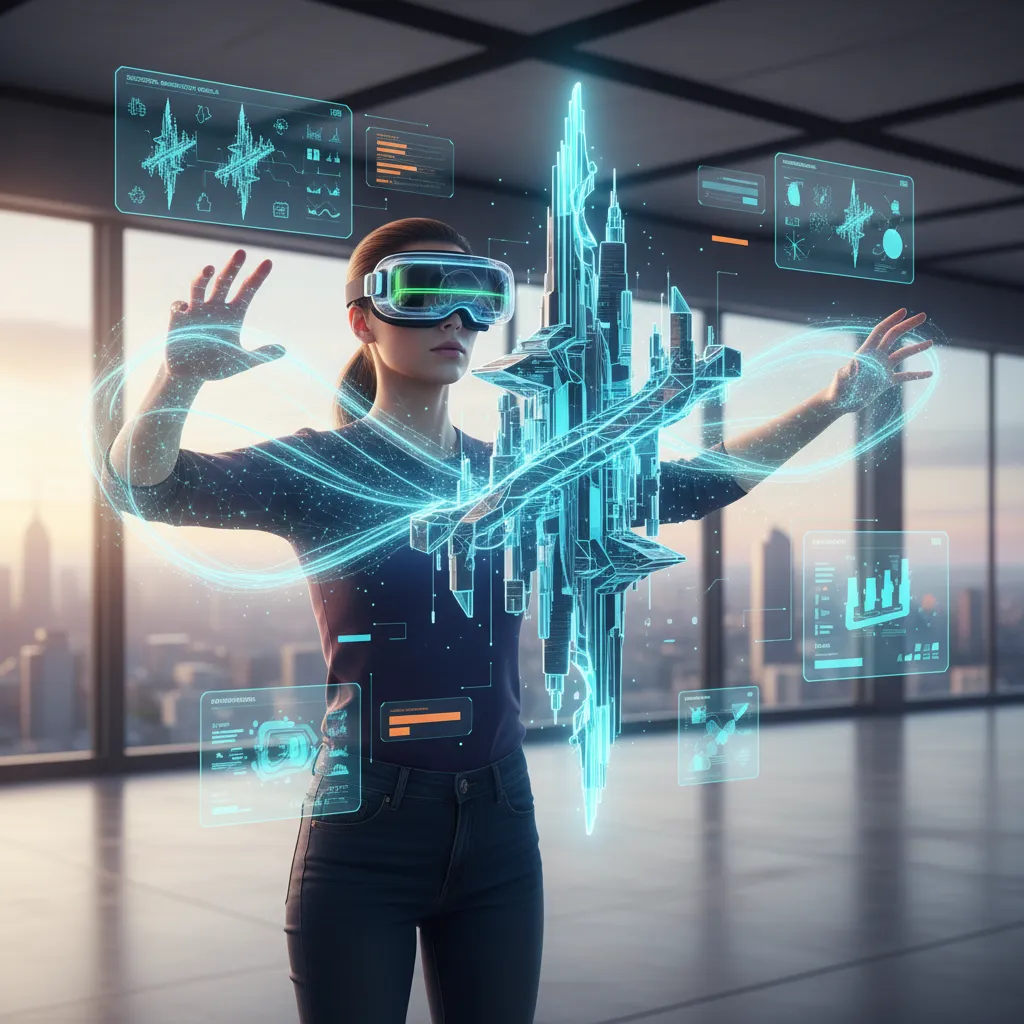 A designer sculpts a 3D model in mixed reality with AI assistance, demonstrating the power of generative AI in creative spatial applications.
This capability not only democratizes content creation but also allows for unprecedented levels of customization and scale, feeding the demand for diverse and rich AI and 3D environments. For more insights into how AI is revolutionizing content creation across the board, see our guide on the Ultimate Guide to Generative AI in Content Creation.
AI Across the XR Spectrum: AR, VR, and MR
The various forms of Extended Reality (XR) each offer unique avenues for AI in XR to enhance immersion and functionality. AI acts as a fundamental enabler across Augmented reality AI, Virtual reality AI, and Mixed reality AI, pushing the boundaries of what these technologies can achieve.
Augmented Reality (AR) AI: Blending Digital with Physical
Augmented reality AI focuses on intelligently enhancing our perception of the real world. AI provides the crucial intelligence to make digital overlays feel like they truly belong in our physical space.
- Persistent Anchoring: AI algorithms ensure that virtual objects remain fixed in their designated real-world locations, even as users move around. This stability is vital for believability in AI and reality merging scenarios.
- Occlusion and Depth Perception: Advanced AI spatial awareness allows AR systems to understand depth, meaning virtual objects can be correctly occluded (hidden) by physical objects, creating a much more realistic perception.
- Contextual Information Delivery: From displaying directions on a city street to providing real-time data about an engine part, AI in AR headsets delivers highly relevant information precisely when and where it’s needed. For example, a technician could wear AR glasses and have AI highlight specific components needing repair.
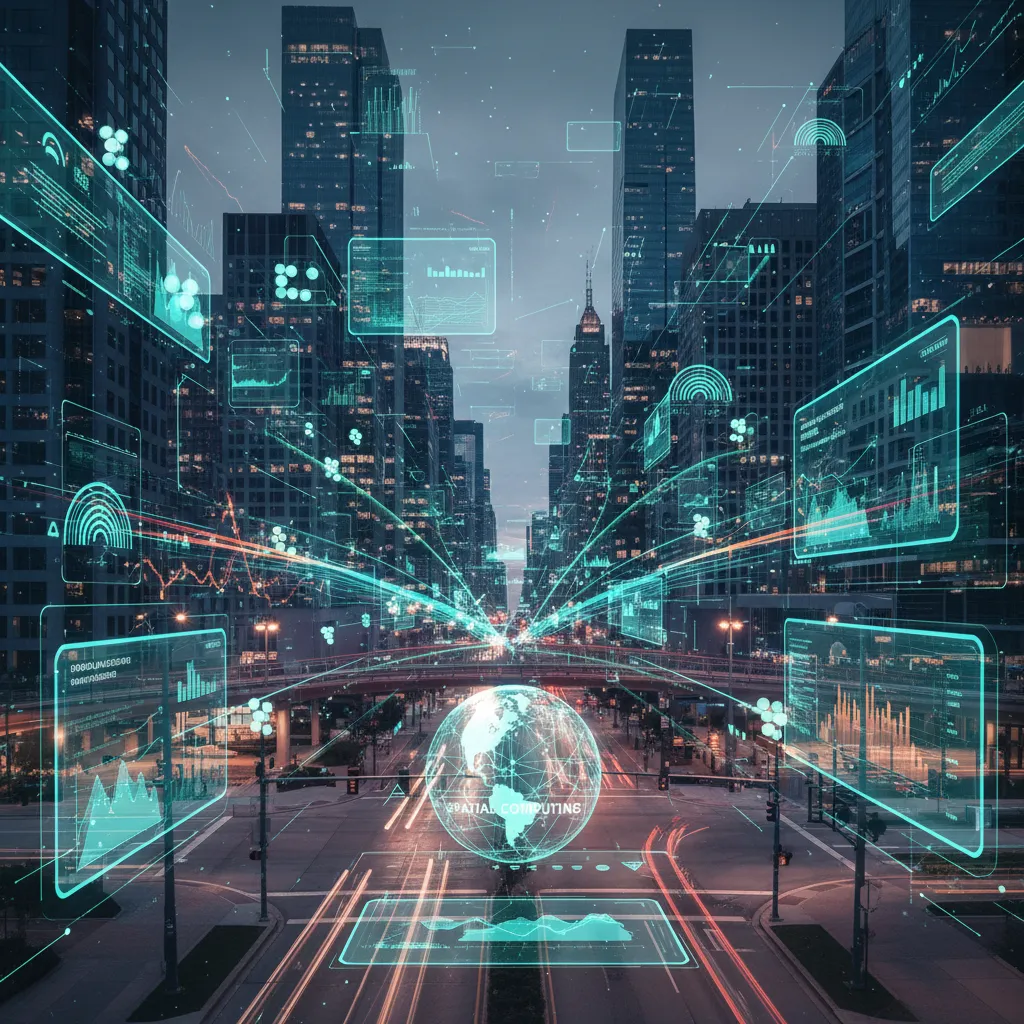 Augmented reality data points overlay an urban landscape for smart city planning, powered by AI to provide real-time, actionable insights.
This intelligent layering of information is not just about convenience; it’s about transforming how we interact with our environment, leading to innovations like wearable tech revolutionizing health and fitness or guiding us through complex tasks in industrial settings.
Virtual Reality (VR) AI: Crafting Fully Immersive Worlds
In Virtual reality AI, the intelligence focuses on creating believable, interactive, and dynamic digital worlds. AI handles everything from the behavior of virtual characters to the responsiveness of the environment.
- Intelligent NPCs and Avatars: AI powers non-player characters (NPCs) and user avatars with realistic behaviors, natural language processing, and adaptive responses, making virtual interactions more engaging.
- Dynamic World Generation: Beyond generative AI for content, AI in VR can dynamically alter environments based on user actions, storylines, or even biometric feedback, creating unique and replayable experiences in AI-driven virtual worlds.
- Adaptive Audio and Haptics: AI can intelligently manage spatial audio cues and haptic feedback, intensifying immersion by simulating realistic sounds and tactile sensations that correspond to virtual events.
- Performance Optimization: AI algorithms can optimize the rendering of complex VR environments in real-time, ensuring smooth framerates and reducing latency, which is crucial for preventing motion sickness and enhancing user comfort.
Mixed Reality (MR) AI: The Ultimate Convergence
Mixed reality AI represents the pinnacle of AI’s integration into spatial computing, offering the most sophisticated blend of digital and physical. Here, AI’s ability to understand both environments simultaneously is paramount.
- Seamless Digital-Physical Interaction: AI enables virtual objects to react realistically to physical objects and vice-versa. A virtual ball could bounce off a real table, or a digital assistant could correctly interpret a physical gesture in the room.
- Environmental Meshing: AI builds a detailed 3D mesh of the real environment, allowing digital content to occupy and respect physical space, creating convincing interactions and preventing digital objects from “clipping” through physical ones.
- Persistent Digital Content: MR AI allows virtual content to be anchored and persistent in physical space across multiple sessions and users. Imagine leaving a virtual note on a physical whiteboard that others can see later through their MR headset.
Extended Reality (XR) AI: The Umbrella of Innovation
Collectively, Extended reality AI encompasses the intelligent capabilities across AR, VR, and MR. It’s about creating a spectrum of immersive technologies where AI is the common thread, driving higher levels of presence, interaction, and utility. The future of spatial computing is intrinsically linked to the advancements in AI in XR, as these intelligent systems promise to unlock ever more compelling and useful immersive tech AI experiences. As spatial computing development progresses, AI will continue to be the force multiplier.
Transformative Applications of Spatial AI
The integration of AI into spatial computing is not merely an academic exercise; it’s driving tangible, transformative applications across a multitude of sectors. From revolutionizing industries to enhancing everyday life, spatial AI applications are rapidly moving from conceptual to practical.
Enterprise and Industrial Innovation
For businesses and industries, enterprise spatial AI and industrial spatial AI are unlocking new levels of efficiency, safety, and innovation.
- Manufacturing and Design: Engineers and designers can utilize mixed reality AI to prototype and visualize products in 3D, interacting with virtual models as if they were physically present. AI can assist in optimizing designs, simulating performance, and identifying potential flaws long before physical production. This accelerates spatial computing development dramatically.
- Healthcare and Medicine: Surgeons can use augmented reality AI headsets for AI-guided procedures, overlaying patient data, anatomical models, or even real-time ultrasound imagery directly onto the surgical field. This enhances precision, reduces invasiveness, and improves patient outcomes. Training for medical professionals can also be revolutionized through realistic virtual reality AI simulations.
- Training and Simulation: From highly realistic flight simulators for pilots to hazardous environment training for industrial workers, AI-powered spatial computing creates immersive and safe learning environments. AI can adapt scenarios in real-time based on trainee performance, providing personalized and effective learning experiences.
- Maintenance and Repair: Field technicians can wear AI in AR headsets that provide interactive 3D instructions, highlight problem areas, and even connect them with remote experts who can “see” what they see and provide guidance through digital annotations. This reduces downtime and boosts productivity.
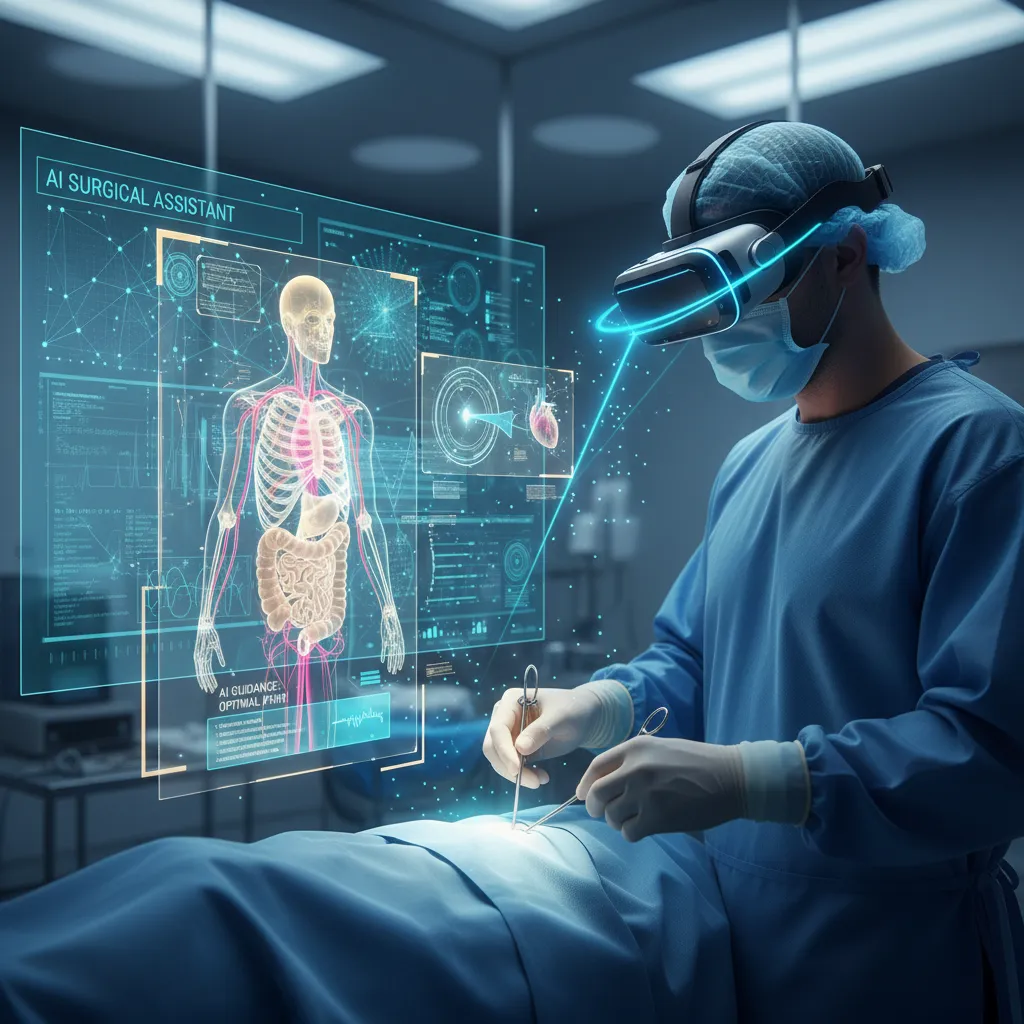 A surgeon uses an AR headset for AI-guided surgery with holographic overlays, showcasing the precision and data augmentation possible with enterprise spatial AI.
Consumer Experiences and Entertainment
On the consumer front, consumer spatial computing and personal spatial computing are redefining entertainment, social interaction, and personal productivity.
- Gaming: AI-driven virtual worlds in VR are becoming more dynamic, with intelligent NPCs, procedurally generated content, and adaptive narratives that respond to player choices. AR games blend digital characters and challenges into the real world, creating interactive adventures in everyday environments.
- Social Interaction: The metaverse spatial computing vision relies heavily on AI to power realistic avatars, facilitate natural language conversations, and create dynamic social spaces where users can interact in entirely new ways. Virtual meeting spaces with AI-powered avatars can make remote collaboration feel more present and engaging.
- Education: Immersive learning experiences powered by AI allow students to explore historical sites in VR, conduct virtual science experiments, or interact with 3D models in AR, making complex subjects more accessible and engaging.
- Navigation and Information: AR navigation apps can overlay directions onto your actual view of the street, while AI can provide contextual information about landmarks or points of interest as you pass them.
 Professionals collaborate in a virtual meeting with AI-powered avatars, showcasing advanced human-computer interaction in spatial computing.
For individuals seeking to boost their efficiency in these new digital realms, exploring tools like those discussed in Unlock Your Potential: Top AI Tools for Everyday Productivity becomes increasingly relevant.
The Metaverse: A New Frontier for Spatial AI
The metaverse spatial computing concept is perhaps the ultimate manifestation of AI’s power in spatial computing. It envisions a persistent, shared, 3D virtual space where users can interact with each other, digital objects, and AI agents.
- Persistent Digital Worlds: AI will manage the vast, complex, and ever-evolving environments of the metaverse, ensuring consistency and dynamism across countless users and experiences.
- Intelligent Agents and NPCs: AI will populate the metaverse with intelligent virtual beings that can guide, entertain, educate, and assist users, making the digital world feel alive and responsive.
- Economic Systems: AI can help manage and optimize complex virtual economies within the metaverse, facilitating transactions, managing resources, and ensuring fair play.
- Content Generation at Scale: As mentioned, generative AI for spatial computing will be critical for populating the metaverse with diverse and rich content, from landscapes and buildings to avatars and interactive elements.
The sustainable development of such vast digital ecosystems is also a growing concern, as explored in articles like Sustainable AI: Eco-Friendly Innovation for a Greener Digital Future.
Human-Computer Interaction Redefined
At the heart of all these applications is a profound evolution in human-computer interaction spatial. AI is enabling more natural and intuitive ways for us to engage with technology.
- Natural Language Interfaces: AI-powered voice assistants and chatbots within spatial environments allow users to communicate with systems using natural language, making interaction seamless.
- Gesture Recognition and Tracking: Advanced AI algorithms accurately interpret complex hand gestures, body movements, and even gaze tracking, transforming our physical actions into digital commands.
- Haptic Feedback: AI can intelligently control haptic feedback systems to provide realistic tactile sensations, enhancing the feeling of presence and interaction with virtual objects.
- Emotion and Intent Recognition: Future spatial AI systems will be able to detect user emotions and infer intent, allowing for truly empathetic and adaptive interactions that anticipate needs rather than just reacting to commands.
The Future Landscape: Trends and Innovations in Spatial Computing
The trajectory of spatial computing trends points towards an increasingly intelligent, integrated, and ubiquitous digital layer over our physical world. The future of spatial computing will be defined by continued innovation, driven primarily by advancements in AI.
Edge AI for Seamless Experiences
One of the most significant trends is the shift towards Edge AI spatial computing. Instead of relying solely on cloud-based processing, AI is increasingly being deployed directly on devices like AR headsets and smart glasses.
- Reduced Latency: Processing data locally drastically reduces the time it takes for AI to react, leading to more responsive and fluid real-time spatial AI experiences.
- Enhanced Privacy: Keeping sensitive spatial data on the device minimizes the need to transmit it to the cloud, addressing critical privacy concerns.
- Offline Capability: Edge AI enables spatial applications to function even without a constant internet connection, expanding their utility in remote or bandwidth-limited environments.
- Increased Reliability: By distributing computational load, edge AI makes spatial systems more robust and less susceptible to network disruptions.
The Rise of Next-Gen Spatial Platforms
The next wave of spatial computing innovation will see the emergence of highly sophisticated next-gen spatial platforms. These platforms will offer comprehensive toolkits for developers, enabling the creation of more complex, interoperable, and scalable spatial applications.
- Universal Scene Graphs: Standards for describing and sharing spatial data will become crucial, allowing digital content to persist and be accessed across different devices and applications.
- AI-Powered Development Tools: Developers will leverage AI to accelerate the creation of spatial experiences, using generative AI for asset creation, code generation, and even testing.
- Open and Interoperable Ecosystems: The goal is a spatial web where content and experiences are not siloed within proprietary platforms but can flow freely, much like the current internet.
Ethical Considerations and Responsible Development
As AI and reality merging becomes more pervasive, ethical considerations move to the forefront. Responsible spatial computing development requires careful thought about the implications.
- Data Privacy: The collection of highly personal spatial data (eye-tracking, body movements, environment mapping) raises significant privacy concerns. Strong regulations and transparent data handling practices will be essential. This resonates with the broader need for safeguarding sanctuary: smart home security and privacy in the AI era.
- Bias in AI: Biases present in training data for AI models could inadvertently be embedded into spatial experiences, leading to discriminatory outcomes or skewed perceptions of reality.
- Digital Divide: Ensuring equitable access to these powerful technologies is crucial to prevent exacerbating existing societal inequalities.
- Addiction and Disinformation: The immersive nature of spatial computing, amplified by AI, could potentially lead to addictive behaviors or the spread of highly convincing, AI-generated disinformation.
Bridging Realities: The Evolution of Digital Twins
The concept of AI for digital twins is set to become a cornerstone of future spatial computing. Digital twins are virtual replicas of physical objects, processes, or even entire environments, continuously updated with real-time data.
- Predictive Maintenance: AI-powered digital twins can simulate potential failures in industrial machinery, allowing for proactive maintenance and preventing costly downtime.
- Urban Planning: Digital twins of cities can simulate the impact of new infrastructure, traffic patterns, or environmental changes, aiding in more sustainable and efficient urban development.
- Personalized Health: Imagine a digital twin of your own body, constantly updated with health data, allowing AI to model the effects of different diets, exercise regimes, or medical treatments.
Challenges and the Road Ahead
Despite its immense promise, the widespread adoption of AI spatial computing faces several significant challenges. Overcoming these hurdles will be crucial for realizing the full potential of these transformative technologies.
Data Privacy and Security in Spatial Environments
The intimate nature of spatial data—information about our physical spaces, movements, and interactions—introduces unprecedented privacy concerns. How this data is collected, stored, processed, and shared will be paramount. Developing robust security protocols and clear ethical guidelines is critical to building user trust.
Computational Demands and Hardware Evolution
Creating convincing and interactive spatial experiences requires immense computational power. While Edge AI spatial computing helps, current hardware often struggles to deliver high-fidelity graphics and complex AI processing in compact, wearable form factors without compromising battery life or user comfort. Continued advancements in specialized processors, low-power components, and efficient AI algorithms are necessary.
Standardization and Interoperability
For spatial computing to truly flourish, there needs to be greater standardization across platforms, devices, and content formats. A fragmented ecosystem, where experiences are locked into specific hardware or software, will hinder widespread adoption and limit the potential for spatial computing innovation. Efforts towards open standards for AI and 3D environments and shared next-gen spatial platforms are vital.
Bridging the Gap: Real-world Integration
Integrating spatial computing seamlessly into everyday life requires more than just powerful tech; it needs intuitive user interfaces, compelling use cases, and a shift in user behavior. Overcoming initial adoption barriers and demonstrating clear value propositions will be key to moving beyond niche applications to mainstream use.
Conclusion
The convergence of Artificial Intelligence and spatial computing is not just an incremental step; it’s a monumental leap towards a future where our digital and physical realities are inextricably linked. AI is the indispensable intelligence that empowers spatial systems to perceive, understand, and interact with our world in ways previously confined to the realm of science fiction. From bolstering AI spatial awareness and driving AI-powered immersive experiences to enabling generative AI for spatial computing and redefining human-computer interaction spatial, AI is the engine behind unlocking these new realities.
As we continue to navigate the exciting landscape of AI in XR, we are witnessing the birth of groundbreaking spatial AI applications across enterprise, consumer, and the evolving metaverse spatial computing domains. While challenges related to data privacy, computational demands, and standardization remain, the relentless pace of spatial computing innovation and the transformative potential of real-time spatial AI and Edge AI spatial computing promise to reshape how we live, work, and connect. The future of spatial computing is not just about technology; it’s about creating a more intelligent, intuitive, and profoundly interconnected world.
Are you ready to step into these new realities? The journey has only just begun, and the power of AI in spatial computing is poised to redefine our perception of what is possible. Embrace the change, explore the potential, and prepare for a future where the digital world doesn’t just reside on your screen, but intelligently surrounds you.
FAQs
Q1. What is the fundamental difference between spatial computing and traditional computing?
Spatial computing enables computers to understand and interact with the physical world in a three-dimensional context, blending digital information directly into our environment. Traditional computing primarily operates on 2D screens, with digital information confined within device boundaries.
Q2. How does AI enhance spatial awareness in AR/VR applications?
AI enhances AI spatial awareness by enabling AR/VR systems to accurately perceive, map, and understand the physical environment in real-time. This includes identifying objects, understanding surfaces, tracking user movements, and managing digital content’s interaction with physical elements, making experiences more realistic and stable.
Q3. Can generative AI truly create entire 3D environments for spatial computing?
Yes, generative AI for spatial computing can create complex 3D models, textures, and even entire environments from simple text prompts or existing data. This capability significantly accelerates content creation for virtual worlds, AR experiences, and the metaverse, democratizing access to sophisticated 3D asset generation.
Q4. What are some of the most promising enterprise applications of spatial AI?
Some promising enterprise spatial AI applications include AI-guided surgery and medical training in healthcare, virtual prototyping and design optimization in manufacturing, remote assistance and maintenance in industrial settings, and immersive training simulations for various sectors.
Q5. How will AI in spatial computing impact everyday human-computer interaction?
Human-computer interaction spatial will become far more natural and intuitive. AI will enable interactions through gestures, gaze, and natural language within 3D environments, moving beyond traditional keyboards and mice to create seamless and immersive ways of engaging with digital information that blends with our physical world.
Q6. What role does Edge AI play in the future of spatial computing?
Edge AI spatial computing is crucial for reducing latency, enhancing data privacy, and enabling offline capabilities for spatial applications. By processing AI tasks directly on devices like AR headsets, it ensures real-time responsiveness and reduces reliance on constant cloud connectivity, making experiences more seamless and reliable.
Q7. Are there ethical concerns regarding AI and reality merging?
Yes, AI and reality merging raises significant ethical concerns, particularly around data privacy due to the collection of intimate spatial data, the potential for AI biases to influence perceptions, and the risks of addiction or the spread of highly convincing disinformation within immersive environments. Responsible development and clear regulations are essential.
Q8. What are the key challenges in the development of next-gen spatial platforms?
Key challenges for next-gen spatial platforms include addressing computational demands for high-fidelity experiences, achieving widespread standardization and interoperability across different devices and ecosystems, ensuring robust data privacy and security, and effectively integrating these technologies into everyday life to move beyond niche adoption.