The Rise of AI PCs: A 2024 Game-Changer
Introduction: The Dawn of the Intelligent Machine
We stand at the cusp of the greatest transformation in personal computing since the switch from hard drives to SSDs, or perhaps even the jump from DOS to Windows. For decades, the personal computer landscape was defined by the CPU (Central Processing Unit) and the GPU (Graphics Processing Unit). But in 2024, a new paradigm is taking hold, signaled by the arrival of the AI PC.
This isn’t just a slight bump in processor speed or a new marketing buzzword; it represents a fundamental architectural change that moves artificial intelligence from the distant, expensive cloud directly onto your desktop or AI-powered laptops.
The AI PC is built specifically to handle the intensive, complex, and continuous calculations required by modern generative AI models. It promises a future where your computer anticipates your needs, secures your data proactively, and handles demanding creative tasks with unprecedented efficiency.
If you’ve been wondering what is an AI PC, how it differs from a standard machine (AI PC vs regular PC), and which models will define the market in the coming years, you’ve come to the right place. We will dive deep into the specific AI hardware driving this revolution, explore the incredible AI PC benefits, and look at the competitive landscape defining the best AI PC 2024.
Defining the AI PC: More Than Just a Marketing Buzzword
The term “AI PC” has entered the mainstream tech vocabulary quickly, but its definition is precise and hinges on a single, crucial component: the Neural Processing Unit.
The Core Difference: Introducing the Neural Processing Unit (NPU)
For years, AI tasks on PCs relied heavily on the CPU or, for graphically intensive operations, the GPU. However, neither was optimized for the specific type of matrix mathematics and parallel processing required for sustained AI inference—tasks like background noise suppression, real-time upscaling, or running local large language models (LLMs).
Enter the NPU (Neural Processing Unit).
The NPU is a dedicated AI chip engineered specifically for accelerating machine learning (ML) and AI workloads. It doesn’t replace the CPU or the GPU; rather, it works in concert with them in a tri-architecture design:
- CPU (The Brain): Handles general computing, sequential tasks, and operating system management.
- GPU (The Artist): Handles graphics rendering, massive parallel calculations, and high-throughput gaming/video editing.
- NPU (The Intuition): Handles sustained, repetitive, low-power AI tasks, focusing on energy efficiency and speed for on-device AI.
This dedication means the NPU can handle tasks that would normally drain a laptop’s battery or severely bog down the CPU, allowing the rest of the system to run smoothly. This is the essential feature that defines a true AI PC.
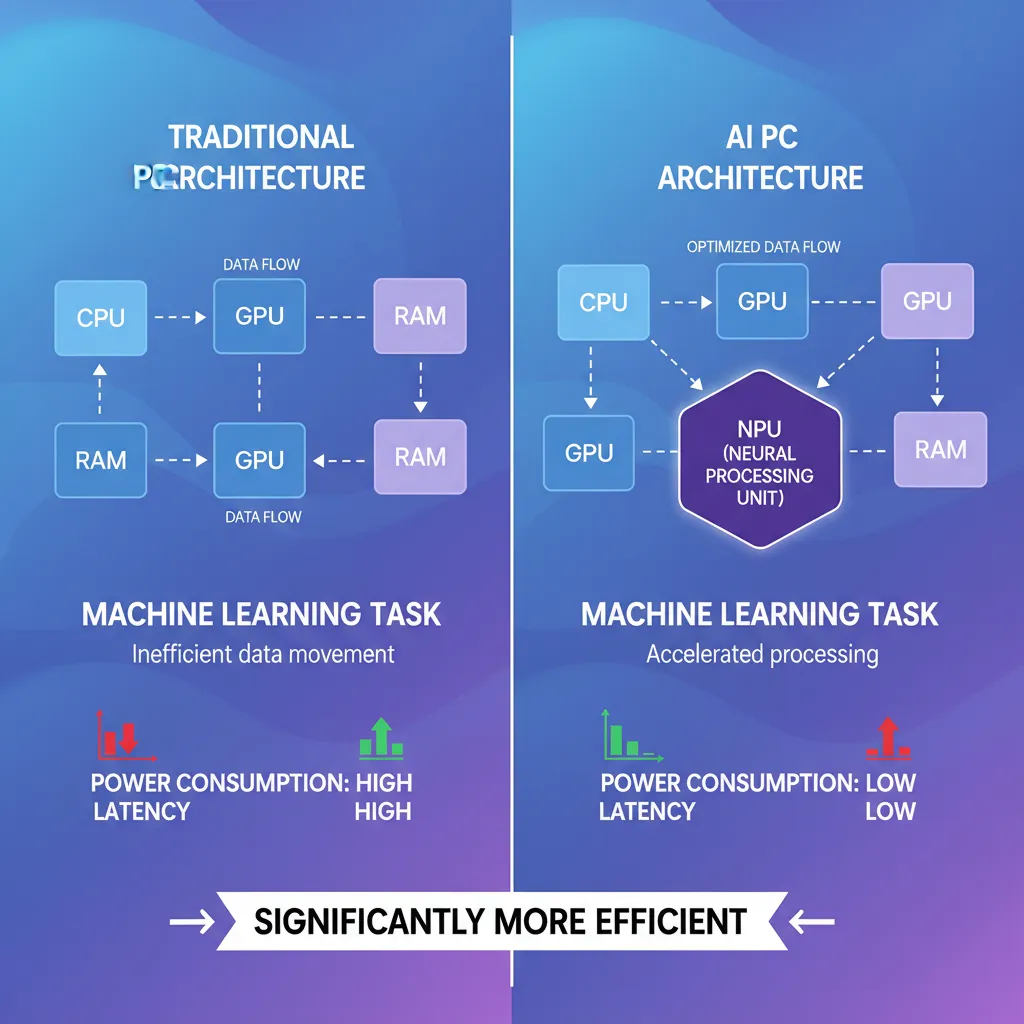
The integration of the NPU allows the PC to perform edge AI—meaning the intelligence is processed locally, on the device, rather than being shipped to and from the cloud. This has immense implications for privacy, responsiveness, and connectivity.
Why 2024 is the Tipping Point
While dedicated AI accelerators have existed for years in mobile phones (like Apple’s Neural Engine), 2024 marks the year this technology became standard in mainstream desktop and laptop AI PC processor architectures.
Major silicon manufacturers—Intel, AMD, and Qualcomm—have aggressively integrated high-performance NPUs directly into their latest generation of chips, making AI capabilities ubiquitous across the new PC fleet.
| Feature | Traditional PC (2020) | AI PC (2024+) |
|---|---|---|
| Primary AI Processing | CPU & GPU (high power draw) | Dedicated NPU (low power draw) |
| Real-Time Responsiveness | Limited by cloud latency | Instantaneous on-device AI |
| Privacy & Security | Data often sent to cloud for processing | Data stays local, enhanced security |
| Battery Life Impact | Significant power consumption during AI use | Minimal power drain due to NPU efficiency |
| Flagship Chips | Intel Core i/AMD Ryzen standard | Intel Core Ultra, AMD Ryzen AI, Qualcomm Snapdragon X Elite |
AI PC vs Regular PC: Where the Performance Gap Emerges
Understanding the architectural difference is one thing, but witnessing the performance difference is another. The gap between an AI PC vs regular PC manifests in three critical areas: efficiency, security, and specialized applications.
1. The Pursuit of Ultimate Efficiency
The NPU’s primary function isn’t just to be fast; it’s to be fast and power-efficient. When you run AI applications—even something simple like background blur on a video call—a traditional PC would rely on the CPU, severely impacting battery life.
The NPU, however, consumes a fraction of the power for the same task. This means AI PC benefits include significantly longer battery life when utilizing features like:
- Continuous Background Processes: Maintaining eye contact correction or live captions without draining power.
- Intelligent Power Management: The NPU can monitor usage patterns and manage system resources far more intelligently than a standard power regulator, leading to tangible gains in runtime for AI-powered laptops.
2. Security and Privacy on the Edge
One of the most significant implications of edge AI is enhanced security. When machine learning models run locally, sensitive data—like biometric information, document summaries, or search history—never leaves the device.
In an AI PC, the NPU can be used to run dedicated security algorithms, such as:
- Real-time Threat Detection: Identifying and neutralizing sophisticated malware or zero-day exploits much faster than traditional signature-based antiviruses.
- Secure Authentication: Handling facial recognition or fingerprint matching entirely within a secure enclave on the NPU, minimizing vulnerability.
3. Accelerated Application Performance
While a high-end GPU will still outperform an NPU for tasks like training massive language models, the NPU excels at the inference stage—which is what users actually experience daily. Applications can offload low-latency tasks to the NPU, freeing up the CPU for multitasking.
For example, many photo editing and video editing applications now include NPU-optimized features, such as automatic object detection, advanced noise reduction, or super-resolution upscaling, which are handled almost instantly by the dedicated hardware.
[Related: claude-3-5-sonnet-the-new-ai-speed-king/]
The Engine Room: Key AI PC Processors and Platforms
The rapid rise of the AI PC is not driven by software alone, but by a heated battle among silicon manufacturers to provide the best and most potent AI PC processor architecture.
Intel Core Ultra: The Meteor Lake Pioneer
Intel was among the first to fully embrace the tri-architecture philosophy, launching the Intel Core Ultra series (codenamed Meteor Lake) in late 2023. These chips were explicitly branded as the foundation for the Microsoft AI PC ecosystem.
The key innovation of the Core Ultra is the dedicated NPU block, which Intel calls the AI Boost NPU.
- Focus: Delivering efficient, sustained AI performance for Windows functions like Copilot in Windows, background blurring, and system optimization.
- Performance Metric: Intel measures NPU performance in TOPS (Tera Operations Per Second). The latest iterations are significantly increasing this figure to handle increasingly complex on-device LLMs.
AMD Ryzen AI: The XDNA Architecture
AMD quickly followed suit, integrating its proprietary XDNA NPU architecture into the AMD Ryzen AI processors (like the Ryzen 8040 series). AMD’s approach emphasizes both performance and scalability, aiming to provide a compelling blend of traditional CPU performance and cutting-edge AI capability.
- Focus: Targeting the high-performance desktop and mobile markets, ensuring their NPU can handle both professional creative loads and advanced gaming features.
- Advantage: Seamless integration with the existing Radeon graphics ecosystem, allowing for easy optimization of applications utilizing both the GPU and the NPU.
The ARM Contender: Qualcomm Snapdragon X Elite
Perhaps the most significant disruptor in the AI PC landscape is the introduction of Qualcomm’s family of chips, including the Qualcomm Snapdragon X Elite. These chips, built on the ARM architecture, are designed specifically for extreme power efficiency while delivering best-in-class NPU performance.
- Focus: Maximum efficiency and performance for thin-and-light AI-powered laptops, directly challenging the power efficiency dominance traditionally held by Apple’s M-series chips.
- Game-Changer: The Snapdragon X Elite boasts impressive TOPS figures, specifically optimized for running generative AI models directly on the device, potentially revolutionizing the AI PC price point for comparable performance.
AI PC Use Cases: Transforming Work and Play
The true value of the AI PC lies not in the specifications, but in the experiences it unlocks. AI PC applications stretch across productivity, creativity, security, and even relaxation.
Boosting Creative Workflows: AI PC for Creatives
Creative professionals are among the first to realize the massive potential of the NPU. Tasks that used to require minutes of cloud rendering or heavy GPU load can now be handled locally and instantly.
- Generative AI Integration: Running powerful text-to-image or text-to-video models (like Stable Diffusion or local LLMs) directly on the NPU, drastically cutting down on cloud subscription fees and latency.
- Video Editing Acceleration: Real-time background replacement, automatic object masking, and intelligent color grading using the NPU in software like Adobe Premiere or DaVinci Resolve.
- 3D Modeling & Design: Speeding up rendering previews and optimizing complex geometry based on user intent. The AI PC for creatives is about removing technical friction from the creative process.
Enhanced Productivity for Business: AI PC for Business
For the professional environment, the AI PC for business is a productivity powerhouse centered around intelligent automation and streamlined communication.
- Intelligent Meetings: Real-time transcription, translation, and summary generation during video conferences, all processed locally without needing a third-party server.
- Proactive Document Handling: Automatically organizing files, suggesting relevant data based on context, and running deep semantic searches across local documents.
- Dynamic Background Management: The NPU maintains perfect framing, focus, and lighting adjustment during calls, allowing users to concentrate purely on the conversation.
A New Era for AI PC for Gaming
While gaming relies heavily on the GPU, the NPU is beginning to play a crucial supporting role, especially in pushing the boundaries of realism and immersion.
- Advanced Upscaling: AI-powered upscaling techniques (like NVIDIA’s DLSS or AMD’s FSR) can run even more efficiently when the ML component is offloaded to the NPU, providing higher frame rates without loss of quality.
- Intelligent NPCs and World Generation: Future game engines will leverage the NPU to run complex AI models that govern non-player characters (NPCs) or generate procedural content in real-time, leading to more believable and dynamic game worlds.
- Adaptive Performance: The NPU monitors thermal and performance data, intelligently throttling or boosting resources to maintain optimal frame rates without user intervention.
[Related: ai-personal-growth-master-habits-unlock-potential/]
Software is the Soul: The Role of Copilot and Windows
Hardware is just the foundation; the software ecosystem is what transforms the AI PC into a truly integrated experience. Microsoft, a key driver in this revolution, is ensuring that Windows 11 is seamlessly integrated with the NPU capabilities of modern hardware.
Living on the Edge: Copilot in Windows and Real-Time Interaction
Microsoft’s Copilot in Windows is the poster child for the AI PC era. While initially, Copilot relied heavily on cloud connectivity, the latest versions leverage the NPU for core functions, ensuring real-time responsiveness.
The key features relying on on-device AI include:
- Recall and Context Search: The ability to instantly search and find content based on semantic context, regardless of whether it’s a document, an image, or a moment in a video, is powered by local indexing accelerated by the NPU.
- System-Wide Language Processing: Quick summarization of emails, dynamic creation of images, and instant text editing are handled by optimized, small LLMs running directly on the AI hardware.
- Physical Integration (The Copilot Key): The dedicated Copilot key on new AI-powered laptops signifies Microsoft’s commitment to making this AI functionality as standard as the Windows key itself.
Next-Gen Security Features Powered by the NPU
Security is perhaps the most invisible yet profound benefit of the NPU. Because the NPU is designed to perform constant, low-power monitoring, it enhances security capabilities far beyond traditional methods.
The NPU’s ability to analyze data streams (like camera feeds or microphone input) in real-time without sending that data to the cloud makes features like “Smart Presence Detection” highly effective and private. The computer can tell if you are looking at the screen or if someone is shoulder surfing, locking the display immediately, all thanks to edge AI.
This symbiotic relationship between specialized AI chips and optimized software is what separates the current generation of PCs from the past, cementing 2024 as the beginning of the future of personal computing.
The Best AI PCs 2024: Reviewing the Early Contenders
The market is rapidly filling with compelling hardware that embodies the AI PC concept. Manufacturers are racing to integrate the latest Intel, AMD, and Qualcomm chips, focusing on maximizing the AI PC features for specific user needs.
Microsoft AI PC: Setting the Standard with Surface
Microsoft’s own Surface line has historically acted as a reference design for the Windows ecosystem. The latest Surface laptops and desktops are naturally among the definitive best AI PC 2024 contenders.
- Key Focus: Deep, seamless integration with Copilot and Windows 11’s latest NPU-accelerated features.
- The Review Angle: Users looking for the purest expression of the Windows AI vision, featuring excellent touch interaction and robust security, often gravitate here.
Dell AI PC: Power and Professionalism
Dell has positioned its new Latitude (business) and XPS (premium consumer) lines to leverage the NPU primarily for professional productivity.
- Key Focus: Performance-heavy AI PC for business tasks, video conferencing enhancements, and robust battery optimization using Intel Core Ultra processors.
- The Review Angle: Dell often focuses on sophisticated cooling and premium build quality, making their devices a top choice for professionals needing reliable AI acceleration for demanding workloads.
HP AI PC: Design Meets Intelligence
HP is focusing heavily on design and user experience, embedding AI features that simplify everyday life, such as contextual power adjustments and collaboration tools.
- Key Focus: Thin, sleek designs (like the Spectre line) that maximize the NPU’s power efficiency, ensuring powerful AI tools are available on the go.
- The Review Angle: The HP AI PC models frequently score highly on aesthetics and include bespoke software that takes advantage of the NPU for features like smart camera tracking and security.
Lenovo AI PC: Enterprise and Versatility
Lenovo, with its powerhouse ThinkPad and versatile Yoga lines, has built the AI PC around enterprise readiness and innovative form factors.
- Key Focus: Enhanced enterprise security, reliability, and innovative input methods optimized for AI interactions. The Lenovo AI PC often uses the NPU to bolster BIOS and firmware security against emerging AI-driven threats.
- The Review Angle: Their integration of both Intel Core Ultra and AMD Ryzen AI options provides versatility, catering to users who prioritize durability and diverse functionality.
Understanding the AI PC Price Point and Market Trajectory
As with any major technological shift, the initial adoption phase comes with questions regarding cost. While the very first NPU-enabled laptops might have commanded a slight premium, the integration of these features is quickly becoming standard, impacting the overall AI PC price structure.
The Value Proposition
When comparing the AI PC vs regular PC, the value is no longer purely measured in clock speed or core count, but in efficiency and functionality. An AI PC saves money over time by:
- Reducing Cloud Costs: Offloading subscription-based AI tasks (transcription, summary generation) from expensive cloud services to the local NPU.
- Extending Hardware Lifespan: By distributing processing load across the CPU, GPU, and NPU, system components operate under less stress, potentially extending the machine’s viable lifespan.
Current trends show that mid-to-high-tier laptops and desktops starting around the $1,000 to $1,500 mark are routinely including NPUs. As manufacturing scales, we can expect the NPU to become standard even in budget-friendly systems, driving the future of personal computing forward aggressively.
[Related: eco-friendly-gadgets-sustainable-living-tech/]
The Future of Personal Computing: AI Everywhere
The AI PC is not the final destination; it’s merely the vessel for the next wave of technological innovation. The introduction of the NPU lays the groundwork for pervasive, context-aware computing where the operating system truly learns and adapts to the user.
Beyond the Desktop: The Generative AI Experience
As NPUs become more powerful (measured in hundreds of TOPS), they will be capable of running increasingly complex and full-featured generative models entirely locally. Imagine a time when your PC can not only summarize a document but also write a custom, professionally formatted response using your personal tone and style, all without needing an internet connection.
This push toward on-device AI is critical. While cloud AI is powerful, edge AI is personal. It allows for the creation of truly individualized experiences where privacy and personalization coexist seamlessly.
The Role of Software Developers
The success of the AI PC hinges on developers leveraging the NPU. Companies like Adobe, Blackmagic Design, and even specialized productivity startups are rapidly updating their applications to include NPU-optimized paths. This competition to deliver the best AI PC features will be the main driver of innovation over the next few years.
We are moving away from the “app-centric” view of computing and towards a “capability-centric” model, where the underlying AI fabric handles tasks automatically and intelligently. The future of personal computing is about anticipating needs, not just executing commands.
[Related: apple-intelligence-top-ai-features-coming-to-ios-18/]
Conclusion: Why the AI PC is the 2024 Game-Changer
The Rise of AI PCs in 2024 marks a defining moment in technology. It is a fundamental shift from general-purpose processing to specialized, dedicated AI acceleration, spearheaded by the Neural Processing Unit (NPU).
The transition from a standard PC to an AI PC is not just about raw speed, but about intelligent efficiency, enhanced security, and the ability to run next-generation generative AI tools locally. Whether you are a professional seeking AI PC for business benefits, a creator requiring a performance boost (AI PC for creatives), or a gamer looking for the highest fidelity, the NPU-equipped machine offers distinct advantages.
As Intel Core Ultra, AMD Ryzen AI, and Qualcomm Snapdragon X Elite chips become standard, the AI PC benefits—from longer battery life and better privacy to seamless Copilot integration—will become indispensable.
If you are considering an upgrade in the near future, prioritize a machine equipped with a dedicated NPU. This hardware is not merely a specification; it is your gateway to the future of personal computing, guaranteeing that your machine is ready to handle the accelerating demands of the AI era. The revolution is here, and the AI PC is leading the charge.
FAQs About the AI PC Revolution
Q1. What exactly is a Neural Processing Unit (NPU)?
The NPU (Neural Processing Unit) is a specialized microprocessor designed explicitly to accelerate machine learning, deep learning, and artificial intelligence workloads. It works alongside the CPU and GPU but is highly optimized for the massive parallel calculations required by AI models, delivering superior efficiency and speed for on-device AI tasks.
Q2. Are all new laptops considered AI PCs?
No. A device is generally classified as a true AI PC only if it incorporates a dedicated, high-performance Neural Processing Unit (NPU) within its primary processor. While many regular PCs can run basic AI software using their CPU or GPU, the AI PC offers dedicated AI hardware acceleration for superior performance and power efficiency.
Q3. What are the primary benefits of on-device AI?
The main benefits of on-device AI (or edge AI) include improved privacy (data stays local), instantaneous responsiveness (no cloud latency), and greater power efficiency. This enables features like real-time background noise cancellation, immediate image search, and system-wide Copilot functions without relying on a constant, fast internet connection.
Q4. How much does an AI PC cost (AI PC price)?
The AI PC price point varies widely based on specifications and brand (Dell AI PC, HP AI PC, etc.), but the core NPU technology is becoming standard across mid-to-high-range devices. Currently, most powerful AI PCs with dedicated NPUs start in the range of $1,000 to $1,500, with specialized high-end workstations costing significantly more.
Q5. Will I need to replace my current PC immediately?
If your current PC meets your needs, immediate replacement is not necessary. However, if you rely heavily on emerging generative AI tools, creative applications, or are frustrated by poor battery life during video conferencing, upgrading to an AI PC will provide significant efficiency and functionality improvements that your current hardware cannot match.
Q6. Which AI PC processor brands dominate the market?
In 2024, the market is dominated by three main chip families integrating NPUs: Intel Core Ultra (Meteor Lake), AMD Ryzen AI (Hawk Point), and the ARM-based Qualcomm Snapdragon X Elite. Each offers a distinct balance of performance and power efficiency, but all are dedicated to driving the AI PC revolution.
Q7. What are the key AI PC applications right now?
Key AI PC applications and AI PC use cases currently include intelligent search (like Windows Recall), advanced video conferencing features (eye contact, background blurring, live transcription), creative content acceleration (AI upscaling, generative fill), and highly efficient proactive security measures.