The Quantum AI Revolution: Unlocking Unprecedented Computing Power
Introduction
Imagine a world where the most complex scientific mysteries are unraveled in moments, where life-saving drugs are designed with pinpoint precision, and where global challenges like climate change are tackled with unprecedented computational power. This isn’t the distant future; it’s the promise of the quantum AI revolution, a transformative convergence of quantum computing and artificial intelligence. For decades, both fields have pushed the boundaries of what’s possible, each demonstrating incredible potential independently. Now, their synergy is poised to unlock a new frontier of innovation, redefining our understanding of problem-solving and accelerating progress across every sector imaginable.
In this deep dive, we’ll explore what makes quantum AI so revolutionary, how AI quantum computing is set to redefine processing capabilities, and the exciting realm of quantum machine learning. We’ll delve into the foundational principles that drive this fusion, examine the diverse quantum computing applications already emerging, and peer into the future of AI as it intertwines with quantum technology. Prepare to discover how this powerful alliance could usher in an era of AI innovations quantum breakthroughs, shaping the very fabric of our digital and physical world.
The Dawn of a New Era: Understanding Quantum Computing and AI
To truly grasp the magnitude of the quantum AI revolution, we must first understand the individual powerhouses driving it: quantum computing and artificial intelligence. While seemingly disparate, their combined strengths create a formidable force far greater than the sum of their parts.
Quantum Computing: Beyond Classical Limits
Classical computers, the ones we use every day, process information using bits that represent either a 0 or a 1. Quantum computers, on the other hand, operate on the mind-bending principles of quantum mechanics. Their fundamental unit of information is the qubit, which can exist in a superposition of both 0 and 1 simultaneously. Furthermore, qubits can become ‘entangled’, meaning their states are linked, even when physically separated. This phenomenon allows quantum computers to process vast amounts of information in parallel, exploring multiple possibilities concurrently.
This ability fundamentally changes how we approach certain computational problems. For specific, complex tasks—like factoring large numbers, simulating molecular structures, or solving optimization puzzles—quantum computing offers the potential for exponential speedups over even the most powerful supercomputers. It’s not about being faster at every task, but about being uniquely capable of solving problems that are intractable for classical machines. The sheer computational quantum computing power it offers could unlock scientific discoveries previously thought impossible.
Artificial Intelligence: Powering the Digital World
Artificial intelligence has already transformed our world, from personal assistants to personalized recommendations, medical diagnostics to autonomous vehicles. AI systems, particularly those powered by machine learning and deep learning, excel at identifying patterns, making predictions, and learning from data. They’ve revolutionized fields by automating complex tasks, enhancing decision-making, and enabling intelligent interactions.
However, even with its incredible advancements, classical AI faces inherent limitations. Training sophisticated deep learning models requires immense computational resources and massive datasets, consuming significant energy and time. Certain types of problems, such as optimizing highly complex systems or discovering novel chemical compounds from scratch, still push the limits of classical AI’s pattern recognition and simulation capabilities. This is where the synergy with quantum computing becomes critical.
The Synergistic Union: Why Quantum AI?
The question isn’t whether quantum AI is possible, but rather why it’s inevitable. The core idea is to leverage the unique processing capabilities of quantum mechanics to enhance and accelerate AI algorithms, while also using AI to control, optimize, and advance quantum systems themselves. This dualistic relationship is encapsulated in the concepts of AI for quantum and AI in quantum.
AI for quantum refers to using classical AI, particularly machine learning, to help design, control, and characterize quantum hardware. This includes everything from optimizing qubit gate operations and mitigating errors to developing better quantum architectures. AI in quantum, conversely, involves employing quantum computers to run AI algorithms, potentially leading to faster training times, more sophisticated models, and the ability to process data patterns that are currently beyond our reach. This mutual enhancement creates a powerful feedback loop, driving both fields forward.
Quantum Machine Learning: A Paradigm Shift
One of the most exciting frontiers in the quantum AI revolution is quantum machine learning. This emerging field explores how quantum algorithms can be used to improve machine learning tasks, ranging from data processing and pattern recognition to optimization and generative modeling.
At its heart, quantum machine learning seeks to replace or augment classical machine learning components with quantum equivalents. Imagine a quantum neural network where the “neurons” are qubits, capable of existing in multiple states simultaneously, allowing for a much richer and more complex representation of data. This could lead to:
- Faster Training:
Quantum algorithmsfor tasks like linear algebra (a cornerstone of many machine learning models) could significantly speed up the training of complex models, making it feasible to analyze even larger datasets. - Enhanced Pattern Recognition: The ability of quantum systems to process high-dimensional feature spaces could allow AI to identify subtle patterns in data that are invisible to classical algorithms.
- More Efficient Optimization: Many machine learning problems boil down to optimization tasks. Quantum algorithms, particularly quantum annealing, are inherently suited for finding optimal solutions in vast landscapes of possibilities.
- Novel Data Representations: Quantum states themselves can serve as highly compressed and expressive representations of data, potentially leading to more powerful predictive models.
Researchers are actively developing AI quantum algorithms for various machine learning applications, including classification, regression, clustering, and even deep learning. The potential for quantum computing deep learning is particularly intriguing, as it could enable the creation of models with unprecedented complexity and learning capacity.
[Related: mastering generative ai art tools trends creative futures]
Key Applications of Quantum AI: Reshaping Industries
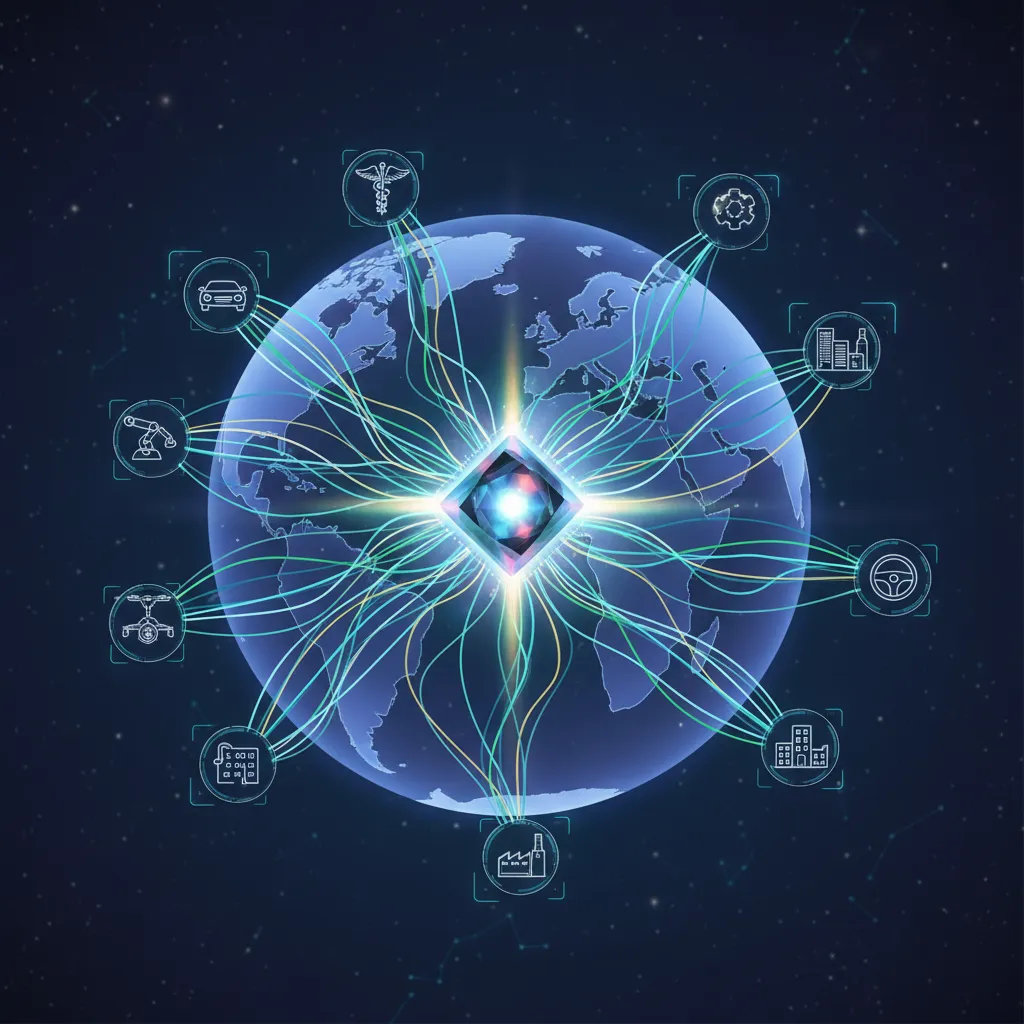
The theoretical promise of quantum AI is compelling, but its real impact will be felt in the practical applications that emerge. The quantum computing impact will resonate across numerous industries, offering quantum computing solutions to some of humanity’s most persistent and complex problems.
Healthcare and Drug Discovery
One of the most profound quantum computing applications lies in healthcare. Simulating molecular interactions with perfect accuracy is a computationally intensive task for classical computers due to the quantum nature of atoms and molecules. Quantum AI can revolutionize:
- Drug Discovery: By accurately simulating molecular structures and interactions, quantum computers can rapidly screen billions of potential drug compounds, identifying the most promising candidates for treating diseases. This could dramatically cut down the time and cost of bringing new medicines to market.
- Personalized Medicine: Analyzing complex genomic and proteomic data to tailor treatments to an individual’s unique biological makeup.
Quantum machine learningcan identify subtle biomarkers for disease predisposition and treatment response. - Protein Folding: Solving the intricate problem of how proteins fold, which is crucial for understanding diseases like Alzheimer’s and Parkinson’s.
Financial Modeling and Optimization
The financial sector, with its reliance on complex data analysis and risk assessment, is ripe for quantum AI disruption.
- Portfolio Optimization:
Quantum algorithmscan process vast financial datasets to construct optimal investment portfolios that balance risk and return more effectively than classical methods. - Fraud Detection: Identifying sophisticated patterns of fraudulent activity in real-time.
- Algorithmic Trading: Developing more advanced and adaptive trading strategies.
- Risk Assessment: More accurately modeling complex financial derivatives and market fluctuations.
Materials Science
Designing novel materials with specific properties, such as superconductors or highly efficient catalysts, is a painstaking process of trial and error. Quantum AI can accelerate this by:
- Simulating Material Properties: Precisely predicting how materials will behave at the atomic level, leading to the development of lighter, stronger, or more conductive materials for everything from aerospace to electronics.
- Catalyst Discovery: Identifying new catalysts for industrial processes, making them more efficient and environmentally friendly.
Logistics and Supply Chain
Optimization problems are central to logistics, and quantum AI offers a powerful toolkit.
- Route Optimization: Finding the most efficient routes for delivery networks, reducing fuel consumption and delivery times.
- Resource Allocation: Optimizing the distribution of resources in complex supply chains to prevent bottlenecks and minimize waste.
Enhanced Cybersecurity
While quantum computing poses a potential threat to current encryption methods (see AI ethics quantum considerations), it also offers solutions:
- Quantum-Resistant Cryptography: Developing new encryption algorithms that are impervious to quantum attacks, securing our digital future.
- Quantum Key Distribution (QKD): A method of secure communication that leverages quantum mechanics to detect any eavesdropping attempts.
The Road Ahead: Challenges and Breakthroughs in Quantum AI
The quantum AI revolution is undoubtedly exciting, but it’s important to acknowledge that it is still in its nascent stages. Significant quantum computing challenges remain, even as quantum computing breakthroughs continue to push the boundaries of what’s possible.
Navigating the Obstacles
- Hardware Stability and Error Correction: Qubits are incredibly fragile and prone to decoherence, where their quantum state collapses due to interaction with the environment. Building stable, fault-tolerant
AI quantum hardwareis a monumental engineering challenge. Error correction in quantum systems is far more complex than in classical computers. - Scalability: Current quantum computers typically have a limited number of qubits. Scaling these machines to hundreds or thousands of stable, interconnected qubits, which would be necessary for truly revolutionary
AI quantum computing, is a major hurdle. - Software Development: The unique nature of quantum programming requires new paradigms and tools. The field of
quantum software developmentis rapidly evolving, but user-friendly frameworks and languages are still maturing. - Talent Gap: There’s a significant shortage of experts proficient in both quantum mechanics and AI. Bridging this talent gap is crucial for accelerating
AI research quantumefforts and translating theoretical advancements into practical applications. - Cost and Accessibility: Quantum computers are incredibly expensive to build and operate, limiting their accessibility to a select few research institutions and large corporations. Efforts are underway to develop
quantum computing solutionsthat are more accessible, such as cloud-based quantum services.
Recent Quantum Computing Breakthroughs
Despite the challenges, the pace of innovation is rapid, leading to encouraging quantum computing breakthroughs:
- Improved Qubit Coherence: Scientists are continually extending the coherence times of qubits, allowing them to maintain their quantum state for longer periods.
- Hybrid Architectures: The development of
hybrid quantum AImodels, which combine classical computing power with quantum co-processors, is allowing for the exploration of real-world problems even with today’s noisy, intermediate-scale quantum (NISQ) devices. - Advancements in
AI Quantum Hardware: Companies are making strides in developing various qubit technologies, including superconducting qubits, trapped ions, and photonic qubits, each with its own advantages and challenges. - Growth of
Quantum Computing Startups: A vibrant ecosystem ofquantum computing startupsis emerging, driving innovation in both hardware and software, and focusing on specificquantum computing commercialapplications. These companies are attracting significant investment and talent, accelerating the transition from lab to industry. [Related: the depin revolution building tomorrows decentralized physical infrastructure]
The Future of AI and Quantum Technology
The AI and quantum future is not merely a hypothetical scenario but an unfolding reality that promises to reshape every facet of human endeavor. As quantum computing trends continue their upward trajectory, driven by increasing investment and groundbreaking AI innovations quantum, we can expect profound shifts in how we approach science, technology, and even daily life.
The quantum computing future suggests a landscape where AI in scientific discovery is dramatically accelerated. Researchers will leverage AI-powered quantum simulations to model complex biological systems, understand fundamental physics, and develop new materials at an unprecedented pace. This could lead to cures for diseases currently considered incurable, clean energy solutions, and even a deeper understanding of the universe itself. Imagine AI research quantum pushing the boundaries of material science, leading to batteries that charge in seconds and last for weeks, or entirely new forms of sustainable energy.
Beyond scientific research, the integration of artificial intelligence quantum capabilities will trickle down into commercial applications. Industries like finance, logistics, and manufacturing will find quantum computing solutions to their most challenging optimization problems, leading to greater efficiency, reduced waste, and more resilient systems. Quantum software development will become a critical skill, enabling a new generation of developers to build applications that harness this immense power.
However, with great power comes great responsibility. The AI ethics quantum discussion is paramount. We must proactively address questions of access, ensuring that the benefits of quantum AI are shared equitably and don’t exacerbate existing inequalities. Furthermore, the potential for quantum computing impact on cybersecurity requires careful consideration, demanding the development of robust quantum-resistant cryptographic standards to protect our digital infrastructure. Issues such as potential job displacement due to advanced automation powered by quantum AI also need thoughtful societal planning and policy responses.
Hybrid Approaches: Bridging the Classical-Quantum Divide
While the vision of large-scale, fault-tolerant quantum computers is compelling, the reality of current quantum computing challenges means that hybrid quantum AI approaches are likely to be the dominant paradigm for the foreseeable future. These hybrid quantum AI models combine the strengths of classical and quantum computing, allowing each to handle the tasks they are best suited for.
In a hybrid quantum AI architecture, a classical computer often acts as the orchestrator, managing data, performing pre-processing, and executing parts of an algorithm that are well-suited for classical processing. When a computationally intensive sub-routine that leverages quantum principles is required, the task is offloaded to a quantum computer as a co-processor. The results from the quantum computation are then fed back to the classical system for further processing.
This approach offers several distinct advantages:
- Leveraging Existing Infrastructure: It allows researchers and companies to begin experimenting with
AI-powered quantumsolutions without waiting for the perfect, fully fault-tolerant quantum computer. - Mitigating Quantum Limitations: Classical computers can handle the error correction, control, and data management aspects that are still challenging for current quantum devices.
- Gradual Adoption: It provides a pathway for
quantum computing commercialapplications to emerge, even with the relatively noisy and limited qubits available today. Companies can iteratively integrate quantum components into their existing AI workflows, gradually increasing quantum involvement as the technology matures. - Optimizing Resource Usage: By selectively using quantum resources for tasks where they provide a provable advantage,
hybrid quantum AIensures efficient use of precious and expensive quantum computing time.
Examples of hybrid quantum AI include using quantum variational algorithms to optimize parameters for classical neural networks or employing quantum sampling techniques to enhance generative AI models. This pragmatic approach is paving the way for the gradual but inevitable integration of quantum technology into mainstream AI in advanced computing.
[Related: guardians digital frontier ai revolutionizing cybersecurity]
Conclusion
The quantum AI revolution represents a pivotal moment in human history, merging the boundless potential of quantum mechanics with the transformative power of artificial intelligence. From quantum machine learning promising faster, more insightful analyses to quantum computing applications that could redefine healthcare, finance, and materials science, the synergistic potential of AI quantum computing is staggering. We stand at the precipice of an era where previously intractable problems might finally yield to the unprecedented computing power unlocked by this fusion.
While significant quantum computing challenges remain, the relentless pace of quantum computing breakthroughs and the emergence of hybrid quantum AI solutions demonstrate that this revolution is well underway. As AI and quantum future unfolds, it promises not just technological advancement, but a fundamental shift in our capacity for innovation and discovery. By embracing proactive AI ethics quantum discussions and fostering collaboration across scientific and industrial fronts, we can ensure that this revolution serves humanity’s highest good. The journey into AI in advanced computing is just beginning, and the quantum AI revolution is set to be its most exciting chapter yet.
FAQs
Q1. What is the primary difference between classical AI and quantum AI?
Classical AI relies on traditional bits (0 or 1) and algorithms designed for sequential processing, excelling at pattern recognition and data analysis. Quantum AI leverages qubits and quantum phenomena like superposition and entanglement, enabling it to process information in fundamentally different ways, potentially leading to exponential speedups for specific, complex computational tasks and novel ways of representing data that classical AI cannot achieve.
Q2. How will quantum AI impact everyday life?
While not immediately affecting daily tasks like browsing the internet, quantum AI will have a profound indirect impact. It will accelerate the discovery of new drugs and materials, lead to more efficient energy solutions, enhance cybersecurity, and optimize logistics, ultimately improving healthcare, making products better, and solving large-scale societal challenges that benefit everyone.
Q3. What are the main challenges to widespread quantum computing adoption for AI?
Key quantum computing challenges include the instability and error-proneness of qubits (decoherence), the difficulty in scaling quantum computers to a large number of stable qubits, the complexity of quantum software development, and the high cost of AI quantum hardware. Overcoming these requires significant research, engineering, and investment.
Q4. Can quantum computers truly learn faster than classical computers?
For certain types of learning tasks and specific AI quantum algorithms, quantum computers theoretically offer exponential speedups in processing complex data and performing optimization, which are core to machine learning. This doesn’t mean they are universally faster, but for highly specific and challenging quantum machine learning problems, they hold the potential to learn far more efficiently.
Q5. What industries are most likely to benefit first from quantum machine learning?
Industries dealing with complex optimization problems and molecular simulations are poised to benefit first. This includes healthcare and pharmaceuticals (drug discovery, personalized medicine), finance (portfolio optimization, risk assessment), materials science (designing new materials), and logistics (supply chain optimization).
Q6. Is quantum AI a threat to current encryption methods?
Yes, quantum computing has the potential to break many of the widely used public-key encryption methods that secure our digital communications today (e.g., RSA and ECC). This is a significant concern addressed by AI ethics quantum discussions. However, researchers are actively developing quantum-resistant cryptography to safeguard against this future threat, ensuring our data remains secure.
[Related: unlock potential top ai tools everyday productivity]