The DePIN Revolution: Building Tomorrow’s Decentralized Physical Infrastructure

Introduction
Imagine a world where the internet isn’t controlled by a handful of corporations, but by millions of individuals. A world where your personal data, your connectivity, and even your energy supply are managed by a distributed network of peers, not centralized entities. This isn’t a distant sci-fi fantasy; it’s the audacious vision behind Decentralized Physical Infrastructure Networks, or DePIN.
The internet has evolved in waves. From the static web to the dynamic, user-generated content of Web2, we’re now on the cusp of Web3 – a decentralized, open, and user-owned internet. While much of the Web3 conversation has focused on digital assets, DeFi, and NFTs, the underlying physical infrastructure that powers our digital lives remains largely centralized. This is where DePIN steps in, poised to ignite a revolution by bringing the principles of blockchain and decentralization to the very real, tangible world of physical infrastructure.
In this comprehensive guide, we’ll dive deep into what is DePIN, exploring how DePIN works, its profound advantages, and the diverse DePIN use cases that are already shaping our future. We’ll examine prominent DePIN projects and discuss the future of DePIN, offering insights for anyone looking to invest in DePIN or simply understand this groundbreaking web3 infrastructure paradigm. Prepare to discover how these decentralized physical infrastructure networks are not just a technological innovation, but a fundamental shift in how we build, own, and interact with the physical world around us.
What Exactly is DePIN? Demystifying Decentralized Physical Infrastructure Networks
At its core, DePIN stands for Decentralized Physical Infrastructure Networks. It represents a paradigm shift from traditional, centrally managed infrastructure to a model where physical infrastructure is built, maintained, and operated by a distributed community of individuals or organizations. Think of it as crowdfunding meets crowd-building for real-world assets.
Traditionally, large corporations or governments own and operate critical infrastructure like telecommunications networks, data centers, and energy grids. While these systems are robust, they often come with drawbacks: high costs, single points of failure, lack of transparency, and limited accessibility. The DePIN revolution seeks to address these issues by leveraging blockchain physical infrastructure and token incentives.
In essence, dePIN explained boils down to this:
- Physical Infrastructure: This refers to tangible assets like Wi-Fi hotspots, data storage devices, energy meters, IoT sensors, or even electric vehicle charging stations.
- Decentralized: Instead of a single entity controlling these assets, they are owned and operated by a vast network of independent participants.
- Networks: These individual contributions are coordinated and incentivized through a blockchain or distributed ledger technology.
The result is a more resilient, efficient, and community-driven approach to building and scaling essential services. This isn’t just about digital assets; it’s about real-world assets DePIN, where physical resources are tokenized and managed on a blockchain, creating crypto physical networks that are transparent and auditable.
How DePIN Works: A Deeper Dive into Tokenized Infrastructure
Understanding how DePIN works is key to grasping its revolutionary potential. The magic happens through a combination of hardware, blockchain technology, and carefully designed economic incentives, often referred to as tokenized infrastructure.
The process typically unfolds in these steps:
-
Hardware Deployment: Individuals or entities deploy specific hardware devices – these could be Wi-Fi routers, storage drives, GPS trackers, or energy sensors – contributing their resources to a network. For example, a person might set up a small weather station in their backyard, contributing local climate data.
-
Data & Service Contribution: This hardware actively collects data (e.g., location data, environmental readings, internet bandwidth usage) or provides a service (e.g., decentralized storage, wireless connectivity). This data or service is then fed into the decentralized network.
-
Verification on Blockchain: The crucial step is verification. The network, leveraging
blockchain physical infrastructure, uses cryptographic proofs and consensus mechanisms to verify the authenticity and quality of the contributed data or service. This ensures that participants are providing valid and useful contributions, preventing fraud and maintaining network integrity. -
Token Incentives: Once contributions are verified, participants are rewarded with
DePIN cryptotokens. These tokens serve multiple purposes:- Incentivization: They encourage individuals to deploy hardware and contribute resources. The more valuable their contribution, the more tokens they earn.
- Governance: Token holders often have a say in the network’s future development and parameters.
- Utility: Tokens can be used to pay for services within the network or traded on exchanges.
-
Network Growth & Utility: As more participants join and contribute, the network’s coverage, capacity, and resilience grow. This creates a powerful flywheel effect: increased utility attracts more users and developers, which further incentivizes contributors, expanding the network even more.
 Abstract visualization of data flow in a decentralized network, illustrating how individual nodes contribute to a larger, cohesive system.
This model creates a stark contrast to DePIN vs traditional infrastructure. Instead of a top-down, centralized approach where a single company builds and operates, DePIN fosters a bottom-up, community-driven ecosystem. This is the essence of dePIN technology at play.
Key Pillars of the DePIN Ecosystem
The flourishing DePIN ecosystem is built upon several foundational principles that distinguish it from conventional infrastructure models. These pillars ensure its resilience, efficiency, and fairness:
-
Decentralization: This is the bedrock. No single entity controls the network. Power is distributed among participants, making the system resistant to censorship, single points of failure, and monopolistic practices. This distributed ownership also fosters innovation, as anyone can contribute to the network’s growth.
-
Verifiability and Transparency: All transactions, contributions, and rewards are recorded on a public blockchain. This inherent transparency allows anyone to audit the network’s operations, ensuring fairness and preventing manipulation. Cryptographic proofs verify the integrity of the data and services provided.
-
Incentive Alignment: The token economic model is designed to align the interests of all participants. Contributors are rewarded for providing valuable resources, while users benefit from affordable and robust services. This creates a virtuous cycle where network growth directly benefits its community.
-
Community Ownership and Governance: Many DePIN projects empower their token holders with governance rights, allowing them to vote on important decisions regarding the network’s development, treasury management, and future direction. This collective ownership fosters a sense of responsibility and commitment among participants.
-
Real-World Utility: Unlike some blockchain projects that remain purely theoretical, DePIN is inherently tied to tangible, real-world applications. It directly addresses the need for better, more accessible, and more resilient physical infrastructure, making its value proposition clear and immediate.
The Transformative Power of DePIN: Unpacking Its Advantages
The shift to decentralized physical infrastructure networks isn’t just a technical novelty; it offers compelling advantages that could reshape industries and improve lives globally. These DePIN advantages are what make the revolution so potent:
1. Enhanced Resilience and Redundancy
Traditional centralized infrastructure is vulnerable to single points of failure. A server outage, a natural disaster, or a cyber-attack can cripple entire systems. DePIN, by contrast, distributes operations across thousands or millions of independent nodes. If one node fails, the network reroutes, ensuring continuous service. This inherent redundancy makes DePIN networks far more resilient and robust.
2. Lower Costs and Increased Accessibility
Building and maintaining traditional infrastructure is incredibly capital-intensive, often requiring massive investments from corporations or governments. DePIN significantly reduces these upfront costs by leveraging existing resources and incentivizing individual contributions. This “crowd-sourced” model can lead to cheaper services for end-users and expand access to infrastructure in underserved areas. Imagine cheaper, more ubiquitous internet access in remote regions, or more affordable data storage for small businesses.
3. Fostering Innovation and Competition
By lowering the barrier to entry, DePIN encourages innovation. Developers and entrepreneurs can build new services and applications on top of existing decentralized networks without needing to establish their own costly infrastructure. This creates a dynamic marketplace, fostering competition and driving continuous improvement, which is often stifled in monopolistic traditional infrastructure sectors.
4. Greater Transparency and Trust
The blockchain foundation of DePIN ensures transparency. All network activities, from data contribution to token rewards, are recorded on an immutable ledger. This eliminates the need for trusted intermediaries and allows anyone to verify the network’s operations, building a higher degree of trust among participants and users.
5. Empowering Individuals and Communities
DePIN democratizes infrastructure ownership. Instead of being passive consumers, individuals can become active participants, contributing resources and earning rewards. This empowers communities, giving them a direct stake in the infrastructure that serves them and providing new avenues for economic participation. It’s a move towards a more equitable distribution of wealth and resources.
DePIN in Action: Real-World Use Cases and Prominent Projects
The theory behind DePIN is compelling, but its true power is best understood through its practical applications. DePIN use cases are incredibly diverse, spanning across multiple industries and laying the groundwork for a truly decentralized digital and physical world. Here are some of the most impactful DePIN applications and projects:
1. Decentralized Wireless Networks (e.g., Helium DePIN)
One of the most well-known DePIN projects is Helium DePIN. Helium aims to build a global, decentralized wireless network for IoT devices, and increasingly, for 5G connectivity. Individuals purchase and deploy “Hotspots” (specialized routers) that provide network coverage. In return, they earn Helium’s native crypto token. This has allowed Helium to rapidly deploy a massive network with significantly lower costs than traditional telecom providers.
2. Decentralized Storage Networks (e.g., Filecoin DePIN)
Data storage is another critical area ripe for decentralization. Filecoin DePIN allows users to rent out their unused hard drive space to others, forming a global, decentralized storage marketplace. This provides a more resilient, censorship-resistant, and often more affordable alternative to centralized cloud storage providers like AWS or Google Cloud. Data is encrypted and sharded across multiple nodes, enhancing security and privacy. [Related: The Quantum Leap: How Quantum Computing Will Reshape Our Future]
3. Decentralized Mapping and Geospatial Data (e.g., Hivemapper DePIN)
Imagine a real-time, globally updated map built by a community. Hivemapper DePIN is doing just that. Users attach specialized dashcams to their vehicles, collecting street-level imagery and mapping data as they drive. This data is then used to create a decentralized map, and contributors are rewarded with HONEY tokens. This approach offers a constantly refreshed, community-verified mapping solution that can challenge traditional mapping services.
4. Decentralized Compute and Rendering (e.g., Render Network DePIN)
High-performance computing, especially for graphics rendering and AI model training, requires immense processing power. The Render Network DePIN allows users with powerful GPUs to contribute their idle compute power to a decentralized network. Artists, studios, and AI developers can then tap into this collective compute resource for demanding tasks, often at a lower cost than centralized alternatives. This is a prime example of leveraging web3 infrastructure for intensive computational needs.
5. Decentralized Energy Grids
While still emerging, decentralized energy grids are a promising DePIN use case. Projects in this space aim to create peer-to-peer energy markets where individuals with solar panels or other renewable energy sources can sell excess energy directly to their neighbors. This can reduce reliance on centralized power companies, make grids more resilient, and accelerate the transition to sustainable energy.
6. Decentralized VPNs and Content Delivery Networks (CDNs)
DePIN can also power privacy-focused services. Decentralized VPNs leverage a global network of community-run nodes to route internet traffic, enhancing user privacy and circumventing censorship. Similarly, decentralized CDNs can store and deliver content closer to users, improving website performance and reducing reliance on centralized cloud providers.
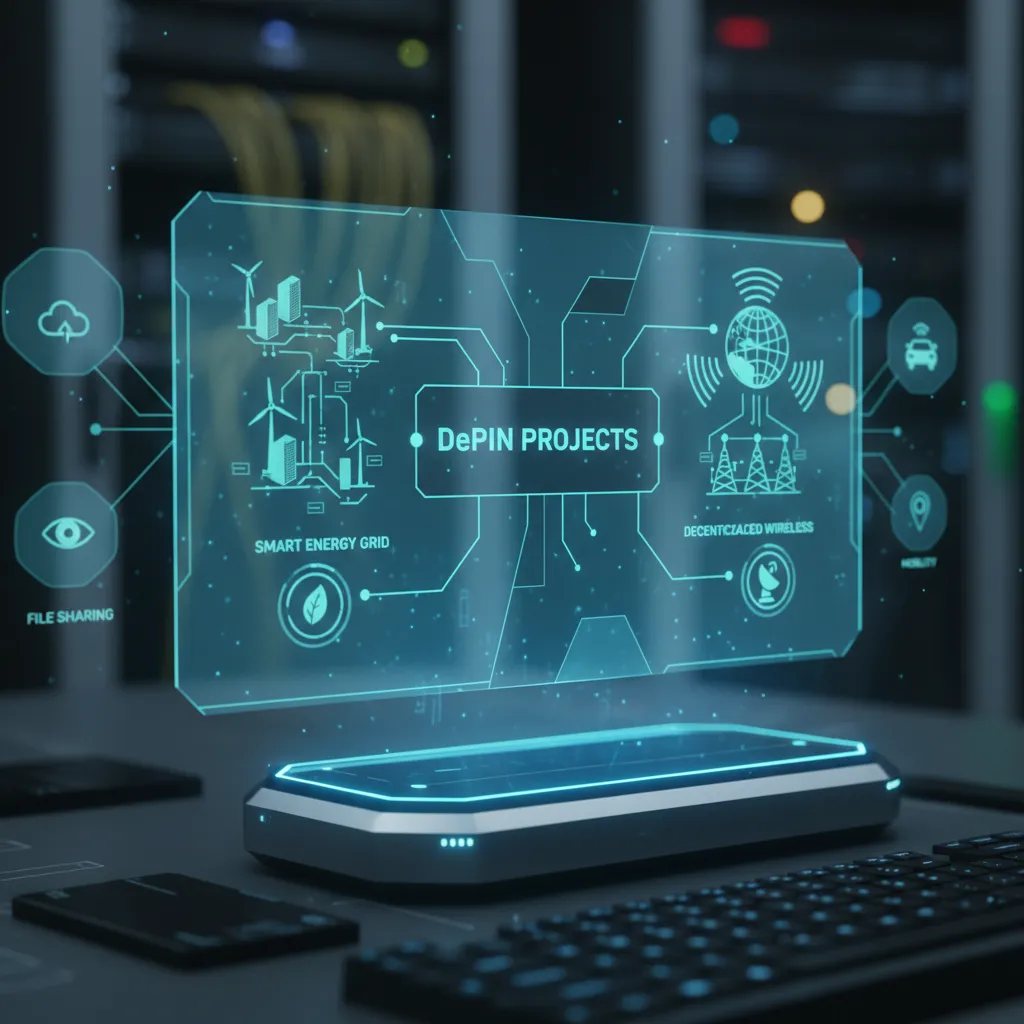 Holographic interface showing DePIN projects and applications, highlighting the vast array of possibilities within the decentralized infrastructure space.
These examples barely scratch the surface of the full potential of DePIN applications. From environmental sensing to supply chain tracking, the ability to build and monetize physical infrastructure in a decentralized manner opens up a world of possibilities.
Investing in the Future: Navigating the DePIN Landscape
The growth of DePIN has captured the attention of investors and innovators alike, making invest in DePIN a hot topic. The DePIN market cap has seen significant growth, and many believe it represents one of the most promising sectors within the broader crypto physical networks landscape. However, like any emerging technology, DePIN investment guide requires careful consideration.
Understanding DePIN Investment Potential
The appeal of DePIN for investors stems from several factors:
- Real-World Utility: Unlike speculative digital assets, DePIN projects are tied to tangible, real-world services. This provides an inherent value proposition that can be easier to understand and evaluate.
- Massive Market Size: The markets DePIN aims to disrupt – telecommunications, storage, energy, logistics – are multi-trillion-dollar industries. Even a small penetration into these markets could lead to substantial growth.
- Early Stage Growth: Many
DePIN projectsare still relatively nascent, offering potentially significant upside for early investors. Thebest DePIN projects 2024are those demonstrating clear use cases, strong community support, and robust technology. - Tokenomics: Well-designed tokenomics that align incentives for contributors and users can create sustainable growth models for these networks.
Key Factors to Consider for DePIN Investments
Before you invest in DePIN crypto or DePIN projects, it’s crucial to conduct thorough due diligence:
-
Project’s Core Technology and Team:
- Does the project have a viable technical solution?
- Is the team experienced and transparent?
- What is their roadmap for future development?
-
Use Case and Market Opportunity:
- Does the project address a real-world problem with a significant market?
- Is there demonstrable demand for its decentralized service?
- How does it compare to traditional and other decentralized competitors?
-
Tokenomics and Incentives:
- Is the token design sustainable?
- Are incentives aligned for both providers and consumers of the service?
- What is the inflation schedule and utility of the token?
-
Community and Adoption:
- Does the project have an active and engaged community?
- Is there a growing number of participants deploying hardware or using the service?
- Are there partnerships or integrations with other Web3 or traditional companies?
-
Regulatory Landscape:
- The regulatory environment for
crypto physical networksis still evolving. Understand the potential risks and how the project plans to navigate them.
- The regulatory environment for
Remember, investing in any cryptocurrency or blockchain project carries significant risk. It’s essential to do your own research, understand your risk tolerance, and never invest more than you can afford to lose. [Related: AI Unleashed: Revolutionizing Money & Smart Personal Finance]
 Secure ledger with tokenized physical assets, illustrating the foundational blockchain technology behind DePIN that ensures transparency and immutability.
Challenges and the Road Ahead for DePIN
While the promise of the DePIN revolution is immense, the journey ahead is not without its challenges. Addressing these hurdles will be critical for the future of DePIN and its widespread adoption.
1. Scalability and Performance
As DePIN networks grow, they must be able to handle an increasing volume of data and transactions without compromising speed or efficiency. Ensuring that blockchain physical infrastructure can scale to meet global demand for services like high-bandwidth internet or real-time mapping data is a significant technical challenge. Innovations in layer-2 solutions and more efficient blockchain architectures will be key.
2. User Experience and Adoption
For DePIN to reach mainstream users, the onboarding process for both contributors and consumers needs to be simplified. Setting up hardware, managing tokens, and interacting with decentralized applications can be complex for non-technical users. Projects must focus on intuitive interfaces and seamless experiences to drive broader adoption.
3. Regulatory Uncertainty
The regulatory landscape for decentralized physical infrastructure networks is still nascent and varies significantly across jurisdictions. Clarity on issues like token classification, data privacy, and compliance with existing infrastructure regulations will be crucial for institutional adoption and broader market acceptance. Projects will need to adapt to evolving legal frameworks.
4. Security and Trust
While blockchain offers inherent security advantages, the integration of physical hardware introduces new vectors for potential vulnerabilities. Ensuring the integrity of data collected by sensors, preventing hardware tampering, and securing the overall network from malicious attacks are ongoing challenges that DePIN projects must constantly address.
5. Competition with Traditional Giants
DePIN projects are often competing with well-established, well-funded traditional infrastructure providers. Overcoming brand loyalty, entrenched market positions, and the sheer scale of existing operations will require superior technology, compelling economics, and strong community building.
Despite these challenges, the trajectory for DePIN is overwhelmingly positive. The continuous innovation in DePIN technology, the growing interest from both retail and institutional investors, and the undeniable advantages of decentralization are powerful tailwinds. The DePIN ecosystem is expanding rapidly, attracting brilliant minds and significant capital. As these networks mature, they are poised to deliver on the promise of a more open, resilient, and equitable infrastructure for everyone. The future of DePIN looks bright, charting a course towards a world where our physical infrastructure is as decentralized and empowering as the internet itself.
Conclusion
The DePIN revolution represents a pivotal moment in the evolution of technology, bridging the digital realm of Web3 with the tangible world of physical infrastructure. By leveraging blockchain physical infrastructure and robust token economies, decentralized physical infrastructure networks are redefining how essential services like connectivity, storage, energy, and mapping are built, owned, and operated.
From the widespread coverage provided by Helium DePIN to the secure, distributed storage of Filecoin DePIN and the community-driven mapping of Hivemapper DePIN, we’ve seen how DePIN projects are already delivering on the promise of a more resilient, cost-effective, and accessible future. The DePIN advantages are clear: enhanced redundancy, reduced costs, fostered innovation, increased transparency, and greater empowerment for individuals and communities.
As the DePIN ecosystem matures, addressing challenges like scalability, user experience, and regulatory clarity will be crucial. However, the momentum behind DePIN technology is undeniable, signaling a transformative shift from centralized monopolies to a future where crypto physical networks are built by the many, for the many.
This isn’t just about investing in a new DePIN crypto token; it’s about investing in a fundamental change in how our world works. It’s about participating in the creation of infrastructure that is more equitable, more robust, and truly serves the public good. The DePIN revolution isn’t coming; it’s already here, building tomorrow’s decentralized physical infrastructure, one node at a time. The question isn’t whether it will succeed, but how quickly you’ll join in shaping its future.
FAQs
Q1. What is DePIN crypto?
DePIN crypto refers to the native cryptocurrencies or tokens used within Decentralized Physical Infrastructure Networks (DePINs). These tokens serve multiple purposes, including incentivizing participants to contribute physical resources (like Wi-Fi coverage or storage space), paying for services within the network, and often granting governance rights to token holders.
Q2. How do DePIN projects generate revenue?
DePIN projects primarily generate revenue from the utility fees charged for using the decentralized infrastructure they provide. For example, a decentralized storage network might charge users for storing their data, or a decentralized wireless network might charge for data usage. A portion of these fees can go to the network’s treasury, with another portion often used to buy back and burn tokens, or to reward network contributors.
Q3. What are the main risks associated with investing in DePIN?
Investing in DePIN carries risks such as technological immaturity, regulatory uncertainty in various jurisdictions, intense competition from traditional infrastructure providers, potential for security vulnerabilities in hardware or software, and the risk of insufficient adoption or network growth. Token price volatility is also a significant factor.
Q4. Is DePIN part of Web3?
Yes, DePIN is considered a crucial component of Web3. While Web3 traditionally focuses on decentralized digital applications and assets, DePIN extends these principles to the physical world, providing the real-world infrastructure layer necessary to support a truly decentralized internet. It bridges the gap between blockchain technology and tangible assets.
Q5. What distinguishes DePIN from IoT?
While both DePIN and the Internet of Things (IoT) involve interconnected physical devices, DePIN specifically focuses on decentralizing the ownership, operation, and incentivization of these devices through blockchain. IoT primarily deals with the technology of connecting devices and collecting data, often in a centralized manner. DePIN leverages IoT devices but integrates them into a cryptoeconomic model for distributed infrastructure.
Q6. What are “real-world assets DePIN”?
“Real-world assets DePIN” refers to the concept of tokenizing and managing tangible physical infrastructure assets on a blockchain, enabling their decentralized operation and ownership. This includes things like telecom towers, energy grids, data centers, and even sensors, all of which generate real-world value and can be represented as digital tokens within a DePIN ecosystem.
Q7. What is the potential impact of DePIN on traditional industries?
DePIN has the potential to profoundly disrupt traditional industries by offering more efficient, cost-effective, and resilient alternatives to centralized infrastructure. It could lead to lower service costs, increased innovation, greater accessibility, and a more equitable distribution of infrastructure ownership, challenging the long-standing monopolies in sectors like telecommunications, cloud computing, and energy.