SLMs Explained: The Future of On-Device AI

Introduction: Why Size Matters in the Age of AI
For the last few years, the world has been captivated by the sheer power and capability of Large Language Models (LLMs) like GPT-4 and Claude. These behemoths, with hundreds of billions of parameters, run in massive data centers, requiring huge amounts of energy and infrastructure. They’ve defined the current era of artificial intelligence, but they represent only half of the story.
The other half is arguably more impactful for the average person: the rise of Small Language Models (SLMs).
SLMs are the quiet engine of the next generation AI. These lightweight AI models are fundamentally changing how we interact with technology by bringing advanced intelligence directly to our devices—smartphones, laptops, cars, and even small IoT sensors. This shift from cloud-based processing to on-device AI is not just an optimization; it’s a revolution in speed, privacy, and accessibility.
This comprehensive guide will explain what is an SLM, how they differ from their larger siblings (SLM vs LLM), the core benefits of SLMs, and how technology giants like Microsoft (with Microsoft Phi-3) and Google (with Google Gemma) are leading the charge in deploying powerful yet efficient AI directly into your hands. Prepare to explore the frontier of local AI models and discover why SLMs are the foundational layer for the future of artificial intelligence.
What Exactly Are Small Language Models (SLMs)?
At its core, a Small Language Model (SLM) is a type of neural network designed specifically for efficiency. While there is no strict industry definition for the parameter count, SLMs are generally considered models that possess anywhere from a few hundred million parameters up to around 10 billion.
The primary goal of an SLM is not to achieve state-of-the-art general intelligence across every possible task—a domain still dominated by LLMs. Instead, the focus is on achieving high performance on a specific subset of tasks while maintaining an exceptionally small footprint and low computational requirement.
Defining the SLM Advantage
SLMs are highly optimized, which translates into several defining characteristics:
- Compact Neural Networks: They use fewer layers and parameters than LLMs, making the overall model size dramatically smaller (often in the gigabytes or even megabytes, compared to the terabytes required for some LLMs).
- Efficient AI Models: Their smaller size leads to significantly faster inference times (the time it takes the model to generate a response), enabling real-time AI processing that is impossible for cloud-dependent LLMs.
- Local Deployment: They are designed to run directly on consumer hardware—including AI on mobile devices, laptops, and specialized chips—making them ideal for embedded AI systems and AI for IoT.
This efficiency is paramount for bringing the power of natural language processing (NLP) out of the cloud and into the real world, addressing critical issues like latency, cost, and data security.
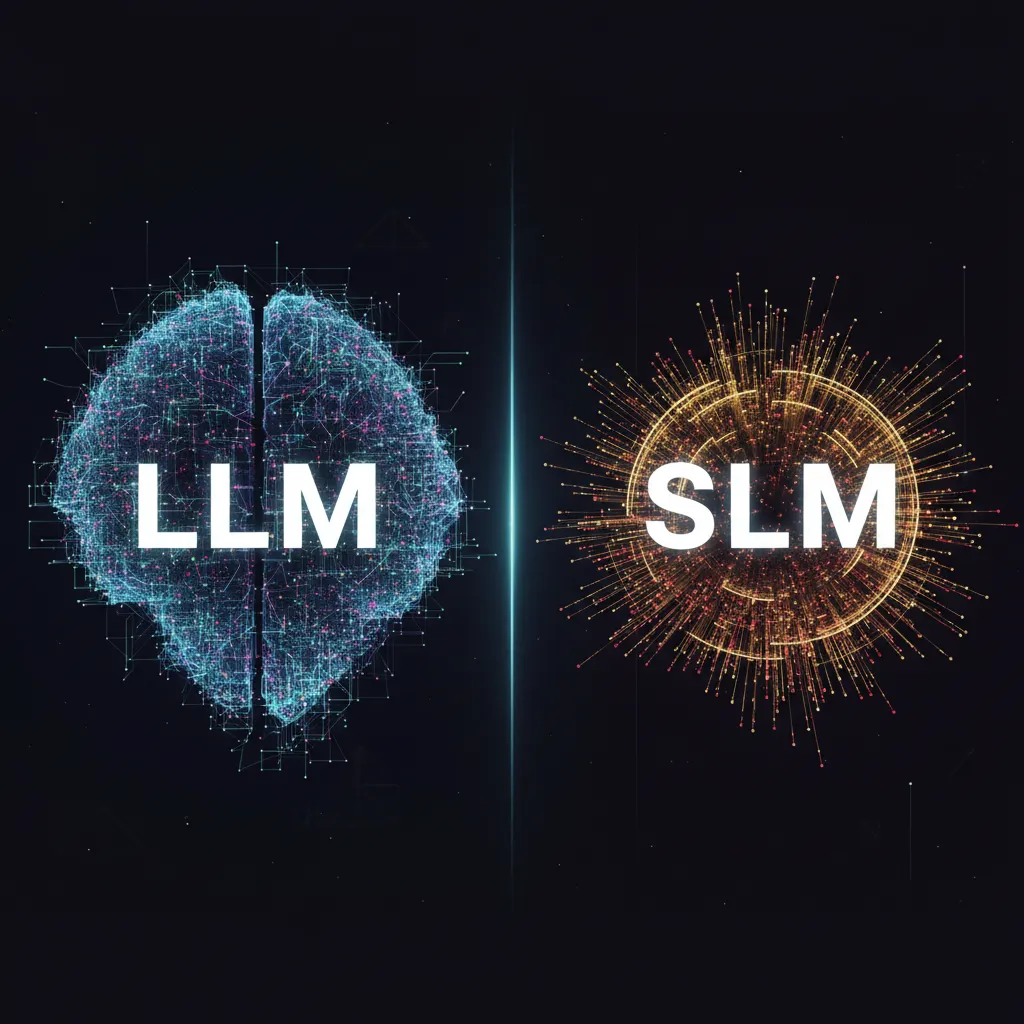
SLM vs LLM: Understanding the Crucial Differences
The comparison between SLMs and LLMs is not about which model is “better,” but rather which model is better suited for a specific context. They are two different tools serving different needs.
| Feature | Small Language Model (SLM) | Large Language Model (LLM) |
|---|---|---|
| Parameter Count | < 10 Billion (e.g., 1B, 3B, 7B) | > 50 Billion (often 100B to 1T+) |
| Model Size | Small (MBs to low GBs) | Massive (High GBs to TBs) |
| Deployment Location | Edge devices (smartphones, laptops, IoT, drones) | Cloud servers (Data Centers) |
| Latency | Extremely low (low-latency AI), near-instantaneous | Higher, dependent on network speed and server load |
| Cost | Low inference cost (runs locally, zero API calls) | High inference cost (requires powerful cloud GPUs) |
| Core Capabilities | Specialized, fine-tuned tasks (summarization, translation, specific coding, personalized assistance) | Generalist, complex reasoning, creative writing, expansive knowledge retrieval |
| Data Privacy | Excellent (private AI), data stays on the device | Dependent on service provider policies (data must travel to the cloud) |
The divergence lies in capability versus efficiency. LLMs excel at complex, abstract reasoning across vast domains of knowledge. SLMs, on the other hand, are the workhorses of the future, specializing in speed and immediacy. For tasks that require instant feedback, such as powering a personal AI assistant or instantly summarizing a document on your laptop, the SLM’s efficiency trumps the LLM’s expansive knowledge.
The Rise of Specialized SLMs
SLMs are not simply scaled-down LLMs; they often undergo a highly specialized training process, including model distillation, where knowledge is transferred from a larger model to a smaller one. This results in highly capable, yet compact, models like Microsoft Phi-3. Phi-3, for instance, has shown performance comparable to much larger LLMs on certain common sense reasoning and language understanding benchmarks, making it a compelling alternative for constrained environments. Similarly, Google’s Gemma family of models prioritizes accessibility and deployment flexibility.
This specialization is key to enabling what we call edge AI—intelligence that functions independently of the central cloud.
[Related: Guardians of the Digital Frontier: AI Revolutionizing Cybersecurity]
The On-Device AI Revolution: Benefits of Local Processing
The move to on-device AI is driven by more than just technical novelty; it solves fundamental problems associated with centralized, cloud-based computing. When an SLM is deployed locally, the entire interaction stays within the user’s device, ushering in a new era of performance and security.
1. Superior Speed and Low Latency
Latency, the delay between input and output, is the Achilles’ heel of cloud-based AI. Every query to an LLM must travel over the internet to a data center, be processed, and then travel back. This round trip can take hundreds of milliseconds, which is noticeable and disruptive for real-time applications.
When an SLM AI runs directly on the device, the latency drops to near zero, limited only by the device’s processing speed. This low-latency AI is essential for instant features like:
- Predictive text generation while typing.
- Real-time voice transcription and translation in communication apps.
- Instant execution of complex device commands (e.g., “Find all photos from last summer with the dog”).
2. Enhanced Privacy and Security (Private AI)
Perhaps the most compelling argument for SLMs is privacy. For businesses and individuals concerned about sensitive data, sending information to a third-party server is a major risk. Because local AI models process data entirely on the device, the information never leaves the user’s control.
This capability to enable private AI is critical in regulated industries (like finance and healthcare) and for everyday personal use, ensuring that personal notes, banking details, or health inquiries remain confidential.
3. Independence from the Internet (Offline AI)
Cloud dependency means that AI capabilities vanish without a strong network connection. SLMs enable truly offline AI. Whether a user is on a remote plane, in a subway, or has limited data, core AI functions—such as grammar correction, text summarization, or answering questions based on stored documents—remain fully operational.
This is a game-changer for reliability and accessibility, especially in regions with unreliable internet infrastructure or for applications like field robotics and military use cases.
4. Cost Efficiency
For companies relying heavily on AI, the cumulative cost of API calls and cloud GPU time for massive LLMs can be prohibitive. By shifting inference to the user’s device via SLMs, organizations can drastically reduce their operating expenses and reliance on large-scale cloud infrastructure providers. This democratization of AI processing power lowers the barrier to entry for smaller developers and startups.
The Technical Backbone: How SLMs Achieve Efficiency
Achieving powerful performance in a compact package is a significant feat of engineering. The success of SLM AI hinges on advanced technical strategies focused on AI model optimization and hardware integration.
1. Quantization: The Art of Data Compression
The most important technique for making an LLM small enough to be an SLM is quantization. Neural networks typically store their parameters (weights) using 32-bit floating-point numbers (FP32). Quantization reduces this precision, often down to 8-bit integers (INT8) or even 4-bit (INT4).
- FP32 (32-bit): High precision, requires 4 bytes of memory per parameter.
- INT8 (8-bit): Lower precision, requires only 1 byte per parameter (a 4x reduction in size).
While reducing precision can slightly affect accuracy, modern quantized language models use sophisticated methods to minimize this loss, achieving massive memory and computation savings with minimal performance degradation. This process is crucial for running large models like Gemma or Phi-3 efficiently on consumer hardware.
2. Knowledge Distillation and Pruning
- Knowledge Distillation: This involves training the smaller SLM (the “student”) to mimic the output behavior of a much larger, more powerful LLM (the “teacher”). The student model learns the decision boundaries and complex relationships of the teacher, acquiring high-level knowledge without needing the teacher’s massive parameter count.
- Pruning: This technique involves identifying and removing redundant or less important weights and connections within the compact neural networks. The model is “thinned,” making it smaller and faster while retaining its critical functional pathways.
3. Specialized Training and Fine-Tuning
Unlike generalized LLMs trained on the entire internet, SLMs benefit greatly from focused SLM fine-tuning. Once a base SLM is developed, it is optimized for specific, high-value tasks, such as medical summarization, coding assistance, or customer service response generation. This specialization allows the model to be highly effective in its domain without needing billions of parameters dedicated to unrelated knowledge.
[Related: AI in Healthcare: Revolutionizing Medicine and Patient Care]
4. AI Hardware Acceleration
The final piece of the puzzle is specialized hardware. Modern smartphones, tablets, and edge devices are increasingly equipped with dedicated Neural Processing Units (NPUs) or Tensor Processing Units (TPUs). This AI hardware acceleration is engineered to perform the matrix multiplications necessary for neural network inference much faster and more energy-efficiently than standard CPUs or general-purpose GPUs.
This symbiotic relationship between optimized SLM software and dedicated AI hardware is what truly enables the ubiquity of high-performance on-device AI.
Core Applications of SLMs: AI on Mobile Devices and Beyond
The deployment of SLMs is rapidly moving beyond simple digital assistants into mission-critical, high-impact areas, defining how technology integrates into our daily lives.
1. The Personal AI Assistant Reimagined
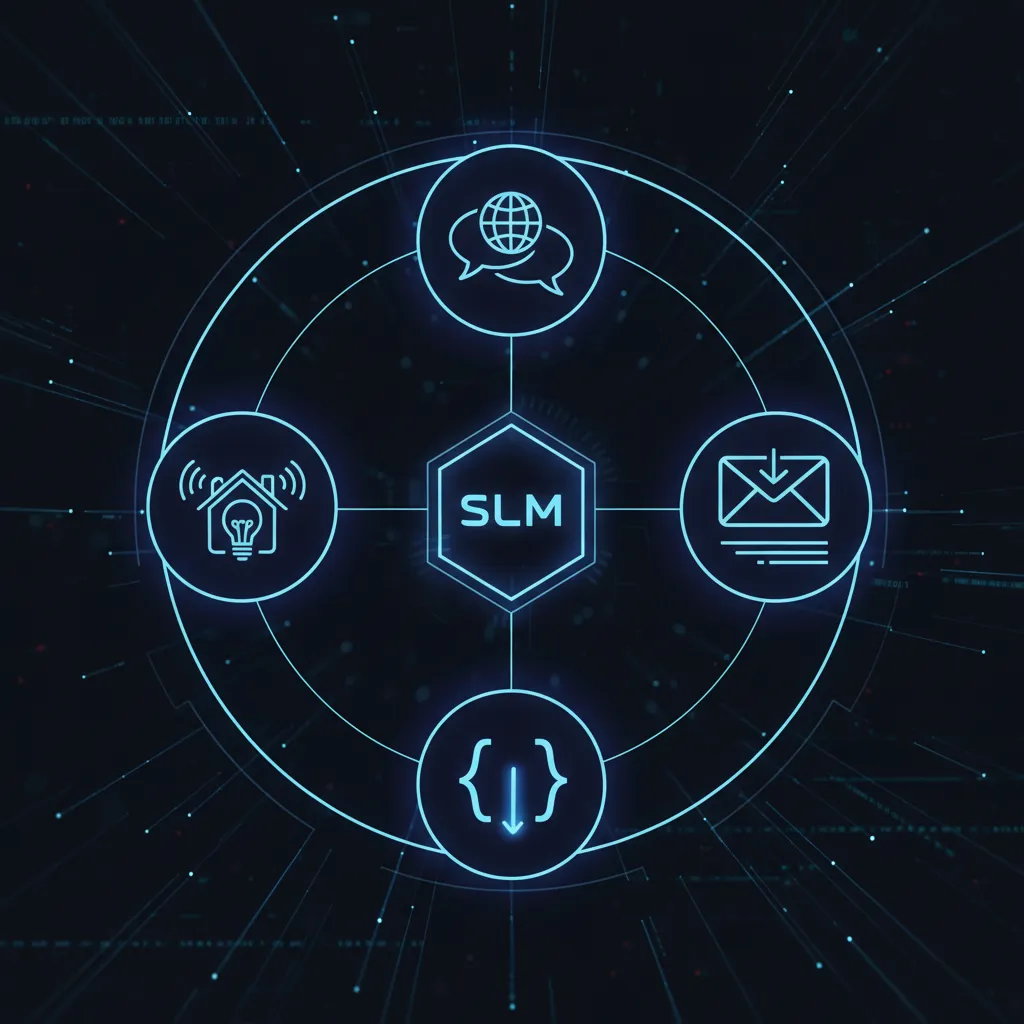
The personal AI assistant is evolving from a cloud-dependent novelty (like Siri or Alexa) into a deeply integrated, highly private tool. With SLMs running locally on a smartphone, your assistant can:
- Contextual Understanding: Analyze your emails, messages, calendar, and notes privately to offer proactive, highly relevant suggestions.
- Instant Summaries: Provide immediate summaries of long documents or web pages without needing to upload the content to a cloud server.
- Smart Device Control: Run complex, multi-step commands for smart homes and vehicles with zero network latency.
This reliance on AI on mobile devices ensures that personalization doesn’t come at the cost of privacy.

2. AI for IoT and Edge Devices
The Internet of Things (IoT) encompasses billions of sensors, cameras, and embedded systems—devices with minimal memory and processing power. SLMs provide the perfect solution for bringing intelligence to these endpoints:
- Real-Time Monitoring: Industrial sensors can use SLMs to analyze vibration or temperature data locally, identifying anomalies and generating alerts in real time, rather than flooding the central cloud with raw data.
- Smart Security Cameras: Cameras can use SLMs for local object detection and classification (e.g., distinguishing a person from an animal) before deciding if footage needs to be transmitted. This saves bandwidth and enhances privacy.
- Autonomous Systems: Drones and small robotics use embedded AI systems powered by SLMs to make instant navigation and decision-making calculations required for high-speed operation.
3. Enterprise and Industry Specific Solutions
In enterprise environments, SLMs are fine-tuned for specialized knowledge domains.
- Legal & Finance: SLMs can scan thousands of legal documents or financial reports for specific clauses or risks instantly, performing specialized natural language processing (NLP models) tasks with high accuracy, all within the firm’s secured local network.
- Customer Service: SLMs can power first-line customer service bots locally on a website or in an application, handling 80% of common queries instantly and autonomously before escalating complex issues to a human or larger LLM.
- Coding Assistance: Lightweight SLMs are being integrated into IDEs (Integrated Development Environments) to provide context-aware code suggestions and auto-completion, allowing engineers to work faster, even when offline.
[Related: Unlock the Potential: Top AI Tools for Everyday Productivity]
Navigating the Future: Challenges and the Path Ahead for SLMs
While the trajectory for SLMs is overwhelmingly positive, their deployment introduces a unique set of challenges and opportunities that will define the future of artificial intelligence.
1. The Challenge of Capability vs. Size
The fundamental trade-off remains: an SLM, by definition, has less knowledge and less reasoning capability than a state-of-the-art LLM. For complex, abstract tasks requiring massive context or creative generation, the LLM will still be necessary.
The Solution: Hybrid AI Architectures. The emerging standard is a tiered system where the SLM handles the vast majority of local, low-latency tasks, and only the most complex, generalist queries are selectively routed to the cloud-based LLM. This “AI Broker” approach maximizes both efficiency and capability.
2. Resource Constraints and Optimization
Even with aggressive optimization, running an SLM places a noticeable drain on device resources, particularly battery life and memory. Developers must continually push the boundaries of AI model optimization to ensure that running a local AI assistant doesn’t significantly impair the device’s basic function.
The Solution: Hardware Co-design. Chipmakers (like Qualcomm, Apple, and MediaTek) are increasingly designing processors with specialized NPUs that are highly power-efficient for running these specific lightweight AI models, making the integration seamless for end-users.
3. Ethical and Deployment Concerns
Because SLMs are highly specialized, they carry the risk of being highly biased if the training data is not carefully curated. Furthermore, unlike cloud models that can be instantly updated, updating billions of locally deployed SLMs across various embedded AI systems presents a logistical challenge.
The Solution: Continuous Monitoring and Over-the-Air Updates. Robust delivery mechanisms and rigorous pre-deployment safety checks are essential to ensure the ethical and functional reliability of these autonomous local models.
The Next Generation AI: Democratization and Personalization
The rise of Small Language Models marks a pivotal moment in technology, one where AI transitions from a niche, centralized service into a decentralized utility. This shift is driving the democratization of AI by making advanced capabilities available to anyone, anywhere, regardless of their network connection.
Real-time AI processing on the edge transforms not just devices, but entire industries. Imagine a world where:
- Your glasses instantly translate and subtitle conversations in real-time AI processing.
- Your kitchen appliance can manage complex dietary needs and personalized meal planning using private AI based on local inventory.
- Educational tools can offer highly customized tutoring using NLP models that adapt instantly to a student’s learning pace, even when working offline. [Related: Unlocking the Potential: AI Revolutionizing Personalized Learning]
This convergence of efficiency and intelligence—the SLM revolution—is the key to unlocking the true potential of personal AI assistant technologies and defining the parameters of the digital world for the next decade.
The future is not just about big AI; it’s about smart, fast, and local AI.

Conclusion: The Quiet Revolution of Compact Intelligence
Small Language Models (SLMs) are not merely a footnote in the history of AI; they are the architectural foundation for the future of artificial intelligence. By prioritizing efficiency, speed, and local operation, they have solved the critical latency and privacy issues that constrained the deployment of their larger siblings, the LLMs.
From advanced AI on mobile devices powered by models like Google Gemma and Microsoft Phi-3, to critical AI for IoT applications, SLMs are enabling edge AI and offline AI that provide personalized, instantaneous service. Their reliance on techniques like quantized language models and SLM fine-tuning ensures high performance in a low-resource environment.
As hardware manufacturers continue to refine AI hardware acceleration, and as model developers master the art of producing ever-more capable lightweight AI models, the distinction between the “smart” and the “device” will blur entirely. The next generation AI will be intrinsically private, instantaneous, and deeply woven into the fabric of our everyday lives—a future quietly powered by the silent efficiency of the Small Language Model.
FAQs: Understanding Small Language Models (SLMs)
Q1. What is the main difference between an SLM and an LLM?
The main difference lies in scale and purpose. LLMs (Large Language Models, typically 50B+ parameters) are designed for broad, complex, and generalist tasks, requiring massive cloud computing resources. SLMs (Small Language Models, typically 10B or fewer parameters) are designed for efficiency, speed, and specialization, enabling on-device AI and low-latency AI for specific tasks like summarization, translation, and private assistance, often running without an internet connection.
Q2. Can SLMs be used for complex coding tasks?
Yes, specialized SLMs can be highly effective for many coding tasks. By undergoing rigorous SLM fine-tuning on code datasets, models like Phi-3 can perform excellent code generation, context-aware auto-completion, debugging assistance, and syntax checking directly within an IDE. While they may struggle with extremely complex, multi-file architectural reasoning that an LLM excels at, they handle most daily developer needs with high speed and precision.
Q3. How do Small Language Models ensure data privacy?
SLMs ensure data privacy by operating as local AI models (or private AI). Since the model runs entirely on the user’s device (e.g., a smartphone or laptop), the input data and the resulting output never have to leave the device or be transmitted to a third-party cloud server. This makes them ideal for processing sensitive personal or proprietary information safely.
Q4. What is quantization in the context of SLMs?
Quantization is a technique used in AI model optimization to drastically reduce the size and computational requirements of a neural network. It involves converting the model’s parameters (weights) from high-precision floating-point numbers (e.g., 32-bit) to lower-precision integers (e.g., 8-bit or 4-bit). This transformation creates quantized language models that require significantly less memory and can run faster on AI hardware acceleration found in consumer electronics.
Q5. Are SLMs the same as open-source LLMs?
Not necessarily. While many SLMs are released open-source (like Google’s Gemma), the term SLM refers to the model’s architectural size and efficiency, not its licensing status. Many massive LLMs are also open-source, and conversely, some proprietary SLMs exist. The defining characteristic of an SLM is its compact size and design for embedded AI systems.
Q6. Will SLMs replace LLMs entirely?
No, SLMs are unlikely to replace LLMs entirely. They are complementary technologies. LLMs will continue to dominate use cases requiring massive data ingestion, highly creative generation, or complex, abstract reasoning. SLMs will dominate use cases requiring real-time AI processing, low cost, high privacy, and offline AI functionality. The future of AI is a synergistic ecosystem where both types of models cooperate in hybrid architectures.
Q7. What are examples of commercially available SLMs?
Prominent examples of commercially focused and research-forward efficient AI models include:
- Microsoft Phi-3: A family of models (e.g., 3.8B, 7B) designed to achieve strong performance relative to their size, tailored for responsible, efficient deployment.
- Google Gemma: A family of open lightweight AI models (e.g., 2B, 7B) derived from the same research as the Gemini models, aimed at fostering innovation in the developer community and enabling on-device AI.