Securing DeFi with AI: Next-Gen Protections for Decentralized Finance

Introduction
Decentralized Finance (DeFi) has exploded from a niche concept into a multi-billion dollar ecosystem, promising a future of open, permissionless, and transparent financial services. Yet, this rapid innovation has created a digital Wild West, where fortunes are made and lost in the blink of an eye. In 2023 alone, over $1.8 billion was stolen in crypto hacks, a stark reminder of the immense decentralized finance risks at play. The very code that powers these platforms—immutable and autonomous—can also be their greatest vulnerability.
Traditional cybersecurity measures, designed for centralized systems, often struggle to keep pace with the novel attack vectors emerging in the Web3 security landscape. The complexity of smart contracts and the speed of blockchain transactions demand a more intelligent, proactive, and automated defense system. This is where Artificial Intelligence (AI) enters the picture, not just as a buzzword, but as a critical ally in the fight for a safer decentralized future.
This article dives deep into the symbiotic relationship between AI and blockchain technology. We’ll explore how AI in decentralized finance is creating a new paradigm of fintech security solutions, moving beyond reactive fixes to build next-gen financial security. From AI-powered smart contract auditing that spots flaws humans might miss to autonomous security systems that can thwart attacks in real-time, you’re about to discover how AI is becoming the indispensable guardian of your crypto asset protection.
The Alarming State of DeFi Security: Why We Need a Paradigm Shift
The promise of DeFi is its autonomy. Transactions execute based on pre-written code without intermediaries. But what happens when that code is flawed? The consequences are immediate and often irreversible. The history of DeFi is littered with cautionary tales, where single exploits have drained millions from protocols, shaking user confidence and highlighting the urgent need for advanced DeFi security.
Understanding the Core Decentralized Finance Risks
To appreciate the solution, we must first understand the problem. Attackers leverage several common vulnerabilities:
- Smart Contract Exploits: This is the most common attack vector. Flaws in the code, such as reentrancy bugs, integer overflows, or flawed logic, can be exploited by malicious actors to drain funds. The infamous DAO hack in 2016 was an early, painful lesson in the importance of robust smart contract security.
- Flash Loan Attacks: A unique DeFi risk, flash loans allow users to borrow massive amounts of cryptocurrency with no collateral, provided the loan is repaid within the same transaction block. Attackers use these instant loans to manipulate market prices on decentralized exchanges (DEXs), exploit oracle vulnerabilities, and profit from the resulting arbitrage, all in a matter of seconds.
- Oracle Manipulation: DeFi protocols rely on “oracles” to feed them real-world data, like asset prices. If an attacker can manipulate this data feed, they can trick a protocol into undervaluing or overvaluing assets, leading to unfair liquidations or theft.
- Rug Pulls and Scams: Not all risks are technical. Malicious developers can create seemingly legitimate projects, attract investor funds into a liquidity pool, and then abruptly withdraw all the assets and disappear, leaving investors with worthless tokens.
These challenges demonstrate that manual oversight and traditional security firewalls are insufficient for the dynamic and high-stakes environment of DeFi. We need a system that can think, learn, and act at machine speed—we need AI.
The AI Cavalry: How AI is Revolutionizing DeFi Risk Management
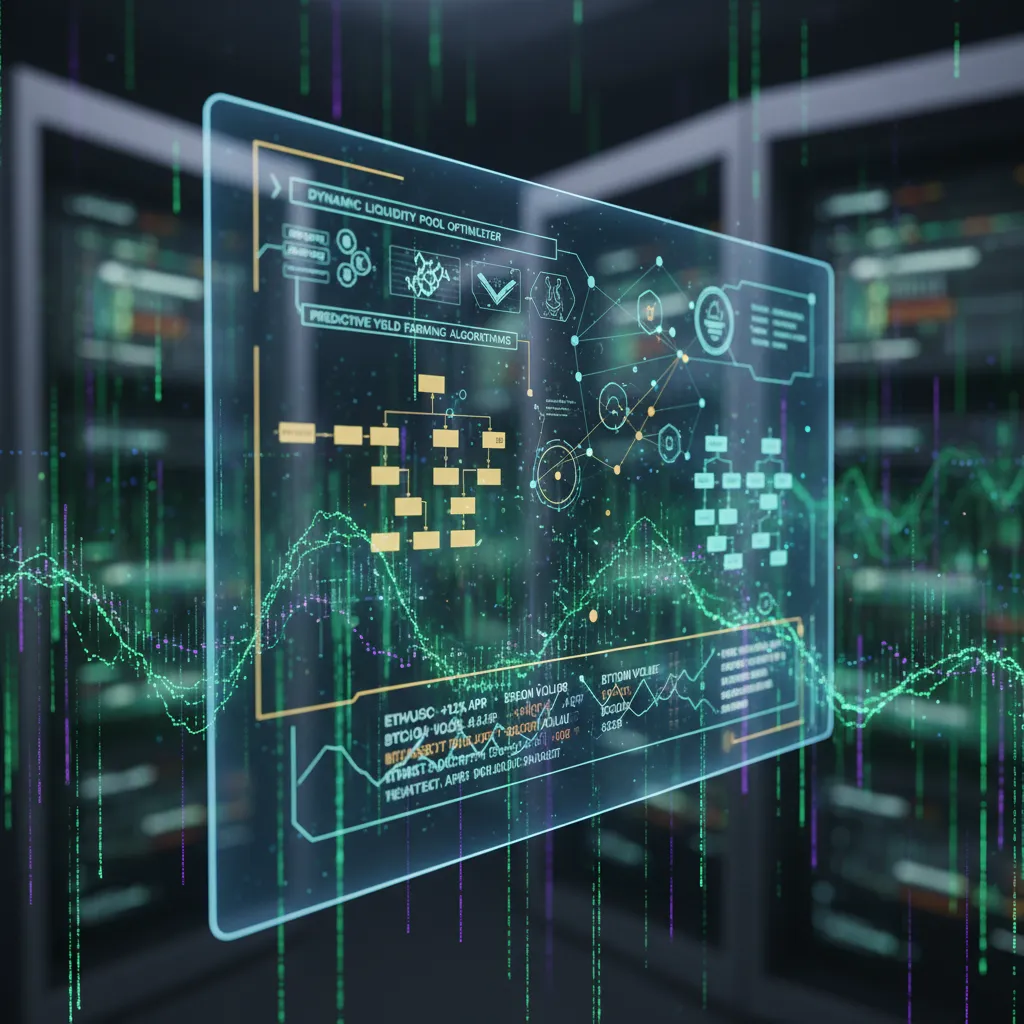
Artificial Intelligence and its subfield, machine learning for blockchain security, represent a fundamental shift from a reactive to a proactive security posture. Instead of just patching vulnerabilities after an attack, AI systems can predict, identify, and neutralize threats before they cause damage. This is the core of effective DeFi risk management in the modern age.
AI can analyze vast datasets of on-chain information—transactions, smart contract code, wallet behaviors—to identify patterns that are invisible to the human eye. This allows it to build a baseline of “normal” activity for a protocol and instantly flag deviations that could signal an attack. It’s like having a team of millions of tireless security analysts watching over the ecosystem 24/7.
AI-Powered Smart Contract Auditing: Beyond Human Capability
Before a DeFi protocol launches, its smart contracts undergo a security audit. Traditionally, this is a manual process where experts comb through thousands of lines of code to find vulnerabilities. While essential, human audits are time-consuming, expensive, and can still miss subtle, complex flaws.
AI in crypto auditing supercharges this process. AI tools use techniques like:
- Natural Language Processing (NLP): To understand the comments and logic within the code, flagging inconsistencies between the intended function and the actual code.
- Pattern Recognition: AI models are trained on vast libraries of known vulnerabilities and code exploits. They can scan new contracts and instantly identify familiar malicious patterns or “code smells.”
- Formal Verification: AI can mathematically prove that a smart contract will behave as expected under all possible conditions, providing a much higher level of assurance than manual testing alone.
- Predictive Analysis: By analyzing a contract’s complexity and interactions, AI can predict potential future attack vectors that may not even be widely known yet, crucial for DeFi innovation security.
This automated approach doesn’t replace human auditors but acts as a powerful force multiplier, allowing them to focus on complex architectural logic while the AI handles the painstaking line-by-line analysis.
Related: AI-Powered Digital Twins: Revolutionizing Industries for a Future of Innovation

Real-Time Threat Intelligence and Anomaly Detection
One of AI’s greatest strengths is its ability to operate in real-time. For DeFi, where an attack can be over in seconds, this is a game-changer. AI fraud detection DeFi systems constantly monitor on-chain activity, acting as a decentralized immune system.
Here’s how it works:
- Establishing a Baseline: The AI analyzes a protocol’s typical transaction patterns—average volume, wallet interactions, function calls, and gas fees.
- Continuous Monitoring: It watches every new transaction, comparing it against the established baseline in real-time.
- Anomaly Flagging: When a transaction or a series of transactions deviates significantly from the norm, it’s flagged as an anomaly. This could be a single wallet suddenly interacting with a contract in an unusual way or a rapid succession of transactions designed to manipulate a liquidity pool.
- Alerting and Response: The system can immediately alert developers or even trigger an automated response, like a temporary pause of the protocol, preventing DeFi hacks before funds are lost.
This AI-driven threat intelligence is crucial for defending against zero-day exploits and sophisticated market manipulation schemes.
Advanced DeFi Security Solutions Fueled by AI
The application of AI in DeFi security goes far beyond just auditing and monitoring. A new generation of sophisticated, AI-powered financial security tools is emerging, offering comprehensive protection for both protocols and their users.
AI-Driven Risk Assessment for Protocols and Users
For investors, navigating the DeFi landscape can be daunting. How do you know if a new high-yield protocol is a legitimate innovation or a ticking time bomb? AI-driven risk assessment provides a data-backed answer.
These platforms act like credit scoring agencies for DeFi. They ingest a wide range of data points, including:
- On-Chain Metrics: Liquidity, transaction volume, token holder distribution, and smart contract activity.
- Code Analysis: The results of automated token security AI audits and the complexity of the contract code.
- Social Sentiment: Analyzing discussions on social media and developer forums to gauge community trust and identify potential red flags.
- Team Vetting: Assessing the anonymity and track record of the development team.
By processing this information, AI generates a simple, easy-to-understand risk score, empowering users to make informed decisions and avoid potential scams. This is a crucial step in maturing the ecosystem and protecting the average user.
Related: The Copilot+ PC Buyer’s Guide: Top AI Laptops of 2024

Autonomous Security Systems: The Future is Now
The holy grail of blockchain security AI is full automation. Autonomous security systems DeFi are intelligent agents that can not only detect threats but also respond to them independently, without human intervention.
Imagine a flash loan attack is initiated against a lending protocol. An AI security agent monitoring the mempool (where pending transactions wait) could detect the malicious sequence of transactions before it’s even confirmed on the blockchain. The agent could then automatically execute a counter-measure, such as front-running the transaction with a protective action that pauses the targeted contract function, neutralizing the threat entirely.
These decentralized applications security agents represent the pinnacle of proactive defense, turning smart contracts into self-defending entities. While still an emerging field, the development of these autonomous guardians is a key part of the roadmap for building truly secure DeFi protocols.
Related: AI Agents are Here to Automate Your Digital Life
AI for Crypto Forensics and Incident Response
Even with the best defenses, incidents can happen. When they do, the race is on to trace and recover the stolen funds. The transparent nature of the blockchain is an advantage, but attackers use sophisticated techniques like crypto mixers and chain-hopping to launder funds and obscure their tracks.
AI for crypto forensics is a powerful tool for law enforcement and security firms. By applying machine learning to blockchain analytics for security, these systems can:
- De-anonymize transactions by clustering wallets that are likely controlled by the same entity.
- Trace the flow of stolen funds across multiple blockchains and through complex mixing services.
- Identify attacker infrastructure, such as exchange deposit addresses, which can help in recovering assets.
AI can process and connect data points across millions of transactions far more efficiently than human analysts, dramatically speeding up investigations and increasing the chances of holding hackers accountable.

Conclusion: A Smarter, Safer Future for Decentralized Finance
Decentralized finance stands at a crossroads. Its potential to reshape global finance is undeniable, but this future is entirely dependent on building a secure and trustworthy foundation. The relentless wave of hacks and exploits has proven that the old security playbook is no longer enough.
The integration of Artificial Intelligence is not just an incremental improvement; it is the essential evolutionary step for DeFi security. By leveraging AI fraud detection, predictive auditing, and autonomous security systems, we can forge a more resilient ecosystem. AI and blockchain technology are a powerful combination, creating a symbiotic relationship where the transparency of the blockchain feeds the intelligence of AI, which in turn protects the integrity of the chain.
The future of DeFi security will be an ongoing arms race between AI-powered attackers and AI-powered defenders. But for users, developers, and investors, embracing these next-gen financial security tools is the only way forward. By building smarter, self-defending protocols, we can finally unlock the full, world-changing potential of decentralized finance.
What are your thoughts on the role of AI in securing our digital asset security? Share your insights in the comments below!
Frequently Asked Questions (FAQs)
Q1. What are the biggest security risks in DeFi?
The most significant risks in DeFi include smart contract vulnerabilities (like reentrancy bugs), flash loan attacks for market manipulation, oracle manipulation to feed incorrect price data, and social engineering scams like rug pulls where developers abandon a project after raising funds.
Q2. How does AI enhance DeFi security?
AI enhances DeFi security by moving from a reactive to a proactive model. It uses machine learning for real-time anomaly detection in transactions, automates in-depth smart contract audits to find flaws humans might miss, provides predictive risk assessments for protocols, and powers autonomous systems that can neutralize threats before they execute.
Q3. Can AI prevent all DeFi hacks?
No, AI cannot prevent all DeFi hacks. While it significantly improves the chances of detecting and stopping attacks, it is not a silver bullet. Sophisticated attackers are also beginning to use AI to find new vulnerabilities. A defense-in-depth strategy combining AI monitoring, regular human audits, strong community oversight, and user education remains the best approach to DeFi risk management.
Q4. What is an AI-powered smart contract audit?
An AI-powered smart contract audit is a process where AI tools automatically scan a smart contract’s code for known vulnerabilities, logical errors, and potential security holes. These tools use techniques like pattern recognition, formal verification, and symbolic execution to analyze code more quickly and comprehensively than manual audits alone, forming a critical part of modern Web3 security.
Q5. How is machine learning used in blockchain security?
Machine learning for blockchain security involves training algorithms on vast datasets of on-chain transactions. These models learn to identify normal patterns of behavior for a specific protocol or wallet. They can then monitor new transactions in real-time and flag any that deviate from this norm, which could indicate illicit activities like money laundering, wash trading, or the setup for a hack.
Q6. Is it safe to invest in DeFi?
Investing in DeFi carries inherent risks, but safety is improving. It is safer when investors do thorough research, use protocols that have undergone multiple independent and AI-powered audits, and utilize AI-driven risk assessment tools. Diversifying investments and never investing more than you can afford to lose are also crucial principles for navigating the space safely.
Q7. What is the role of AI in crypto fraud detection?
In crypto fraud detection, AI’s role is to analyze transaction patterns at scale to identify illicit behavior. It can detect complex fraud schemes like wash trading on decentralized exchanges, trace funds through mixers in AI for crypto forensics, and flag wallets associated with scams, providing a powerful tool for preventing DeFi hacks and cleaning up the ecosystem.