Quantum AI Unleashed: Reshaping Intelligence & Innovation
Introduction
We stand at the precipice of a technological revolution, a moment defined by the convergence of two of the most powerful forces in modern science: quantum computing and artificial intelligence. This isn’t just an incremental upgrade; it’s a fundamental paradigm shift. Imagine an intelligence not bound by the binary “on or off” logic of today’s computers, but one that operates on the surreal, probabilistic rules of the quantum realm. This is the promise of Quantum AI, a fusion poised to redefine innovation, solve humanity’s most complex problems, and unlock a new era of discovery.
For decades, AI has been powered by classical computers, which store information in bits—simple 1s and 0s. This has led to incredible breakthroughs, from natural language models to self-driving cars. Yet, we are beginning to hit the limits of this classical architecture for certain types of problems. The universe, at its most fundamental level, isn’t classical; it’s quantum. To truly understand and simulate it, and to build a truly advanced intelligence, we need a new kind of computer.
This guide will demystify the exhilarating field of artificial intelligence quantum computing. We’ll journey from the basic principles of a qubit to the mind-bending applications in medicine, finance, and beyond. You’ll learn what quantum machine learning is, who the key players like Google, IBM, and D-Wave are, and what the future of quantum AI holds for us all.
The Quantum Leap: A Primer on Quantum Computing
Before we can merge AI with the quantum world, it’s essential to grasp what makes quantum computing so different. While a classical computer uses bits (0s or 1s), a quantum computer uses “qubits.” This single difference changes everything.
Think of a classical bit as a light switch: it can be either on (1) or off (0). A qubit, however, is more like a dimmer dial that can also spin. Thanks to two principles of quantum mechanics, it can exist in a far richer state:
- Superposition: A qubit can be a 0, a 1, or both simultaneously. This ability to hold multiple values at once allows quantum computers to explore a vast number of possibilities in parallel, providing an exponential speedup for certain calculations.
- Entanglement: This is what Einstein famously called “spooky action at a distance.” Two qubits can become entangled, meaning their fates are linked. Measuring the state of one instantly influences the state of the other, no matter how far apart they are. This interconnectedness creates powerful computational correlations that classical computers cannot replicate.
By harnessing these properties, quantum computers aren’t just faster versions of what we have now; they are a completely new tool designed to solve a different class of problems—problems of immense complexity that are currently intractable. This is the foundation upon which AI in quantum technology is built.
Related: Google I/O 2024: The Biggest AI Announcements
The Fusion: Where AI Meets the Quantum Realm
The relationship between quantum computing and AI is a symbiotic two-way street. Not only will quantum mechanics revolutionize AI, but AI is also essential for advancing quantum computing.
AI for Quantum Computing
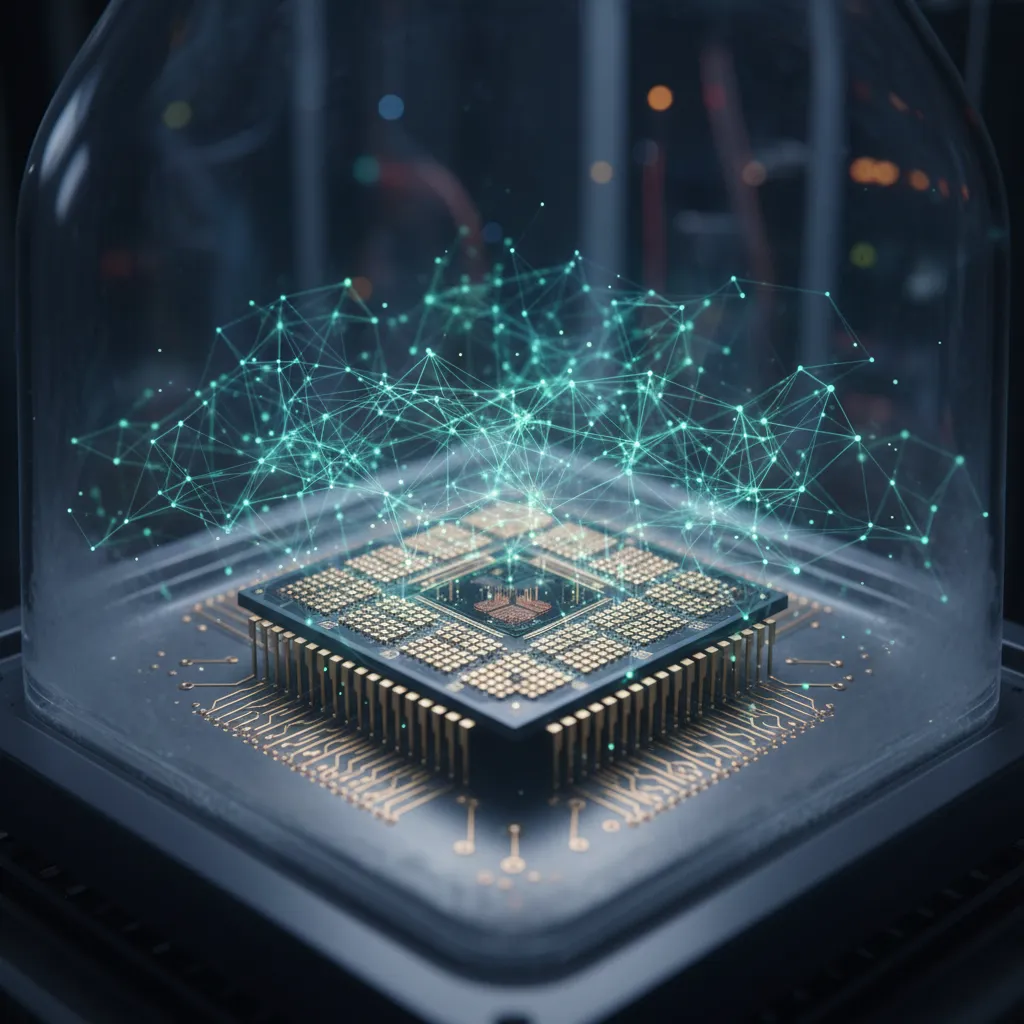
Building and operating quantum computers is incredibly difficult. Qubits are fragile and highly susceptible to environmental “noise” (like tiny temperature fluctuations or vibrations), which can corrupt their delicate quantum state—a problem known as decoherence. This is where classical AI for quantum computing comes in. Machine learning algorithms can:
- Calibrate and Tune Qubits: AI can automatically adjust the complex parameters needed to keep qubits stable and operational.
- Error Correction: AI models can predict and correct the errors that inevitably creep into quantum calculations, making the results more reliable.
- Design Quantum Circuits: AI can help design more efficient quantum algorithms ai and the physical circuits that run them.
Quantum for AI: The Rise of Quantum Machine Learning
The more exciting side of the coin is leveraging quantum computing to supercharge AI. This field is known as Quantum Machine Learning (QML). QML algorithms are designed to run on quantum processors, potentially offering significant advantages over their classical counterparts for specific tasks. The goal is to achieve quantum advantage AI, the point where a quantum system can solve a real-world problem significantly faster or more accurately than the best-known classical supercomputer.
The core idea is that QML can process information in high-dimensional spaces more naturally, making it ideal for finding complex patterns in massive datasets—a cornerstone of modern AI.
Related: Claude 3.5 Sonnet: The New AI Speed King
Deep Dive into Quantum Machine Learning (QML)
QML isn’t just about making existing machine learning models faster. It’s about creating entirely new models that “think” in a quantum way. This includes developing quantum neural networks, which process information using the principles of superposition and entanglement. These networks could theoretically solve problems that are impossible for even the largest classical deep learning models.
Key areas of QML research include:
- Quantum Support Vector Machines (QSVM): A quantum version of a popular classification algorithm that could excel at pattern recognition in fields like medical diagnostics.
- Quantum Principal Component Analysis (QPCA): Used for dimensionality reduction, this could help find the most important features in incredibly complex datasets, like financial market data or genomic information.
- Variational Quantum Eigensolvers (VQE): A hybrid quantum AI approach often used in chemistry and optimization problems.
The development of these algorithms is a central focus of quantum computing research, paving the way for the first truly practical quantum ai applications.
Unlocking Reality’s Code: Key Applications of Quantum AI
The potential impact of quantum AI is vast, promising to disrupt industries and accelerate scientific discovery on a scale we haven’t seen since the invention of the microchip.

Revolutionizing Medicine and Materials: Quantum Chemistry & Simulation
One of the most promising near-term applications is in simulating nature at the molecular level. Classical computers struggle to accurately model the behavior of even moderately complex molecules because molecules are inherently quantum systems.
With quantum simulation ai, researchers can:
- Design New Drugs: Accurately simulate how a potential drug molecule will interact with proteins in the human body, drastically speeding up drug discovery and reducing the need for expensive, time-consuming lab experiments.
- Develop Novel Materials: Create new materials with desired properties from scratch. Imagine designing a superconductor that works at room temperature or a hyper-efficient catalyst for clean energy production. This is the domain of quantum chemistry ai.
Related: AI & Longevity: Unlocking the Secrets to a Longer, Healthier Life
The Future of Finance: Quantum Optimization AI
Many of the hardest problems in finance are optimization problems—finding the best possible outcome from a vast set of options. Quantum computers are naturally suited for this.
Quantum optimization ai could transform finance by:
- Portfolio Management: Analyzing countless variables to find the optimal mix of assets that maximizes returns while minimizing risk.
- Risk Analysis: Running complex Monte Carlo simulations far more efficiently to better model market volatility and predict financial crashes.
- Fraud Detection: Identifying subtle patterns in financial transactions that signal fraudulent activity, a task where machine learning quantum computing could shine.
Enhancing Machine Learning and Data Analysis
Quantum AI has the potential to fundamentally improve the core tasks of machine learning. By processing data in quantum states, algorithms could uncover intricate correlations in datasets that are simply too large and complex for classical computers. This could lead to more accurate climate models, more intelligent supply chain logistics, and more powerful AI recommendation engines.
Fortifying Our Digital World: Quantum Cryptography AI
The power of quantum computing is a double-edged sword. A sufficiently powerful quantum computer could break much of the encryption that protects our data today. However, quantum cryptography AI also offers the solution: new forms of encryption based on the laws of physics.
Technologies like Quantum Key Distribution (QKD) allow for the creation of theoretically unhackable communication channels. Any attempt to eavesdrop on the key exchange would disturb the quantum state, immediately alerting the parties.
The Pioneers: Who is Leading the Quantum AI Race?
The race for quantum supremacy is well underway, with tech giants and specialized startups investing billions of dollars into research and development.
- Google Quantum AI: Google famously claimed to have achieved “quantum supremacy” in 2019 with its Sycamore processor, which performed a specific calculation in 200 seconds that would have taken the world’s most powerful supercomputer 10,000 years. They are a leader in building superconducting qubit systems.
- IBM Quantum AI: IBM has taken a different approach, focusing on building a robust ecosystem and making its quantum computers accessible to researchers and businesses via the cloud. Their roadmap includes plans for processors with thousands of qubits, pushing the boundaries of what’s possible.
- D-Wave Systems: A pioneer in the field, d-wave quantum ai focuses on a specific type of quantum computer called a quantum annealer. While not a universal quantum computer, annealers are exceptionally good at solving optimization problems and have found early commercial applications.
Beyond these giants, a vibrant ecosystem of startups and academic labs is contributing to quantum computing breakthroughs, driving innovation in both hardware and quantum software development.
Bridging Two Worlds: The Rise of Hybrid Quantum-Classical AI
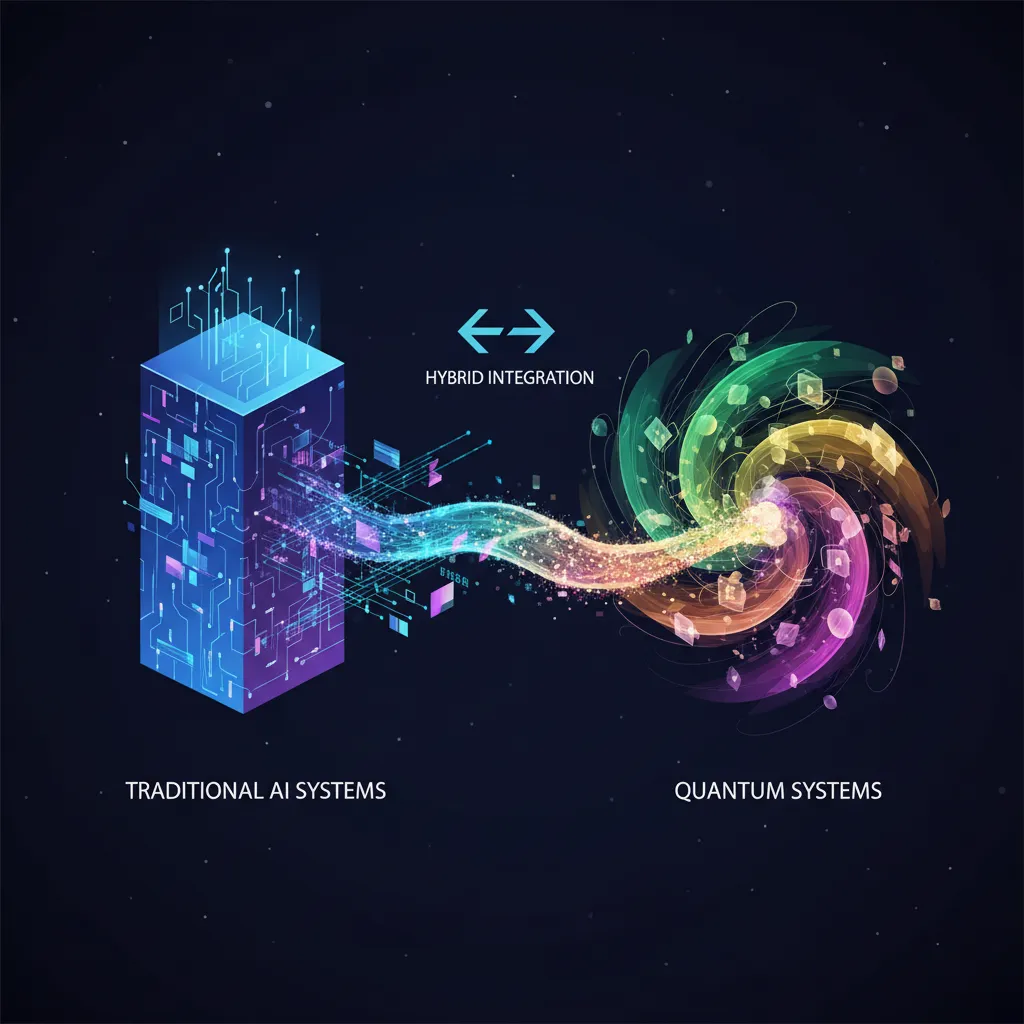
The near-term future of quantum computing ai is not a complete replacement of classical computers but a collaborative partnership. We are in the era of hybrid quantum AI.
In a typical hybrid model:
- A classical computer handles the bulk of the workflow: data preparation, pre-processing, and interpreting the final results.
- It identifies the most computationally intensive part of the problem—the part that is a bottleneck for classical systems.
- This specific, hard part of the calculation is offloaded to a Quantum Processing Unit (QPU).
- The QPU performs its quantum magic and sends the result back to the classical computer to be integrated into the final solution.
This approach allows us to leverage the power of quantum computing today, even with the noisy, intermediate-scale quantum (NISQ) devices currently available. It represents the most practical quantum ai strategy and is the primary model for early quantum AI for business applications.
Related: Apple Intelligence: The Ultimate 2024 AI Guide
Navigating the Quantum Maze: Challenges and Ethical Considerations
The path to a fully realized quantum future is paved with significant obstacles and profound ethical questions that we must address.
Technical Hurdles to Overcome
The primary quantum computing challenges are physical.
- Decoherence: Qubits are incredibly fragile. Interactions with their environment cause them to lose their quantum properties, destroying the computation. Building better-isolated and more stable qubits is a top priority.
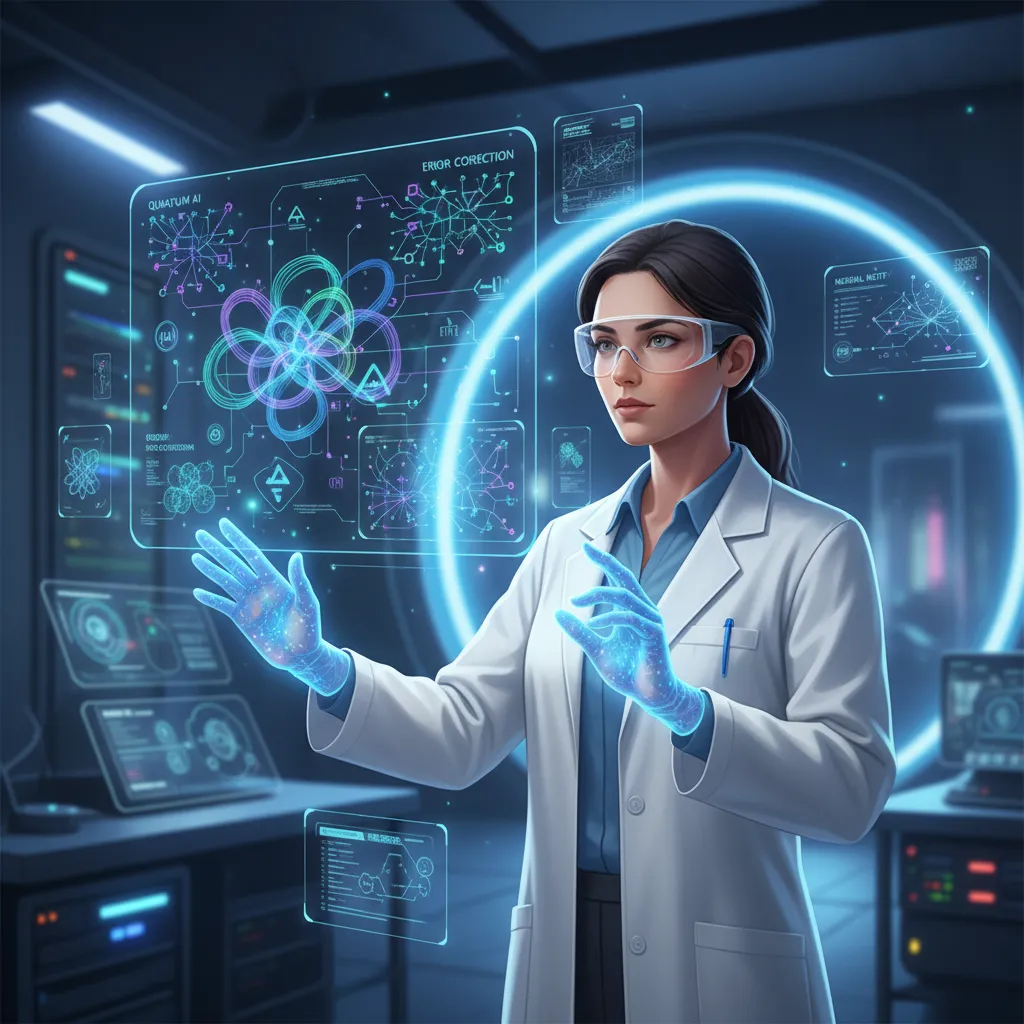
- Error Correction: The noise in current quantum systems leads to high error rates. Developing effective quantum error correction codes is crucial for building fault-tolerant quantum computers that can perform long, complex calculations.
- Scalability: While we can build systems with hundreds of qubits, scaling up to the millions of stable qubits needed for many world-changing applications remains a monumental engineering challenge.
- Software and Talent: The field of quantum software development is still in its infancy. We need new programming languages, compilers, and a new generation of developers who can think in quantum terms.
The Ethical Compass of Quantum AI
The ethical implications quantum ai brings are as significant as its technical challenges.
- Cryptographic Threat: As mentioned, quantum computers could render current cybersecurity standards obsolete, creating a “crypto-apocalypse.” We must proactively transition to quantum-resistant cryptography.
- Bias and Fairness: If quantum AI is trained on biased data, it could amplify societal biases on a massive scale, creating “quantum bias” in areas like hiring, loan applications, and criminal justice.
- Economic Disruption: The impact of quantum AI could lead to widespread job displacement in fields ranging from financial analysis to chemical engineering.
- Dual-Use Technology: A technology powerful enough to design life-saving drugs could also be used to design more dangerous weapons.
Related: Declutter Your Life: Minimalist Strategies for a Serene Home and Mind
The Road Ahead: Future Trends and the Impact of Quantum AI
Despite the challenges, the pace of quantum computing breakthroughs is accelerating. The long-term vision is no longer science fiction but an active area of R&D.
Key quantum computing future trends to watch for include:
- Fault-Tolerant Quantum Computers: The holy grail is to build machines with robust error correction, allowing for reliable and scalable quantum computation.
- Democratization of Access: Cloud platforms from IBM, Google, Amazon, and Microsoft will continue to make quantum hardware more accessible to a broader range of researchers and businesses.
- Quantum AI as a Service (QaaS): Companies will increasingly use quantum computing for specific business problems without needing to own or maintain the hardware themselves.
- The “Quantum-Ready” Workforce: A growing emphasis will be placed on education and training to prepare for the quantum economy.
Conclusion
The convergence of quantum computing and artificial intelligence is not a distant dream; it’s a revolution unfolding in real-time. We are moving from a world of bits to a world of qubits, from classical logic to quantum intuition. This AI powered quantum synergy promises to equip us with the tools to solve problems once thought unsolvable—from curing diseases and mitigating climate change to unraveling the deepest mysteries of the universe.
The journey will be long and complex, filled with both immense challenges and breathtaking discoveries. But one thing is clear: Quantum AI is poised to become one of the most transformative technologies in human history. The digital age gave us the power to process information; the quantum age will give us the power to understand reality itself. The revolution has begun.
FAQs
Q1. What is Quantum AI in simple terms?
Quantum AI is the use of quantum computing for running artificial intelligence and machine learning algorithms. Instead of using classical bits (0s and 1s), it uses qubits, which can be 0, 1, or both at the same time. This allows it to process vast amounts of information in parallel, potentially solving complex problems that are impossible for today’s best supercomputers.
Q2. Does true Quantum AI exist yet?
We are in the very early stages. While researchers have successfully run basic quantum machine learning algorithms on current quantum computers, we do not yet have a large-scale, fault-tolerant quantum computer capable of outperforming classical AI on most practical problems. The current era is focused on research, development, and building “noisy” intermediate-scale quantum (NISQ) devices.
Q3. How will Quantum AI change the world?
The potential impact is massive. Quantum AI could lead to the rapid discovery of new life-saving drugs, the creation of novel materials for clean energy, more efficient financial systems, and unbreakable cryptography. It promises to accelerate scientific research and solve complex optimization problems across nearly every industry.
Q4. What is the difference between AI and Quantum AI?
The fundamental difference lies in the hardware they run on. Traditional AI runs on classical computers that use bits. Quantum AI runs on quantum computers that use qubits. This allows Quantum AI to leverage quantum phenomena like superposition and entanglement to explore an exponentially larger computational space for certain types of problems, enabling a completely different approach to computation.
Q5. Who is leading in Quantum AI?
The race is highly competitive. Tech giants like Google, IBM, and Microsoft are major players, investing heavily in building quantum hardware and cloud platforms. Specialized companies like D-Wave Systems focus on specific quantum approaches like annealing. A global ecosystem of startups and university research labs are also making critical contributions.
Q6. What are the main challenges for Quantum AI?
The biggest challenges are physical and engineering-based. Qubits are extremely fragile and prone to errors from environmental “noise” (a problem called decoherence). Building large-scale, stable, error-corrected quantum computers is a monumental task. Additionally, developing the software and algorithms to effectively program these new machines is a major area of ongoing research.