Perplexity Pages: The New AI Content Generator Reviewed

Introduction: The AI Search Engine That Wants to Be Your AI Blog Writer
In the fiercely competitive landscape of generative AI, a new contender has emerged, shifting the focus from mere answers to structured, ready-to-publish content. We are talking about Perplexity Pages, a powerful new feature launched by Perplexity AI.
Perplexity AI, under the leadership of CEO Aravind Srinivas, initially gained notoriety as the definitive “answer engine”—a sophisticated AI search engine designed to synthesize information from multiple sources and provide cited, verifiable answers, drastically reducing the risk of AI hallucination. But with Pages, the platform is taking a giant leap into the domain of content creation, specifically aiming to be the ultimate AI content generator for long-form articles, reports, and tutorials.
The core promise of Perplexity Pages is simple yet revolutionary: transform complex research into a clean, shareable, and professionally structured webpage in minutes. This tool is not just an upgrade; it’s a fundamental reimagining of the future of blogging and content production.
What You Will Learn in This Comprehensive Review:
This article provides a deep dive and honest Perplexity Pages review, covering everything from its underlying technology (including models like Claude 3 Sonnet) to its practical applications. We will explore the key Perplexity Pages features, offer a full Perplexity Pages tutorial, and conduct a head-to-head comparison (Perplexity vs ChatGPT) to determine if this new tool is the game-changer for AI for SEO and automated content creation that content marketers and bloggers have been waiting for.
If you’re wondering how to create webpage with AI that maintains accuracy, citation, and readability, look no further.
What Exactly is Perplexity Pages? The Fusion of Research and Structure
To understand Perplexity Pages, you must first understand the fundamental difference between Perplexity AI and traditional large language models (LLMs) like GPT-4 or Claude 3. While LLMs generate text based on trained data, Perplexity searches the real-time web, synthesizes that information, and then structures it.
Perplexity Pages capitalizes on this unique process of AI information synthesis and knowledge discovery. Instead of generating a single block of text, Pages orchestrates a comprehensive, multi-step process to produce a fully formed, formatted, and media-ready article—essentially an instant, high-quality draft webpage.
The Core Mechanics: Why Pages Stands Out
At its heart, Pages acts as an advanced AI research assistant that then automatically organizes its findings into a narrative structure.
- Topic and Audience Definition: The user starts by defining a broad topic (e.g., “The economic impact of sustainable AI”) and selecting an intended audience (e.g., “Expert,” “General Public,” “Student”).
- Source Grounding: Using its proprietary search and grounding technology, Perplexity gathers real-time, relevant sources. This is where the crucial element of AI source citation comes in, linking every major claim back to its origin.
- Structured Content AI Generation: The system then automatically drafts a multi-section document, complete with H2 and H3 headings, bullet points, and an introduction and conclusion. This is the essence of structured content AI.
- Customization and Polish: Unlike static output from other tools, Pages provides a highly customizable AI webpage interface where users can easily edit text, rearrange sections, and add media before publishing or exporting.
This process is a significant step beyond standard AI writing tools because it marries authoritative, cited research with immediate, publishable formatting. It truly enables building pages with AI rather than just generating raw text.
A Deep Dive into Perplexity Pages Features and Workflow
The power of Pages lies in its ability to turn a simple idea into a polished, professional piece of content with minimal human intervention. While the tool is available to all users, the most advanced features often require a Perplexity Pro subscription, which grants access to the highest-tier models and unlimited “Pro Searches.”
1. Topic & Intent Structuring
When you initiate a Page, the interface asks for two things:
- Topic: The central theme of your article.
- Focus Areas (Optional but Recommended): Sub-questions or specific angles you want the article to cover. This acts as an advanced prompt engineering mechanism, ensuring the AI blog writer stays on target.
2. Output Customization and Format
After the initial topic is set, the user is presented with options to define the final content structure:
| Feature | Description | Content Marketing Benefit |
|---|---|---|
| Audience Tone | Adjusts the language complexity (e.g., academic, journalistic, simple). | Ensures compliance with specific brand voices and target demographics. |
| Length Control | Allows selection between short, medium, or long articles. | Critical for meeting SEO content strategy requirements for pillar content. |
| Visual Element Integration | AI suggests and places relevant images directly from its search results. | Reduces time spent sourcing visuals for AI-generated articles. |
| Editable Outline | Before generation, users can modify the proposed H2 and H3 section headers. | Guarantees the content aligns with the user’s intended keyword clusters and SERP analysis. |
3. The Power of Grounding and Citations
The single most crucial Perplexity Pages feature is the citation system. Every major factual claim or synthesized paragraph in the resulting Page is linked directly to the web sources Perplexity used for the knowledge discovery.
This grounding is vital for SEO content strategy in the current E-E-A-T (Experience, Expertise, Authoritativeness, Trustworthiness) era. For professional content, verifiable sources are non-negotiable, and Pages delivers this automatically, solving one of the biggest ethical and quality control issues of standard AI writing tools.
/image-topic.webp
[Related: The Power of AI in Gaming: Revolutionizing Worlds, Players, and Development]
Perplexity Pages Tutorial: How to Create a Webpage with AI
The process of building pages with AI using Perplexity is intuitive, but mastering the initial prompt and settings is key to getting high-quality output.
Step 1: Accessing the Pages Feature
If you are a Perplexity Pro user (recommended for advanced features), the Pages option is prominently displayed in the left-hand navigation menu or via a dedicated “Create a Page” button in the search bar.
Step 2: Defining the Scope and Audience
Instead of typing a complex, multi-layered prompt, focus on a specific, high-intent title.
Example Input:
- Topic: The Role of Large Language Models in Sustainable Agriculture
- Audience: Expert
- Length: Long (for a pillar piece)
- Focus Areas: How AI minimizes water usage; LLMs in pest control; Economic sustainability of AI adoption.
This process essentially replaces hours of manual outlining and preliminary research.
Step 3: Reviewing and Refining the Outline
Once the topic is submitted, Perplexity AI generates a tentative outline. This stage is crucial for AI for SEO. Review the generated H2 and H3 headings:
- Are your target keywords naturally integrated into the headers?
- Are there any gaps in the narrative structure?
- If the page is intended for SEO, ensure the headers reflect common user search intent (e.g., “How to use X,” “Benefits of Y”).
You can easily rename, delete, or add new sections here.

Alt Text: A user interface showing the ‘Create a Page’ feature in Perplexity AI, with a prompt being typed into a search bar.
Step 4: Generation and Editing
After confirming the outline, the system begins AI-generated articles creation. This takes a few minutes, leveraging powerful models like Claude 3 Sonnet and GPT-4 (often accessed through the Pro version) for text fluidity, combined with Perplexity’s grounding system.
Once generated, the page opens in an editor that resembles a clean CMS interface. You can:
- Fact Check: Click on the inline citations to review the source material.
- Rewrite: Use built-in AI tools to rewrite specific paragraphs, change the tone, or elaborate on points.
- Adjust Media: Swap out or add new images using the integrated AI image search.
This post-generation editing phase is where the human touch transforms high-quality automated content creation into genuine, authoritative thought leadership.
Perplexity vs ChatGPT: The Battle for Content Marketing Automation
For content teams exploring content marketing automation, the choice often boils down to foundational generative tools versus specialized platforms. Here is how Perplexity Pages stacks up against the current market leader, ChatGPT (or similar generic LLMs), specifically for long-form content generation.
| Feature | Perplexity Pages | Generic LLM (e.g., ChatGPT/GPT-4) |
|---|---|---|
| Source Citation | Automatic and Integrated. Inline citations are standard. | Requires manual prompting and verification (plug-ins may help, but are often less reliable). |
| Information Grounding | Real-time search and synthesis ensures high factual accuracy. | Based on training data; prone to hallucination if not explicitly prompted to search. |
| Output Structure | Automatically generates a full, nested H2/H3 outline (structured content AI). | Outputs raw text that requires significant manual formatting (Markdown, HTML). |
| Use Case | Ideal for research reports, long-form reviews, and authoritative content (AI for SEO). | Best for brainstorming, summarization, creative writing, and quick content drafts. |
| Primary Model Used | Often utilizes a blend, including Claude 3 Sonnet for high-quality, nuanced text. | Specific to its developer (e.g., GPT family, Gemini family). |
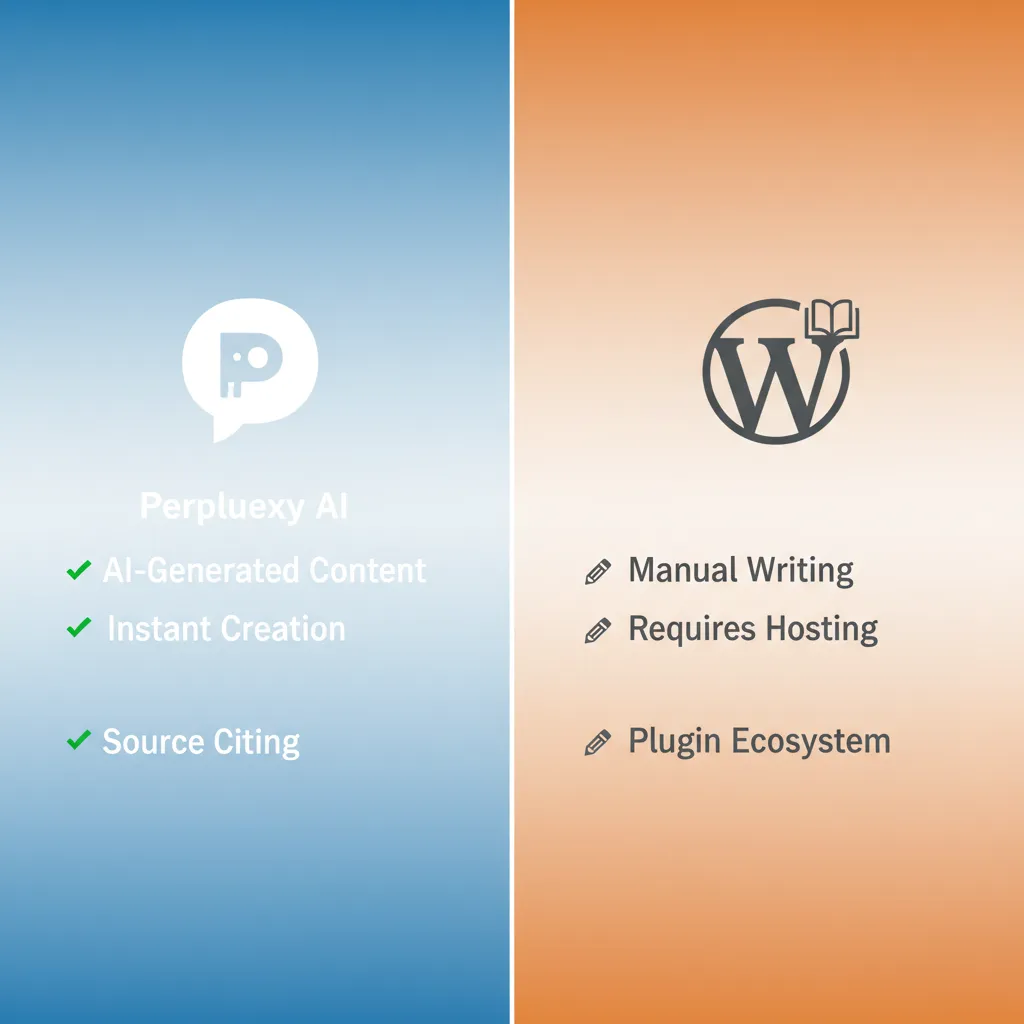
Alt Text: An infographic comparing the features of Perplexity Pages versus traditional blogging platforms like WordPress.
Perplexity Pages fundamentally shifts the starting point. With generic LLMs, you start with text and must add structure, formatting, and credibility. With Pages, you start with a structured, cited page and refine the text. This difference dramatically cuts down the editorial time required for compliance and quality control.
[Related: Mastering Prompt Engineering: Unlock Your AI Potential]
The Strategic Advantage: AI for SEO and Authority
Can Perplexity Pages truly revolutionize SEO content strategy? The answer is a qualified yes, primarily because it addresses the single biggest trust factor missing in most AI content generator tools: authority and verifiability.
1. E-E-A-T Compliance via Source Citation
Google’s emphasis on E-E-A-T (Experience, Expertise, Authoritativeness, and Trustworthiness) means that content must be backed by credible sources. When an AI-generated article contains cited links, it automatically establishes a foundation of trustworthiness.
For serious bloggers, journalists, and corporate content marketers, Pages provides a significant efficiency boost:
- Reduced Fact-Checking: The AI research assistant does the heavy lifting of linking facts to sources.
- Topical Authority: By synthesizing information from the web’s current top-ranking pages, the generated content is inherently topical and comprehensive, supporting a broader knowledge discovery strategy.
2. High-Quality Structured Content
The inherent structure of the output—clean H2s, H3s, and bulleted lists—is exactly what modern SEO demands. Google prefers easily digestible, logically structured content. Pages delivers this structured content AI output by default, saving hours that would otherwise be spent manually converting raw text into a publishable format.
Furthermore, by utilizing sophisticated models like Claude 3 Sonnet, the articles maintain high coherence and linguistic quality, minimizing the need for extensive rewriting to avoid the dreaded “robotic” tone that often plagues low-end AI writing tools.
3. Addressing the Future of Blogging
The future of blogging is not about eliminating human writers; it’s about amplifying their research and structuring capabilities. Perplexity Pages acts as a force multiplier for expert writers. Instead of spending 80% of their time on research and outlining, and 20% on writing and editing, writers can reverse that ratio. They start with a highly accurate, structured draft and dedicate their time to injecting unique expertise, personal examples, and unique insights—the elements only a human can provide.
This approach aligns perfectly with Google’s focus on helpful, people-first content, making Pages an ethical and powerful tool for automated content creation when used responsibly.
[Related: Harvesting Innovation: AI Revolutionizing Precision Agriculture]
Under the Hood: The Technology Powering Perplexity Pages
The sophisticated output of Perplexity Pages is not achieved by a single, monolithic model. Instead, it relies on an interconnected system that combines a powerful, proprietary search index with cutting-edge generative models.
1. The Role of Gemini, GPT-4, and Claude 3 Sonnet
Perplexity AI, and by extension Pages, operates model agnostically, but often uses high-performing models to generate the final prose.
- Claude 3 Sonnet: Known for its strong performance in complex reasoning, long context handling, and high-quality, articulate writing, Sonnet is often employed for generating the narrative flow and nuanced sections of the Page.
- GPT-4 and Gemini: These powerful models provide general intelligence and reasoning capabilities, ensuring the synthesis of information is logical and coherent.
The core ingenuity of Perplexity is how it directs these generative AI models to act strictly on the information retrieved from the real-time web, rather than relying solely on their internal training data.

Alt Text: An illustration showing how AI models like Claude 3 Sonnet power the content generation within Perplexity Pages.
2. The Perplexity Search Layer
The real differentiator for Perplexity AI remains its specialized search layer. This is not a standard Google search; it’s a dedicated AI search engine designed for rapid, precise, and contextual information retrieval.
When you ask Pages to create a webpage with AI about a specific topic, the engine doesn’t just retrieve 10 blue links; it performs deep, iterative queries to find answers to the implicit sub-questions of your topic. This deep dive facilitates unparalleled knowledge discovery and ensures the resulting text is accurate and current.
3. Customization: The Customizable AI Webpage
The resulting Page is essentially a customizable AI webpage. You can export the content in various formats (Markdown, HTML, PDF), but the structure is always ready for immediate use. This makes automated content creation truly seamless, particularly for teams who need to generate high volumes of fact-based content quickly.
The focus on the editable structure demonstrates Aravind Srinivas’s vision: the AI handles the research and organization; the human handles the nuance and distribution.
[Related: Quantum AI Unleashed: Reshaping Intelligence and Innovation]
Is Perplexity Pages Worth the Investment? A Final Review
The advent of Perplexity Pages marks a pivotal moment in the evolution of AI writing tools. It’s not just an AI content generator; it’s a fully integrated research, outlining, drafting, and citation tool.
Who is Perplexity Pages For?
- Professional Content Teams: Marketing agencies and in-house content departments focused on B2B, finance, health, or technology, where factual accuracy and AI source citation are paramount.
- SEO Professionals: Those seeking high-volume, authoritative content that supports a deep SEO content strategy and improves topical authority.
- Researchers and Academics: Individuals who need to quickly synthesize vast amounts of current information into reports and summaries.
- The serious Blogger/Affiliate Marketer: Anyone who understands that future SEO success depends on trustworthiness and comprehensive, structured answers.
The Verdict on Perplexity Pages Review
Perplexity Pages excels where generic generative AI fails: structure, citations, and real-time grounding. It transforms the often-tedious process of research-intensive long-form content creation into a highly efficient, quality-controlled workflow.
The necessity of Perplexity Pro to fully utilize the tool’s potential (especially unlimited access to the best models and advanced features) is the main barrier. However, for serious professionals relying on automated content creation for their livelihood, the time savings and quality increase easily justify the subscription cost.
It is perhaps the most significant step forward in making AI a truly credible and authoritative research and writing partner, solidifying its role as a premier AI blog writer for the future.
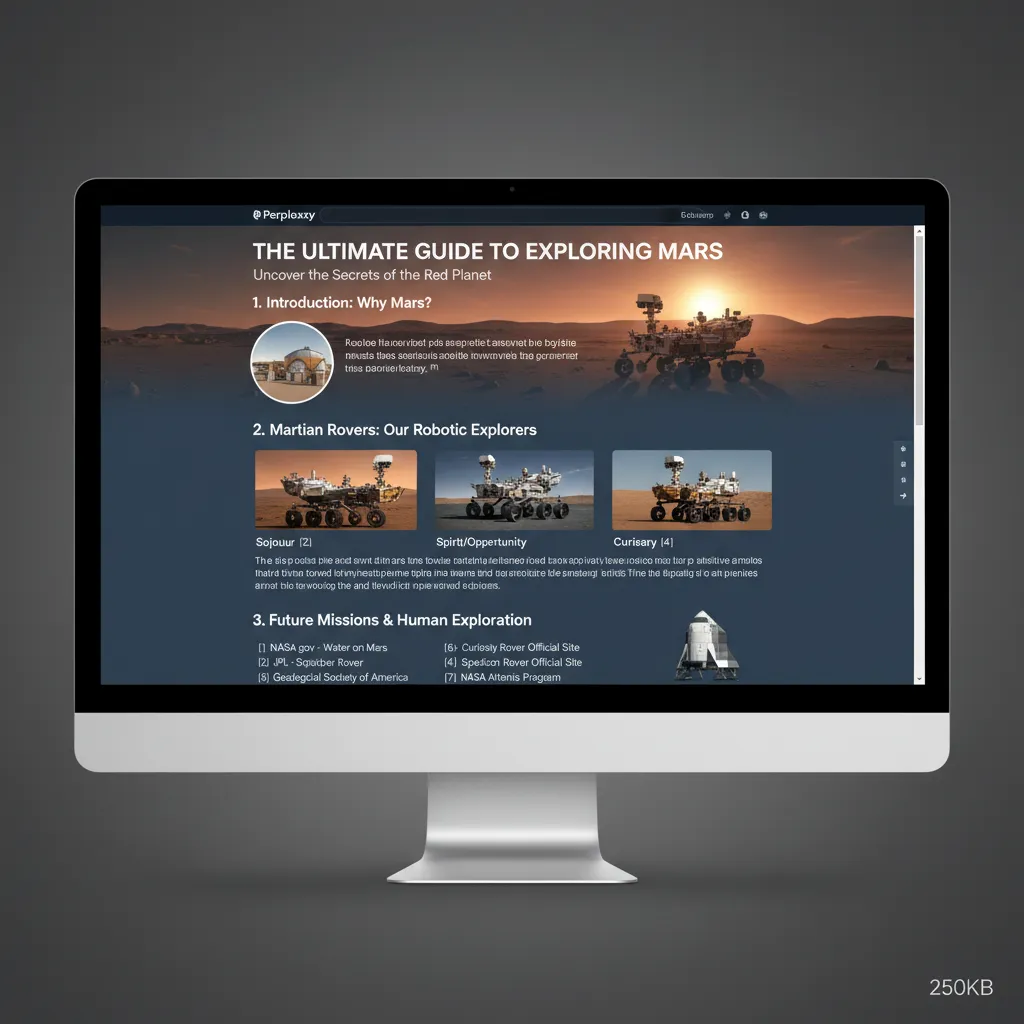
Alt Text: A visual representation of an AI-generated Perplexity Page about ‘exploring Mars’ showing cited sources and images.
Conclusion: The New Standard for AI-Generated Articles
Perplexity Pages is much more than a new feature; it is a declaration of intent from Perplexity AI. By blending its unparalleled AI search engine technology with advanced generative models like Claude 3 Sonnet, it has created an AI content generator that prioritizes trust, structure, and real-time accuracy.
For those dedicated to high-quality SEO content strategy, Pages offers a compelling solution for automated content creation without sacrificing E-E-A-T. It represents a mature evolution of generative AI, allowing users to effortlessly create webpage with AI that are not just readable, but authoritative and verifiable.
If you are looking to elevate your content workflow and ensure your AI-generated articles are grounded in verifiable reality, exploring Perplexity Pages—especially with a Perplexity Pro subscription—is essential for staying ahead in the ever-evolving future of blogging.
[Related: AI Video Generation: The Future of Content Creation]
FAQs (People Also Ask)
Q1. What is Perplexity Pages?
Perplexity Pages is an AI content generator feature within Perplexity AI that allows users to quickly generate comprehensive, structured, and cited long-form articles, reports, or tutorials on any topic. It functions by synthesizing real-time information and organizing it into a ready-to-publish webpage format, making it a powerful AI blog writer.
Q2. How does Perplexity Pages differ from ChatGPT or other LLMs?
The key difference lies in grounding and structure. Perplexity Pages uses its AI search engine to cite real-time sources for every major claim (AI source citation), drastically reducing hallucination. Furthermore, it automatically organizes the output into a professional, multi-section structure (structured content AI), unlike generic LLMs which primarily output raw text.
Q3. Do I need Perplexity Pro to use Perplexity Pages?
While basic access to Perplexity Pages may be available to free users, utilizing the most advanced features—such as unlimited access to the highest-tier models like Claude 3 Sonnet, longer page generation, and enhanced customization—typically requires a Perplexity Pro subscription. Pro users benefit most from the comprehensive AI research assistant capabilities.
Q4. Is Perplexity Pages good for SEO content strategy?
Yes, Perplexity Pages is highly beneficial for AI for SEO. Its emphasis on factual accuracy, AI source citation, and automatically generating well-structured, comprehensive long-form content directly supports Google’s E-E-A-T guidelines, making it a strong tool for developing topical authority and improving SEO content strategy.
Q5. How does Perplexity AI handle knowledge discovery for Pages?
Perplexity AI leverages advanced internal algorithms that function as an integrated AI search engine. This system performs deep, iterative queries on the web, facilitating precise knowledge discovery. It synthesizes information from these verifiable sources, ensuring the resulting content is both current and accurate.
Q6. What kinds of content can I create with Perplexity Pages?
You can create webpage with AI content for a wide variety of formats, including detailed guides, educational tutorials, research summaries, product comparisons, detailed reviews, and high-level reports. The flexibility in setting the length and audience tone makes it suitable for almost any long-form AI-generated articles requirement.
Q7. Who is Aravind Srinivas?
Aravind Srinivas is the co-founder and CEO of Perplexity AI. He is a prominent figure in the generative AI space, having previously worked at OpenAI and DeepMind. He is credited with leading the development of Perplexity AI as a specialized AI search engine focused on grounded answers and verifiable information, which is the foundation for features like Perplexity Pages.
Q8. What is the benefit of the customizable AI webpage feature?
The customizable AI webpage feature allows users to edit the generated content, rearrange sections, add or delete headers, and integrate media directly within the Pages interface. This ensures that the automatically generated content can be quickly refined to align with specific brand guidelines, editorial tones, or unique insights only a human editor can provide, thus making automated content creation truly adaptable.