On-Device AI: The Next Revolution in Tech

Introduction: The Tipping Point for Local Intelligence
For the past decade, Artificial Intelligence has been defined by the cloud. Massive data centers, connected by high-speed internet, crunch unfathomable datasets to power everything from complex language models to streaming recommendations. This centralized model, while powerful, has faced fundamental limitations: dependency on connectivity, unavoidable latency, and serious questions regarding user privacy.
We are now at a pivotal moment. The revolution isn’t about AI getting smarter—it’s about AI getting closer.
The convergence of more efficient AI models, specialized processing chips, and the insatiable demand for instant, personalized experiences is pushing intelligence away from the distant server farm and directly onto the physical devices we use every day. This is the world of on-device AI (also known as edge AI), and it is fundamentally reshaping the landscape of technology, making it faster, more private, and entirely independent.
In this deep dive, we will explore the core concepts of edge computing AI, dissect the advantages of this shift toward local AI processing, examine the hardware innovations powering this new era, and look at the profound implications for privacy and the future of AI without internet. If you’ve ever wondered how your smartphone performs real-time translations instantly, or how your smart watch detects anomalies without uploading your data, you’re already witnessing the power of this paradigm shift.
Defining the Edge: What Exactly is On-Device AI?
To understand the revolution, we must first clearly define the terms.
On-device AI refers to the execution of machine learning models directly on the hardware of an endpoint device—be it a smartphone, a smart speaker, a drone, or an industrial sensor—rather than relying on a remote cloud server. This is the essence of local AI processing.
This concept is part of the broader domain of edge computing AI. In a traditional cloud-based system, the “edge” is where data is collected (your device), and all processing happens in the central cloud. In an edge AI system, a significant portion of the computational workload is shifted to the edge itself.
The Role of Embedded AI Systems
This shift requires embedded AI systems—highly optimized hardware and software stacks designed to handle complex algorithms within tight constraints. Unlike the practically limitless power of a data center, edge devices operate with finite battery life, memory, and processing capabilities. This constraint has spurred innovation in model compression, quantization, and specialized silicon.
The objective is simple: to bring inference (the act of using a trained AI model to make a prediction or decision) as close to the data source as possible. This approach drastically changes the user experience, providing instant responses and keeping sensitive data localized.
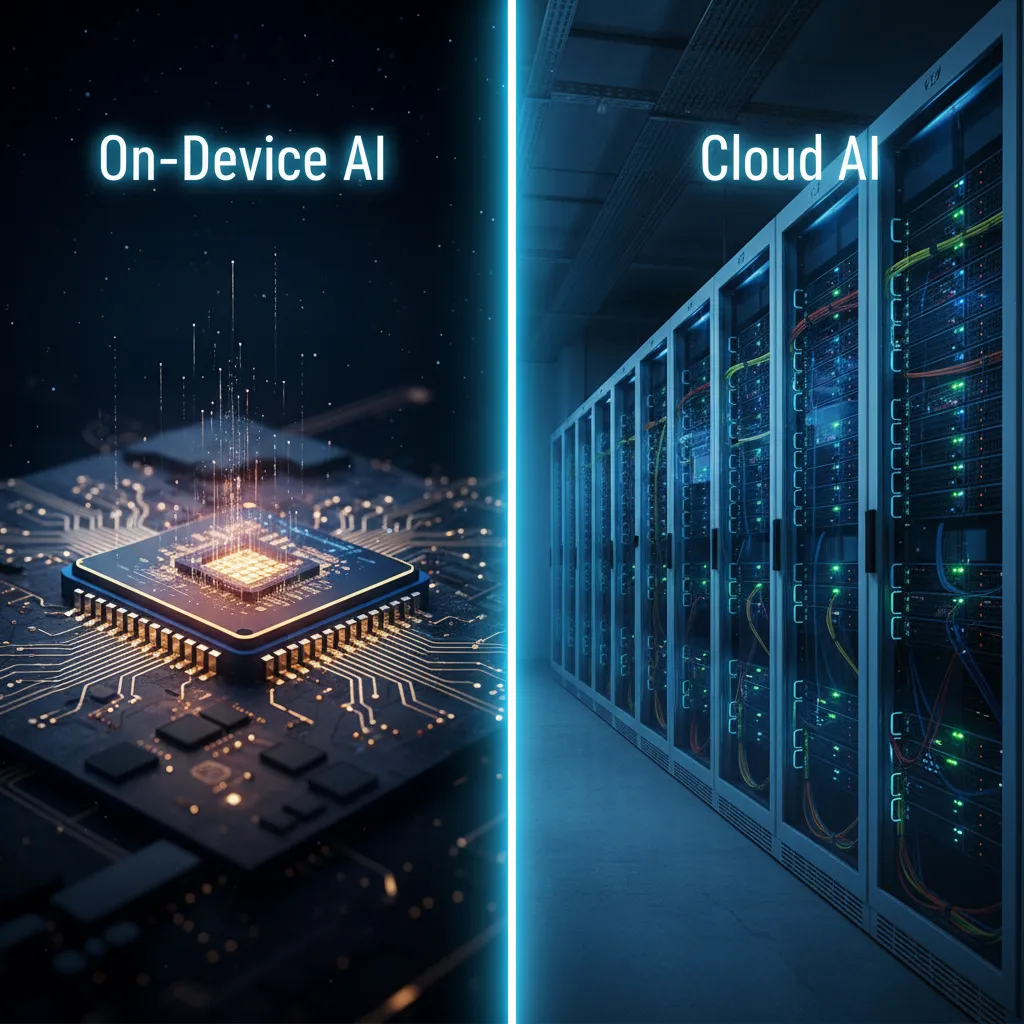
The Architectural Shift: On-Device AI vs. Cloud AI
The core difference between on-device and cloud AI is the location of the computation. This single variable generates cascading effects across four critical areas: latency, connectivity, privacy, and cost.
| Feature | On-Device AI (Edge AI) | Cloud AI (Centralized AI) |
|---|---|---|
| Processing Location | On the endpoint device (smartphone, camera, car) | Remote server farm/data center |
| Data Transmission | Minimal or none; data stays local | High bandwidth required to send data to the cloud |
| Latency | Very Low Latency AI (milliseconds or less) | Higher (dependent on network speed and distance) |
| Connectivity | Operates fully as offline AI or with minimal connection | Requires constant, reliable internet access |
| Privacy/Security | High; data never leaves the user’s device (privacy-focused AI) | Lower; data must be transmitted and stored by a third party |
| Model Size | Requires efficient AI models; typically smaller, optimized models | Can utilize extremely large, complex, and unconstrained models |
| Power | Higher immediate device power consumption (mitigated by NPU) | Minimal device power consumption; high data center energy use |
Latency and Real-Time Processing
For many critical applications, speed is paramount. Consider autonomous driving, augmented reality filters, or real-time language translation. Even a fraction of a second delay caused by sending data to the cloud and waiting for a response (the “round-trip latency”) can be detrimental.
Low latency AI is a primary driver for the adoption of edge AI. By executing the AI model right on the device, the time-consuming process of network transmission is eliminated. This capability unlocks applications requiring immediate decision-making and real-time AI processing that were previously impossible to implement reliably. For example, a drone needs to identify obstacles and adjust its flight path immediately, not after contacting a server hundreds of miles away.
Privacy and Data Sovereignty
Perhaps the most compelling argument for privacy-focused AI and edge processing is data sovereignty. In the cloud model, sensitive personal data—voice commands, photos, medical readings, financial transactions—must be uploaded to a third-party server. This exposes the data to interception, breaches, and mass surveillance. [Related: navigating-ai-ethics-governance-bias-trust-ai-era/]
AI privacy and security are inherent features of on-device computing. When the inference happens locally, the raw, sensitive data never leaves the user’s device. For example, modern voice assistants often use on-device machine learning to recognize your wake word, only sending the command to the cloud after the local model has already screened and processed it. This architecture drastically enhances user trust and regulatory compliance, particularly in sensitive sectors like health and finance.
The Unmissable Advantages of Edge AI
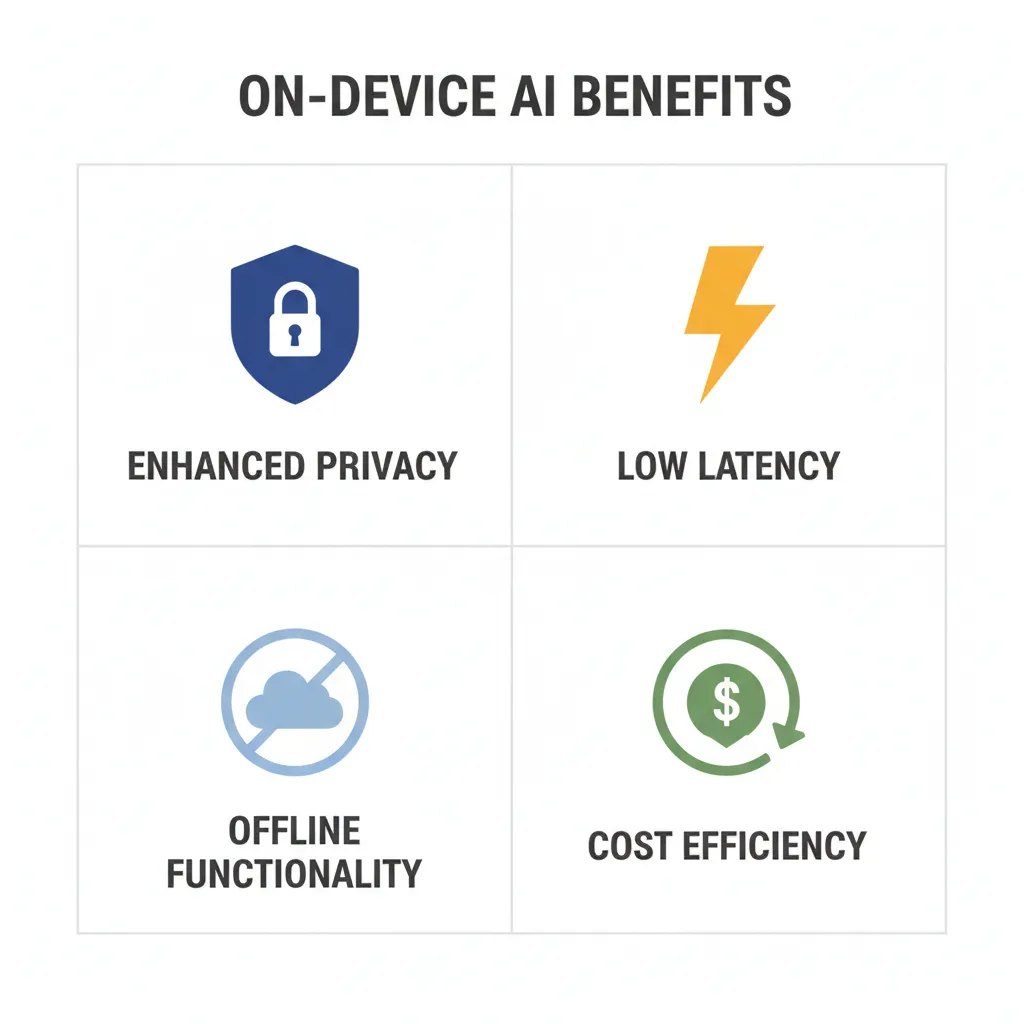
The benefits of relocating intelligence to the edge extend far beyond privacy and speed, offering robust improvements in reliability and operational cost. These advantages of on-device AI are why major tech players are investing billions in edge hardware and software.
1. Robust Offline Functionality
The dependence on constant Wi-Fi or cellular service is a major bottleneck for cloud AI. Edge AI sidesteps this entirely. Since the models reside locally, applications can function seamlessly, providing offline AI capabilities essential for remote locations, air travel, or environments with inconsistent connectivity. A navigation app that uses local AI to analyze traffic patterns based on cached data, or a medical device monitoring a patient in a remote clinic, both demonstrate the power of AI without internet.
2. Lower Operational Costs
While training large AI models remains expensive, running the inference on billions of consumer devices saves cloud providers massive amounts of money. Each successful piece of local AI processing that avoids a data center query translates into lower server bandwidth usage, less power consumption in the server farm, and fewer infrastructure maintenance costs for the service provider.
3. Energy Efficiency (Device Level)
It might seem counterintuitive, but dedicated on-device AI chips are often more energy efficient for AI tasks than general-purpose CPUs or GPUs running the same model. These specialized units, designed specifically for the linear algebra common in neural networks, can perform inference with much greater power efficiency.
4. Customization and Personalization
Edge AI allows for truly personalized experiences. Since the model operates on your device, it can continuously learn and fine-tune itself based only on your local data and habits, creating a bespoke user profile that never needs to be uploaded to a shared cloud.
The Hardware Engine: Accelerating On-Device Machine Learning
The shift to on-device machine learning would be impossible without a simultaneous revolution in silicon design. The hardware landscape has evolved rapidly to support the complex math required by neural networks within the thermal and power envelope of mobile and smart device AI.
On-Device AI Chips: NPUs and Accelerators
The key enabler is the proliferation of dedicated on-device AI chips, generally referred to as Neural Processing Units (NPUs) or AI Accelerators. These are specialized microprocessors designed to handle the matrix multiplication and convolution operations at the heart of AI computation far more efficiently than standard Central Processing Units (CPUs) or even Graphics Processing Units (GPUs).
Major Players: Apple, Qualcomm, and Google
Every major technology manufacturer has invested heavily in proprietary AI hardware acceleration to gain a competitive edge in mobile AI applications.
Apple Neural Engine (ANE)
Apple was an early pioneer, integrating the Apple Neural Engine (ANE) starting with the A11 Bionic chip. The ANE is specifically designed to perform inference tasks like facial recognition (Face ID), Siri processing, and sophisticated computational photography. The integration of Apple Intelligence, which heavily relies on the ANE for on-device processing and personalization, showcases the power and security of this local processing architecture. [Related: apple-intelligence-ios-18-new-ai-guide/]
Qualcomm AI Engine
Qualcomm, a leader in mobile system-on-chips (SoCs), utilizes its Qualcomm AI Engine across its Snapdragon platforms. This engine combines the Sensing Hub, the Hexagon NPU, Adreno GPU, and Kryo CPU to deliver comprehensive AI processing capabilities. Qualcomm’s focus is on scaling edge AI across a vast ecosystem, from flagship phones to IoT devices and automotive systems.
Google’s On-Device AI
Google has made significant strides in optimizing its models for local use. While it uses Tensor Processing Units (TPUs) in the cloud, its mobile devices (like the Pixel line) rely on the Tensor chip’s built-in AI components to handle tasks like Live Translate, Call Screening, and advanced image processing. Google’s on-device AI strategy focuses heavily on optimizing its vast range of open-source and proprietary models (like Gemini Nano) to be highly efficient AI models that run locally.
The Rise of TinyML: AI in Miniature
Beyond high-powered smartphones, there’s a rapidly growing field called tinyML (Tiny Machine Learning). This focuses on optimizing machine learning models to run on extremely low-power microcontrollers and embedded devices, often operating on milliwatts of power.
TinyML is crucial for integrating intelligence into billions of small sensors, wearables, and industrial components where battery life and cost are the strictest constraints. Examples include:
- Vibration analysis in factory equipment to predict maintenance needs.
- Keyword spotting in hearing aids.
- Environmental monitoring sensors that classify sounds or images at the source without transmitting the raw data.
Real-World Applications: AI in Your Pocket and Beyond
The shift to AI on edge devices is not abstract; it’s already powering essential daily functions, proving that real-time AI processing is not just a luxury, but a necessity. The examples below demonstrate how various on-device AI examples are improving security, efficiency, and accessibility.
1. Smartphones and Personal Computing
The modern AI on smartphone experience is largely defined by local processing.
- Computational Photography: Features like portrait mode, scene recognition, and noise reduction are often run entirely by the NPU. This instantaneous processing allows the user to see the enhanced image preview in real time, even before the photo is taken.
- Dictation and Autocorrect: Next-generation keyboard apps use small, powerful language models to predict text, correct grammar, and transcribe speech locally.
- Real-Time Language Translation: This is a classic example of low latency AI. A model translates spoken words almost instantaneously, eliminating the stutter and lag associated with cloud-based translation.

2. IoT and Smart Devices
The Internet of Things (IoT) is arguably the biggest beneficiary of edge computing AI. Every node in an IoT network—from a smart refrigerator to a city traffic light—is a potential edge device.
- Smart Security Cameras: Instead of streaming hours of footage to the cloud for analysis, these cameras now run object detection models locally. They only upload a short clip after recognizing a human or vehicle, saving bandwidth and improving detection speed.
- Predictive Maintenance: In manufacturing, sensors with embedded AI systems constantly analyze machine sounds and vibrations. They can predict equipment failure hours or days in advance, allowing for preemptive maintenance and avoiding costly downtime.
- Smart Home Systems: Local processing allows smart hubs to manage routines and interactions (e.g., locking doors or adjusting thermostats) even during internet outages, maintaining reliability and responsiveness.
3. Automotive and Robotics
Autonomous vehicles require instantaneous decision-making based on complex sensor data. A car cannot wait for a cloud server to determine if an object in the road is a plastic bag or a pedestrian.
- Vehicle Perception: Cameras and LiDAR systems run multiple neural networks on specialized on-device AI chips to detect lanes, other vehicles, pedestrians, and obstacles in milliseconds, ensuring the safety of the vehicle and its occupants.
- Robot Navigation: Industrial robots and warehouse drones use local AI models to map their environment, plan routes, and avoid dynamic obstacles in real time, making them efficient and safe in complex logistical environments. [Related: depin-daily-life-decentralized-networks-smarter-cities/]
The Road Ahead: Challenges and the Future of Decentralized AI
While the shift to the edge offers incredible benefits, it is not without significant technical hurdles. The future success of on-device AI hinges on solving critical challenges related to model size, power consumption, and decentralized management.
Model Efficiency and Optimization
One of the greatest engineering challenges is shrinking vast, powerful AI models (like large language models or complex computer vision architectures) down to a size that can run efficiently on a tiny chip with limited memory. This requires sophisticated techniques:
- Quantization: Reducing the precision of the numerical values (e.g., from 32-bit floating point to 8-bit integer) used in the model weights, dramatically shrinking the model size and speeding up computation with minimal performance loss.
- Pruning and Distillation: Removing unnecessary weights and connections (pruning), or training a small “student” model to mimic the behavior of a much larger “teacher” model (distillation).
- Hardware-Software Co-design: Designing the model architecture (software) specifically to leverage the unique capabilities of the AI hardware acceleration (chips).
Creating these efficient AI models is a continuous race, as device manufacturers push the boundaries of what is possible within a thermal envelope.
The Rise of Decentralized AI
The ultimate evolution of edge AI is decentralized AI. Instead of a single entity (like Google or Apple) owning the AI infrastructure, the collective intelligence is distributed across all participating devices.
Federated Learning is a key concept here. It allows many users’ devices to collaboratively train a shared machine learning model without ever exchanging raw data. Each device calculates updates based on its local data and securely sends only the summary of those updates back to a central server, which aggregates them to improve the global model. This approach maximizes user privacy while still allowing the AI to learn from the diversity of real-world data.
This future iteration promises an era where personalization, privacy, and performance are maximized, moving the world closer to a truly distributed intelligence network.
Security and Update Management
Managing and updating millions or billions of locally deployed AI models presents a logistical challenge. How do manufacturers ensure models are secure against tampering and are updated consistently without disrupting the user experience? Reliable Over-The-Air (OTA) update mechanisms, strong encryption, and tamper-proof hardware must be integrated into every on-device AI system to maintain the integrity of the intelligence and protect user data.
Conclusion: Intelligence, Unbound
On-device AI is far more than a technical upgrade; it is a fundamental shift in how we interact with technology and how we safeguard our personal data. By moving the processing power to the edge, we are resolving the core trade-off between convenience and privacy that has plagued the digital world for years.
The revolution, driven by innovations like tinyML, dedicated NPUs such as the Apple Neural Engine and Qualcomm AI Engine, and the increasing demand for low latency AI, is creating a future where devices are intelligently autonomous, responsive, and trustworthy, even when completely disconnected.
This trend is not slowing down. As hardware becomes more powerful and efficient AI models continue to shrink, the line between what can be done in the cloud and what must be done on the device will increasingly favor the edge. For consumers and enterprises alike, embracing this revolution means stepping into an era of unprecedented speed, reliability, and AI privacy and security. The future of AI is here, and it resides in the palm of your hand, in your car, and in every smart sensor around you.
The question is no longer if AI can perform a task, but where it will perform it. And increasingly, the answer is: locally.
[Related: ai-tutors-revolutionizing-personalized-education/]
FAQs: Understanding On-Device AI
Q1. What is on-device AI?
On-device AI, or edge AI, refers to the processing and execution of machine learning models directly on the local hardware of an end-user device (like a smartphone, computer, or IoT sensor) rather than relying on a connection to a remote cloud server. This enables local AI processing for faster, more private operation.
Q2. How is on-device AI different from cloud AI?
The primary difference lies in the processing location. Cloud AI sends data to a distant server for analysis and receives the result back, requiring reliable internet and suffering from network latency. On-device AI processes data locally, offering low latency AI, offline AI capability, and significantly enhanced data privacy because sensitive information never leaves the device.
Q3. Why is edge AI considered better for privacy and security?
Edge AI is inherently a privacy-focused AI solution because all sensitive data processing occurs locally. The raw data—such as voice recordings, photos, or biometric scans—does not need to be transmitted or stored on third-party cloud servers, mitigating the risks associated with data breaches, interception, and mass surveillance, thus ensuring greater AI privacy and security.
Q4. What specific hardware enables on-device machine learning?
On-device machine learning is enabled by specialized integrated circuits called Neural Processing Units (NPUs) or AI Accelerators. These include components like the Apple Neural Engine, Qualcomm AI Engine, or dedicated modules within Googles on-device AI systems. These chips are optimized for the mathematical operations required by neural networks, making them faster and far more energy-efficient for AI tasks than standard CPUs or GPUs.
Q5. What are common on-device AI examples?
Common on-device AI examples include instant computational photography features (like portrait mode or scene detection on smartphones), real-time language translation, local voice assistant wake-word detection, advanced autocorrect and text prediction, and object detection in smart security cameras. These rely on real-time AI processing and often function as offline AI.
Q6. What is tinyML and why is it important for the future of AI?
TinyML (Tiny Machine Learning) is a specialized subset of edge computing AI focused on running machine learning models on extremely resource-constrained devices, such as microcontrollers that operate on milliwatts of power. It is crucial because it allows billions of small, ubiquitous smart device AI sensors and wearables to gain intelligence, leading to pervasive decentralized AI across the physical world.
Q7. Does on-device AI mean the end of cloud AI?
No. On-device AI and cloud AI are complementary. The cloud remains essential for resource-intensive tasks such as training the massive, generalized AI models and handling heavy processing for non-time-critical applications. On-device AI is best for high-speed inference, personalization, and high-privacy applications, while the cloud handles the heavy lifting of data aggregation and foundational model training. They will continue to operate in a hybrid model.
Q8. What is a key challenge for implementing on-device AI?
A key challenge is creating efficient AI models. Developers must constantly find ways to compress the size of highly complex models (like LLMs) through techniques like quantization and pruning so that they can run effectively on devices with limited memory, thermal, and battery capacity, without significantly sacrificing performance.