Neuromorphic Computing: Unlocking AI’s Next Frontier & Brain-Inspired Tech

Introduction
Artificial intelligence is undergoing an explosive transformation. From generating entire videos with a simple text prompt to powering the next wave of personalized health, AI’s capabilities are expanding at a breathtaking pace. Yet, beneath this progress lies a looming challenge: the immense and ever-growing demand for computational power. Training a single large language model can consume as much energy as a small town, a reality that presents a significant bottleneck for future AI innovation and sustainability.
What if we could build AI that thinks more like us? Not just in its ability to reason, but in the very fabric of its hardware. This is the revolutionary promise of neuromorphic computing, a radical departure from traditional computer design. Instead of forcing AI to run on rigid, power-hungry architectures, this brain-inspired AI approach builds processors that mimic the structure and function of the human brain itself.
In this deep dive, you’ll discover the fascinating world of neuromorphic computing. We’ll explore how these advanced AI architectures are poised to solve AI’s energy crisis, enable powerful real-time processing on a new generation of devices, and potentially pave the way for true cognitive computing. Get ready to learn about the future of machine learning, from spiking neural networks to the groundbreaking chips that are defining AI’s next frontier.
The Silicon Ceiling: Why Traditional AI Hardware is Hitting a Wall
For over 70 years, modern computing has been dominated by the Von Neumann architecture. This design, found in everything from your smartphone to the most powerful supercomputers, is based on a simple but profound concept: separating the central processing unit (CPU) from the memory (RAM). The CPU fetches instructions and data from memory, performs a calculation, and writes the result back.
This has worked remarkably well, but for AI workloads, it creates a massive traffic jam. AI models, especially deep learning networks, require moving colossal amounts of data back and forth between memory and processing units. This constant shuffling creates two critical problems:
- The Memory Wall: The processor often sits idle, waiting for data to arrive from memory. The speed of data transfer, not the processor’s speed, becomes the limiting factor, creating a significant performance bottleneck.
- The Power Drain: This continuous data movement is incredibly energy-intensive. It’s the primary reason why data centers running AI models have such a massive carbon footprint, a growing concern in the push for sustainable AI computing. Related: AI’s Green Revolution: Powering Climate Change Solutions
This fundamental limitation of the Von Neumann design is forcing researchers to look for a new AI computing paradigm. The inspiration for that new paradigm is the most efficient and powerful computer we know: the human brain.
What is Neuromorphic Computing? Engineering a Brain on a Chip
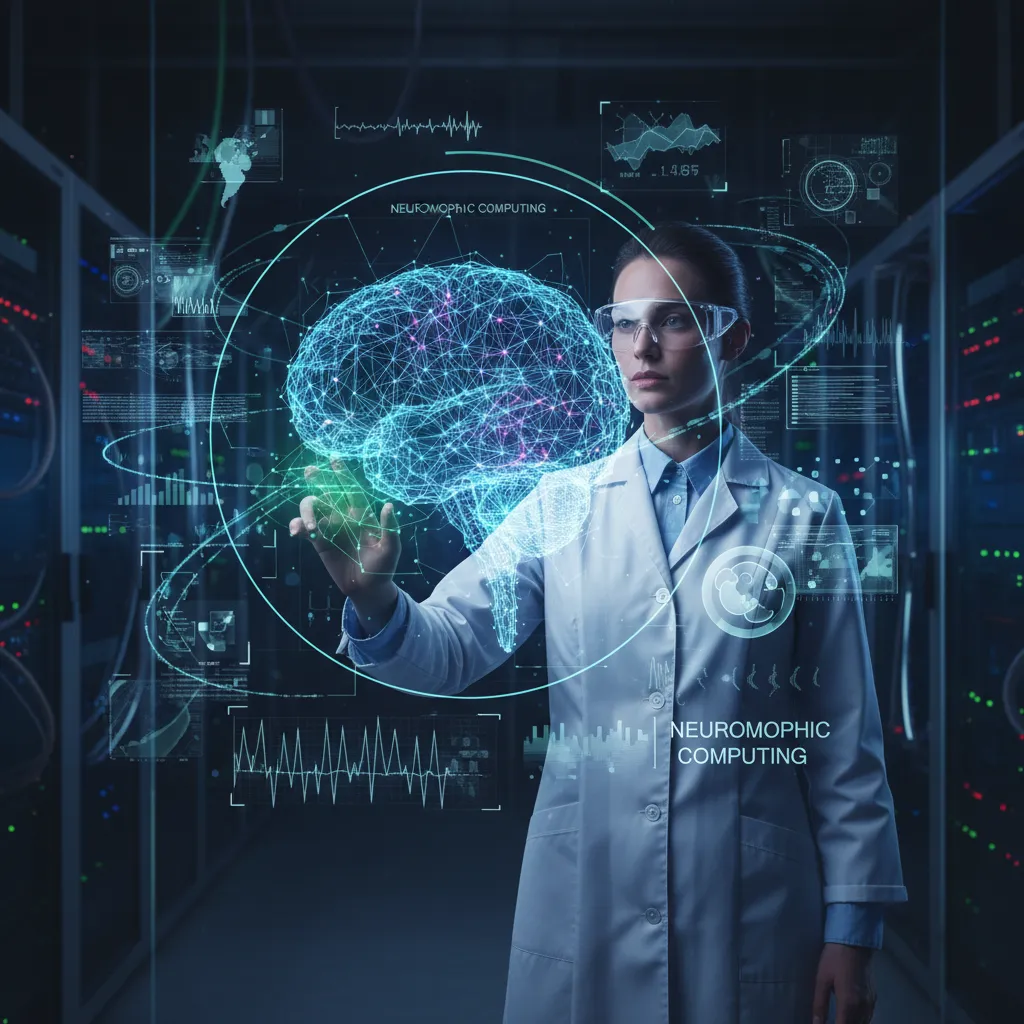
Neuromorphic computing is an approach to computer engineering that models its systems on the biological brain’s structure. Instead of processing information in a linear, sequential fashion like a traditional computer, a neuromorphic chip operates with a vast network of interconnected artificial neurons and synapses, enabling a form of parallel processing AI that is both incredibly efficient and powerful.
This brain-like AI doesn’t just copy the structure; it mimics the brain’s method of communication. It’s an event-driven AI system, which is the secret sauce to its remarkable efficiency.

The Core Principles of Brain-Inspired AI
To truly grasp the AI advancements offered by neuromorphic systems, we need to understand their foundational pillars, which are deeply rooted in neuroscience.
1. Artificial Neurons and Synapses
Just like our brains, neuromorphic chips are built from basic components:
- Neurons: These are the processing nodes. In silicon, they are circuits designed to receive signals, accumulate electrical charge, and “fire” a pulse or “spike” when a certain threshold is reached.
- Synapses: These are the connections between neurons. They have “weights” that determine the strength of the connection, allowing the network to learn and adapt by strengthening or weakening these pathways over time. Advanced research in this area explores using components like memristors for AI to create more dynamic and efficient artificial synapses.
2. Spiking Neural Networks (SNNs)
This is perhaps the most significant departure from conventional AI. Most deep learning models today use Artificial Neural Networks (ANNs), which process data in dense, continuous streams. In every processing cycle, every neuron in the network is activated, performing a calculation whether the input has changed or not.
Spiking Neural Networks (SNNs), the software of neuromorphic hardware, are fundamentally different. They operate on the principle of “spikes” – discrete, asynchronous events that occur only when a neuron’s input threshold is crossed.
- Sparsity and Efficiency: Information is encoded in the timing and pattern of these spikes. A neuron only consumes power when it actively sends a spike. If nothing is happening in its input field, it remains silent. This sparsity makes SNNs extraordinarily energy-efficient, often using orders of magnitude less power than ANNs for the same task. This is the cornerstone of low-power AI.
- Temporal Processing: Because SNNs are inherently time-based, they are exceptionally good at processing real-world sensory data that unfolds over time, like sound, video, and touch.
3. Colocation of Memory and Processing
Neuromorphic chips smash the Von Neumann bottleneck by integrating memory and processing directly. Each artificial neuron has its own localized memory, just as biological synapses store their own connection strengths. By eliminating the need to constantly ferry data across a bus to a separate memory bank, these chips drastically reduce latency and power consumption, enabling true real-time AI processing.
The Architects of the AI Hardware Future: Key Neuromorphic Chips
The journey from neuroscience theory to functional silicon is being led by pioneering research from tech giants and academic institutions. These next-gen AI processors are no longer just lab experiments; they are tangible pieces of the AI hardware future.
Intel’s Loihi: A Chip That Learns on the Fly
Intel has been a major force in the AI hardware research space with its Loihi series of research chips.
- Loihi 1: Introduced in 2017, this chip featured 128,000 artificial neurons and was designed for on-chip learning. It demonstrated remarkable efficiency in tasks like gesture recognition and recognizing smells, using thousands of times less energy than conventional CPUs.
- Loihi 2: The second generation, released in 2021, is faster, more programmable, and more efficient. It packs up to a million neurons on a single chip and allows for more flexible SNN architectures. Loihi 2 is being used by researchers to explore applications in robotics, drone navigation, and developing prosthetic limbs that can process sensory feedback in real-time.
IBM’s NorthPole: A New Direction for Cognitive Computing
IBM has a long history in brain-inspired computing, starting with its TrueNorth chip. Their latest breakthrough, NorthPole, represents another massive leap forward.
- Breaking the Mold: Announced in 2023, NorthPole is designed to be a “digital brain” that excels at inference tasks like image and speech recognition.
- Unprecedented Performance: In benchmark tests, NorthPole has shown to be significantly faster and more energy-efficient than any other chip in its class, including top-tier GPUs. Its unique architecture intertwines processing and memory at an extremely fine-grained level, showcasing the power of this advanced AI architecture.
These chips from Intel and IBM, along with others like the SpiNNaker project and BrainChip’s Akida, are proving that the principles of bio-inspired AI can be translated into powerful, efficient hardware, driving major AI breakthroughs.
Neuromorphic vs. Traditional Computing: A Paradigm Shift
To put the innovation of neuromorphic computing into perspective, it’s helpful to see a direct comparison with the traditional Von Neumann systems we use every day. This isn’t just an incremental improvement; it’s a fundamental change in AI computing paradigms.
| Feature | Traditional Computing (Von Neumann) | Neuromorphic Computing (Brain-Inspired) |
|---|---|---|
| Architecture | Separate CPU and Memory (RAM) | Integrated memory and processing units |
| Data Processing | Synchronous, clock-driven, sequential | Asynchronous, event-driven (spikes) |
| Communication | Data moved over a central bus | Massive parallel communication via synapses |
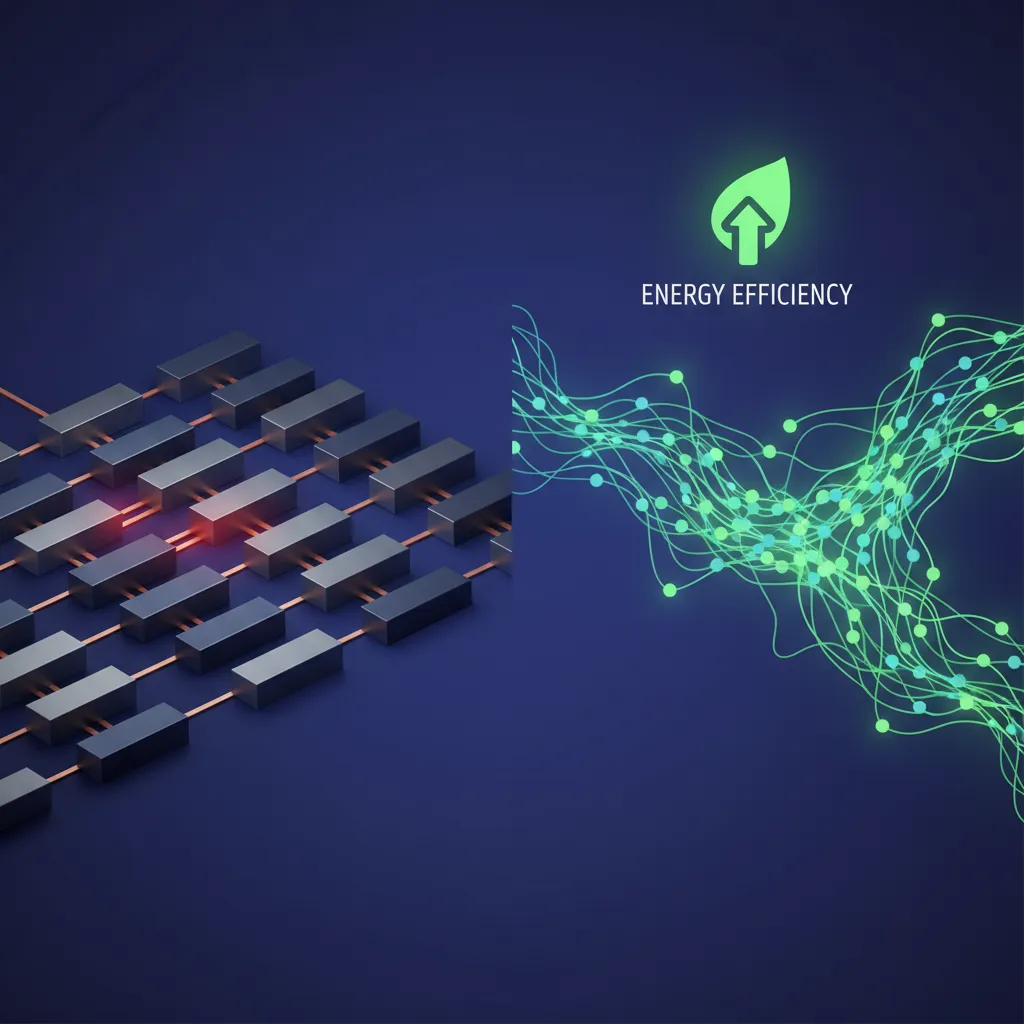
| Energy Usage | High, especially during data transfer | Extremely low, consumes power only when active |
| Learning | Typically offline training | Enables on-chip, continuous, real-time learning |
| Best For | Precise, deterministic calculations (math, logic) | Pattern recognition, sensory data, adaptive control |
| AI Approach | Artificial Neural Networks (ANNs) | Spiking Neural Networks (SNNs) |
This table illustrates why the future of machine learning is likely to be a hybrid one, where different architectures are used for the tasks they are best suited for. While traditional systems will remain essential for high-precision tasks, neuromorphic systems are set to dominate in areas where AI needs to interact with the messy, unpredictable real world.
Real-World Applications: Where Brain-Inspired AI is Making an Impact
Neuromorphic computing is moving beyond the lab and into practical applications that leverage its unique strengths of efficiency and real-time responsiveness.
Smarter and Longer-Lasting Edge Devices
The biggest immediate impact of neuromorphic chips will be in edge computing. AI for edge devices refers to running AI models directly on devices like sensors, cameras, smartphones, and wearables, rather than sending data to the cloud.
The extreme low-power AI capabilities of neuromorphic processors mean they can run complex pattern-recognition tasks for months or even years on a small battery. Imagine:
- Smart Home Sensors: A smoke detector that can not only detect smoke but also smell the specific chemical signature of an electrical fire versus burnt toast, all while running for a decade on a single battery.
- Industrial IoT: Factory sensors that can listen to machinery and predict a failure based on subtle changes in vibration patterns, preventing costly downtime.
- Wearable Health Monitors: A device that continuously analyzes your heart rhythm with high fidelity to detect arrhythmias, a task that would drain a conventional processor’s battery in hours. Related: AI Personalized Health: The Future of Wellness

Real-Time Sensory Processing and Robotics
The brain is a master of processing sensory data in real time, and neuromorphic chips excel at the same thing.
- Machine Vision: A drone equipped with a neuromorphic vision sensor could navigate a cluttered forest by reacting to obstacles in milliseconds, much like an insect does, rather than processing full video frames.
- Audio Processing: Always-on voice assistants that can recognize a specific wake-word with near-zero power consumption, dramatically extending battery life.
- Robotics: A robotic arm with neuromorphic sensors in its fingertips could learn to handle delicate objects by “feeling” the pressure and texture, adjusting its grip in real time.
Healthcare and Scientific Discovery
The ability of AI and neuroscience to converge in hardware opens up incredible possibilities.
- Advanced Prosthetics: Prosthetic hands that can receive spike-based signals from a user’s nerves, allowing for intuitive control and even a sense of touch.
- Early Disease Detection: By analyzing complex biological signals in real time, neuromorphic devices could provide early warnings for conditions like seizures or cardiac events. Related: AI Medical Marvel: Early Disease Detection & Personalized Treatment
- Drug Discovery: Simulating how complex molecules interact within the brain is a computationally intensive task perfectly suited for brain-like architectures, potentially accelerating the search for new medicines.
The Road Ahead: Challenges and the Quest for AGI
Despite its immense promise, the path to widespread adoption of neuromorphic computing is not without its challenges.
- New Programming Models: Developers are used to writing code for sequential processors. Programming for SNNs on asynchronous, parallel hardware requires a complete shift in thinking and new software tools.
- Algorithm Development: Translating the most successful deep learning models (like transformers) into the spiking domain is an active and complex area of research.
- Manufacturing and Scale: Fabricating these complex, brain-like circuits is a cutting-edge AI chip design challenge that requires specialized techniques.
Beyond these hurdles lies one of the most exciting future tech trends: the potential role of neuromorphic computing in the development of Artificial General Intelligence (AGI). Many researchers believe that achieving human-like intelligence will require more than just bigger models and faster processors; it will require artificial general intelligence hardware that can learn, adapt, and reason with the same efficiency and flexibility as the brain. Neuromorphic architectures are our most promising blueprint for building that hardware.
Conclusion: A New Dawn for Artificial Intelligence
Neuromorphic computing is more than just an incremental step in AI; it’s a fundamental reimagining of what a computer is and how it operates. By taking inspiration from the 3.5 billion years of R&D that produced the human brain, we are on the cusp of an AI innovation that promises to be more powerful, more efficient, and more integrated with our world than ever before.
From enabling tiny, intelligent sensors that can run for years to providing the potential hardware backbone for future general intelligence, this brain-inspired paradigm shift is solving the critical energy and performance bottlenecks that threaten to slow down AI’s progress. The work being done by pioneers like Intel and IBM is laying the groundwork for a future where computation is not only smarter but also profoundly more sustainable.
The era of brain-like AI is no longer science fiction. It’s happening now, and it’s set to unlock the next great frontier of artificial intelligence.
Frequently Asked Questions (FAQs)
Q1. What is neuromorphic computing in simple terms?
In simple terms, neuromorphic computing is a method of building computer chips that are modeled after the human brain. Instead of a single powerful processor, they use a network of artificial neurons and synapses that communicate with “spikes” of energy, making them incredibly efficient at tasks like pattern recognition and learning.
Q2. What is a key advantage of neuromorphic chips?
The single biggest advantage of neuromorphic chips is their extraordinary energy efficiency. Because their artificial neurons only consume power when they are actively processing information (sending a “spike”), they can perform complex AI tasks using a tiny fraction of the energy required by traditional CPU or GPU hardware, making them ideal for battery-powered devices.
Q3. What are spiking neural networks (SNNs)?
Spiking Neural Networks (SNNs) are the brain-inspired software models that run on neuromorphic hardware. Unlike traditional AI networks that process data continuously, SNNs are event-driven. Neurons only “fire” when they receive enough input, encoding information in the timing of these spikes. This mimics how biological neurons work and is the key to their efficiency.
Q4. How does neuromorphic computing differ from quantum computing?
Neuromorphic and quantum computing are both advanced, non-traditional computing paradigms, but they solve different problems. Neuromorphic computing excels at cognitive tasks that mimic the brain, like real-time sensory processing and efficient learning. Quantum computing, on the other hand, uses the principles of quantum mechanics to solve complex optimization, simulation, and cryptography problems that are intractable for any classical computer.
Q5. What are some real-world examples of neuromorphic technology?
Real-world examples include advanced industrial sensors that can “hear” when a machine is about to fail, experimental prosthetic limbs that provide sensory feedback, ultra-low-power keyword spotting in smart assistants, and research into autonomous drones that can navigate cluttered environments with insect-like reflexes.
Q6. Who are the leaders in the neuromorphic computing field?
Major leaders in the field include tech giants like Intel, with their Loihi research chips, and IBM, with their NorthPole processor. Academic institutions like the University of Manchester (with the SpiNNaker project) and Stanford University are also major contributors. Additionally, specialized companies like BrainChip are developing and commercializing neuromorphic IP.
Q7. Is neuromorphic computing the future of AI?
While it won’t replace traditional computing for all tasks, neuromorphic computing is widely seen as a critical component of the future of AI. It directly addresses the scaling and energy consumption crises of modern deep learning. Its ability to enable powerful, low-power AI on edge devices and its potential as a hardware foundation for more general intelligence make it one of the most important frontiers in AI advancements.