Meta’s Llama 3: The Ultimate Guide to the New AI Model

Introduction: The Dawn of the Llama Generation
In the rapidly accelerating race for artificial general intelligence (AGI), one company has consistently championed the principle of openness: Meta. With the release of Meta Llama 3, the tech giant has not only delivered its most powerful large language model (LLM) to date but has also fundamentally shifted the goalposts for the open source LLM community.
Llama 3 is more than just Meta’s new AI model; it represents a significant leap forward in terms of capability, efficiency, and accessibility. Whether you are a developer seeking a state-of-the-art foundation model, an enterprise looking to build proprietary applications, or a curious consumer interacting with the Meta AI assistant, understanding the scope of Llama 3 is essential for navigating the future of AI.
This ultimate guide will dissect everything you need to know about what is Llama 3. We’ll cover the official Llama 3 release date details, analyze its breakthrough Llama 3 benchmarks against rivals like GPT-4, explore the different model sizes (the compact Llama 3 8B model and the massive Llama 3 70B model), and provide a practical Llama 3 tutorial on how to use Llama 3 in your own projects.
If you are looking to stay ahead in the world of AI, this comprehensive Llama 3 review is your roadmap.
What is Meta’s Llama 3 and Why Does it Matter?
Llama 3 is the third iteration of Meta’s foundational family of language models, designed to power generative AI applications globally. Released in April 2024, Llama 3 immediately established itself as a leading contender in the realm of next-generation AI models.
The significance of Llama 3 lies in its dual nature: proprietary research yielding industry-leading performance, distributed under a surprisingly permissive license. This approach democratizes powerful AI tools, leveling the playing field against closed-source titans.
The Philosophy Behind Meta’s Open-Source LLM Strategy
Meta’s decision to make Llama 3 largely open source is a massive strategic move. While the definition of “open source” can be nuanced (more on the licensing later), Meta provides full access to the model weights, tokenizer, and development tools.
Why does this matter?
- Transparency and Trust: Open models allow for community scrutiny, identifying potential biases, and improving safety—a critical concern in the development of large language models.
- Rapid Innovation: Developers can iterate faster, fine-tune models for specialized vertical markets, and integrate the technology into complex, unique systems without being locked into a single vendor’s API.
- Competition: Llama 3 injects fierce competition, particularly in the race to be the best open source AI 2024, pushing proprietary companies to innovate quicker and often reduce costs.
Key Innovations and Architectural Upgrades
Meta didn’t just scale up Llama 2; they overhauled the training process and architecture.
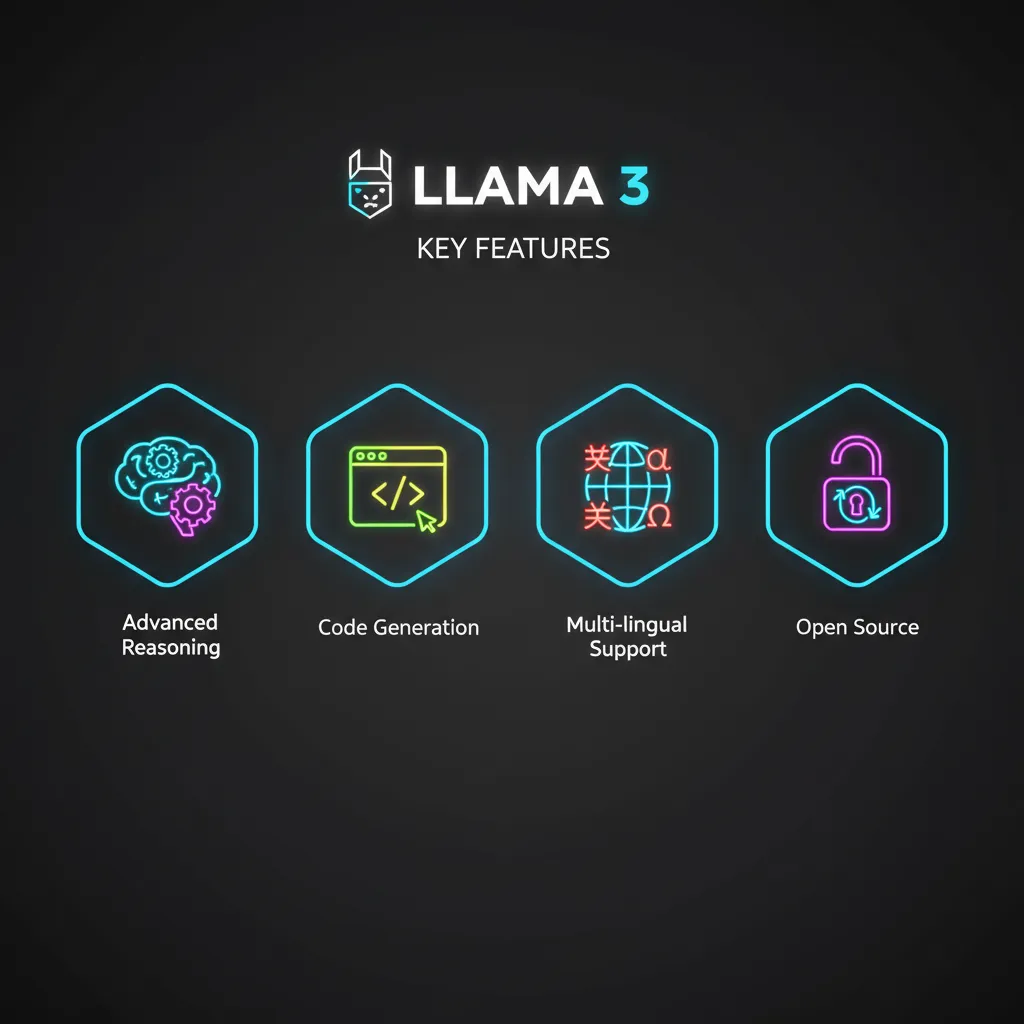
1. Massive Training Dataset: The models were trained on an unprecedented dataset of over 15 trillion tokens, seven times larger than the dataset used for Llama 2. This dataset includes four times more code and multilingual data, making Llama 3 significantly better at handling diverse tasks, including complex Llama 3 coding challenges.
2. State-of-the-Art Tokenizer: Llama 3 uses a new tokenizer with a 128K-token vocabulary. A larger vocabulary makes the encoding of language more efficient, leading to better performance, especially in tasks requiring long context understanding, and it dramatically improves efficiency in non-English languages.
3. Grouped-Query Attention (GQA): Continuing the trend from Llama 2, Llama 3 leverages Grouped-Query Attention, which significantly improves inference speed, especially on the larger models, making running Llama 3 locally or deploying it via the Llama 3 API more efficient.
4. Post-Training Refinements: Meta introduced a sophisticated instruction fine-tuning approach, combining supervised fine-tuning (SFT), rejection sampling, proximal policy optimization (PPO), and direct preference optimization (DPO). This meticulous process results in a model that is dramatically better at following complex instructions and generating safer, more helpful responses.
/image-topic.webp
Image Placement Cue:
The Llama 3 Model Family: 8B, 70B, and Beyond
The strength of Meta’s release strategy lies in offering a spectrum of models tailored for different use cases and hardware constraints.
The Llama 3 8B Model: Efficiency and On-Device AI
The smallest generally available model, the Llama 3 8B model, is an engineering marvel focused on efficiency. It’s small enough to run on consumer-grade hardware and even on specialized edge devices, paving the way for on-device AI integration.
- Ideal for: Mobile applications, edge computing, fast experimentation, and scenarios where low latency is critical.
- Performance: Despite its size, the 8B model surpasses many larger models from the previous generation (like the original Llama 2 13B) and excels as a backbone for specialized, task-specific models after successful Llama 3 fine-tuning.
[Related: SLMs Explained: The Future of On-Device AI]
The Llama 3 70B Model: The Flagship Performer
The Llama 3 70B model is the powerhouse designed for large-scale enterprise deployments and high-stakes generative tasks. This model is engineered to be a true rival to closed-source incumbents. It delivers near-SOTA performance, making it the current standard-bearer for powerful, accessible AI.
- Ideal for: Complex reasoning, multi-turn conversations, detailed content generation, data analysis, and sophisticated Llama 3 use cases in regulated industries like finance and healthcare.
The Future: The >400B Multimodal Model
Crucially, the initial Llama 3 release date only covered the 8B and 70B variants. Meta confirmed that a much larger, multimodal model (over 400 billion parameters) is currently in training. This forthcoming model is expected to integrate vision and potentially other modalities, dramatically narrowing the gap between Llama and fully multimodal competitors, promising even more exciting developments for the future of AI.
Performance Benchmarks: Llama 3 vs. The Competition
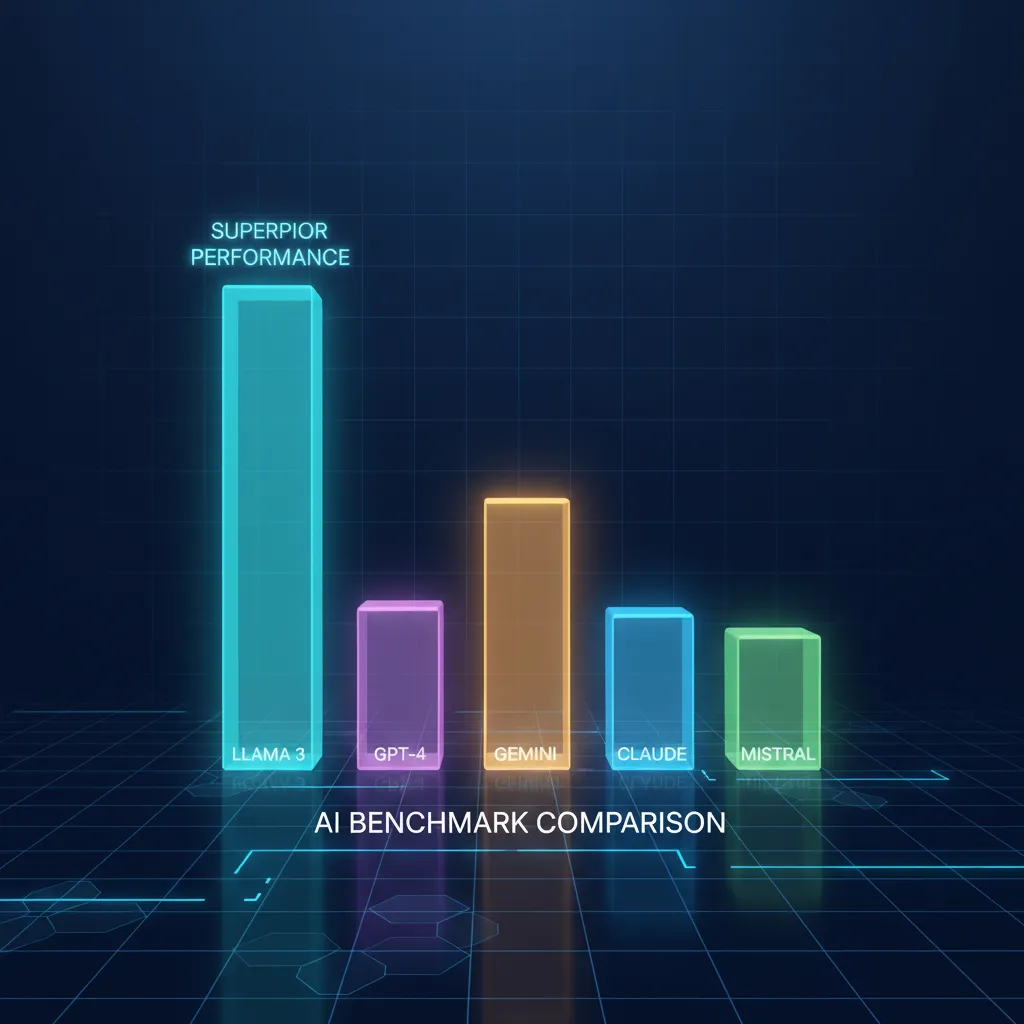
The true test of any large language model lies in its performance across standardized benchmarks. Meta made bold claims, and the initial data supports them: Llama 3 is a game-changer, establishing a new peak for open access models.
Llama 3 vs GPT-4: Closing the Gap
While the largest proprietary models, like GPT-4 and Claude 3 Opus, still hold the crown in certain complex reasoning tasks, the Llama 3 70B model has significantly reduced the performance margin. Furthermore, Llama 3 often outperforms the smaller, but still highly capable, proprietary models like GPT-3.5 Turbo and Claude 3 Sonnet.
| Benchmark Category | Llama 3 8B (Instruction) | Llama 3 70B (Instruction) | Mistral 7B (Instruct) | Claude 3 Sonnet |
|---|---|---|---|---|
| MMLU (Massive Multitask Language Understanding) | 68.4 | 82.0 | 60.1 | 86.8 |
| HumanEval (Coding) | 59.8 | 81.7 | 42.6 | 84.9 |
| GSM8K (Math Reasoning) | 81.3 | 94.0 | 62.3 | 94.8 |
| Toxin (Safety) | Low Score (Better) | Low Score (Better) | Medium Score | Low Score |
Source: Meta AI Official Benchmarks (Scores shown are approximate representations based on published data.)
The Llama 3 benchmarks show remarkable strength in two critical areas:
- Coding (HumanEval): The 70B model’s performance in code generation and debugging is exceptionally high, making it a preferred choice for developers engaged in Llama 3 coding tasks.
- Reasoning (GSM8K/MMLU): Its scores demonstrate advanced comprehension and problem-solving skills, suggesting that its training data and fine-tuning vastly improved its ability to handle complex instructions and logical inference.
This intensive AI model comparison confirms Llama 3’s position not just as a strong open-source option, but as a genuine competitor to commercially available closed models, reinforcing its standing as the best open source AI 2024.
[Related: AI Content Creation: Master Generative AI for Digital Marketing]
/image-topic.webp
Image Placement Cue:
How to Access and Use Llama 3
One of the greatest advantages of Llama 3 is its sheer accessibility. Meta has ensured that users can interact with the model across several platforms, catering to consumers and professional developers alike. This section offers a practical Llama 3 tutorial on getting started with Llama 3.
1. Consumer Access: The Meta AI Assistant
For the average user, the easiest way to experience Llama 3 is through the integrated Meta AI assistant. This AI is now deeply embedded across Meta’s family of applications:
- Facebook & Instagram: Used for image generation, quick search queries, and creative brainstorming within feeds and messaging.
- WhatsApp: Allows users to interact with Meta AI directly in chats for real-time information retrieval, translation, and summaries.
- Ray-Ban Meta Smart Glasses: Provides hands-free, real-time context and information, acting as a personal, always-on AI companion.
The Llama 3 review from consumers has been overwhelmingly positive regarding the speed and quality of responses provided by the integrated assistant.
2. For Developers: The Llama 3 API and Download
Developers have multiple pathways to access and integrate the model into their infrastructure.
Direct Download and Platforms
The official Llama 3 download is available through major hosting platforms, adhering to Meta’s licensing terms:
- Hugging Face: The model weights and tokenizer are easily available on the Hugging Face platform, which simplifies experimentation and model deployment. The Llama 3 on Hugging Face integration makes it easy to use popular libraries like Transformers.
- Cloud Providers (Llama 3 on AWS, Azure, Google Cloud): Major cloud service providers quickly integrated Llama 3 into their machine learning platforms (like AWS SageMaker), offering optimized, scalable environments for deployment. This is the preferred method for large enterprises needing robust infrastructure.
Utilizing the Llama 3 API
While Meta does not host a direct, general-purpose public API in the same vein as OpenAI, many third-party services and cloud platforms provide managed access via an Llama 3 API. For enterprise users, deploying the model on a cloud infrastructure essentially creates a dedicated internal API endpoint.
/image-topic.webp
Image Placement Cue:
3. Running Llama 3 Locally and Fine-Tuning
One of the major draws of Llama 3 being an open access model is the ability to run it on your own hardware, granting total privacy and control.
Running Llama 3 Locally
To begin running Llama 3 locally, you will generally require a machine with a powerful GPU (or multiple GPUs) and significant VRAM, especially for the 70B model. However, smaller quantized versions (like 4-bit versions of the 8B model) can run surprisingly well on modern consumer laptops or specialized hardware accelerators.
Tools like Ollama and various quantization techniques (GGUF, AWQ) have made local deployment significantly easier and more accessible, even for those new to LLMs.
Llama 3 Fine-Tuning
For specialized tasks—such as creating an AI that excels at legal documentation or a highly specific industry vocabulary—Llama 3 fine-tuning is the path forward. Because the weights are accessible, developers can use techniques like Parameter-Efficient Fine-Tuning (PEFT) or LoRA to adapt the foundational model to proprietary datasets. This process allows businesses to leverage Meta’s immense general training while embedding their unique organizational knowledge.
Real-World Llama 3 Use Cases
The robust performance and flexible licensing of Llama 3 unlock a vast array of practical applications across industries. This level of detail in the Llama 3 review showcases its true value beyond benchmarks.
1. Enhanced Code Generation and Developer Tools
As demonstrated by its HumanEval scores, Llama 3 is an outstanding coding partner.
- Auto-completion and Suggestion: Integrating Llama 3 into IDEs (Integrated Development Environments) provides highly accurate, context-aware code completion for multiple languages.
- Code Translation: Enterprises can use Llama 3 to migrate legacy codebases from one language to another, a complex task that demands high-level logical reasoning.
- Debugging and Documentation: Developers can submit code snippets to Llama 3 to identify complex bugs, propose fixes, and automatically generate comprehensive documentation and tests.
[Related: AI Revolutionizing Biodiversity Conservation]
2. Enterprise Search and Knowledge Retrieval
For large organizations, quickly accessing internal documentation, policy manuals, and past reports is crucial.
- RAG (Retrieval-Augmented Generation): Llama 3 shines when paired with RAG systems. It can retrieve highly accurate information from proprietary databases and synthesize it into coherent, human-readable answers, driving efficiency in customer service and internal knowledge management.
3. Creative Content and Digital Marketing
In digital marketing and content creation, Llama 3 acts as a highly effective creative partner.
- SEO Content Generation: Generating high-quality blog posts, meta descriptions, and ad copy tailored for specific target keywords with nuance and style.
- Creative Storytelling: Developing complex narratives, scripts, and product descriptions that require a deep understanding of human language and context.
[Related: AI in Finance: The Future of Your Wallet]
4. Educational and Research Tools
Llama 3’s reasoning skills make it an excellent educational assistant, capable of explaining complex topics, summarizing dense academic papers, and generating practice problems for students. The accessible nature of the model encourages researchers worldwide to use it as a foundational tool for accelerating scientific discovery.
Is Llama 3 Truly Open Source? Licensing and Distribution Deep Dive
A frequent question surrounding Meta Llama 3 is whether it truly adheres to the spirit of open source, especially given Meta’s sheer size. The answer, while generally positive, requires careful consideration of its licensing.
The Apache 2.0 License
Meta released Llama 3 under the permissive Apache 2.0 license. This license is highly favorable for commercial use, allowing businesses to:
- Use the models for nearly any purpose.
- Modify the model and create derivative works.
- Distribute modified versions without paying royalties.
This means that for the vast majority of developers and companies, Llama 3 acts as a powerful, freely available foundation model.
The Scale Restriction Clause
Like its predecessor, Llama 3 includes a critical scale restriction. Companies with more than 700 million monthly active users are typically barred from using the model unless they obtain a special license from Meta. This clause is specifically designed to prevent the model from being immediately leveraged by Meta’s direct, large-scale competitors (like Google, Apple, or Amazon for specific services, though many have partnerships).
The Verdict on Open Source:
While the restriction on massive companies technically keeps it out of the domain of the purest open-source definition, for the overwhelming majority of the AI community—including startups, researchers, small and medium enterprises, and individual developers—is Llama 3 open source? Yes, practically speaking, it offers unprecedented access and freedom compared to proprietary models. It has fundamentally lowered the barrier to entry for developing and deploying powerful AI solutions.
The Future of AI: What Meta’s New AI Model Means for the Industry
The launch of Llama 3 is a watershed moment for the trajectory of large language models and the future of AI.
Accelerating the Open Ecosystem
Llama 3’s high performance forces other open-source projects to rapidly innovate. The release validates the thesis that industry-leading AI capabilities can be democratized. This fuels intense development in smaller, more efficient models—like those detailed in our guide on [Related: SLMs Explained: The Future of On-Device AI]—and pushes the entire open-source ecosystem toward greater performance and ethical accountability. The race to be the best open source AI 2024 is now hotter than ever.
Redefining Competition
For proprietary AI developers, Llama 3 represents a significant threat to their mid-tier offerings. Why pay a substantial API fee for a model that performs only marginally better than a powerful, freely available foundation model?
This dynamic forces proprietary companies to focus their resources on truly differentiating features:
- Unmatched multimodal capabilities (vision, audio, etc.).
- Massively scaled models far beyond 70B parameters.
- Highly specialized enterprise integrations and guarantees.
Llama 3 has solidified Meta’s position as a major contributor to AI infrastructure, positioning it as an indispensable layer in the technological stack for the next decade of development. The continued evolution of the Llama series and the introduction of the larger, multimodal version will be pivotal in shaping the landscape of next-generation AI models.
[Related: The DePIN Revolution: Building Tomorrow’s Decentralized Physical Infrastructure]
/image-topic.webp
Image Placement Cue:

Conclusion: Setting the Standard for Open Innovation
Meta Llama 3 is not merely an incremental update; it is a declaration of Meta’s commitment to empowering the global developer community. By offering a model with near-SOTA performance, exceptional Llama 3 coding capabilities, and flexible licensing, Meta has democratized access to the building blocks of powerful, modern AI applications.
If you are a developer, now is the time to leverage the Llama 3 download and begin getting started with Llama 3. Explore the Llama 3 API, experiment with Llama 3 fine-tuning, and see how the Llama 3 70B model can transform your most ambitious projects. For consumers, the enhanced Meta AI assistant represents a sleek, powerful entry point into personalized, real-time generative AI.
The era where only a handful of corporations controlled the best foundational models is rapidly drawing to a close. With Llama 3, the open-source community now wields a formidable tool, promising an era of unprecedented innovation and competition in the journey toward the future of AI.
FAQs
Q1. What is the official Llama 3 release date?
Meta Llama 3 was officially announced and initially released in April 2024. The release included the 8B and 70B parameter models. Meta also announced that a larger, multimodal model (over 400 billion parameters) is currently in training and will be released in subsequent updates.
Q2. How does Llama 3 vs GPT-4 compare in practical use?
While GPT-4 generally maintains a slight edge in complex, abstract reasoning and theory-of-mind tasks, the Llama 3 70B model closes the gap significantly, especially in specialized areas like coding (HumanEval) and math reasoning (GSM8K). For most common business and developer Llama 3 use cases, the performance difference is negligible, making Llama 3 a compelling, cost-effective, and open alternative.
Q3. Can I use Llama 3 commercially, and is Llama 3 open source?
Yes, the weights for Llama 3 are released under the Apache 2.0 license, which permits commercial use and modification. It is functionally open source for most users. However, companies with more than 700 million monthly active users must seek a special licensing agreement from Meta.
Q4. What is the difference between the Llama 3 8B model and the Llama 3 70B model?
The Llama 3 8B model is designed for high speed and efficiency, making it ideal for running locally, on edge devices, or in resource-constrained environments. The Llama 3 70B model is the flagship performer, offering state-of-the-art results for complex tasks, enterprise applications, and advanced reasoning, requiring significantly more computing power.
Q5. What platforms support Llama 3 download and deployment?
You can perform a Llama 3 download via Hugging Face. Furthermore, major cloud providers offer seamless deployment, including Llama 3 on AWS (SageMaker), Microsoft Azure, and Google Cloud, simplifying access to the Llama 3 API for large-scale enterprise use.
Q6. What kind of hardware is needed for running Llama 3 locally?
For running Llama 3 locally, the requirements depend on the model size and quantization. The 8B model (quantized) can run on a modern GPU with 8GB–16GB of VRAM. The 70B model, however, requires significantly more VRAM, usually 80GB or more, often necessitating multiple high-end GPUs or specialized hardware accelerators.
Q7. How does Llama 3 help with coding and development tasks?
Llama 3 excels at Llama 3 coding tasks due to its extensive training on a massive code dataset and its high HumanEval benchmark scores. It is proficient in code generation, debugging, cross-language translation, and generating context-aware suggestions, positioning it as a top choice for developer productivity tools.