Llama 3.1 for Business: Powering Next-Gen Enterprise AI Solutions

Introduction
The conversation around enterprise AI is undergoing a seismic shift. For years, the landscape has been dominated by proprietary, closed-source models offered as APIs. While powerful, they often come with significant trade-offs: high costs, limited customization, and concerns over data privacy. Businesses have been asking for more control, more flexibility, and a more transparent path to building truly unique AI capabilities. Enter Meta’s Llama 3.1.
This latest iteration in the Llama family isn’t just an upgrade; it’s a declaration that the future of enterprise AI is open. As a state-of-the-art open-source Large Language Model (LLM), Llama 3.1 provides businesses with the raw power to build, customize, and deploy advanced AI solutions on their own terms. It represents a fundamental move from “renting” AI to “owning” your AI stack.
This comprehensive guide will explore how Llama 3.1 is powering the next generation of enterprise AI. We’ll dive into its core advantages over proprietary models, explore tangible business use cases across various industries, and provide a practical roadmap for integration and deployment. Whether you’re a CTO planning your company’s AI strategy, a developer eager to start building, or a business leader seeking a competitive edge, this article will illuminate the path to harnessing the transformative power of Llama 3.1.
What is Llama 3.1 and Why is it a Game-Changer for Enterprises?
At its core, Llama 3.1 is a family of large language models developed by Meta, made freely available for research and commercial use. It builds upon the success of its predecessors with significant architectural improvements and training on a massive, high-quality dataset. But what makes it a true game-changer for the business world are its new capabilities and the philosophy behind its release.
The Llama 3.1 family comes in several sizes, each tailored for different needs:
- Llama 3.1 8B: A highly efficient model perfect for on-device applications, rapid prototyping, and less complex tasks where speed is critical.
- Llama 3.1 70B: The workhorse of the family, offering a fantastic balance of performance and resource requirements, suitable for a wide range of enterprise applications.
- Llama 3.1 405B: The flagship model, a true heavyweight competitor to the best proprietary models available, designed for the most complex reasoning, analysis, and generation tasks.
Key enhancements that set Llama 3.1 apart include a massive 128K context window (which can be extended further), improved reasoning and code generation abilities, and significantly lower false refusal rates, meaning it’s more helpful and reliable for business queries. The open-source nature of Llama 3.1 is its defining feature. It means companies can inspect the model, modify it, and deploy it anywhere—from their own on-premise servers to a private cloud—granting them complete control over their AI destiny.
The Core Advantages: Why Choose Llama 3.1 Over Proprietary AI?
While API-based models from providers like OpenAI and Anthropic offer convenience, Llama 3.1 presents a compelling value proposition for businesses looking for long-term, strategic AI integration. The advantages of this open-source LLM enterprise approach are clear and substantial.
Unprecedented Customization and Control
The single greatest advantage of Llama 3.1 is the ability to create custom LLM solutions. Instead of using a generic, one-size-fits-all model, you can fine-tune Llama 3.1 on your company’s proprietary data. Imagine an AI that understands your specific product catalog, internal jargon, customer history, and unique business processes.
This level of customization allows you to build a defensible competitive moat. Your AI becomes a unique asset that competitors cannot replicate by simply subscribing to the same public API. This is crucial for AI workflow automation and creating truly intelligent internal tools that speak your company’s language. [Related: Autonomous AI Agents: The Future of Personal Assistant Productivity]
Enhanced Security and Data Privacy
In an era of stringent data regulations like GDPR and CCPA, sending sensitive customer or corporate data to a third-party API is a significant risk. Llama 3.1 security is a top concern for enterprises, and its open-source nature provides the ultimate solution: control.
By deploying Llama 3.1 on your own infrastructure (on-premise or in a virtual private cloud), you ensure that your sensitive data never leaves your control. This is a non-negotiable requirement for industries like finance, healthcare, and legal. You control the security protocols, access logs, and data governance, eliminating the black box of third-party data handling.

Superior Cost-Effectiveness at Scale
The pay-per-token model of proprietary APIs can become prohibitively expensive at scale. Every query, every test, and every user interaction racks up costs. While there is an upfront investment in hardware and talent for deploying Llama 3.1, the long-term Llama 3.1 cost effectiveness is undeniable.
Once the infrastructure is in place, the marginal cost of running additional queries is close to zero. You are paying for compute, not for each individual thought the AI generates. This economic model encourages experimentation and widespread adoption within an organization, leading to greater AI innovation in business without the fear of a runaway API bill.
Future-Proofing and Avoiding Vendor Lock-In
Basing your entire AI strategy on a single proprietary provider creates a dangerous dependency. What if they change their API, raise prices, or alter their terms of service? The Llama 3.1 open source benefits include freedom and flexibility. You are not tied to any single cloud provider or MLOps platform. You can switch your infrastructure, modify the model, and adapt to the changing technology landscape without seeking permission. This agility is a cornerstone of a robust, long-term AI powered business transformation. [Related: Apple Intelligence: A Deep Dive into the Top AI Features in iOS 18]
Real-World Llama 3.1 Business Use Cases Across Industries
The true potential of Llama 3.1 for business is realized when applied to solve real-world problems. Its versatility makes it a powerful tool for nearly any industry seeking to enhance efficiency, unlock insights, and create better customer experiences.
For Customer Service & Support
- Hyper-Intelligent Chatbots: Move beyond frustrating, keyword-based bots. Fine-tune Llama 3.1 on your product manuals and support logs to create a chatbot that can understand complex queries, troubleshoot issues, and guide users with human-like empathy.
- AI-Powered Agent Assist: Summarize long customer conversations in real-time, suggest relevant knowledge base articles to support agents, and analyze sentiment to flag at-risk customers for immediate attention.
- Automated Ticket Analysis: Automatically categorize and route incoming support tickets, identify emerging issues by clustering themes from thousands of customer interactions, and reduce manual administrative overhead.
For Software Development and IT Operations
The introduction of Code Llama 3.1, a specialized version fine-tuned for programming tasks, makes this a particularly powerful area for Llama 3.1 integration.
- Advanced Code Generation: Generate boilerplate code, write complex algorithms from natural language descriptions, and create unit tests automatically, freeing up developers to focus on high-level architecture.
- Intelligent Debugging: Feed error logs and code snippets into the model to get suggestions for fixes, explanations of complex legacy code, and potential security vulnerabilities.
- Automated Documentation: Drastically reduce the time spent on writing documentation by having Llama 3.1 generate clear, concise explanations for functions and codebases.

For Marketing and Sales
- Dynamic Content Personalization: Generate thousands of variations of ad copy, email subject lines, and product descriptions tailored to specific customer segments, significantly improving engagement and conversion rates.
- In-Depth Market Research: Analyze market reports, social media trends, and customer reviews to generate comprehensive summaries of market sentiment and competitor strategies.
- Sales Intelligence: Transcribe and analyze sales calls to identify key customer pain points, successful talking points, and coaching opportunities for the sales team.
For Finance and Business Intelligence
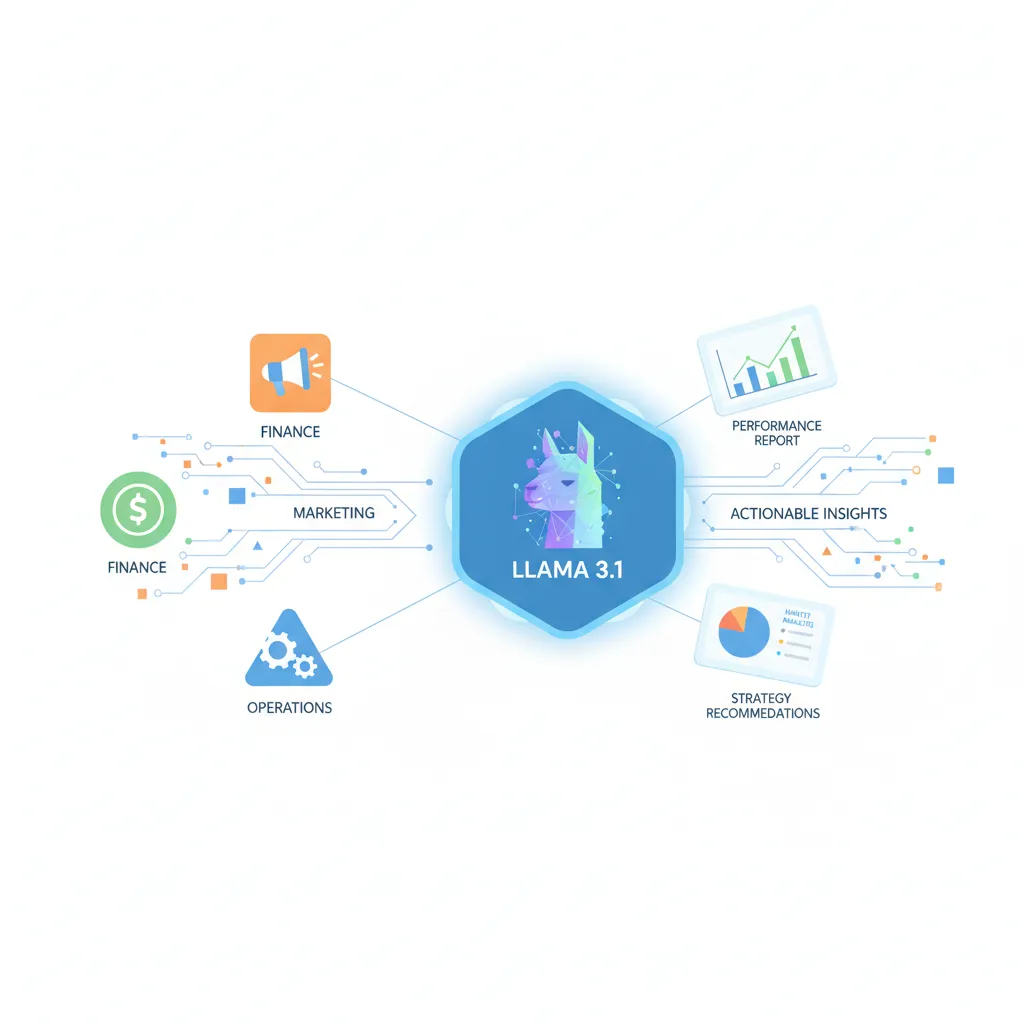
- Financial Document Analysis: Automate the extraction and analysis of data from complex financial documents like 10-K filings, earnings reports, and loan applications, turning unstructured text into actionable business intelligence AI.
- Sophisticated Fraud Detection: Train Llama 3.1 to recognize anomalous patterns in transaction data that might indicate fraudulent activity, moving beyond simple rule-based systems.
- Natural Language Reporting: Allow business leaders to query complex databases using plain English. Instead of complex SQL, a manager could ask, “What were our top-selling products in the Northeast region last quarter, and how did that compare to the previous year?” [Related: The AI-Powered Wallet: How Artificial Intelligence is Shaping the Future of Your Finances]
A Practical Guide to Llama 3.1 Integration and Deployment
Adopting an open-source model like Llama 3.1 requires a more hands-on approach than using a simple API. However, a structured Llama 3.1 implementation strategy can make the process manageable and highly rewarding.
Step 1: Defining Your AI Implementation Strategy
The first step in any successful AI model deployment is to move past the hype and define a clear business objective.
- Identify the Problem: Don’t start with the technology; start with a pain point. What process is inefficient? Where are you lacking insights? A well-defined problem will guide your entire project.
- Assess Data Readiness: High-quality, relevant data is the lifeblood of a custom LLM solution. Evaluate the availability, cleanliness, and accessibility of the data you’ll need for fine-tuning.
- Choose the Right Model: Don’t default to the largest model. The 405B is powerful, but the 70B might be more than sufficient and more cost-effective for your initial use case. The 8B model could be perfect for a simple, high-volume task.
Step 2: Setting Up the Infrastructure
This is where you decide where your model will live.
- Cloud vs. On-Premise: Cloud platforms like AWS, Google Cloud, and Azure offer managed services (like Amazon SageMaker) that simplify the deployment of large language models for enterprise. On-premise deployment offers maximum security but requires more in-house expertise to manage the hardware (primarily high-end GPUs).
- Leverage Deployment Platforms: Services like Hugging Face, Fireworks.ai, and Replicate provide infrastructure and tools specifically designed to host and serve open-source models, which can significantly accelerate your timeline.
Step 3: Data Integration and Fine-Tuning
This is where you give Llama 3.1 its specialized knowledge.
- Data Preparation: Clean and structure your company data into a format suitable for training. This is often the most time-consuming but critical part of the process.
- Fine-Tuning vs. RAG:
- Fine-Tuning: Actually retrains a part of the model on your data, embedding the knowledge directly. It’s more complex but results in a highly specialized model.
- Retrieval-Augmented Generation (RAG): A popular and often simpler approach where the model is given access to a knowledge base (like your company’s internal wiki). When a query comes in, the system first retrieves relevant documents and then feeds them to Llama 3.1 as context to generate an answer.
Step 4: Building, Testing, and Scaling Your Application
Once your model is trained and deployed, the work continues.
- API Access and Integration: Build an internal Llama 3.1 API access point so your various applications and services can interact with the model.
- Rigorous Evaluation: Test the model extensively for accuracy, bias, and harmful outputs. Use a “red team” approach to try and break it.
- Monitor and Iterate: The MLOps lifecycle is continuous. Monitor the model’s performance in production, collect new data, and plan for periodic retraining to keep it up-to-date and effective. This is key to building scalable AI solutions.
Addressing Enterprise AI Challenges with Llama 3.1
While the benefits are immense, successful enterprise AI adoption requires confronting potential challenges head-on. Llama 3.1 and its surrounding ecosystem provide powerful tools to mitigate these issues.
- The Talent Gap: Deploying open-source models requires expertise in MLOps, data science, and infrastructure management. However, the rapidly growing community around Llama, extensive documentation, and platforms that simplify deployment are making it more accessible than ever. Investing in training your existing team is often a more effective strategy than trying to hire for a perfect skillset.
- Responsible AI and Safety: AI models can perpetuate biases present in their training data. It’s crucial to implement a strong ethical framework. Meta provides tools like Llama Guard 2 and Code Shield to help filter unsafe inputs and outputs. Furthermore, internal testing and continuous monitoring are essential to ensure the model behaves responsibly.
- Complexity of Management: An AI model is not a one-and-done installation. It requires ongoing monitoring, maintenance, and retraining. Embracing an MLOps (Machine Learning Operations) mindset and leveraging tools for versioning, deployment, and monitoring is key to managing this complexity effectively.
The Future of Enterprise AI is Open
The release of Llama 3.1 is more than just a new product; it’s a marker for the entire industry. The trend is clear: businesses are moving towards a more open, transparent, and controllable AI future. The era of being solely dependent on a few large tech companies for generative AI is giving way to a more democratized ecosystem.
Llama 3.1 provides the toolkit for this AI powered business transformation. It allows companies to not just be consumers of AI, but to become creators of it, building intelligent systems that are deeply integrated with their unique data and workflows. This is the path to building lasting, defensible advantages in the age of artificial intelligence. [Related: Copilot+ PCs: The Next Wave of AI-Powered Laptops Has Arrived]
Conclusion
Llama 3.1 represents a pivotal moment for generative AI enterprise adoption. It effectively dismantles the primary barriers that have kept many businesses on the sidelines: prohibitive costs, data security risks, and lack of customization. By offering state-of-the-art performance in an open-source package, Meta has empowered businesses of all sizes to take control of their AI strategy.
From revolutionizing customer support with highly tailored chatbots to accelerating software development with intelligent coding assistants, the Llama 3.1 business use cases are as vast as they are impactful. The journey requires investment in skills and infrastructure, but the payoff—a secure, cost-effective, and fully customized AI capability—is a strategic advantage that will define industry leaders for the next decade.
Ready to explore how Llama 3.1 can transform your business? Start by identifying a key operational challenge or an untapped data source within your organization. The path to building your own AI future is clearer than ever, and it starts with the power and flexibility of an open-source foundation.
Frequently Asked Questions (FAQs)
Is Llama 3.1 free for commercial use?
Yes, Llama 3.1 is free for both research and commercial use. However, per Meta’s policy, companies with more than 700 million monthly active users must request a special license from Meta to use it, a condition that does not affect the vast majority of businesses.
How does Llama 3.1 compare to OpenAI’s GPT-4o?
The largest Llama 3.1 405B model is highly competitive with GPT-4o and other top-tier proprietary models in major benchmarks, often excelling in areas like code generation and reasoning. The primary difference is strategic: Llama 3.1 is an open-source model you control, customize, and host yourself, whereas GPT-4o is a closed-source product accessed via an API, prioritizing convenience over control.
What is Code Llama 3.1?
Code Llama 3.1 is a specialized version of the model that has been specifically fine-tuned for programming-related tasks. It excels at code generation, code completion, debugging, and explaining code in various programming languages, making it an invaluable tool for software development teams.
What skills are needed to deploy Llama 3.1 in a business?
A successful deployment typically requires a cross-functional team with skills in machine learning engineering (MLOps) for deployment and monitoring, data science for preparing data and fine-tuning, cloud infrastructure management for managing the underlying hardware, and software development for integrating the model into applications.
Can Llama 3.1 run on-premise?
Absolutely. This is one of its most significant advantages for enterprises. Deploying Llama 3.1 on your own on-premise servers gives you maximum control over data security and privacy, ensuring that sensitive information never leaves your network.
What’s the difference between the Llama 3.1 model sizes (8B, 70B, 405B)?
The numbers refer to the number of parameters in the model (in billions).
- 8B: The smallest and fastest model, ideal for simple tasks, on-device applications, and environments with limited computational resources.
- 70B: A powerful, well-balanced model that offers excellent performance for a wide range of complex business tasks without the extreme hardware demands of the largest model.
- 405B: The state-of-the-art flagship model, designed for the most demanding tasks that require deep knowledge, nuanced reasoning, and top-tier performance.