Llama 3.1 for Business: Powering Next-Gen Enterprise AI Solutions

The conversation around enterprise AI is undergoing a seismic shift. For years, the most powerful generative models were locked away behind proprietary APIs, forcing businesses to choose between cutting-edge capabilities and control over their data and costs. That era is officially ending. With the release of Meta Llama 3.1, the landscape of Generative AI enterprise solutions has been irrevocably altered, offering businesses an unprecedented combination of power, flexibility, and strategic independence.
Llama 3.1 isn’t just an incremental update; it’s a declaration that the future of business intelligence is open. Powered by a new state-of-the-art 405B parameter model, this release democratizes access to elite AI capabilities previously reserved for a select few. For decision-makers, developers, and strategists, this opens up a world of possibility for creating custom AI models Llama 3.1 that are deeply integrated, secure, and perfectly aligned with their unique operational needs.
This comprehensive guide dives deep into Llama 3.1 for business. We’ll explore its groundbreaking features, map out concrete enterprise use cases, provide a strategic implementation framework, and analyze how it stacks up against other enterprise large language models. Get ready to discover how you can leverage Meta’s open-source powerhouse to drive a genuine AI transformation business strategy and secure a lasting competitive advantage.
What is Llama 3.1? A Paradigm Shift in Open-Source AI
At its core, Llama 3.1 is the latest iteration of Meta’s family of open-source large language models (LLMs). While its predecessor, Llama 3, was already a formidable force, Llama 3.1 represents a monumental leap forward, primarily through the introduction of its new flagship model.
The Llama 3.1 family now includes:
- Llama 3.1 8B: A highly efficient model perfect for on-device applications, simple summarization, and rapid-response chatbots where speed is critical.
- Llama 3.1 70B: A powerful and balanced model that offers a fantastic performance-to-cost ratio, ideal for a wide range of enterprise tasks from content creation to complex RAG (Retrieval-Augmented Generation) systems.
- Llama 3.1 405B: The new titan. This model is designed to compete directly with the world’s best proprietary models, offering unparalleled nuance, deep reasoning, and state-of-the-art coding abilities for the most demanding business challenges.
The release of the 405B model signals Meta’s commitment to making top-tier AI accessible. It challenges the long-held belief that enterprises must rely on closed-source “black box” solutions for maximum power. This move champions a future where companies can build AI solutions for businesses on a foundation they can inspect, modify, and fully control.
The Enterprise-Grade Leap: Key Features of Llama 3.1
What makes Llama 3.1 so compelling for enterprise use? It’s not just about the bigger model; it’s about a collection of strategic enhancements that directly address the pain points of modern businesses.
The Colossal 405B Model: Unprecedented Power and Nuance
The headline feature is, without a doubt, the 405 billion parameter model. In the world of LLMs, more parameters generally correlate to a more profound understanding of language, logic, and context. For businesses, this translates to:
- Superior Reasoning: The ability to solve complex, multi-step problems, from financial modeling to scientific research analysis.
- Enhanced Creativity: Generating highly nuanced and contextually aware marketing copy, reports, and creative content.
- Fewer Errors: A significant reduction in “hallucinations” or factual inaccuracies, which is critical for building trustworthy AI systems. Related: Combating AI Hallucinations: Building Trustworthy Systems
This model isn’t just big; it’s smart. It consistently scores at or near the top of major industry benchmarks, proving that open-source large language models for business can deliver elite performance.
Expanded Context Window: A Game-Changer for Complex Tasks
Llama 3.1 now supports a 128K token context window out of the box—a significant increase that allows the model to process and “remember” vast amounts of information in a single prompt. Think of it as the model’s short-term memory. A larger window is crucial for tasks like:
- Analyzing lengthy documents: Reviewing entire legal contracts, annual financial reports, or extensive research papers to extract key insights.
- Complex code analysis: Ingesting large codebases to identify bugs, suggest optimizations, or explain functionality.
- Maintaining long conversations: Powering customer support bots that remember the entire history of an interaction, providing a seamless user experience.
Enhanced Multimodality and Tool Use
Modern business workflows are not text-only. AI integration business strategies require models that can interact with various systems. Llama 3.1 has made significant strides in “tool use,” allowing it to more effectively call external APIs, access databases, and run functions. This transforms the LLM from a simple text generator into an active agent that can execute tasks, automate workflows, and provide much richer, data-driven answers.
Advanced Coding and Reasoning Capabilities
For tech-forward enterprises, Llama 3.1’s coding prowess is a massive asset. The 405B model, in particular, excels at generating high-quality code, debugging complex issues, and translating code between languages. This directly accelerates software development cycles, empowers data science teams, and improves overall developer productivity, leading to significant Llama 3.1 productivity gains.

Unlocking Business Value: Top Llama 3.1 Use Cases for Enterprise
Theory is great, but value is realized through application. Here’s how businesses are leveraging the Llama 3.1 use cases enterprise-wide to solve real-world problems and drive growth.
1. Hyper-Personalized Customer Service Automation
Standard chatbots are obsolete. With Llama 3.1, companies can build sophisticated AI agents for Llama 3.1 for customer service automation. These agents can understand complex customer intent, access order histories, process returns via API calls, and escalate to human agents with a full conversation summary. The result is a faster, more accurate, and deeply personalized customer experience that builds loyalty and reduces operational costs.
2. Sophisticated Data Analytics and Business Intelligence
Vast amounts of enterprise data are unstructured—emails, reports, call transcripts, and customer reviews. Llama 3.1 for data analytics can sift through this data to uncover hidden trends, gauge market sentiment, and perform competitive analysis. A financial firm could use it to summarize thousands of news articles to inform trading strategies, while a retailer could analyze product reviews to identify common complaints and opportunities for improvement. Related: AI Algorithmic Trading: Mastering Market Prediction with Tech
3. Accelerated Content Creation and Marketing
Marketing teams can use Llama 3.1 as a powerful co-pilot for creating everything from blog posts and social media campaigns to technical documentation and internal communications. Its ability to maintain a consistent tone of voice and adapt to different formats makes it an invaluable tool for scaling content production without sacrificing quality. Related: AI Content Power-Up: Speed and Quality Today!
4. Streamlined Software Development and Code Generation
The robust Llama 3.1 developer tools and coding capabilities allow development teams to offload time-consuming tasks. Developers can use it to generate boilerplate code, write unit tests, translate legacy code to modern languages, or simply get a “second opinion” on a complex algorithm. This frees up senior developers to focus on high-level architecture and innovation.
5. Intelligent Internal Knowledge Management
Imagine a “corporate brain” that any employee can query in natural language. By fine-tuning Llama 3.1 on internal documents, wikis, and databases, enterprises can create a powerful search and discovery tool. A new hire could ask, “What is our Q4 marketing strategy for the European market?” and get a concise, accurate summary with links to source documents, dramatically improving AI decision making business-wide.
The Strategic Advantage: Why Choose Llama 3.1 Over Other Enterprise LLMs?
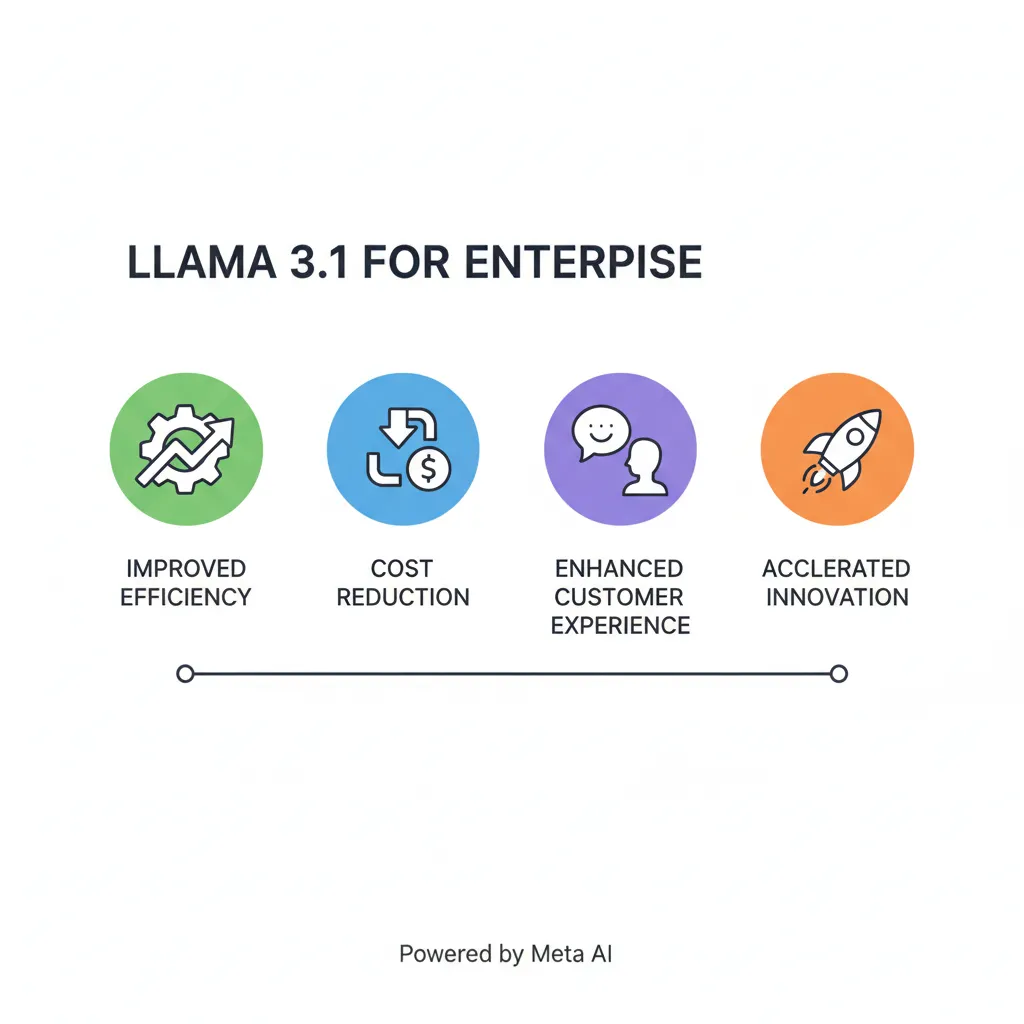
In a market with strong contenders like OpenAI’s GPT-4o and Anthropic’s Claude 3.5 Sonnet, Llama 3.1’s open-source nature provides a distinct and powerful Llama 3.1 competitive advantage.
The Power of Open-Source: Customization and Control
This is the number one differentiator. With proprietary models, you are limited to the provider’s API. With Meta Llama 3.1 enterprise, you have access to the model weights. This allows for deep fine-tuning on your company’s private data, creating a bespoke AI that understands your specific jargon, customers, and processes. This level of customization is simply not possible with closed-source alternatives.
Unbeatable Cost-Effectiveness at Scale
While running large models requires an initial investment in infrastructure (or cloud computing credits), it can be significantly more cost-effective in the long run. API calls to proprietary models charge on a per-token basis, which can become prohibitively expensive for high-volume applications. With a self-hosted Llama 3.1 instance, you pay for the computation, not the usage, making the Llama 3.1 cost effectiveness a major draw for scaling AI solutions.
Enhanced Security and Data Privacy
For industries like finance, healthcare, and law, data security is non-negotiable. Using a third-party API means sending your sensitive data to an external vendor. Deploying Llama 3.1 on your own servers (on-premise or in a private cloud) ensures that your proprietary data never leaves your control. This is a critical factor for maintaining compliance and protecting intellectual property. Related: Securing DeFi with AI: The Next-Gen Protections
Avoiding Vendor Lock-In
Building your entire AI strategy on a single proprietary platform creates significant vendor lock-in. If that provider changes its pricing, alters its API, or shifts its business focus, your operations could be severely disrupted. The open-source AI business model fostered by Llama 3.1 gives you the freedom and flexibility to adapt, migrate, and control your own AI destiny.
Your Roadmap to Success: A Llama 3.1 Implementation Guide
Adopting a powerful technology like Llama 3.1 requires a strategic approach. Here is a simplified Llama 3.1 implementation guide to get you started.

Step 1: Define Your Strategic AI Goals
Don’t start with the technology; start with the business problem. What specific process do you want to improve? Are you aiming to reduce customer service response times, increase developer productivity, or generate sales leads? Clear KPIs are essential for measuring the success of your strategic AI for enterprise initiatives.
Step 2: Assess Your Infrastructure and Talent
Be realistic about your capabilities. Running the 405B model requires significant GPU resources. You’ll need to decide between investing in on-premise hardware or leveraging cloud providers like AWS, Google Cloud, or Microsoft Azure, many of whom offer optimized environments for Llama models. You also need personnel with AI/ML expertise to manage deployment and fine-tuning.
Step 3: Choose the Right Model and Fine-Tuning Strategy
You don’t always need the biggest model. Start with the 70B model for many tasks, and only use the 405B for problems requiring the deepest reasoning. Explore parameter-efficient fine-tuning (PEFT) techniques like LoRA, which allow you to adapt the model for specific tasks without the massive computational cost of a full retrain.
Step 4: Prioritize Responsible AI and Governance
With great power comes great responsibility. Implement safety measures from the start. Use tools like Meta’s Llama Guard 2 to filter harmful inputs and outputs. Establish clear internal policies for data privacy, bias mitigation, and ethical use. Building AI applications with Llama 3.1 responsibly is key to long-term success.
Step 5: Pilot, Iterate, and Scale
Start with a small, high-impact pilot project. Test the solution with a limited group of users, gather feedback, and measure performance against your KPIs. Use these learnings to refine the model and the workflow before planning a broader rollout across the organization.
Overcoming Enterprise AI Adoption Challenges
Despite its immense potential, any AI for large enterprises faces hurdles. Here’s how the Llama 3.1 ecosystem helps address common enterprise AI adoption challenges.
- The Talent Gap: The open-source community around Llama is a massive asset. Resources, tutorials, and pre-trained models on platforms like Hugging Face can significantly lower the barrier to entry and help upskill your existing teams.
- Infrastructure Costs: Cloud platforms are competing to be the best place to run Llama, leading to more competitive pricing and managed services that simplify deployment. The long-term ROI from avoiding per-token API fees often justifies the initial infrastructure investment.
- Data Security and Compliance Concerns: As highlighted earlier, the ability to self-host is Llama 3.1’s ultimate answer to security concerns. It puts you in the driver’s seat of your data governance strategy, ensuring Llama 3.1 security enterprise-wide.

The Future of Enterprise AI is Open and Collaborative
Llama 3.1 is more than just a set of models; it’s a catalyst for a more open, collaborative, and innovative AI ecosystem. It empowers businesses to move from being passive consumers of AI to active builders of intelligent systems. The future of enterprise AI will not be defined by a single, monolithic model but by a diverse range of powerful foundation models like Llama 3.1 that can be adapted and specialized for countless tasks.
This approach fosters innovation, reduces costs, and ensures that the immense power of AI is distributed more equitably. By embracing Meta AI for enterprise, companies are not just adopting a new tool; they are investing in a future-proof strategy that prioritizes control, customization, and long-term value.
Conclusion
The release of Meta Llama 3.1 marks a pivotal moment for enterprise AI solutions Llama 3.1. The introduction of the 405B model erases the performance gap with closed-source competitors, while its open-source nature provides a powerful strategic advantage. For businesses ready to take control of their AI destiny, Llama 3.1 offers a clear path forward.
By delivering unparalleled customization, robust security, and superior cost-effectiveness at scale, it provides all the necessary ingredients for building truly transformative AI solutions for businesses. The era of being locked into expensive, inflexible AI platforms is over. The era of strategic, open, and powerful enterprise AI is here. The only remaining question is: how will your business leverage it to build its future?
Frequently Asked Questions (FAQs)
Q1. What is Llama 3.1 for business?
Llama 3.1 for business refers to the application of Meta’s open-source large language models (8B, 70B, and the new 405B) within a corporate environment. It allows companies to build, customize, and deploy powerful AI solutions for tasks like customer service, data analysis, content creation, and software development while maintaining control over their data and infrastructure.
Q2. Is Llama 3.1 free for commercial use?
Yes, Llama 3.1 models are available for free for both research and commercial use, subject to Meta’s acceptable use policy. This allows businesses of all sizes to leverage state-of-the-art AI without licensing fees, though they are responsible for their own computing and infrastructure costs.
Q3. How does Llama 3.1 compare to GPT-4o for enterprise use?
Llama 3.1 405B is highly competitive with GPT-4o on major performance benchmarks. The key difference for enterprises is its open-source nature. Llama 3.1 offers greater customization through fine-tuning, enhanced security via self-hosting, and potentially lower long-term costs, whereas GPT-4o provides a managed, easy-to-use API but with less control and potential data privacy concerns.
Q4. What are the main benefits of using an open-source model like Llama 3.1?
The primary benefits are control, customization, cost-effectiveness, and security. Businesses can modify the model for their specific needs, avoid vendor lock-in, reduce high-volume API costs by self-hosting, and ensure their sensitive data never leaves their secure environment.
Q5. Can I fine-tune Llama 3.1 on my company’s private data?
Absolutely. This is one of the most significant advantages of Llama 3.1. You can use your proprietary datasets to fine-tune the model, creating a specialized AI that understands your unique business context, terminology, and customer base far better than a generic model could.
Q6. What infrastructure is needed to run Llama 3.1?
Running Llama 3.1, especially the 70B and 405B models, requires significant computational power, specifically high-end GPUs. Enterprises can either invest in on-premise servers or utilize cloud computing platforms like AWS, Google Cloud, and Microsoft Azure, which offer scalable, on-demand GPU instances optimized for large models.
Q7. How does Meta ensure the security of Llama 3.1 for enterprises?
Meta promotes a multi-layered approach to security. They release safety-tuned models like Llama Guard 2 and Code Shield to help filter risky content. However, the ultimate security advantage comes from Llama 3.1’s open-source design, which allows businesses to deploy it within their own secure infrastructure, giving them full control over data access and governance.