Llama 3.1: Revolutionizing Business AI with Enhanced Performance & Security

The world of enterprise AI is in a constant state of evolution, with new models vying for supremacy. For businesses, the choice often boils down to a complex equation of performance, cost, security, and control. Meta has just thrown a heavyweight contender into the ring with the release of Llama 3.1, a significant upgrade to its open-source family of large language models (LLMs). This isn’t just another incremental update; it’s a strategic move designed to challenge the dominance of closed-source giants and empower businesses to build powerful, custom AI solutions.
With its colossal 405B parameter model, newfound multimodal capabilities, and a robust suite of security features, Llama 3.1 represents a paradigm shift for generative AI business applications. This article is your comprehensive guide to understanding the real-world impact of Llama 3.1. We’ll dive deep into its performance boosts, dissect its security architecture, explore practical use cases, and lay out a strategic framework for integrating this transformative technology into your operations. Prepare to discover how Meta’s latest offering can become your company’s next significant competitive advantage.
What is Llama 3.1? A Paradigm Shift for Open-Source Enterprise AI
At its core, Llama 3.1 is the next generation of Meta’s open-source large language models. While its predecessor, Llama 3, was already highly capable, Llama 3.1 elevates the game by introducing a new, much larger model and critical features aimed directly at enterprise and commercial users. It’s not just bigger; it’s smarter, more versatile, and safer.
The new family consists of three distinct model sizes, allowing for incredible AI scalability Llama 3.1 is built for:
- Llama 3.1 405B: The flagship model, a massive 405-billion parameter powerhouse designed for complex reasoning, advanced problem-solving, and superior code generation. This is the model that directly competes with top-tier proprietary models like GPT-4o.
- Llama 3.1 70B: A balanced model offering excellent performance for a wide range of tasks without the intense computational requirements of the 405B version. It’s a workhorse for many enterprise AI applications.
- Llama 3.1 8B: A lightweight and efficient model perfect for on-device applications, simple automation, and scenarios where speed and low resource consumption are paramount. Related: On-Device AI: The Next Revolution in Tech
Beyond the new model sizes, two key upgrades stand out:
- Multimodal Capabilities: For the first time, Llama models can now understand and process both text and images. This opens up a vast new landscape of Llama 3.1 applications, from analyzing product images to interpreting charts and graphs.
- Extended Context Window: With a 128K token context window, Llama 3.1 can analyze and reference vast amounts of information in a single prompt—equivalent to a 400-page book. This is crucial for tasks like summarizing long reports or querying extensive internal knowledge bases.
The Performance Boost: Why Llama 3.1 is a Game-Changer for Business Intelligence
Performance isn’t just about benchmark scores; it’s about a model’s ability to deliver tangible results that drive business transformation AI. The Llama 3.1 performance boost translates directly into more accurate insights, faster development cycles, and more innovative solutions.
Unpacking the 405B Model: The New Apex Predator
The Llama 3.1 405B model is an absolute beast. It has demonstrated state-of-the-art performance across numerous industry benchmarks, including MMLU (knowledge), GPQA (graduate-level reasoning), and HumanEval (coding).
What does this mean for your business?
- Superior Problem-Solving: The model’s advanced reasoning can tackle complex strategic questions, from market entry analysis to supply chain optimization, providing more nuanced and reliable insights for AI-driven decision making.
- Exceptional Code Generation: It can write, debug, and explain code with incredible proficiency, drastically accelerating AI development Llama 3.1 projects and the creation of internal tools. Related: How AI is Reshaping the World of Code and Software Development
- Nuanced Content Creation: For marketing and communications, it can generate highly sophisticated, context-aware, and on-brand content that truly resonates with target audiences.
Advanced Reasoning and Code Generation
The improvements in reasoning and coding are not just incremental. They enable a new class of AI productivity tools business teams can leverage. Imagine an AI assistant that doesn’t just fetch information but helps your development team architect a new software feature, identifies potential security vulnerabilities in existing code, and drafts the technical documentation simultaneously. This level of capability transforms the LLM from a simple tool into a genuine collaborative partner, fostering AI innovation enterprise-wide.
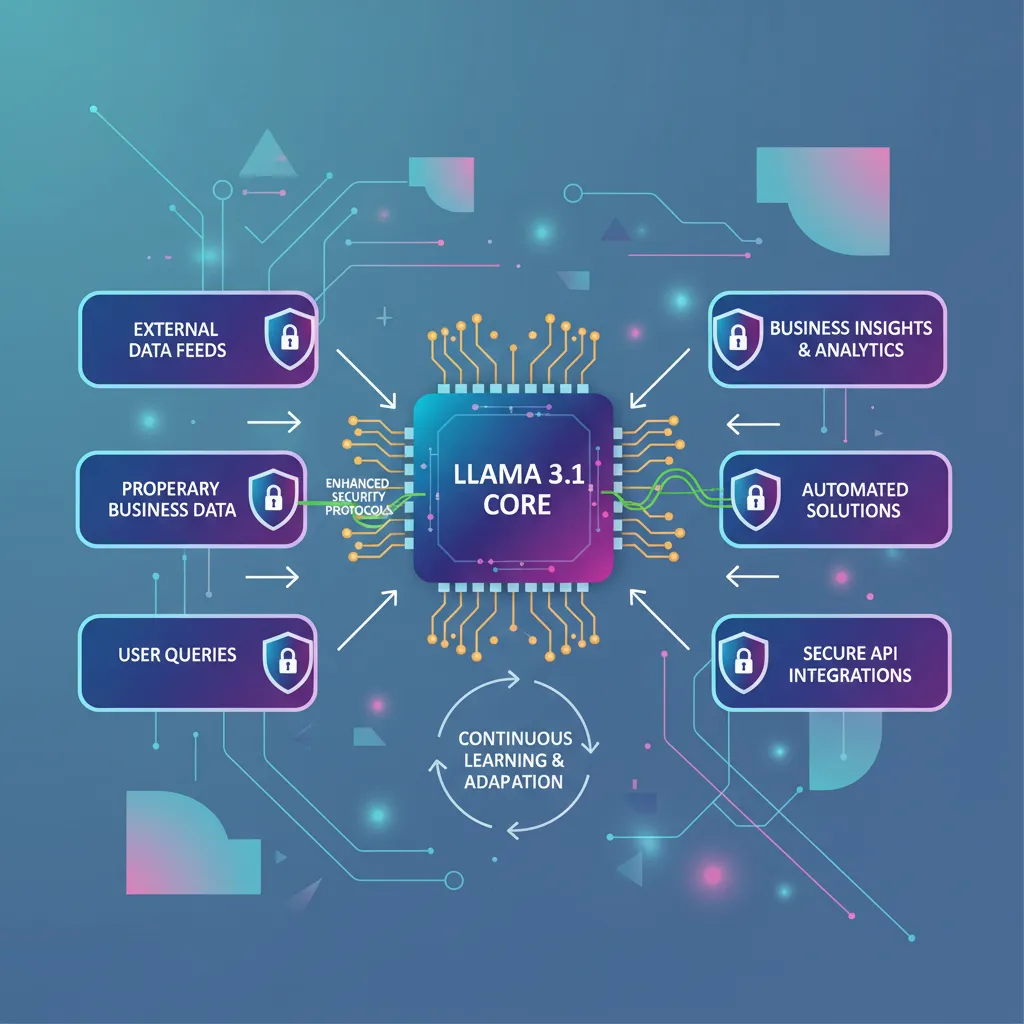
Multimodality in Action: From Text to Vision
The ability to process images is a game-changer for countless industries. It moves business intelligence AI beyond text-based data into the rich world of visual information.
Consider these practical Llama 3.1 use cases:
- Retail & E-commerce: Analyze customer-submitted photos of products to understand usage patterns or identify defects for returns.
- Manufacturing: Monitor factory floor cameras to spot production anomalies or safety hazards in real time.
- Insurance: Process images from accident claims to automatically assess damage and expedite processing.
- Healthcare: Analyze medical imaging (with proper fine-tuning and compliance) to assist radiologists in identifying potential areas of concern.
This fusion of text and vision allows businesses to unlock insights from previously untapped unstructured data sources, creating a more holistic view of their operations.
Fortifying the Enterprise: Llama 3.1’s Enhanced Security and Data Privacy
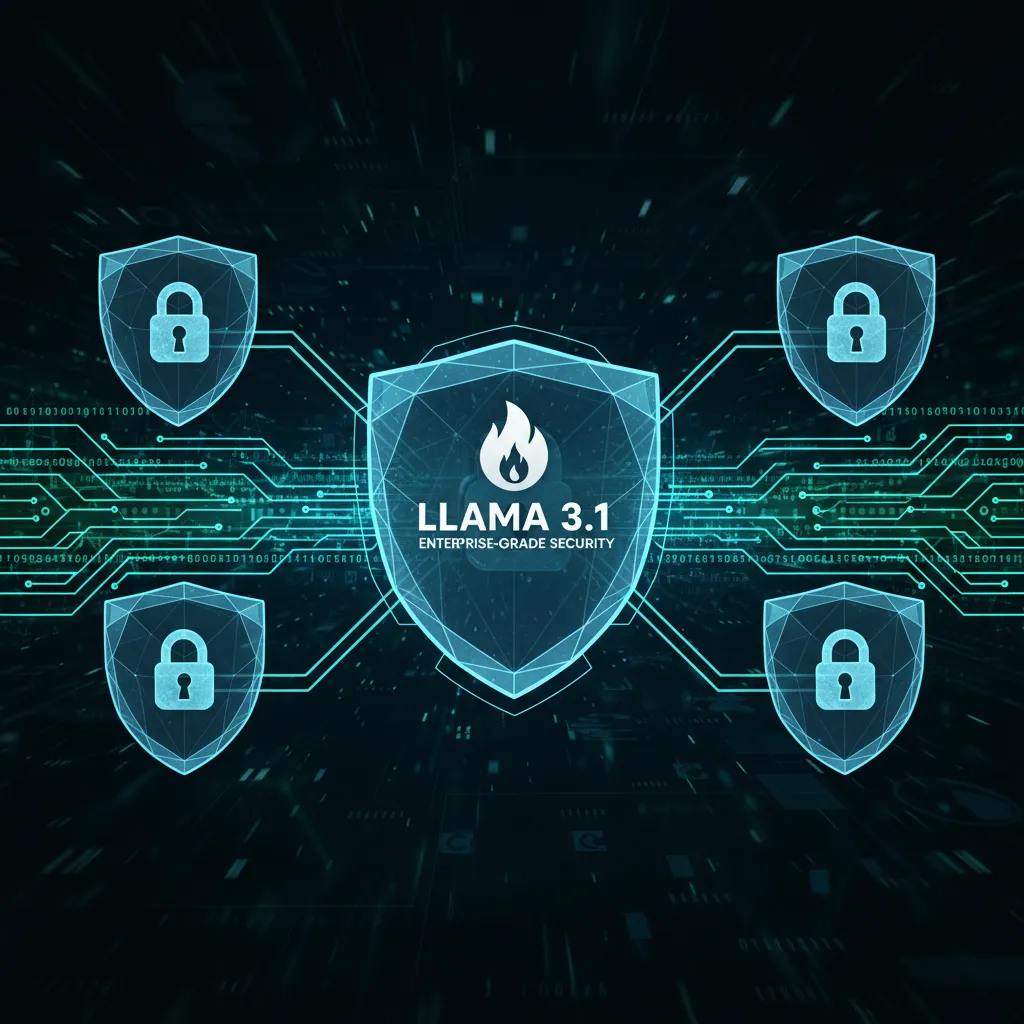
For any business considering AI adoption, security is non-negotiable. A data breach or the deployment of an insecure AI model can be catastrophic. Meta understands this, and the Llama 3.1 security features are a clear indication of their focus on enterprise-grade safety and ethical AI business Llama 3.1 practices.
Introducing Llama Guard 2 and Code Shield
Meta has released powerful new tools to help organizations deploy Llama 3.1 responsibly:
- Llama Guard 2: This is a state-of-the-art safety model designed to classify both inputs (prompts) and outputs (responses). It uses a detailed taxonomy to identify and filter potentially harmful, unsafe, or unethical content, acting as a crucial checkpoint for any AI application.
- Code Shield: Specifically for AI development Llama 3.1 applications, Code Shield is designed to filter insecure code generated by the model in real-time. It can detect code that may lead to vulnerabilities like insecure dependencies, command injection, or data leaks, adding a critical layer of protection to the software development lifecycle.

The Power of Open-Source Control for Data Privacy
One of the most significant advantages of an open-source AI enterprise model like Llama 3.1 is control over Llama 3.1 data privacy. Unlike using a closed, API-based model from a third-party provider, Llama 3.1 can be self-hosted on your own infrastructure—whether on-premise or in a private cloud.
This means:
- Your data never leaves your control. Proprietary and sensitive customer data is not sent to an external vendor, drastically reducing the risk of exposure.
- Full compliance with regulations. You can ensure your AI deployment adheres to strict data privacy laws like GDPR, HIPAA, and CCPA.
- Complete customization of security protocols. You can integrate the model directly into your existing security stack and protocols. Related: Federated Learning: The Future of Private, Collaborative AI
This level of control is a fundamental requirement for industries like finance, healthcare, and government, making Meta Llama 3.1 solutions a viable and attractive option.
Ethical AI and Responsible Deployment
True AI innovation enterprise requires a foundation of trust. The open nature of Llama 3.1, combined with tools like Llama Guard 2, empowers organizations to build ethical AI business Llama 3.1 applications. Businesses can fine-tune the models not only on their proprietary data but also on their specific ethical guidelines and corporate values, ensuring the AI’s behavior aligns with the company’s principles. Related: AI Ethics Unpacked: Navigating the Moral Maze of Intelligent Systems
Strategic Integration: Deploying Llama 3.1 in Your Business Ecosystem
Understanding Llama 3.1’s capabilities is the first step. The next is developing a robust Llama 3.1 integration strategy. This involves identifying high-impact opportunities and implementing them in a phased, measurable way.
Identifying High-Impact Llama 3.1 Use Cases
The versatility of Llama 3.1 means it can be applied across virtually every department. Here are some high-impact ideas to get you started:
| Department | Use Case | Business Impact |
|---|---|---|
| Marketing | Hyper-personalized email campaigns & ad copy | Increased conversion rates, higher customer engagement. |
| Customer Support | Intelligent chatbots with multimodal input | Faster resolution times, 24/7 support, reduced operational costs. |
| Sales | Automated lead summarization & follow-up drafting | Increased sales team productivity, shorter sales cycles. |
| R&D | Summarizing complex research papers & data analysis | Accelerated innovation, faster time-to-market. |
| Operations | Optimizing logistics & automating process documentation | Improved efficiency, reduced errors, streamlined workflows. |
| HR | Screening resumes & creating an internal skills database | Faster hiring, improved internal mobility and talent management. |
A Phased Llama 3.1 Integration Strategy
A “big bang” approach to AI is risky. A more prudent strategy involves a phased Llama 3.1 deployment:
- Start with a Pilot Project: Choose a low-risk, high-impact use case. An internal Q&A bot trained on company documentation is an excellent starting point. This allows your team to gain experience with the technology in a controlled environment.
- Measure and Learn: Define clear KPIs for the pilot project. Measure its impact on productivity, cost savings, or employee satisfaction. Gather feedback to understand its strengths and weaknesses.
- Scale to Core Functions: Using insights from the pilot, begin integrating Llama 3.1 into more critical business functions. This could involve enhancing your CRM with AI-powered insights or automating parts of your customer support workflow. Related: The AI Content PowerUP: How to Boost Speed and Quality Today
- Foster a Culture of Innovation: Establish a center of excellence or a dedicated team to explore new custom AI solutions Llama 3.1 can enable. Encourage employees across departments to identify potential applications.
AI Cost Optimization with an Open-Source Model
While Llama 3.1 is free to download, its Total Cost of Ownership (TCO) is not zero. Businesses must account for compute resources (powerful GPUs), infrastructure, and the expertise required to deploy and maintain the model.
However, for businesses using AI at scale, this upfront and ongoing investment can lead to significant AI cost optimization Llama 3.1 offers compared to pay-per-token API models. With an API, costs scale directly and endlessly with usage. With a self-hosted model, once the infrastructure is in place, the cost per inference can become dramatically lower, making large-scale deployment economically feasible.
The Competitive Landscape: Llama 3.1 vs. Other Enterprise AI Models in 2024
The release of Llama 3.1 405B places it in direct competition with the best proprietary models available. How does it stack up in the Llama 3.1 vs other models enterprise debate?
| Feature | Llama 3.1 (405B) | OpenAI’s GPT-4o | Anthropic’s Claude 3.5 Sonnet |
|---|---|---|---|
| Model Type | Open-Source (weights available) | Closed API | Closed API |
| Performance | State-of-the-art, excels in coding & reasoning | State-of-the-art, strong in conversation & vision | State-of-the-art, strong in vision & coding |
| Cost Model | Upfront/Ongoing Infrastructure Cost | Pay-per-token/Subscription | Pay-per-token/Subscription |
| Customization | Very High (deep fine-tuning & modification) | Limited via fine-tuning API | Limited via fine-tuning API |
| Data Privacy | Maximum Control (self-hosted) | Relies on OpenAI’s privacy policy | Relies on Anthropic’s privacy policy |
| Ideal For | Building custom, proprietary AI solutions at scale. | Rapid prototyping, general-purpose applications. | High-stakes text and visual analysis tasks. |
Finding Your Competitive Advantage with Llama 3.1
The “best” model is entirely dependent on your business strategy.
- If you’re a startup or small business needing a quick, powerful AI solution without managing infrastructure, an API-based model like GPT-4o might be the right choice initially.
- However, if you are an established enterprise looking to build a long-term, defensible AI capability—a true competitive moat—then the Llama 3.1 competitive advantage is clear. The ability to deeply customize the model on your proprietary data and business logic, combined with total control over security and deployment, allows you to create custom AI solutions Llama 3.1 that your competitors cannot replicate with off-the-shelf APIs.
The Future of Enterprise AI is Open
The release of Llama 3.1 is more than just a new product; it’s a powerful statement about the future of enterprise AI. It signals a trend towards powerful, open, and customizable models that empower businesses rather than locking them into a specific ecosystem. This democratization of high-performance AI will spur a new wave of innovation, especially for Llama 3.1 for startups and established companies alike. As these models become even more efficient, we’ll see a continued push towards powerful on-device AI and highly specialized models trained for specific industries and tasks.
Conclusion: Your Next Move in the AI Revolution
Llama 3.1 is not just an upgrade; it’s a strategic asset. With its top-tier 405B model, enterprise-grade security tools, and the unparalleled control offered by its open-source nature, it provides a clear pathway for businesses to build truly differentiated AI capabilities. From enhancing productivity with advanced automation to unlocking new revenue streams through data-driven insights, the potential applications are boundless.
The question is no longer if you should adopt generative AI, but how. By embracing the power and flexibility of Llama 3.1 business solutions, you can take control of your AI destiny, secure your data, and build a powerful engine for growth and innovation. The AI revolution is here—it’s time to decide how you’ll lead it.
Frequently Asked Questions (FAQs)
### Q1. What is Llama 3.1 used for in business?
Llama 3.1 is used for a wide range of business applications, including advanced code generation for software development, hyper-personalized marketing content, intelligent customer service chatbots, complex data analysis for business intelligence, and automating internal workflows. Its new multimodal (image and text) capabilities also enable use cases like analyzing product photos or interpreting charts.
### Q2. Is Llama 3.1 free for commercial use?
Yes, Llama 3.1 models are free for both research and commercial use, subject to Meta’s license terms. While the model itself is free, businesses must account for the costs of the computational infrastructure (hardware) and expertise needed to host, fine-tune, and maintain it.
### Q3. How does Llama 3.1 compare to GPT-4o?
The Llama 3.1 405B model is highly competitive with GPT-4o, achieving state-of-the-art results on many industry benchmarks. The key difference is the deployment model: Llama 3.1 is open-source and can be self-hosted for maximum data privacy and customization, while GPT-4o is a proprietary model accessed via an API, offering ease of use at the cost of control.
### Q4. What are the new features of Llama 3.1?
The main new features of Llama 3.1 are the introduction of a massive 405-billion parameter model for top-tier performance, multimodal capabilities (it can process images as well as text), an extended 128K context window for analyzing long documents, and new security tools like Llama Guard 2 and Code Shield for safer enterprise deployment.
### Q5. Is Llama 3.1 secure for enterprise data?
Llama 3.1 can be made highly secure for enterprise data. Because it’s an open-source model, it can be deployed on a company’s private servers or cloud infrastructure. This means sensitive data never has to be sent to a third-party vendor. Additionally, tools like Llama Guard 2 and Code Shield provide layers of protection against generating harmful or insecure content.
### Q6. What does the “405B” in Llama 3.1 405B mean?
The “405B” stands for 405 billion parameters. Parameters are the variables within an AI model that it learns from training data. In simple terms, a higher number of parameters generally allows a model to learn more complex patterns and nuances, leading to more powerful and sophisticated performance in tasks like reasoning, language understanding, and problem-solving.