Llama 3.1: Unleashing Breakthrough Performance in Open-Source AI

Introduction
The world of generative AI is in a state of constant, exhilarating flux. Just when we think the pace of innovation might slow, a new contender emerges to redefine the boundaries of what’s possible. Enter Meta Llama 3.1, the latest and most powerful iteration in Meta’s family of openly available large language models (LLMs). This isn’t just an incremental update; it’s a monumental leap forward for the open-source AI community, delivering performance that directly challenges the top proprietary models from Google and OpenAI.
For developers, researchers, and enterprise leaders, the release of Llama 3.1 signals a paradigm shift. It democratizes access to state-of-the-art AI breakthroughs, offering a powerful, customizable, and transparent alternative to closed-source systems. In this comprehensive deep dive, we’ll unpack everything you need to know about the Meta Llama 3.1 series. We’ll explore its groundbreaking features, analyze its benchmark-shattering performance, and discuss what its arrival means for the future of AI development and real-world AI applications.
What is Llama 3.1? The Next Evolution in Open-Source AI
At its core, Llama 3.1 is not a single model but a family of pretrained and instruction-tuned large language models, released by Meta AI. It builds upon the immense success of Llama 3, pushing the envelope in terms of scale, capability, and performance. The family includes three primary sizes:
- Llama 3.1 405B: The flagship model, a powerhouse designed to compete with the best models in the world.
- Llama 3.1 70B: A highly capable mid-range model offering a superb balance of performance and efficiency.
- Llama 3.1 8B: A nimble and efficient model perfect for on-device applications and faster response times.
Meta’s philosophy with the Llama project has always been rooted in open-source machine learning. By making these powerful tools “openly available,” Meta empowers a global community of developers and researchers to build, innovate, and scrutinize the technology. This approach not only accelerates AI innovation but also fosters transparency and a deeper understanding of how these complex systems work, a crucial aspect of responsible AI development.
The Crown Jewel: A Closer Look at Llama 3.1 405B
The undisputed star of the show is the Llama 3.1 405B model. With 405 billion parameters, it represents one of the most powerful open-source LLMs ever created. Its performance isn’t just impressive for an open model; it’s competitive at the absolute highest tier of AI, standing toe-to-toe with giants like OpenAI’s GPT-4o and Google’s Gemini 1.5 Pro.
This level of LLM performance is the result of training on a colossal and meticulously curated dataset, rumored to be in the realm of 15 trillion tokens. The model demonstrates exceptional capabilities in complex reasoning, nuanced understanding, and advanced problem-solving.
Smashing the Benchmarks
When it comes to AI benchmarks, Llama 3.1 405B puts up staggering numbers. It achieves state-of-the-art results across a wide range of industry-standard tests, proving its mettle in everything from general knowledge to expert-level coding.
Here’s a simplified look at how it stacks up on a few key benchmarks:
| Benchmark | Description | Llama 3.1 405B Performance |
|---|---|---|
| MMLU | Measures broad knowledge and problem-solving across 57 subjects. | Top-tier, comparable to GPT-4o and Claude 3 Opus. |
| HumanEval | Evaluates the model’s ability to generate correct software code. | Exhibits significant gains over Llama 3, rivaling specialist coding models. |
| GPQA | Assesses reasoning ability with graduate-level physics, biology, and chemistry questions. | Demonstrates expert-level reasoning capabilities. |
| MATH | Tests mathematical problem-solving skills. | Strong performance, indicating robust logical deduction. |
These results are more than just numbers; they translate to tangible, real-world capabilities that make Llama 3.1 a viable, and often preferable, choice for demanding enterprise AI solutions.
Game-Changing Features: What’s New in Llama 3.1?
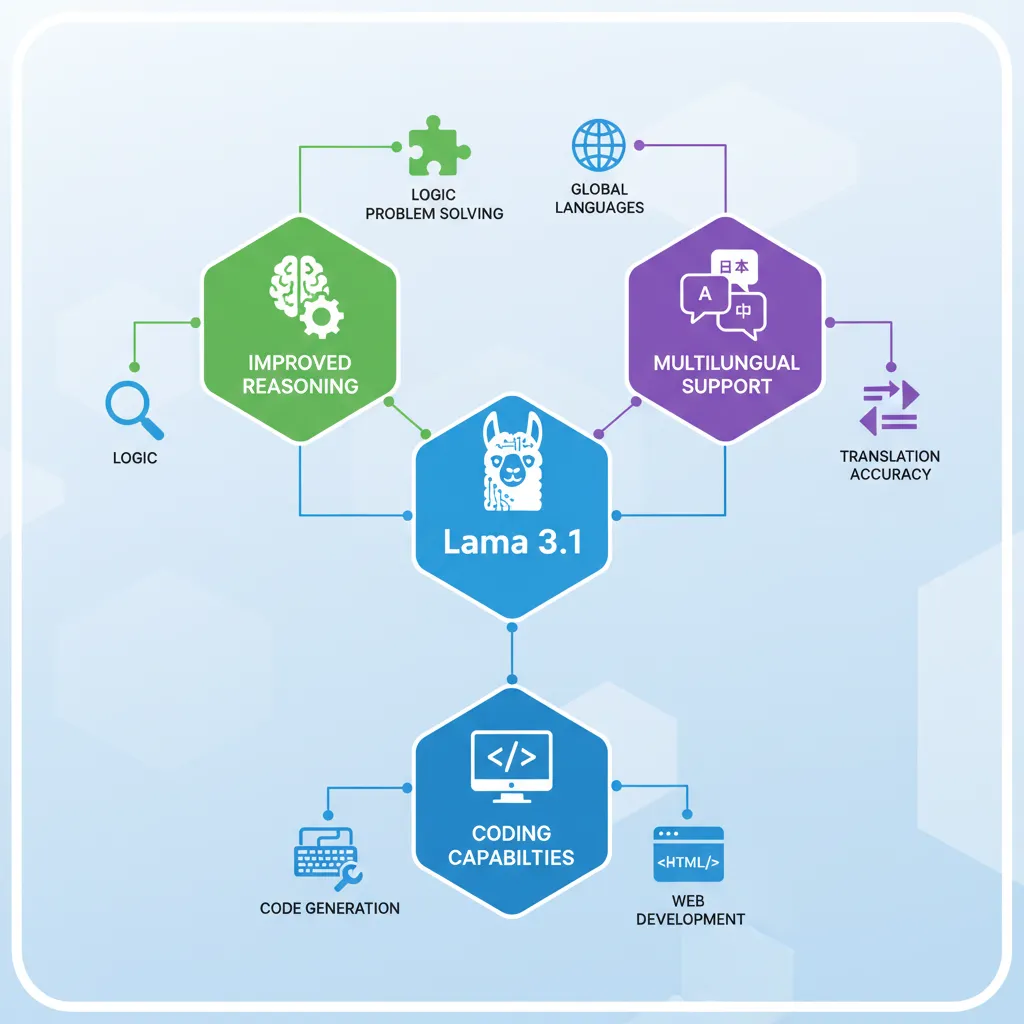
Llama 3.1 introduces several transformative features that significantly expand its utility and power. These upgrades address some of the most critical demands in AI development today, from handling vast amounts of information to understanding visual data.
Massive Context Window: From 128K to 1 Million Tokens
Perhaps the most significant architectural enhancement is the expansion of the context window. Llama 3.1 can now handle up to 1 million tokens of context through scalable architecture. A “context window” is the amount of information a model can consider at one time.
What does this mean in practice?
- Document Analysis: You can feed the model an entire novel, a lengthy legal contract, or a comprehensive research paper and ask complex questions about its content.
- Codebase Comprehension: AI for developers gets a massive boost. A developer can provide an entire software codebase for analysis, debugging, or documentation.
- Enhanced Memory: For conversational AI, this means the model can maintain a much longer and more coherent conversation, remembering details from much earlier in the dialogue.
This single feature unlocks a vast range of new and sophisticated AI applications, making Llama 3.1 an incredibly versatile tool for knowledge-intensive tasks.
Advanced Code Generation and Reasoning
Meta has heavily focused on improving Llama 3.1’s coding abilities. The model now demonstrates a more profound understanding of programming logic, algorithms, and syntax across various languages. It’s not just about writing code snippets; it’s about reasoning through complex software development problems, suggesting architectural improvements, and debugging intricate issues. This positions Llama 3.1 as an indispensable assistant for individual developers and entire engineering teams. Related: The Rise of Small Language Models: Powering the Next Wave of Edge AI
Introducing Multimodality: The Power of Vision
For the first time in the Llama family, the 405B model possesses vision capabilities. This means it can process and interpret visual information, a key step toward more comprehensive artificial intelligence. This multimodal functionality allows it to:
- Analyze charts and graphs: Extract data and summarize insights directly from images.
- Visual Q&A: Answer questions about what’s happening in a photograph or diagram.
- Describe images: Provide detailed, context-aware captions for visual content.
This addition aligns Llama 3.1 with other cutting-edge AI models and is a critical component for building the next-gen AI assistants and tools that can seamlessly interact with the world in all its forms.
Enhanced Efficiency and Deployment
While the 405B model grabs headlines, the 70B and 8B variants are crucial for the broader AI ecosystem. These models have been optimized for efficiency, allowing them to be deployed in environments with resource constraints. Llama 3.1 deployment is flexible, with support from major cloud providers, hardware platforms like NVIDIA and AMD, and popular hubs like Hugging Face. This Llama 3.1 open access ensures that developers can choose the right model size for their specific needs, from large-scale cloud applications to on-device AI.
Llama 3.1 vs. The Titans: A Head-to-Head AI Model Comparison
The central question for many is how Llama 3.1 fares against the established proprietary leaders. This AI model comparison highlights a major shift in the competitive landscape.
Llama 3.1 vs. GPT-4o
This is the matchup everyone is watching. On many core benchmarks, Llama 3.1 405B is statistically on par with GPT-4o. The key differentiator is openness. While GPT-4o is a black-box API, Llama 3.1 gives developers the model weights, allowing for deep customization, fine-tuning, and local deployment, which provides significant advantages in cost, privacy, and control. Related: What is GPT-4o? OpenAI’s New Free AI Model Explained
Llama 3.1 vs. Claude 3 Opus
Anthropic’s Claude 3 Opus has been praised for its massive context window and sophisticated reasoning. Llama 3.1 now competes directly on this front with its 1M token capability. The choice between them may come down to specific use cases, with Llama 3.1’s open nature again being a powerful draw for enterprises wanting to build proprietary solutions.
Llama 3.1 vs. Gemini 1.5 Pro
Google’s Gemini 1.5 Pro also boasts a large context window and strong multimodal capabilities. The competition here is fierce. Meta’s open approach with Llama 3.1 fosters a different kind of ecosystem—one built on community collaboration rather than integration into a single company’s product suite. This can lead to more diverse and rapid innovation. Related: Gemini vs. ChatGPT: Which AI Assistant Reigns Supreme in 2024?
Quick Comparison Table:
| Feature | Llama 3.1 405B | GPT-4o | Claude 3 Opus | Gemini 1.5 Pro |
|---|---|---|---|---|
| Access Model | Openly Available | Proprietary API | Proprietary API | Proprietary API |
| Parameters | 405 Billion | Not Disclosed | Not Disclosed | Not Disclosed |
| Max Context | ~1 Million Tokens | 128K Tokens | 200K Tokens | ~1 Million Tokens |
| Vision | Yes | Yes | Yes | Yes |
| Customization | High (Fine-tuning) | Low | Low | Low (some options) |
| Primary Advantage | Openness, Performance | Ecosystem, Speed | Reasoning, Safety | Google Integration |
The Impact on the AI Ecosystem: More Than Just a Model
The release of a model as powerful as Llama 3.1 into the open community has profound implications that extend far beyond benchmark scores.
Empowering Developers and Researchers
For the global community of AI for developers and researchers, Llama 3.1 is a gift. It provides access to a state-of-the-art foundation model without the prohibitive costs or access restrictions of proprietary systems. This levels the playing field, allowing smaller teams, startups, and academic institutions to conduct cutting-edge AI research and build novel applications that were previously out of reach.

Driving Enterprise AI Solutions
Businesses are increasingly looking to integrate AI into their core operations. Llama 3.1 offers a compelling proposition for enterprise AI solutions. Companies can fine-tune the model on their private data to create highly specialized assistants, analytics tools, and automation workflows. Because the model can be self-hosted, it provides a crucial advantage for organizations with strict data privacy and security requirements.
Real-World AI Applications: Putting Llama 3.1 to Work
The true test of any AI model is its practical utility. The advanced Llama 3.1 capabilities unlock a host of powerful real-world applications across industries.
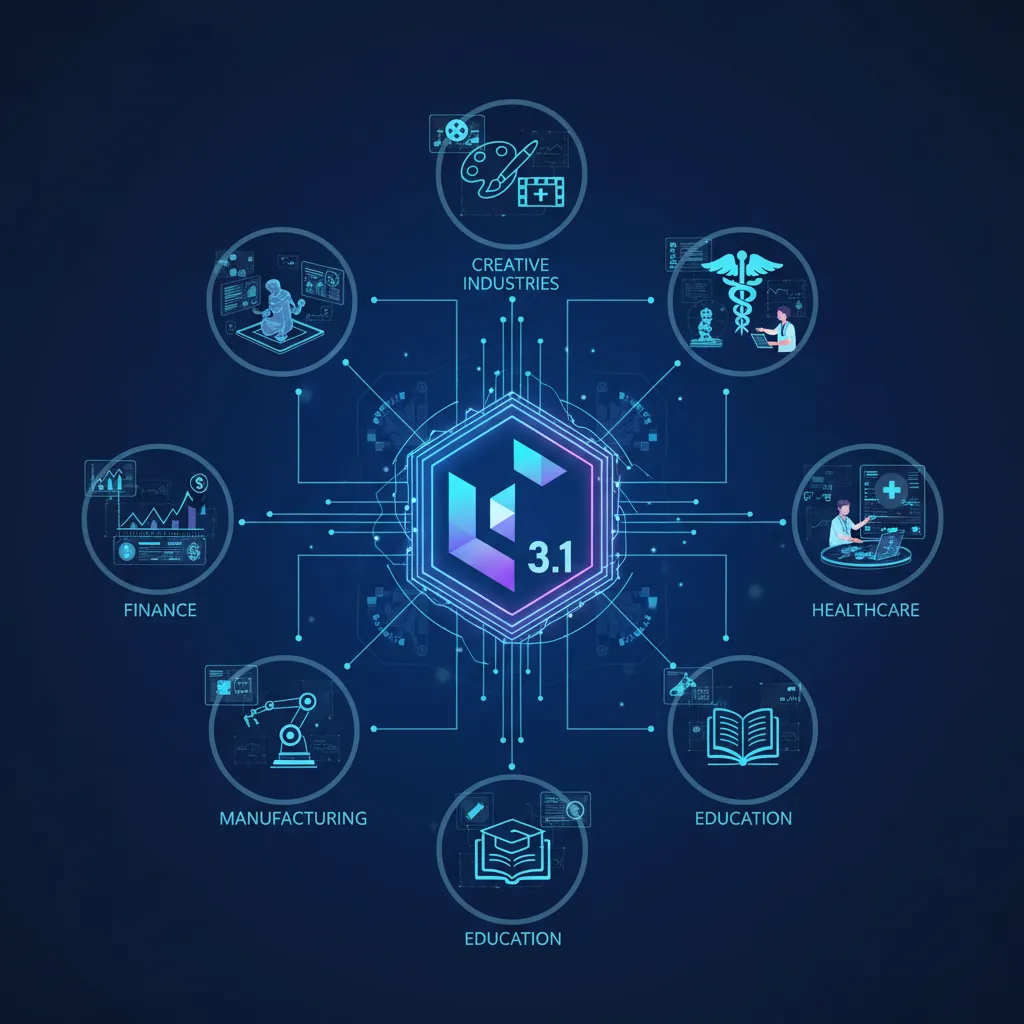
- Hyper-Personalized Customer Service: Build conversational AI agents that have a complete history of customer interactions (thanks to the large context window) to provide incredibly knowledgeable and helpful support.
- Advanced Legal and Medical Analysis: Analyze thousands of pages of legal documents or medical research papers in seconds to find precedents, summarize findings, and identify critical information.
- Next-Generation Developer Tools: Create AI-powered coding assistants that understand an entire application’s architecture, helping to write better code faster and prevent bugs before they happen.
- Creative Content Generation: Draft long-form content like books, detailed reports, or complex scripts with a high degree of coherence and creativity.
- Sophisticated Financial Modeling: Process decades of financial reports and market data to identify trends and build predictive models. Related: The Fintech Revolution: Mastering Your Money with Innovative Personal Finance Tools
The possibilities are limited only by the creativity of the developers who build upon this powerful foundation. Related: Google AI Overviews: The Ultimate SEO Guide for the New Era of Search
Conclusion
Meta Llama 3.1 is not just another entry in the long list of AI models 2024. It is a landmark release that redefines the balance of power in the AI industry. By delivering performance that rivals the best closed-source models and making it openly available, Meta has ignited a new wave of possibility for the entire AI ecosystem.
With its massive context window, new vision capabilities, and state-of-the-art reasoning, Llama 3.1 provides the tools for building the next generation of intelligent applications. It represents a powerful statement about the importance of the open-source AI movement in shaping a more accessible, innovative, and transparent future of AI. The race is on, and for the first time, the open community has a true champion capable of running with the giants.
What will you build with the power of Llama 3.1? The future is open.
Frequently Asked Questions (FAQs)
Q1. What is Meta Llama 3.1?
Llama 3.1 is the latest family of large language models from Meta AI. It includes several sizes, with the flagship 405B model offering performance competitive with top proprietary AIs like GPT-4o. It is an “openly available” model, meaning developers have broad access to use, modify, and build upon it.
Q2. Is Llama 3.1 free to use?
Llama 3.1 is available at no cost for research and commercial use, subject to the terms of its license. While the model itself is free, users will incur costs for the computational resources (e.g., cloud servers, GPUs) required to run or fine-tune it.
Q3. How is Llama 3.1 different from Llama 3?
Llama 3.1 is a significant upgrade over Llama 3. Key differences include a much larger context window (up to 1 million tokens), new multimodal (vision) capabilities in the 405B model, improved coding and reasoning skills, and overall better performance on major AI benchmarks.
Q4. What can the Llama 3.1 405B model do?
The 405B model is a highly versatile AI capable of complex tasks like writing professional code, analyzing lengthy documents (e.g., books, legal contracts), answering questions about images, engaging in sophisticated reasoning, and powering advanced conversational AI applications.
Q5. How does Llama 3.1 compare to GPT-4o?
On many standard benchmarks, Llama 3.1 405B performs at a level comparable to GPT-4o. The primary difference is their access model. Llama 3.1 is open for developers to customize and host themselves, offering more control and privacy, whereas GPT-4o is a closed, proprietary model accessed via an API.
Q6. Where can I access and use Llama 3.1?
Llama 3.1 is available through multiple platforms. Developers can download it from hubs like Hugging Face, Meta’s official website, and it is supported by major cloud service providers (AWS, Google Cloud, Microsoft Azure) and hardware manufacturers (NVIDIA, AMD, Intel).
Q7. Is Llama 3.1 truly open source?
Meta refers to Llama 3.1 as “openly available.” While it is not released under a traditional open-source license like MIT or Apache 2.0, its license is very permissive, allowing for broad research and commercial use with some restrictions. This approach provides many of the key benefits of open source to the AI community.