Beyond Creation: How AI Cures the Art World’s Discovery Dilemma
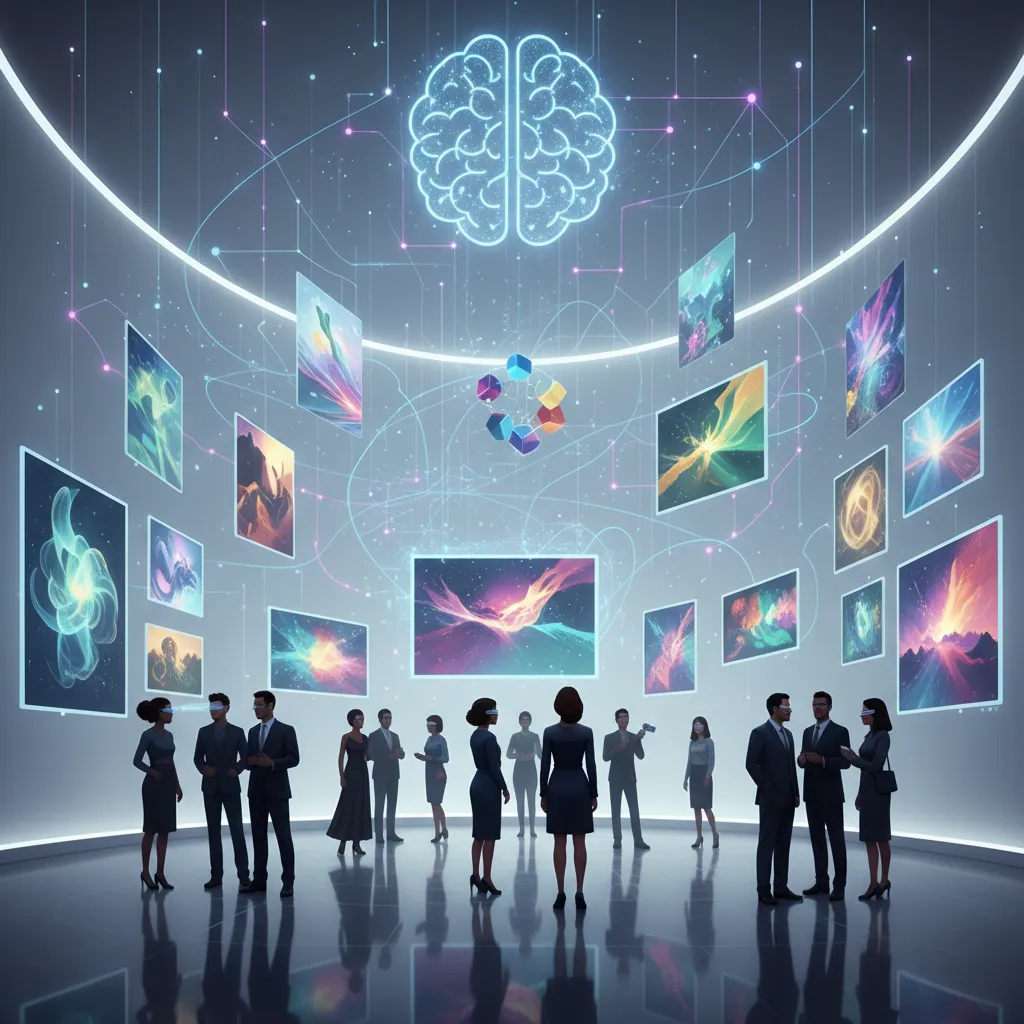
The art world is drowning in a paradox of abundance. Every day, an unprecedented wave of creative work floods the market—from oil on canvas to ephemeral digital masterpieces. For every celebrated artist exhibiting in a major gallery, thousands of equally talented creators remain undiscovered. This is the art world’s “discovery dilemma”: a frustrating chasm between brilliant art and the people who would love to own it. For collectors, it’s analysis paralysis. For artists, it’s a battle for visibility.
For decades, the industry has relied on a small group of human gatekeepers—critics, gallerists, and curators—to filter this ocean of creativity. But what if there was a better way? A more democratic, insightful, and deeply personal way to navigate this complex landscape?
Enter artificial intelligence. While most headlines focus on AI creating art, its most profound impact may be in how we find, understand, and connect with it. AI is emerging not as a replacement for the artist, but as the ultimate curator, analyst, and matchmaker. This article dives beyond the hype of generative art to explore how AI art curation, powerful art recommendation systems, and deep AI art analysis are solving the discovery dilemma, fundamentally reshaping the future of the art market for everyone involved.
The Overwhelming Canvas: Why Art Discovery Was Broken
For centuries, the path to art discovery was linear and exclusive. An artist had to catch the eye of a gallery, which in turn had to entice a collector. This system, while responsible for building incredible collections, is inherently limited and slow to adapt. In the digital age, these limitations have become glaringly obvious.
Here’s a snapshot of the challenges that created the discovery dilemma:
- The Sheer Volume: With the rise of digital tools and online platforms, the volume of art being produced is staggering. It’s humanly impossible for any person or institution to keep up, meaning countless high-quality works are simply never seen by the right audience.
- The Echo Chamber of Gatekeepers: Traditional curation often reflects the tastes and biases of a select few. This can lead to a homogenized art scene where certain styles or artist demographics are overrepresented, while innovative and diverse voices struggle to break through.
- Analysis Paralysis for Collectors: For both new and seasoned collectors, the process can be daunting. How do you find works that truly resonate with you? How do you distinguish between a fleeting trend and a lasting artistic movement? This uncertainty often leads to sticking with “safe” well-known names, further stifling the market for emerging talent.
- The Visibility Hurdle for Artists: For an artist without connections, getting noticed is like shouting into a hurricane. The process of marketing, networking, and applying for exhibitions is a full-time job that detracts from their primary focus: creating. The challenge of discovering new artists AI aims to solve is a direct result of this systemic bottleneck.
This broken system created a market ripe for disruption. The need for smarter, more scalable, and more personalized discovery tools has never been greater. The art industry AI revolution isn’t just a tech trend; it’s a direct response to these deep-seated problems.
Enter the AI Curator: Moving Beyond Human Limitations
When we talk about AI art curation, we’re not talking about a simple algorithm that filters by color or price. We’re talking about a sophisticated system that leverages complex AI technologies to understand art on a near-human level, but at a scale that is anything but human. It processes millions of data points to see the invisible threads connecting different artists, movements, and styles.
The Core Technologies Driving the Change
This revolution is powered by a confluence of advanced AI disciplines, each playing a crucial role in deconstructing and understanding art:
- Machine Learning & Neural Networks: At the heart of it all, these systems are trained on massive datasets containing millions of images of artworks. They learn to recognize everything from broad artistic movements like Cubism to the subtle brushstroke signature of a single artist. This allows them to categorize and connect art with incredible accuracy.
- Computer Vision: This is the “eye” of the AI. Computer vision algorithms break down an image into its core components—color palettes, composition, textures, lighting, and subject matter. This technology powers visual search art tools, allowing you to upload an image of a style you like and find similar works from artists you’ve never heard of. The rapid advancements in this field are astonishing. Related: Google Veo: The AI Video Tool That Changes Everything
- Natural Language Processing (NLP): Art doesn’t exist in a vacuum. NLP analyzes the text surrounding a piece—artist statements, critical reviews, historical documents, and social media commentary—to build a rich contextual understanding. It can link an artwork to its cultural significance, its narrative, and the conversation surrounding it.
How AI Art Analysis Works Under the Hood
So, what happens when an AI “looks” at a painting? It’s a process of deep art data analytics. The AI isn’t just seeing a picture; it’s translating it into a complex web of data.
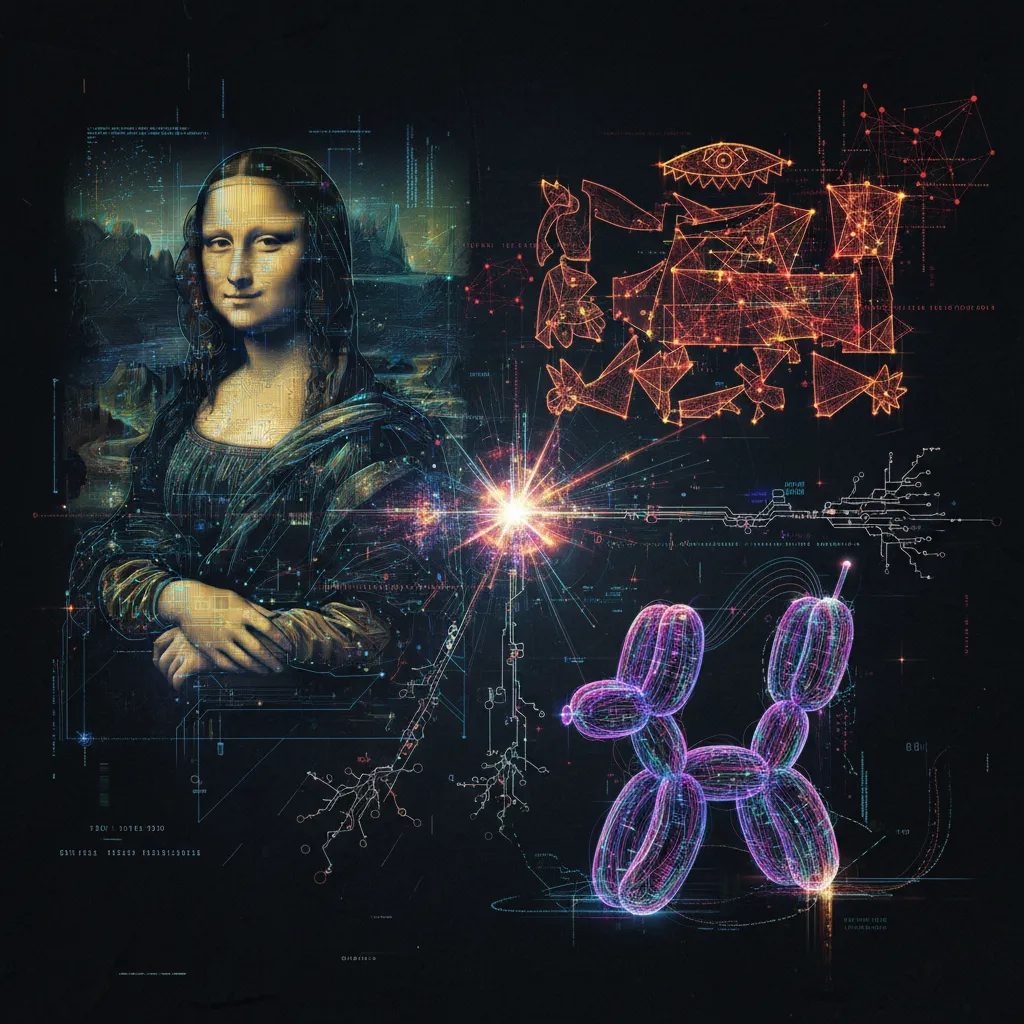
An AI might perform the following analysis:
- Compositional Breakdown: It maps the geometry of the piece, identifying leading lines, focal points, and adherence to principles like the rule of thirds.
- Color Palette Extraction: It identifies the dominant and subtle colors, understanding their relationship and potential emotional impact based on color theory.
- Brushstroke/Texture Analysis: In a high-resolution image, it can analyze the texture and direction of brushstrokes to identify the artist’s technique, a key factor in art authenticity AI.
- Stylistic Fingerprinting: By comparing these data points to its vast database, the AI can identify the work’s primary artistic movement (e.g., “85% Impressionism, 15% Post-Impressionism”) and even pinpoint influences from specific artists.
This level of granular AI art analysis moves curation from a purely subjective act to one informed by objective, scalable data, providing a powerful new lens through which to view art.
AI for Art Collectors: A Personalized Gallery at Your Fingertips
For collectors, these art tech innovations are game-changing. The technology demystifies the market and empowers individuals to collect with more confidence and personal conviction. The era of relying solely on a gallerist’s recommendation is ending; the era of data-driven, hyper-personalized collecting is here.
Personalized Art Recommendations: More Than “If You Like Monet…”
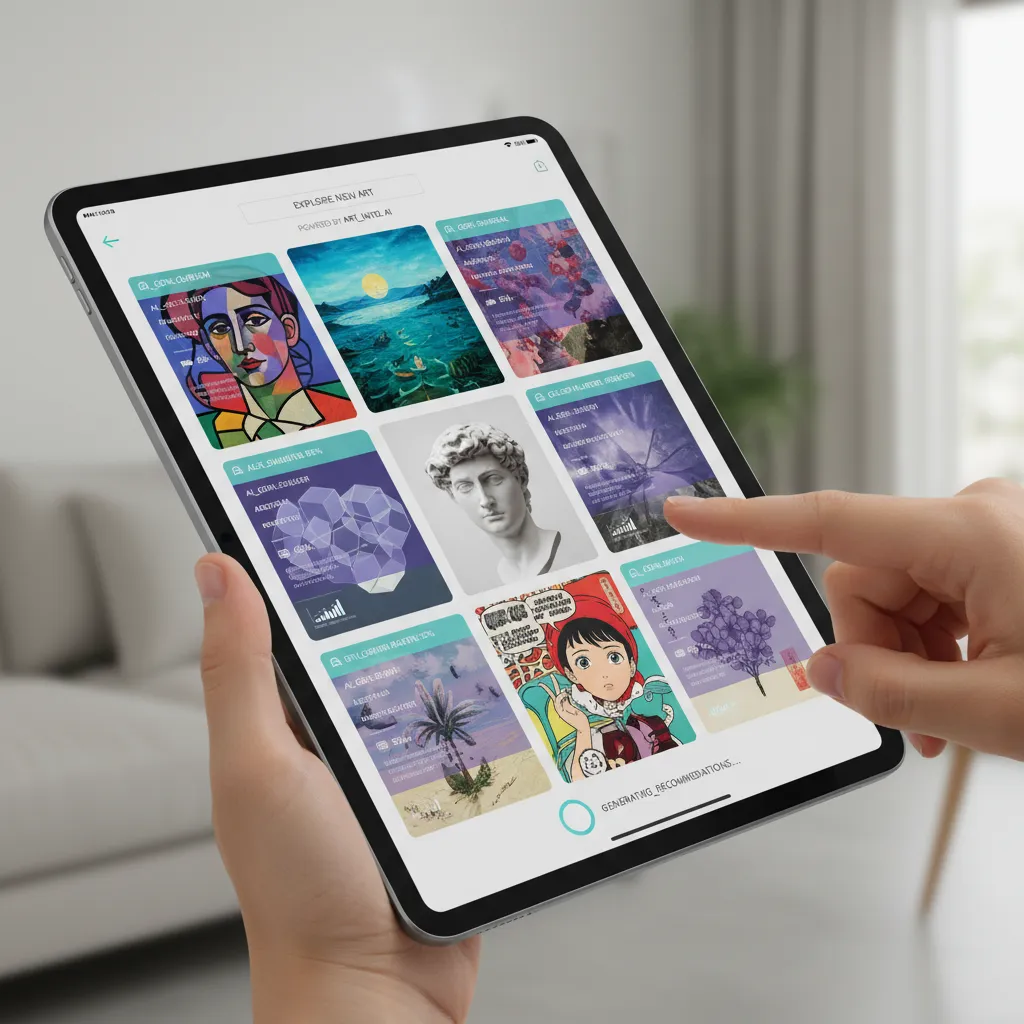
The true magic of art discovery AI lies in its ability to build a nuanced “taste profile” for each user. Traditional recommendation engines are simplistic, but modern art recommendation systems operate on a much deeper level.
Imagine you save a few artworks on a platform. The AI doesn’t just see that you liked three landscape paintings. It might notice that you’re drawn to a specific cerulean blue, prefer compositions with a low horizon line, and respond to the chaotic energy of expressionistic brushwork, even across different genres. It then scours its database of thousands of artists to find works that match this complex aesthetic DNA. This is how you discover an emerging artist in another country whose style perfectly aligns with your unique taste. Related: Perplexity Pages: The AI Content Generator Taking on Google

Due Diligence and Valuation: AI as an Expert Eye
Beyond taste, AI provides powerful tools for art collection management AI. Making a significant art purchase requires due diligence, and AI is becoming an indispensable assistant.
- AI for Art Valuation: How much is a piece really worth? AI platforms can analyze millions of data points from auction records, gallery sales, and artist career trajectories to provide a data-driven valuation estimate. This AI art market intelligence offers a crucial layer of objectivity, helping collectors avoid overpaying and identify undervalued assets. This financial savvy is essential in today’s market. Related: Master Your Money: The Top Personal Finance Apps for 2024
- Art Authenticity AI: Forgery is the art market’s oldest plague. AI is its most modern enemy. By analyzing high-resolution scans, AI can detect inconsistencies invisible to the human eye—the weave of the canvas, the chemical composition of the paint, the microscopic signature of a brushstroke—to flag potential fakes with astonishing accuracy.
Uncovering Hidden Gems and Market Trends
Perhaps the most exciting application for collectors is AI’s ability to forecast AI art market trends. By analyzing data from social media, MFA graduate shows, and online art platforms, machine learning models can identify emerging artists who are gaining traction long before they hit the mainstream auction circuit. This allows collectors to get in early, supporting artists at the beginning of their careers and making potentially lucrative investments. This is the new frontier of discovering new artists AI.
Reshaping the Institution: AI in Galleries and Museums
The impact of this technology extends far beyond the individual collector. Galleries, museums, and cultural institutions are leveraging AI to redefine their operations and enhance the visitor experience.
Curating Digital Art and AI-Driven Exhibitions
The rise of generative art platforms and digital art has presented a unique challenge for curators. How do you exhibit art that can be infinitely reproduced or is designed to change over time?
AI in galleries is providing the answer. We’re now seeing AI driven art exhibitions where the artwork on display changes based on audience interaction, time of day, or even external data feeds like the weather. AI algorithms can help in curating digital art by finding thematic links between thousands of different pieces to create cohesive and dynamic shows that would be impossible to assemble manually. The process itself is a form of creativity. Related: The Ultimate Guide to Generative AI for Content Creation
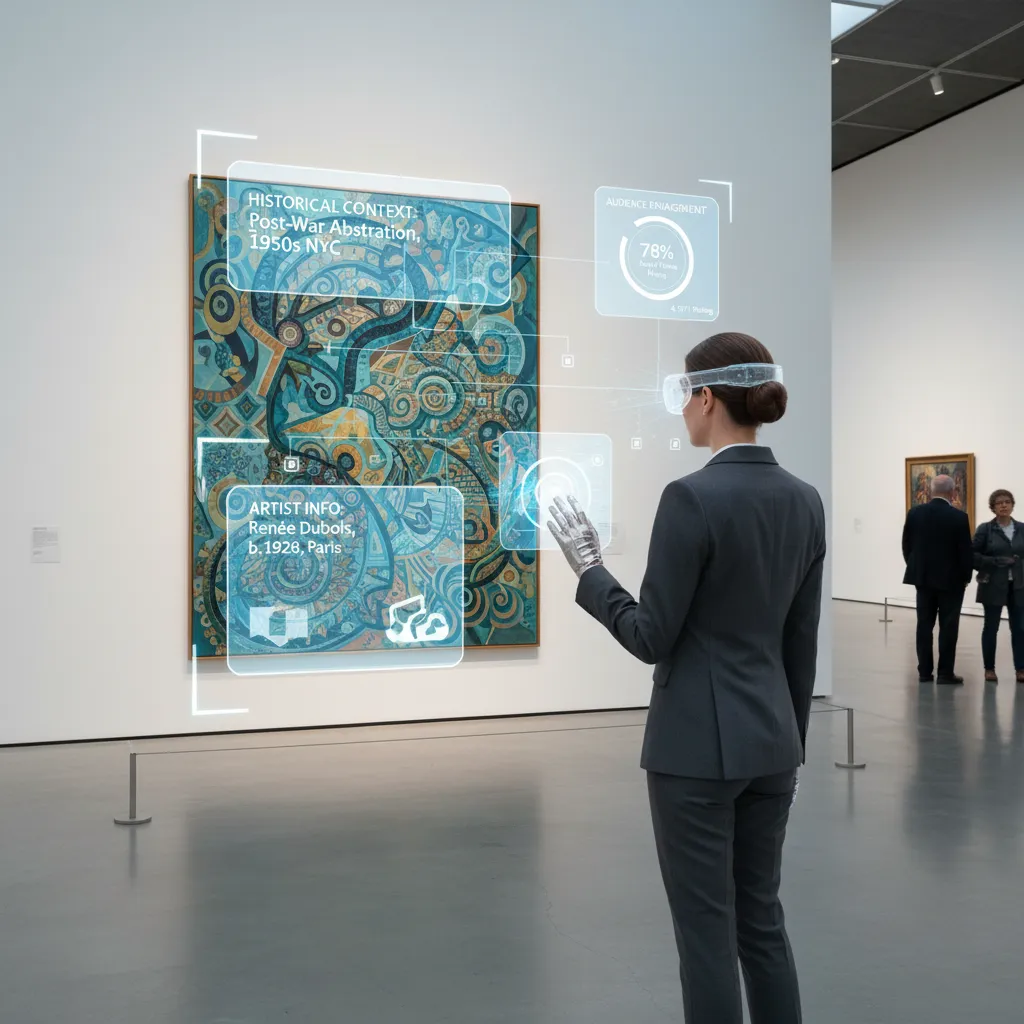
Enhancing the Visitor Experience with AI in Museum Technology
Museums are transforming from static repositories into interactive learning environments, thanks to AI in museum technology. Imagine pointing your phone at a 17th-century painting and having an AI-powered app tell you the story behind it, analyze its composition in real-time, and show you other works from the same period. This level of personalized, context-aware engagement is becoming the new standard. This integration of powerful software into our daily devices mirrors broader tech trends. Related: What is Apple Intelligence? Your Guide to iOS 18’s AI Superpowers
Digitizing and Protecting Cultural Heritage
AI also plays a vital, behind-the-scenes role. AI for cultural heritage initiatives are using machine learning to digitize and catalog vast archives of artifacts, making them accessible to researchers worldwide. Furthermore, AI can analyze the condition of ancient artifacts and artworks to predict degradation, helping conservators take preventative action to preserve our shared history for future generations.
The Symbiotic Future: AI Tools for Artists
While this article focuses on curation, it’s crucial to recognize that the line between creation and curation is blurring. The same AI that helps a collector discover art can also help an artist create and market it.
Artists are now using AI tools for artists to:
- Analyze Their Own Portfolio: An artist can use AI to see how their body of work fits into current market trends and identify potential new audiences.
- Generate Inspiration: AI can create novel stylistic blends or suggest compositional ideas, acting as a tireless creative partner.
- Manage Their Business: AI can help with pricing strategies, identifying which galleries to approach, and managing their online presence, freeing them up to focus on their craft.
Generative art platforms are not just places to create; they are vibrant ecosystems where new AI and artistic movements are born and discovered in real-time. This creates a powerful feedback loop where AI helps create, curate, and connect art, accelerating the evolution of the AI creative industries.
Conclusion: An Augmented and Accessible Art World
Artificial intelligence is not here to replace the human touch in the art world. The intuition of a seasoned curator, the emotional response to a powerful piece of art, and the creative genius of the artist remain irreplaceable.
Instead, AI is augmenting our abilities. It is curing the discovery dilemma by breaking down old barriers, democratizing access, and providing a level of insight and personalization that was previously unimaginable. It empowers collectors to build more meaningful collections, enables artists to find their audience, and allows institutions to share our cultural heritage in more dynamic and engaging ways.
We are moving beyond the simple novelty of AI-generated images into a more mature era of AI-powered curation, analysis, and connection. The future of the art market isn’t a world run by machines; it’s a world where human creativity is amplified by intelligent tools, ensuring that more great art is seen, appreciated, and cherished by more people. The discovery dilemma is being solved, one algorithm at a time.
Frequently Asked Questions
H3: How is AI used in art curation?
AI is used in art curation to analyze massive datasets of artworks, identifying stylistic patterns, thematic connections, and emerging trends. It powers personalized art recommendation systems for collectors, helps galleries design dynamic exhibitions, and provides data-driven insights to augment the decisions of human curators.
H3: Can AI accurately determine the value of a piece of art?
AI can provide a highly accurate, data-driven estimate of an artwork’s value by analyzing millions of data points, including past auction results, the artist’s career trajectory, market trends, and provenance. However, the final valuation often still requires human expertise to account for subjective factors like cultural significance and historical context.
H3: What is AI art analysis?
AI art analysis is the process of using computer vision and machine learning algorithms to deconstruct an artwork into objective data. This includes analyzing its color palette, composition, brushstroke techniques, and style to compare it against a vast database of other art, thereby identifying influences, classifying its genre, and even assisting in authentication.
H3: Will AI replace human art curators?
It’s highly unlikely that AI will replace human art curators. The consensus among experts is that AI will function as a powerful assistant or tool. AI can handle the immense task of data processing and pattern recognition, while human curators will continue to provide the essential narrative, cultural context, and emotional intelligence needed to create truly meaningful exhibitions.
H3: How do art recommendation systems work?
AI-powered art recommendation systems create a detailed “taste profile” for a user by tracking which artworks they view, save, or purchase. Using machine learning, the system looks beyond simple genre matches and analyzes deep stylistic attributes (like color, texture, and composition) to find and suggest new artworks from a global database of artists that align with the user’s unique aesthetic preferences.
H3: Can AI help with authenticating art?
Yes, AI is becoming a critical tool in art authentication. By analyzing high-resolution digital images of a piece, AI can detect microscopic details invisible to the human eye, such as inconsistencies in canvas weave, the chemical signature of pigments, and the unique pressure patterns of an artist’s brushstrokes, to identify potential forgeries.