Google’s AI Overviews: The Future of Search & SEO

Introduction: The New Dawn of Search
The familiar landscape of the Google Search Engine Results Page (SERP) is changing faster than ever before. For decades, the goal of SEO was straightforward: rank in the top ten “blue links.” But with the introduction and widespread rollout of Google AI Overviews, fueled by the advanced Gemini in Google Search, the rules of the game have fundamentally shifted.
AI Overviews—the evolution of what was formerly known as the Search Generative Experience (SGE)—represent more than just an interface change. They are Google’s commitment to an AI-powered search future where users receive synthesized, comprehensive answers directly at the top of the SERP, potentially bypassing traditional organic results entirely.
This isn’t just a technical update; it’s a strategic challenge for every publisher, marketer, and business relying on web traffic. The central question is no longer how to rank, but how to be selected and cited by the AI.
In this deep dive, we will meticulously unpack what are AI Overviews, analyze the genuine impact of AI on organic traffic, and detail the essential SEO strategies 2024 requires to thrive in this AI-first search environment. If you want to future-proof your digital presence and master AI search engine optimization, understanding this shift is non-negotiable.
Decoding Google’s AI Overviews: What Are They Really?
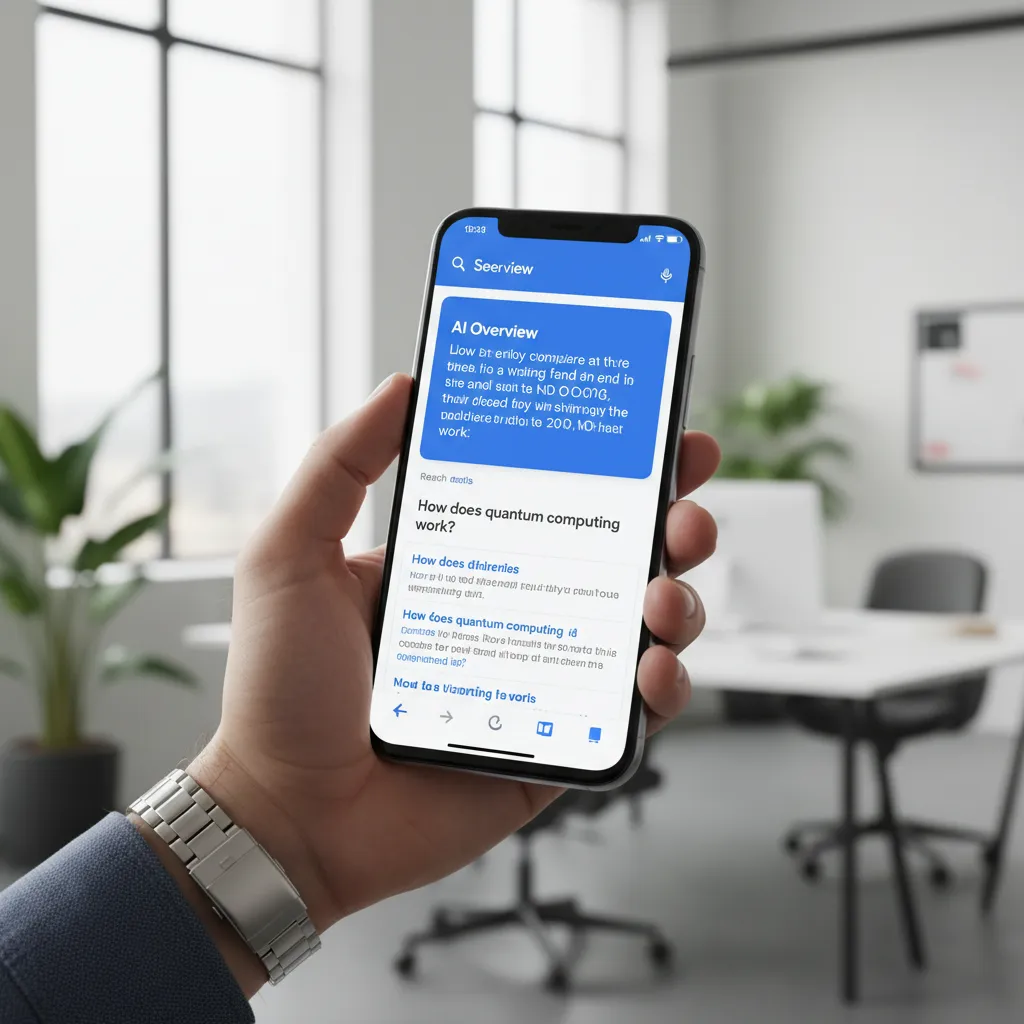
AI Overviews are concise, synthesized summaries of information, generated by Google’s generative AI (Gemini), appearing above the traditional organic search results. Their purpose is to answer complex, multi-faceted, or conversational search queries instantly, streamlining the user journey and providing a richer, more direct search experience.
From SGE to AI Overviews: A Naming Evolution
Google initially introduced this feature as the Search Generative Experience (SGE) during its experimental phase. The rebranding to “AI Overviews” at Google I/O 2024 signifies its graduation from a beta test to a core, mainstream feature integrated into Google Search. While the name has changed, the underlying goal remains the same: to leverage generative AI to provide definitive, aggregated answers.
How Gemini Powers the New Search Experience
The cornerstone of the AI Overview system is the Gemini family of large language models (LLMs). Unlike the older knowledge graph systems, which relied on pre-structured data, Gemini can:
- Understand Complex User Intent: It goes beyond simple keyword matching to grasp the nuance and context of conversational search queries.
- Synthesize Information: It reads and cross-references data from multiple authoritative web sources, creating a single, coherent narrative summary.
- Provide Multi-Step Reasoning: It can handle queries requiring logical deduction, planning, or comparison (e.g., “Plan a 3-day itinerary in Paris that avoids major crowds and includes vegan restaurants”).
This deep synthesis capability is what makes the AI Overview so powerful—and so disruptive to traditional SEO.
Crucial Takeaway: The AI is not simply reciting a featured snippet; it is generating new content based on multiple high-quality sources, often citing 3-5 different publishers within the summary.
The Unavoidable Impact on Organic Traffic and Click-Through Rates (CTR)
The biggest concern facing publishers is the potential erosion of traffic due to the efficiency of the AI Overview. If users get their answer instantly, why would they scroll down and click on a traditional link?
The Rise of Zero-Click Searches
The shift toward zero-click searches is accelerating. AI Overviews are designed to satisfy informational intent directly on the SERP. While this is a massive benefit of AI in search for users (saving time and effort), it means that for simple “what is” or “how to” queries, the vast majority of clicks will remain with Google itself.
Traffic Redistribution: Clicks vs. Citations
While the fear is that will AI replace SEO, the reality is more nuanced. AI Overviews do not abolish clicks entirely; they redistribute them.
- Traffic Loss for Low-Value Content: Content that merely restates facts or offers thin value will likely see a significant decrease in traffic, as the AI can easily extract and summarize that information.
- Traffic Retention for Deep Expertise: Content that provides unique insights, personal experience, proprietary data, tools, or is highly commercial (transactional intent) will maintain its value.
- The Value of Citation: When Google’s AI uses your site as a source, a clickable citation link often appears. This citation, while less prominent than a top organic rank, offers a new form of visibility. The challenge is ensuring the AI cites your authoritative source over a competitor’s.
The objective changes from getting the click via position to getting the credit via citation. This means the content must be so demonstrably reliable and expertly crafted that Gemini selects it as a source.
Navigating the New SERP and AI’s Effect on CTR
The new SERP hierarchy places AI Overviews at the apex, followed by sponsored results (often tailored by the AI), and then the traditional “blue links.” This means the classic organic position 1 now functions more like position 4 or 5 in terms of immediate visibility.
Marketers must focus on:
- Optimizing for Featured Snippets (Still Relevant): Although AI Overviews dominate, structured data and clear, concise paragraphs (the old way of optimizing for snippets) still help the AI digest your content easily.
- Encouraging Follow-up Clicks: Structure your content so the AI Overview only answers the initial part of a query, leaving the user needing to click through for the in-depth implementation steps, unique case studies, or critical comparison data.
[Related: The XAI Revolution: Demystifying AI Decisions, Trust & Transparency]

Adapting SEO Strategies for the AI-First Era (SEO Strategies 2024)
If AI Overviews represent a new layer of knowledge synthesis, the core of SEO must move from tactical keyword matching to strategic knowledge presentation. This requires a renewed focus on content quality, trust, and semantic completeness.
The Primacy of E-E-A-T and Trust
E-E-A-T (Experience, Expertise, Authoritativeness, and Trustworthiness) has never been more critical. The AI is programmed to prioritize high-quality, reliable information. If Gemini is building a summary to present as fact, it must rely on sources that embody maximum E-E-A-T.
Deep Expertise and Authoritative Sourcing
To satisfy the AI, content creators must:
- Demonstrate First-Hand Experience: Write about what you have genuinely done or tested. This is the ‘E’ (Experience) in E-E-A-T. For example, a review of a software tool must include screenshots or methodology that only a real user would possess.
- Show Credentials: Ensure author biographies clearly state their qualifications and relevant industry experience.
- Fact-Check Aggressively: In an environment where the AI is synthesizing facts, small inaccuracies can lead to your content being deprioritized or, worse, excluded entirely from the summary generation.
Optimizing for Semantic and Conversational Search
The days of ranking for a single, exact-match keyword are waning. Gemini excels at semantic search, understanding the relationship between concepts rather than just matching words.
To thrive, SEOs must embrace:
- Entity Optimization: Focus on covering an entire entity (a person, place, concept, or thing) exhaustively. If your article is about “electric vehicles,” it should cover charging infrastructure, battery chemistry, major manufacturers, policy implications, and future trends—all logically interconnected.
- Answering “Implied” Questions: Think about the six or seven immediate follow-up questions a user would have after the initial query. Answering these within the same article increases your semantic density and makes your page a definitive source.
Targeting Long-Tail Keywords and Complex Queries
While simple queries (weather today) are easily handled by the AI Overview, the sweet spot for driving clicks lies in complex, highly specific long-tail keywords for AI search.
Example:
- Simple Query: “best running shoes” (High risk of zero-click overview)
- Complex Query: “best neutral running shoes for marathon training on asphalt under 10oz” (Lower competition, higher likelihood the user needs to click through for a detailed comparison table and professional review.)
By targeting depth and specificity, you provide information too niche for the AI to fully summarize in a snippet, thus encouraging the click-through.
Actionable Optimization Tactics for AI Overviews
The theory of AI search is fascinating, but practical implementation is what separates success from stagnation. Here are the core tactics for how to optimize for AI search today.
Structure Your Content for Synthesis (Scannability)
The AI’s job is to read and extract. If your content is presented in dense, unstructured paragraphs, the AI struggles to reliably pull discrete facts. You must make the extraction process as easy as possible.
Key Structural Elements:
- Definitive Headings: Use H2s and H3s that are direct answers to specific questions. Instead of “Our Strategy,” use “Step-by-Step Guide to Deploying Containerized Applications.”
- Concise Summaries: Start sections with a short, bolded summary sentence that can stand alone as a snippet.
- Bulleted and Numbered Lists: These are highly favored by both AI and users. Use lists to clearly enumerate steps, pros, cons, and essential items.
- Tables: Use HTML tables for comparative data (prices, features, specifications). Tables are powerful structured data elements that the AI frequently uses to generate comparative summaries.
Using Structured Data and Schema Markup
Structured data (Schema.org markup) is the language search engines use to understand the context and purpose of your content. While this was important for rich snippets, it is vital for AI Overviews.
- FAQ Schema: Use FAQ schema on content sections that directly answer common questions. This tells Google exactly which pieces of text are designed to be concise answers.
- HowTo Schema: If your content is a tutorial, use HowTo schema to delineate the precise steps, making it easier for Gemini to generate a step-by-step procedure.
- FactCheck Schema: If you are debunking a common myth or stating a verifiable fact, use FactCheck markup to reinforce your authority.
[Related: The Rise of AI Personal Assistants: Automate Your Life & Boost Productivity]
Focus on Specificity and Exhaustiveness (The “Definitive Guide” Approach)
In the AI era, thin content will inevitably fail. Your goal should be to create content that serves as the definitive resource on a given topic, leaving no sub-topic unanswered.
If you are tackling “Google AI Overviews,” you must cover: the technology (Gemini), the history (SGE), the impact (traffic/CTR), the strategy (E-E-A-T), and the tactics (structured data/schema). This completeness signals high quality to both traditional algorithms and generative AI.
Mastering the Art of Internal Linking
Internal links serve two critical functions in the age of AI Overviews:
- Authority Signal: Strong internal linking (connecting related, deep-dive posts) shows Google (and Gemini) the breadth and organization of your site’s expertise, reinforcing your site-wide E-E-A-T.
- User Journey Management: If a user clicks through from an AI citation, strong internal links ensure they don’t bounce immediately. They guide the user to the next logical piece of high-value content, increasing time-on-site and reducing pogo-sticking.
Use descriptive, keyword-rich anchor text for all links.
Example: Instead of “Click here for more,” use: “For a deeper look into leveraging generative tools, check out our guide on [Related: AI Content Powerup: Speed and Quality Today].”

The New Relationship Between AI and Content Creation
The emergence of AI Overviews changes not just how search engines rank content, but also how we create it. The competitive threshold for AI and content creation has risen dramatically.
Leveraging AI for Research, Not Replacement
The irony is that to rank in an AI-driven search engine, you must produce content that is superior to what the AI can easily generate. This means:
- Using AI as a Research Assistant: Use tools like Gemini or other LLMs to identify gaps in existing SERPs, understand the core intent of competitor articles, and brainstorm comprehensive subheadings.
- Data Aggregation and Summarization: AI can quickly process hundreds of data points. Use it to create the foundational factual layer of your article, but ensure every fact is validated and enriched by human commentary.
The output must be an amalgam of AI-assisted research and irreplaceable human insight, experience, and editorial voice.
Differentiating Human Insight from Generative Content
Google has been clear: high-quality content, regardless of the method of creation, is what matters. However, for a site to gain and maintain the E-E-A-T required for AI Overviews, the content must clearly demonstrate human value that generic generative text lacks.
What Human Insight Adds:
- Original Data & Case Studies: Surveys, proprietary research, and unique experiments.
- Unfiltered Opinions & Predictions: Informed speculation or unique perspectives on the future of an industry.
- Ethos and Tone: A consistent, recognizable, and trustworthy brand voice.
- Nuance: Addressing exceptions to rules, complexities, and real-world trade-offs that simple summaries omit.
If your content sounds like a slightly polished Wikipedia entry, the AI will synthesize it without citing you. If your content offers genuine expertise, the AI must cite you to maintain its own authority.
[Related: AI Content Powerup: Speed and Quality Today]
Preparing for the Next Evolution of Search (Beyond AI Overviews)
While we are focused on AI Overviews today, Google’s generative search journey is ongoing. Preparing for AI-first search means looking ahead at trends that will further define the future of SEO.
Personalized and Predictive Search
Gemini’s integration is moving search toward hyper-personalization. The answers you see in your AI Overview will increasingly be tailored based on your past search history, location, and demonstrated interests.
SEO Implication: This diminishes the concept of a single universal SERP. Marketers must optimize for specific user cohorts and intents, ensuring their content speaks directly to a niche audience rather than trying to satisfy everyone vaguely.
User Experience (UX) and the New SERP Hierarchy
The search engine results page is becoming an interactive dashboard, not just a list of links. The AI Overview often includes interactive follow-up questions, carousel suggestions, and embedded tools.
Optimizing UX for AI Search:
- Speed (Core Web Vitals): Fast loading times remain critical. If a user clicks a citation link, a slow page load is a signal of poor experience, which can negatively impact future AI citation decisions.
- Mobile-First Design: Given that most AI Overviews are experienced on mobile devices, flawless responsiveness and ease of reading are essential.
- Clarity and Design: High-quality imagery, clear data visualizations, and intuitive navigation reinforce the sense of authority and professionalism that the AI favors.
This emphasis on comprehensive and user-friendly design goes hand-in-hand with E-E-A-T. A trustworthy source must also be a usable source.
[Related: Navigating AI Ethics, Governance, Bias & Trust in the AI Era]

Conclusion: The Adaptable Future of SEO
The integration of Google AI Overviews marks the most significant structural change to search since the dawn of mobile. It is not the death of SEO, but rather its most powerful evolution. The question is not will AI replace SEO, but whether SEO professionals are prepared to adapt their focus from technical optimization to strategic knowledge curation.
To succeed in this AI search engine optimization landscape, you must:
- Become a Specialist: Prioritize creating definitive, comprehensive, and high-E-E-A-T content that satisfies complex, multi-layered queries.
- Structure for Synthesis: Use clear headings, lists, tables, and structured data to make your information easily digestible for Gemini.
- Embrace Citation over Position: View the AI Overview as a new potential distribution channel where visibility is measured in authoritative citations, not just organic clicks.
The future of SEO belongs to those who view Google’s AI as a sophisticated audience of one—a knowledge synthesist that only trusts the best, most experienced, and most reliable sources on the web. By focusing on genuine value and human insight, you can ensure your digital presence is not only visible but indispensable in the new SERP.
FAQs: Preparing for Google AI Overviews
Q1. What is the difference between SGE and Google AI Overviews?
The SGE (Search Generative Experience) was the initial, experimental name for Google’s generative AI feature in search. Google rebranded it to AI Overviews to signal its move from a testing phase to a primary, integrated feature powered by the Gemini model, making it a permanent part of the core search experience for many users globally.
Q2. How will AI Overviews impact my website’s organic traffic?
The impact of AI on organic traffic will vary. Content that provides simple, factual answers will likely see a decrease due to zero-click searches. However, content that offers deep, unique insights, comprehensive guides, or requires proprietary tools will likely retain traffic, especially if cited by the AI Overview, as users click through for implementation or verification.
Q3. What is the most critical factor for optimizing content for AI search?
The single most critical factor is enhancing your site’s E-E-A-T (Experience, Expertise, Authoritativeness, and Trustworthiness). Google’s Gemini model is trained to synthesize answers from the most reliable sources. Demonstrating real-world experience and authoritative sourcing is essential for your content to be selected and cited in the AI Overview.
Q4. Should I stop optimizing for traditional keywords?
No. While the methodology shifts, traditional keyword research is still fundamental. You should pivot from targeting simple, broad keywords to focusing on long-tail keywords for AI search and complex, conversational search queries. These specific queries often require more context and detail, making a click-through to your full article more necessary.
Q5. How can I structure my content to make it easier for Gemini to use?
To make content easier for Gemini in Google Search to synthesize, use a highly structured format: employ clear H2 and H3 headings as distinct questions or topics, utilize bulleted lists for steps and features, and incorporate factual data into HTML tables. Implementing Schema markup (FAQ, HowTo) further aids the AI in identifying extractable information.
Q6. Will AI Overviews replace Featured Snippets?
AI Overviews pros and cons suggest they supersede, rather than fully replace, Featured Snippets. While AI Overviews provide a more sophisticated, synthesized, and often multi-sourced answer, the foundational methods used to optimize for featured snippets (clear, concise answers to specific questions) are still effective strategies for making your content AI-digestible.
Q7. Is there a specific way to check if my site is being cited in an AI Overview?
Currently, there is no dedicated Google Search Console report for AI Overview citations. You must actively monitor search results for your primary, high-traffic queries. When an AI Overview appears, visually inspect the “Sources” section to see if your website is listed as one of the contributing sources for the synthesized summary.