Google’s AI Overview: The Ultimate 2024 Guide
Introduction: The Ground Shifts Beneath Google Search
For over two decades, the Google Search results page was a familiar landscape: a search box followed by ten blue links. In 2024, that world fundamentally changed. The deployment of Google’s new search feature, the AI Overview, marks the single most significant transformation in information retrieval since the mobile revolution.
Initially known as the Search Generative Experience (SGE), this feature, powered by Google Search generative AI, transforms a simple query into a comprehensive, conversational, and highly contextual summary placed directly at the top of the results page. This isn’t just a tweak; it’s Google’s definitive leap into becoming a generative AI search engine.
Whether you are a casual user seeking quick answers, a digital marketer trying to protect organic traffic, or a publisher navigating the impact of AI on SEO, understanding this technology is no longer optional—it is essential. This ultimate guide will demystify the Google AI Overview, explain precisely how AI Overview works, detail its controversial rollout, and provide actionable strategies for both consumers who want to disable Google AI Overview and professionals who must master optimizing for AI Overviews.
We’ll analyze the pivot from traditional search vs AI Overview, addressing the critical questions surrounding AI Overview accuracy and the ultimate future of search as envisioned at events like Google I/O 2024 search.
What Exactly is Google’s AI Overview?
At its core, the AI Overview is Google’s primary mechanism for integrating large language models (LLMs) directly into the main search experience. Instead of just indexing and matching keywords to web pages, the AI Overview uses Google’s generative models (like Gemini) to synthesize information from multiple high-quality sources, providing an immediate, factual summary—the AI-generated search summaries.
The feature attempts to answer complex questions directly, reducing the need for users to click through multiple links. For queries like “What are the best sustainable tech innovations for home living?” or “How do I make a sourdough starter?”, the AI Overview provides a step-by-step guide or a curated list, complete with visual elements and suggested follow-up questions.
The Core Mechanism: How AI Overview Works
The process behind the Google SGE (Search Generative Experience), now called AI Overview, is a sophisticated orchestration between traditional ranking signals and generative models.
- Query Interpretation: When a user types a query, Google first determines if it is a question suitable for generative AI. Simple navigation or time-sensitive searches (like “weather in London”) are often handled by standard snippets.
- Source Retrieval: For generative queries, Google’s traditional ranking algorithms (BERT, MUM, etc.) still run, identifying the most relevant and authoritative pages (based on E-E-A-T) on the web.
- Synthesis and Grounding: The Gemini model ingests content from these top-ranking sources. Crucially, the model is instructed to ground its answer in the factual data provided by these sources. This process aims to prevent “hallucinations” common in un-grounded LLMs.
- Presentation: The model generates the concise summary—the AI search results—and displays them in a distinct box at the top of the SERP. The summary is accompanied by citations (links) to the source websites, providing transparency and allowing users to deep-dive.

The result is a dynamic, evolving piece of content that sits above the traditional organic and sometimes even paid listings. Understanding this dual-engine approach is key for anyone involved in content creation, as it reveals that traditional high-quality content still serves as the fuel for the AI answer.
From SGE to AI Overview: A Naming Evolution
The initial testing phase, launched in 2023 through Google Labs AI Overview, was labeled the Search Generative Experience (SGE). In mid-2024, as the feature moved out of Labs and into the main search interface for US users, Google simplified the branding to “AI Overview.”
This simplification signifies Google’s commitment to making AI in Google Search mainstream, treating it not as an experimental feature but as the new default method of information delivery. It represents a major step in the Google Search update 2024.
The User Experience: Benefits and Controversies
The introduction of the Google AI answers has polarized users and publishers. For some, it’s a productivity game-changer; for others, it’s a frustrating barrier to deep information and a threat to journalistic integrity.
The Upside: Instant Answers and Efficiency
For the average user, the primary benefit of the AI Overview is speed and convenience. If you need a quick definition, a complex comparison, or a summary of historical events, the AI-generated search summaries provide the necessary information instantly.
AI Overview examples often showcase its multi-step reasoning capability. For instance, if you search, “Plan a three-day trip to Rome including historical sites and modern restaurants,” the AI Overview can generate a plausible itinerary, complete with suggested times, directly on the search page. This enhanced functionality satisfies complex search intent immediately, improving the overall user experience AI search.
The Downside: Accuracy and Hallucinations
The most talked-about aspect of the early rollout, and the subject of much of the AI search controversy, was AI Overview accuracy. Due to the generative nature of the models, highly publicized instances of bizarre, incorrect, or even dangerous advice circulated widely online.
While Google has rapidly iterated and improved the grounding models, the risk remains, particularly with niche or sensitive queries. When the system incorrectly synthesizes low-quality or satirical sources, it creates “hallucinations”—confidently stated, yet entirely false, facts. This issue forces users and content creators to grapple with the trustworthiness of the AI search results.
- Fact-Checking Necessity: Users are still required to look at the source links, fundamentally undermining the goal of instant, frictionless answers.
- Source Attribution: Early versions sometimes struggled with clear attribution, leading to ethical concerns among content creators.
Impact on Traditional Search vs. AI Overview
The fundamental tension exists between the traditional ranking links and the new generative box. Traditional search vs AI Overview is a battle for visibility.
| Feature | Traditional Search (Organic Links) | AI Overview (Generative Summary) |
|---|---|---|
| Goal | Direct user to the best external resource. | Answer the query directly on the SERP. |
| Output | 10 blue links, featured snippets (text/image). | Synthesized summary, often conversational. |
| Visibility | Below ads; primary focus of the page. | Top-of-page prominence (Position Zero). |
| Primary Risk | User leaves too quickly (high bounce rate). | User never clicks through (zero-click search). |
The AI Overview effectively occupies the ultimate “Position Zero,” pushing traditional organic listings further down the page. For businesses relying on organic traffic, this shift represents an existential threat, as the goal of many users is fulfilled before they ever see the classic search results.
[Related: unlocking-new-realities-ai-spatial-computing/]
The SEO Revolution: Adapting to the New Search Landscape
For SEO professionals and content creators, the Google algorithm update AI is a clear signal: the definition of optimization has changed. We are no longer solely optimizing for clicks; we are now optimizing to be the trusted source that the AI uses to formulate its answer. This is the essence of AI Overviews for SEO.
The Zero-Click Search Dilemma
The greatest fear among publishers regarding the impact of AI on SEO is the rise of the “zero-click search.” If the AI Overview provides a complete, satisfactory answer to the user’s query, the user has no reason to click through to the source website.

While initial data from testing phases showed a mix of outcomes—some sites saw an increase in traffic from well-cited AI Overviews, others saw a sharp decline—the general consensus is that informational, short-tail keywords (e.g., “what is X”) will suffer the most.
Strategies to mitigate zero-click traffic loss:
- Focus on Transactional Intent: Optimize for commercial or navigational queries (e.g., “best budget laptops 2025 review,” or “buy running shoes near me”) which AI Overviews are less likely to fully satisfy.
- Depth and Authority: Create content so comprehensive and nuanced that the AI can only provide a high-level summary, forcing interested users to click through for the full value.
- Visual Appeal: Ensure your source is strong in visual assets (charts, videos, unique images), as the AI Overview still struggles to fully synthesize and replace media experiences.
Strategic Optimization for AI Overviews
To thrive in this new environment, content creators must shift their focus to becoming the canonical source that informs the AI, thereby achieving prominence through citation and placement within the summary. This is the definition of optimizing for AI Overviews.
Focusing on Authority and E-E-A-T
Google’s generative models are designed to pull information from the most authoritative sources. The foundation of optimization remains the enhancement of your website’s E-E-A-T (Experience, Expertise, Authoritativeness, and Trustworthiness).
- Expertise: Ensure content is written or reviewed by verified experts in the field. This is especially crucial for Your Money or Your Life (YMYL) topics (finance, health, safety).
- Originality and Depth: AI models prefer content that provides unique insights and novel research, rather than repurposed information. Be the originator of the fact, not just the repeater.
Structured Data and Featured Snippets
Although the AI Overview uses LLMs, it still heavily leverages the existing structure of the web. Structured data (Schema markup) helps Google and its AI understand the specific entities and relationships on your page.
- Use FAQ Schema: Questions and answers formatted with FAQ schema are easily digestible by the AI, often leading to them being directly incorporated into the summary or the “People Also Ask” section.
- Use HowTo Schema: For procedural queries,
HowToschema breaks down the process into clear, machine-readable steps, which is ideal for the AI’s generative format.
Entity Optimization and Semantic SEO
Semantic SEO is more critical than ever. The AI is not looking for a keyword string; it is looking for an entity (a person, place, thing, or concept) and its relationship to other entities.
- Entity Clarity: Clearly define the main entities on your page. If you are writing about sustainable habits, use synonyms and related terms like “eco-friendly,” “zero-waste,” “circular economy,” and “green technology” to ensure comprehensive coverage.
- Connect Concepts: Create content clusters that thoroughly cover a topic from all angles. An AI is less likely to synthesize a fragmented answer when it can draw from a single, deeply interconnected resource.
[Related: ethical-ai-content-creation-navigating-bias-trust/]
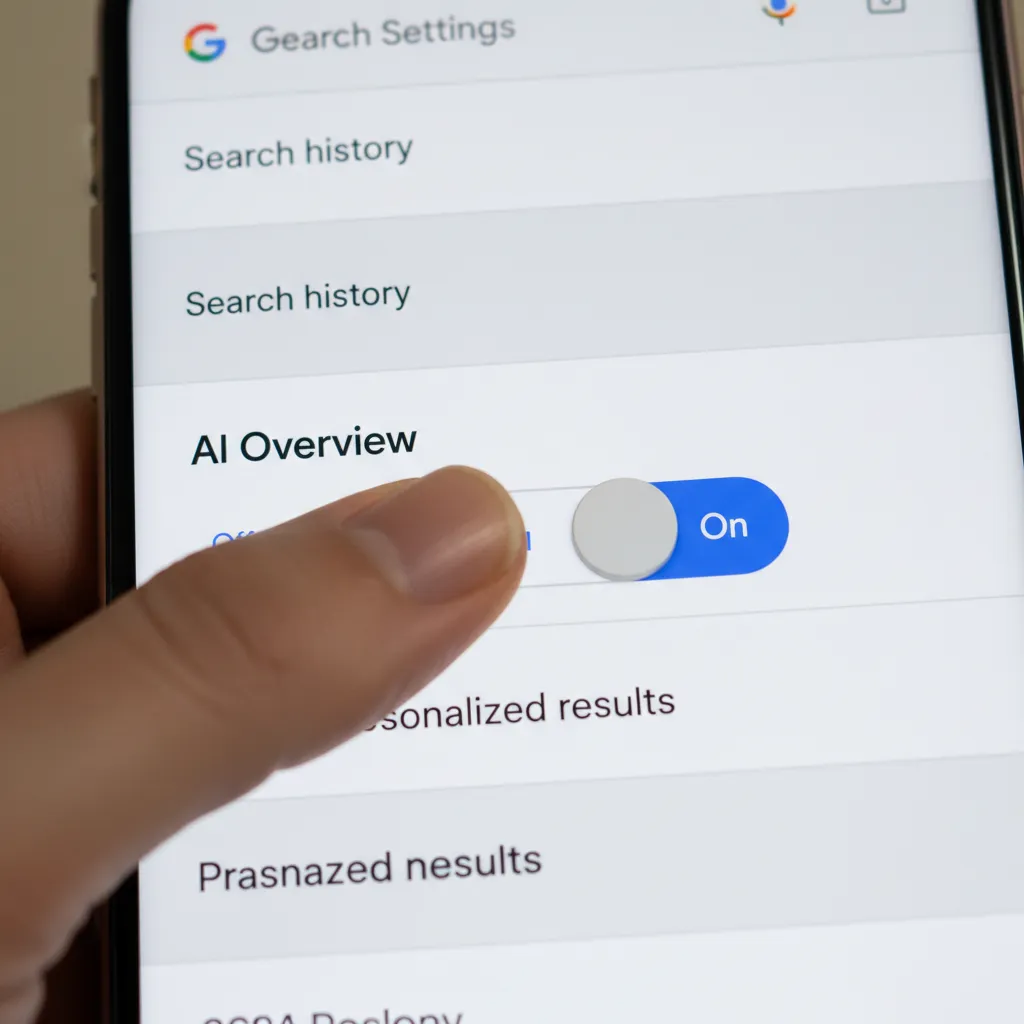
Taking Control: How to Disable Google AI Overview
A significant portion of user searches revolve around finding ways to get rid of AI Overview. While Google intends for the feature to be the default for complex queries, they recognize that not all users want or trust the AI-generated search summaries.
The user-facing control mechanisms, which allow you to stop Google AI answers from appearing, have shifted since the initial rollout in Google Labs AI Overview.
The Current Status of the Disable Option
For users in regions where the AI Overview is fully rolled out, completely and permanently disabling the feature for all searches across all devices can be difficult, as Google is integrating it as a core function.
However, Google does provide mechanisms to manage or limit its appearance:
-
Google Labs Opt-Out (Legacy Method): If you are still in a testing region or accessing an early version, the ability to turn off AI Overviews often resides in the Google Labs feature settings.
- Action: Navigate to the Labs icon (often a beaker or test tube) in your search settings. If the SGE/AI Overview toggle is present, you can manually switch it off. As the feature graduates, this toggle often disappears.
-
Using Specific Search Operators: A practical, though manual, way to bypass the AI Overview is by forcing Google into a more traditional search mode.
- Action: Use advanced search operators like quoting phrases (e.g.,
"best way to make coffee"), which sometimes forces Google to rely on traditional indexing rather than generative summaries.
- Action: Use advanced search operators like quoting phrases (e.g.,
Step-by-Step Guide for Limiting AI Overview
If the hard disable option is unavailable, the best strategy to limit its frequency is through your preference settings and browser extensions:
- Adjusting Search Preferences: Ensure your device and location settings are accurately set. While not a direct toggle, certain regions or preference settings might prioritize traditional results.
- Using Browser Extensions: Third-party extensions have emerged that specifically target and hide the AI Overview box via CSS, effectively giving you a clean SERP. Search for browser add-ons that “hide Google SGE.”
- Clear Intent Queries: Formulate queries that are inherently navigational or transactional, which are less likely to trigger the AI Overview.
It is important to note that opting out of the generative experience means you will miss out on the intended benefits, such as enhanced travel planning, detailed code explanations, and the ability to ask follow-up questions directly within the search interface.
The Road Ahead: Google I/O 2024 and Beyond
The introduction of the AI Overview is not the finish line; it is the starting block for the future of search. Insights from Google I/O 2024 search emphasized multi-modal input, complex reasoning, and seamless integration of AI assistance into daily life.
Multi-step Reasoning and Complex Queries
Google’s ambition is to move beyond simple fact synthesis to truly solve complex, multi-step problems that traditionally require research across dozens of websites.
For example, instead of just searching “how much protein is in salmon,” future versions of Google Search generative AI aim to handle queries like: “Plan a week of high-protein, low-carb dinners using ingredients I can find at my local farmer’s market, and generate a shopping list that accounts for my peanut allergy.”
This level of contextual awareness and planning demonstrates a massive leap in utility, making the AI Overview less of a summary tool and more of a personal research assistant.
The Future of Source Attribution
Addressing the ethical and traffic concerns, Google is continuously improving source attribution. We can expect future versions to offer even clearer linkage and perhaps integrate more robust publisher compensation models or premium content display options.
The focus will shift from simply citing sources to demonstrating why those sources are trustworthy, reinforcing the importance of E-E-A-T for publishers. The goal is a symbiotic relationship where high-quality content feeds the AI, and the AI drives highly qualified traffic back to the content creators for deeper engagement.

[Related: ai-reshapes-creativity-art-music-design-revolution/]
Conclusion: Navigating the New Era of AI Search
The rollout of Google’s AI Overview is more than just another Google Search update 2024; it is a declaration that the age of the generative AI search engine has arrived. For the user, it promises unparalleled speed and convenience. For the publisher, it demands a radical re-evaluation of content strategy.
Whether you choose to disable Google AI Overview for a cleaner, traditional experience or embrace the challenge of optimizing for AI Overviews, the core truth remains: Quality, authority, and structured data are the most valuable assets in the AI economy.
The search landscape will continue to evolve rapidly. The winners in this new environment will be those who adapt swiftly, creating valuable, original, expert-level content that not only serves human readers but also earns the trust and citation of the powerful new AI. Embrace the shift—the future of finding information is here.
FAQs: Grounded Answers on Google’s AI Overview
Q1. What is AI Overview, and is it the same as Google SGE?
The AI Overview is the new official name for Google’s generative AI feature integrated directly into the Search results page. Yes, it is the evolution of the experimental Search Generative Experience (Google SGE) that was previously available via Google Labs AI Overview. It provides a synthesized, conversational answer above the traditional search results.
Q2. How does the Google AI Overview know which sources to use?
The AI Overview relies on Google’s core ranking algorithms to identify the most relevant and authoritative pages (based on E-E-A-T: Experience, Expertise, Authoritativeness, and Trustworthiness). The generative model then uses the factual information from these top-ranking pages to formulate the summary, ensuring the AI search results are “grounded” in reliable web data.
Q3. Can I completely turn off AI Overviews on Google Search?
For users in regions with a full rollout, a persistent, universal toggle to turn off AI Overviews across all devices is often unavailable, as Google treats it as a core function. However, you can frequently opt out in the Google Labs AI Overview settings (if still available) or use third-party browser extensions to effectively get rid of AI Overview from your SERP view.
Q4. Does the AI Overview only use content written by generative AI?
No. The AI Overview is powered by generative AI (like Google’s Gemini), but the content it provides is based on synthesizing information that already exists on the web. It uses high-quality, human-created content from authoritative sources to formulate its AI-generated search summaries. Your original, well-researched content is the crucial fuel for its answers.
Q5. What is the impact of AI Overview on SEO traffic?
The impact of AI on SEO is complex. For simple, informational queries, traffic may decline due to zero-click searches. However, AI Overviews often cite and link to their sources. Content that achieves citation status can see an increase in highly qualified traffic, particularly for complex topics where the user needs more depth beyond the summary. Effective optimizing for AI Overviews involves increasing domain authority and E-E-A-T.
Q6. Are Google AI answers always accurate?
No. While Google continuously works to improve AI Overview accuracy, the technology is susceptible to occasional errors, known as “hallucinations,” especially when dealing with ambiguous, conflicting, or satirical sources. This is a key part of the AI search controversy. It is always recommended to check the cited sources for critical or sensitive information.
Q7. How can content creators optimize for AI Overviews?
To optimize for the AI Overview, content creators should focus on structural clarity, using headers, bullet points, and high-quality structured data (Schema markup). The content must be comprehensive, expertly written, and focused on becoming the singular, most authoritative source on a specific entity or topic, thus earning the citation spot within the AI Overview.
[Related: personalized-wellness-tech-custom-path-optimal-health/]