Early Retirement: Unlock Financial Independence with New Strategies

Imagine waking up without an alarm, spending your days on passions instead of projects, and having your time truly be your own. This isn’t a distant dream reserved for lottery winners; it’s the achievable goal at the heart of the FIRE movement. For a growing number of people, early retirement is no longer about hitting 65—it’s about unlocking financial independence decades sooner.
The journey to achieve financial freedom has evolved. While the core principles of saving more and spending less remain, the pathways to get there are more diverse and dynamic than ever. This isn’t just about extreme penny-pinching; it’s a complete financial independence mindset shift, leveraging new tools, modern investment vehicles, and innovative income strategies.
This comprehensive FIRE movement guide will walk you through everything you need to know. We’ll demystify the core concepts, explore actionable early retirement strategies, and introduce new retirement planning methods designed for today’s economy. Whether you’re a recent graduate mapping out your future or someone in your 30s looking to accelerate your journey, you’ll learn how to take control of your finances and design a life of freedom.
What is the FIRE Movement? A Modern Perspective
At its core, FIRE stands for Financial Independence, Retire Early. The central idea is to accumulate enough income-generating assets to cover your living expenses for the rest of your life, thereby making traditional work optional. This isn’t about being lazy; it’s about reclaiming your most valuable asset: your time.
The movement champions a high-intensity approach to personal finance:
- Aggressive Saving: Proponents often aim to save 50-70% of their income, a stark contrast to the traditional 10-15% recommendation.
- Smart Investing: Savings are diligently invested, typically in low-cost, broad-market index funds, to let compound growth work its magic.
- Intentional Spending: This involves optimizing expenses and practicing frugal living for financial independence, cutting out waste to redirect money towards wealth-building assets.
But modern FIRE is nuanced. It has branched out into several distinct philosophies, recognizing that one size doesn’t fit all.
The Different Flavors of FIRE: Lean vs. Fat vs. Semi-Retirement
Understanding the variations of FIRE can help you tailor a plan that aligns with your lifestyle goals. The main difference lies in the target annual spending your nest egg needs to support.
Lean FIRE
Lean FIRE is a minimalist approach. Adherents plan to live on a modest budget in retirement, often less than $40,000 per year. This path requires extreme frugality and a deep commitment to reduce expenses retire early, but it offers the fastest route to financial independence due to a smaller target nest egg. It’s ideal for those who find joy in simplicity and value time over material possessions.
Fat FIRE
On the opposite end of the spectrum, Fat FIRE is for those who want to retire early without sacrificing a high standard of living. This approach aims to support a generous annual budget (typically $100,000+), allowing for luxury travel, expensive hobbies, and other comforts. The journey to Fat FIRE is longer and requires a much larger portfolio, often demanding high incomes and aggressive wealth building for early retirement.
Barista FIRE & Coast FIRE (Semi-Retirement Strategies)
These popular semi-retirement strategies offer a middle ground.
- Barista FIRE: You’ve saved enough to cover most, but not all, of your expenses. You leave your high-stress career for a less demanding, often part-time job (like a barista) to cover the spending gap and, crucially, gain access to employer-sponsored health insurance.
- Coast FIRE: You’ve invested enough that, without any further contributions, your portfolio will grow to support a traditional retirement at 65. You no longer need to save for retirement, so you only need to work enough to cover your current living expenses, freeing you from the pressure of high-stakes saving.
The Foundational Pillars of Early Retirement Planning
Regardless of which FIRE path you choose, the mechanics of getting there rest on a few unshakeable pillars. Mastering these is essential for any successful retire early planning.
Pillar 1: Calculate Your FIRE Number
Your “FIRE number” is the amount of money you need invested to become financially independent. The most common way to estimate this is using the 4% Rule.
The rule suggests you can safely withdraw 4% of your initial portfolio value each year in retirement without depleting your principal over the long term. To find your number, simply flip the equation:
Your FIRE Number = Your Estimated Annual Expenses x 25
For example, if you anticipate living on $50,000 per year, your FIRE number would be $50,000 x 25 = $1,250,000.
This calculation highlights the most powerful lever in your FIRE journey: your spending. Every dollar you cut from your annual budget reduces your FIRE number by $25. This is where tools like FIRE calculators can be invaluable for running different scenarios and setting clear retirement savings goals.

Pillar 2: Aggressive Saving & Smart Budgeting
Reaching your FIRE number requires a savings rate that far exceeds the norm. This is achieved through a two-pronged attack: mastering your budget and consciously cutting costs.
Effective budgeting for early retirement isn’t about deprivation; it’s about optimization. It means tracking every dollar to understand where your money is going and aligning your spending with your values. Popular methods include zero-based budgeting or using apps that categorize your spending automatically.
Once you know your numbers, you can focus on the “big three” expenses for the most impact:
- Housing: Consider house hacking (renting out rooms), moving to a lower cost-of-living area, or downsizing.
- Transportation: Opt for a reliable used car instead of a new one, use public transport, or embrace cycling.
- Food: Master the art of cooking at home, buy in bulk, and reduce food waste.
This commitment to mindful spending is the cornerstone of frugal living for financial independence.

New Strategies to Accelerate Your Financial Independence
The traditional “save and invest in an index fund” model is powerful, but modern FIRE seekers are using new retirement planning methods to speed up the timeline. Accelerated financial independence comes from playing offense (increasing income) as much as defense (cutting costs).
Strategy 1: Diversify and Supercharge Your Income Streams
Relying on a single 9-to-5 salary puts a mathematical ceiling on how fast you can progress. To break through it, you need to diversify income streams retirement.
The gig economy and digital landscape have opened up endless opportunities for side hustles for financial independence. These can range from freelance writing, graphic design, or coding to starting an e-commerce store, managing social media for small businesses, or even pet sitting. The key is to find something that leverages your skills or interests and can be scaled over time.
Beyond active side hustles, focus on building passive income for early retirement. This is money earned with minimal active effort. Ideas include:
- Creating digital products: E-books, online courses, or stock photography.
- Dividend investing FIRE: Building a portfolio of stocks that pay regular dividends.
- Affiliate marketing: Earning commissions by promoting products you believe in.
- Real estate: Renting out a property or investing in Real Estate Investment Trusts (REITs).
[Related: AI Content Powerup: Boost Speed and Quality Today]

Strategy 2: Modern Investment Vehicles for FIRE
While low-cost index funds remain the bedrock of most FIRE portfolios, savvy investors are exploring other avenues for smart investing for FIRE.
- Real Estate for Early Retirement: Beyond being a landlord, modern options like real estate crowdfunding platforms allow you to invest in large-scale commercial or residential properties with a small amount of capital. This provides diversification away from the stock market.
- Sector-Specific ETFs: For those with higher risk tolerance, investing in specific sectors you believe will outperform the market (like technology, clean energy, or AI-driven healthcare) can offer higher returns. [Related: AI Health Revolution: Smart Tracking and Proactive Wellness Insights]
- Alternative Investments: While highly speculative, some allocate a small percentage of their portfolio to assets like cryptocurrency or angel investing, understanding the high-risk, high-reward nature.
Effective investment strategies FIRE are not about chasing trends but about creating a diversified, low-cost portfolio that aligns with your timeline and risk tolerance.
Strategy 3: Tax Optimization for Early Retirees
One of the most overlooked strategies for wealth building is minimizing your tax burden. A tax efficient early retirement plan can save you hundreds of thousands of dollars over your lifetime.
Utilize tax-advantaged retirement accounts to their fullest:
- 401(k)/403(b): Max out your employer-sponsored plan, especially if there’s a company match (that’s free money!).
- Roth IRA: Contributions are made with after-tax dollars, meaning all qualified withdrawals in retirement are 100% tax-free.
- Health Savings Account (HSA): This is a triple tax-advantaged account. Contributions are tax-deductible, the money grows tax-free, and withdrawals for qualified medical expenses are tax-free. It’s a powerful tool for covering one of the biggest costs in retirement.
Advanced strategies like Roth conversion ladders can also help you access retirement funds before age 59.5 without penalties. Consulting with a financial advisor who understands the FIRE movement can be immensely valuable here.
The Journey to FIRE: A Step-by-Step Guide
The path to financial independence is a marathon, not a sprint. It’s built on consistent habits and a clear vision.
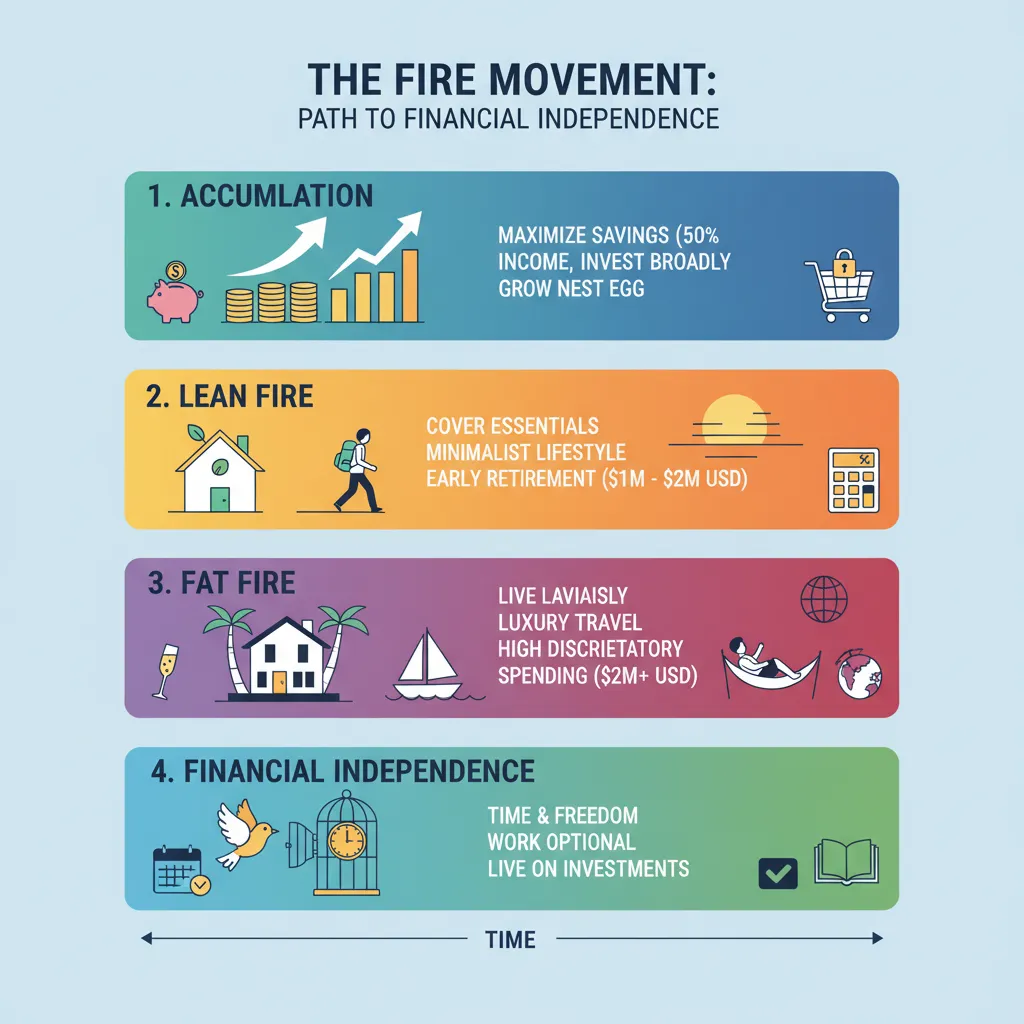
- Step 1: The Mindset Shift: It starts with believing that you can achieve financial freedom. Embrace the financial independence mindset by viewing money as a tool to buy your freedom, not just stuff.
- Step 2: Track Everything: You can’t optimize what you don’t measure. Use an app or a spreadsheet to track your income, expenses, and net worth for at least three months to get a clear picture of your financial health.
- Step 3: Create a Detailed Plan: Define your goals. What type of FIRE are you aiming for? What is your FIRE number? Work backward to set monthly and annual retirement savings goals.
- Step 4: Automate Your Finances: Set up automatic transfers from your checking account to your investment accounts every payday. Pay yourself first. Automation is the key to consistency. [Related: AI in Finance: Top Trends and Tools for 2024]
- Step 5: Review and Adjust: Life happens. Your income, expenses, and goals will change. Review your plan quarterly or annually to ensure you’re still on track and make adjustments as needed.
Overcoming the Hurdles: The Real Challenges of Retiring Early
The FIRE journey is not without its obstacles. Being prepared for them is crucial for long-term success.
The Health Insurance Dilemma
For many, health insurance early retirement is the single biggest challenge, especially in the U.S. Without an employer, you’re on your own. Options include:
- The Affordable Care Act (ACA) Marketplace, where you may qualify for subsidies.
- Private health insurance plans.
- Health-sharing ministries (though these are not traditional insurance).
- Moving abroad to a country with universal healthcare (Geo-arbitrage).
This expense must be a significant line item in your retirement budget.
Combating Burnout and Staying Motivated
Saving 50%+ of your income can be grueling. It’s important to build rewards into your plan and remember why you’re doing this. Connect with the FIRE community online or in person for support and inspiration. Following the best FIRE blogs can provide new ideas and keep your motivation high.
What Happens After You Retire?
Early retirement isn’t just a financial goal; it’s a life transition. Many early retirees struggle with a loss of identity or purpose once they leave the workforce. It’s essential to plan for how you will fill your days. This could involve travel, hobbies, volunteering, or even starting a passion business. Many find joy in post-retirement income ideas that are driven by interest, not necessity.
Conclusion
The path to financial independence retire early is a transformative journey that offers the ultimate prize: complete control over your time and your life. It requires discipline, a clear strategy, and a powerful mindset shift. By combining the foundational principles of aggressive saving and smart investing with new retirement planning methods like diversifying income streams and optimizing for taxes, you can dramatically accelerate your timeline.
Remember, FIRE is not about escaping work you hate; it’s about building a life you don’t need to escape from. The goal is freedom—the freedom to choose how you spend your days, whether that means traveling the world, raising a family, or starting a new venture. Your journey to how to retire young starts not with a windfall, but with a plan. Take the first step today.
Frequently Asked Questions (FAQs)
Q1. What are the 3 main types of FIRE?
The three main types are Lean FIRE, which involves living a minimalist lifestyle on a small budget (e.g., under $40k/year); Fat FIRE, which supports a high-end lifestyle with a large budget (e.g., over $100k/year); and Barista FIRE, a semi-retirement strategy where you work a part-time job to cover current expenses and benefits after your main investments are established.
Q2. What is the 25x rule for retirement?
The 25x rule is a guideline used to determine your “FIRE number,” or the total amount you need to save for retirement. You calculate it by multiplying your projected annual expenses by 25. The theory is based on the 4% rule, suggesting you can safely withdraw 4% of this total each year without depleting your portfolio.
Q3. Is retiring at 40 realistic?
Yes, retiring at 40 is realistic, but it requires significant financial discipline and a high savings rate, often 50% or more of your income, starting in your early 20s. Success depends on factors like your income, spending habits, investment returns, and your desired retirement lifestyle. It is a challenging but achievable goal for dedicated planners.
Q4. What is the biggest challenge of early retirement?
While accumulating the money is a major hurdle, many early retirees find the biggest challenge is non-financial. Securing affordable health insurance early retirement is a top concern. Additionally, creating a new sense of purpose, identity, and social structure after leaving a career can be a significant psychological adjustment.
Q5. How can I start the FIRE journey with no money?
The FIRE journey begins with mindset and habits, not a large bank account. Start by tracking your expenses to understand where your money goes. Create a budget to minimize debt and find areas to save. Focus on increasing your income through new skills or side hustles for financial independence. Even saving and investing small amounts consistently will build momentum through the power of compounding.
Q6. What are the best FIRE blogs to follow for inspiration?
Some of the most respected and best FIRE blogs include Mr. Money Mustache (for hardcore frugality), A Purple Life (for a modern, flexible approach), Mad Fientist (for advanced tax and investment strategies), and The Fioneers (for a focus on the journey and “Slow FI”). These resources provide motivation, practical tips, and a strong sense of community.