DePIN in Action: Real-World Applications of Decentralized Infrastructure

Introduction
Ever wondered who owns the internet? Or the cloud where your photos are stored? Or the cell towers that connect your phone? For the most part, a handful of trillion-dollar corporations do. This centralization has given us incredible technology, but it also comes with chokepoints: censorship, high costs, single points of failure, and limited innovation. What if we could build and own this critical infrastructure ourselves, as a community?
This is the revolutionary promise of DePIN, or Decentralized Physical Infrastructure Networks.
DePIN is a rapidly emerging Web3 sector that uses blockchain technology and crypto-token incentives to build and maintain real-world physical infrastructure in a decentralized way. Think of it as the Airbnb or Uber model for the digital and physical world—allowing anyone to contribute their hardware resources (like Wi-Fi hotspots, hard drive space, or GPU power) and get paid for it.
In this comprehensive guide, we’ll move beyond the buzzwords and dive into the most exciting DePIN real-world applications. You’ll discover how these community-owned networks are already challenging traditional monopolies in everything from wireless connectivity to AI supercomputing. We’ll explore tangible DePIN use cases, explain the economic engine that makes it all work, and look at the future of DePIN in building a more open, resilient, and equitable world.
What is DePIN and Why Does It Matter?
Before we explore the applications, let’s establish a clear foundation. DePIN isn’t just a niche crypto trend; it’s a fundamental rethinking of how we build and manage the services our society depends on.
A Quick DePIN Technology Guide
At its core, every DePIN project combines three key ingredients:
- Physical Infrastructure: This is the “PIN” in DePIN. It refers to real-world hardware like servers, wireless routers, sensors, or even solar panels that provide a useful service. Individuals or businesses, known as providers, purchase and deploy this hardware.
- Blockchain & Smart Contracts: This is the decentralized backend. A blockchain (like Solana, IoTeX, or Ethereum) acts as a transparent and immutable ledger to track services provided and manage payments. It ensures that everyone plays by the same rules without a central authority.
- Token Incentives: This is the economic fuel. DePIN projects use cryptocurrency tokens to reward providers for deploying hardware and maintaining the network, especially during the crucial early stages before user revenue kicks in. This incentive model solves the “cold start” problem that plagues many new networks.
This model creates a powerful “flywheel effect.” Tokens incentivize hardware deployment, which builds a useful network. The useful network attracts paying customers, which creates real revenue and drives up the value of the token, further incentivizing more hardware deployment. It’s a self-perpetuating cycle of growth.
The Core Benefits: DePIN vs. Traditional Infrastructure
The reason DePIN is gaining so much traction is that it offers compelling advantages over the centralized models we use today.
| Feature | Traditional Infrastructure (e.g., AT&T, Amazon Web Services) | DePIN (e.g., Helium, Filecoin) |
|---|---|---|
| Ownership | Corporate-owned and controlled. | Community-owned and operated. |
| Cost Structure | High capital expenditure (CapEx), passed on to consumers. | Lower CapEx, leveraging existing or crowd-funded hardware. |
| Scalability | Slow and expensive to scale. Requires building data centers/towers. | Rapid, organic scaling. Anyone can add a node to the network. |
| Resilience | Centralized points of failure can cause widespread outages. | Highly resilient; no single point of failure. |
| Innovation | Permissioned and controlled by the corporation. | Permissionless; anyone can build on top of the open network. |
| Efficiency | Often inefficient, with significant overhead and bureaucracy. | Lean and efficient, driven by direct market incentives. |
By democratizing infrastructure, DePIN paves the way for more competitive pricing, greater resilience against outages and censorship, and a faster pace of innovation.
DePIN in Action: Groundbreaking Real-World Use Cases
Now, let’s get to the exciting part: seeing how these concepts translate into tangible services you can use today. DePIN is no longer theoretical; it’s a multi-billion dollar ecosystem of blockchain infrastructure projects changing the physical world.
1. Decentralized Wireless (DeWi) Networks
The telecommunications industry is dominated by a few giants who dictate prices and coverage. Decentralized Wireless (DeWi) is flipping this model on its head by allowing people to become the network.
Leading Project: Helium
Helium is the poster child for DePIN. It started by building a global, low-power network for Internet of Things (IoT) devices like smart pet trackers, environmental sensors, and smart city meters. Instead of building cell towers, Helium incentivized individuals to buy and run small “Hotspots” from their homes or offices. These Hotspots provide miles of LoRaWAN coverage and earn their owners HNT tokens in return.
The result? Helium built the world’s largest LoRaWAN network in just a few years, a feat that would have cost a traditional telco billions of dollars and a decade of work. Now, Helium is expanding this model to 5G with Helium Mobile, allowing people to deploy 5G small cells and help build a community-owned mobile network, offering phone plans at a fraction of the traditional cost.
Real-World Impact:
- DePIN for IoT: Provides affordable, widespread connectivity for billions of smart devices.
- Community-Owned Networks: Empowers individuals to own a piece of the internet infrastructure they use daily.
- Lower Costs: Drives down prices for both IoT data and mobile phone plans through sheer competition and efficiency.

2. Decentralized Data Storage Networks
Your data in the cloud isn’t floating in the ether; it’s sitting on a server owned by Amazon, Google, or Microsoft. This creates a centralized point of control and failure. Decentralized storage networks distribute data across thousands of independent computers worldwide, making it more secure, private, and censorship-resistant.
Leading Projects: Filecoin & Arweave
- Filecoin (FIL): Often called the “Airbnb for hard drives,” Filecoin allows anyone with spare storage space to rent it out. It has created a hyper-competitive marketplace for data storage, often at a fraction of the cost of Amazon S3. Its primary use case is for “hot” and “warm” storage—data that needs to be accessed regularly.
- Arweave (AR): Arweave focuses on permanent, immutable storage. You pay once to store your data forever. This makes it perfect for archiving historical records, preserving important journalism, and storing NFTs in a truly permanent way.
Real-World Impact:
- Censorship Resistance: Critical for journalists, activists, and projects like the Internet Archive.
- Cost Savings: Significant reduction in data storage costs for businesses and developers. Related: Unlock Growth: Top AI Tools for Small Business Success
- Data Permanence: Ensures digital information can survive for generations, a core tenet of Web3 physical infrastructure.
3. Decentralized Computing Power (GPU & CPU)
The AI revolution is here, but it runs on a scarce and expensive resource: high-end GPUs (Graphics Processing Units). Companies like NVIDIA have a near-monopoly, and access to their hardware is a major bottleneck for startups and creators. DePIN is democratizing access to this critical resource.
Leading Projects: Render Network & Akash Network
- Render Network (RNDR): Render connects artists and studios needing to render complex 3D graphics and visual effects with a global network of idle GPUs. An animator can submit a job and have it processed in parallel by hundreds of different machines, dramatically cutting down render times and costs compared to using centralized services.
- Akash Network (AKT): Akash is a “Supercloud” for general-purpose computing. It offers a permissionless marketplace for cloud resources (CPU, memory, storage), allowing developers to deploy applications in a more flexible and cost-effective way than traditional cloud providers. It’s a foundational piece of decentralized computing power.
Real-World Impact:
- Powering AI and VFX: Provides the computational backbone for the next generation of AI applications and digital content. Related: Apple M4 Chip: Everything You Need to Know
- Democratizing Access: Levels the playing field, allowing smaller players to compete with tech giants by accessing affordable supercomputing power.
- Efficiency: Taps into a massive pool of underutilized computing resources around the globe.
4. Decentralized Sensor and Data Networks
So much of our modern digital world is built on data about the physical world—maps, weather, traffic, and more. Historically, collecting this data has been the domain of large corporations like Google. DePIN enables a bottom-up approach where individuals contribute data via sensors and are rewarded for it.

Leading Projects: Hivemapper & WeatherXM
- Hivemapper (HONEY): Hivemapper is building a decentralized, continuously updated map of the world. It incentivizes drivers to install simple dashcams in their cars. As they drive, the dashcam maps the surroundings and uploads the data. Drivers earn HONEY tokens for their contributions. This model allows Hivemapper to collect fresher, more detailed street-level imagery than Google Maps, especially in underserved regions.
- WeatherXM (WXM): This project creates hyperlocal weather forecasting networks. Individuals can set up a WeatherXM station at their home, which collects real-time data (temperature, humidity, pressure). This data is used to generate highly accurate local forecasts, which is invaluable for agriculture, insurance, and outdoor event planning.
Real-World Impact:
- DePIN for Smart Cities: Creates the data infrastructure for more efficient and responsive urban environments.
- Community-Sourced Intelligence: Produces more accurate and up-to-date data sets than what centralized entities can achieve alone.
- Fair Compensation: Rewards individuals for the valuable data their devices collect.
5. Decentralized Energy Grids
Our energy grids are aging, centralized, and often inefficient. DePIN offers a path toward more resilient, responsive, and sustainable DePIN solutions by creating peer-to-peer energy markets.
Leading Project: Arkreen (AKRE)
Arkreen is focused on connecting renewable energy assets, like rooftop solar panels and batteries, to a global network. It allows individuals and businesses who generate surplus green energy to “prove” its origin and sell it directly to those who need it. This process of creating and trading Renewable Energy Certificates (RECs) on the blockchain brings transparency and liquidity to the green energy market.
Real-World Impact:
- Promoting Renewables: Provides a direct financial incentive for people to install solar panels and other green energy sources.
- Grid Resilience: Facilitates the creation of microgrids that can operate independently, reducing the impact of large-scale power outages.
- Transparent Green Energy: Fights “greenwashing” by providing a verifiable, on-chain record of renewable energy generation and consumption.

The Flywheel Effect: Understanding DePIN’s Economic Model
What makes all these real-world DePIN examples possible is a brilliant economic model often called the “DePIN Flywheel.” It’s a virtuous cycle that allows these networks to bootstrap themselves from zero to global scale.
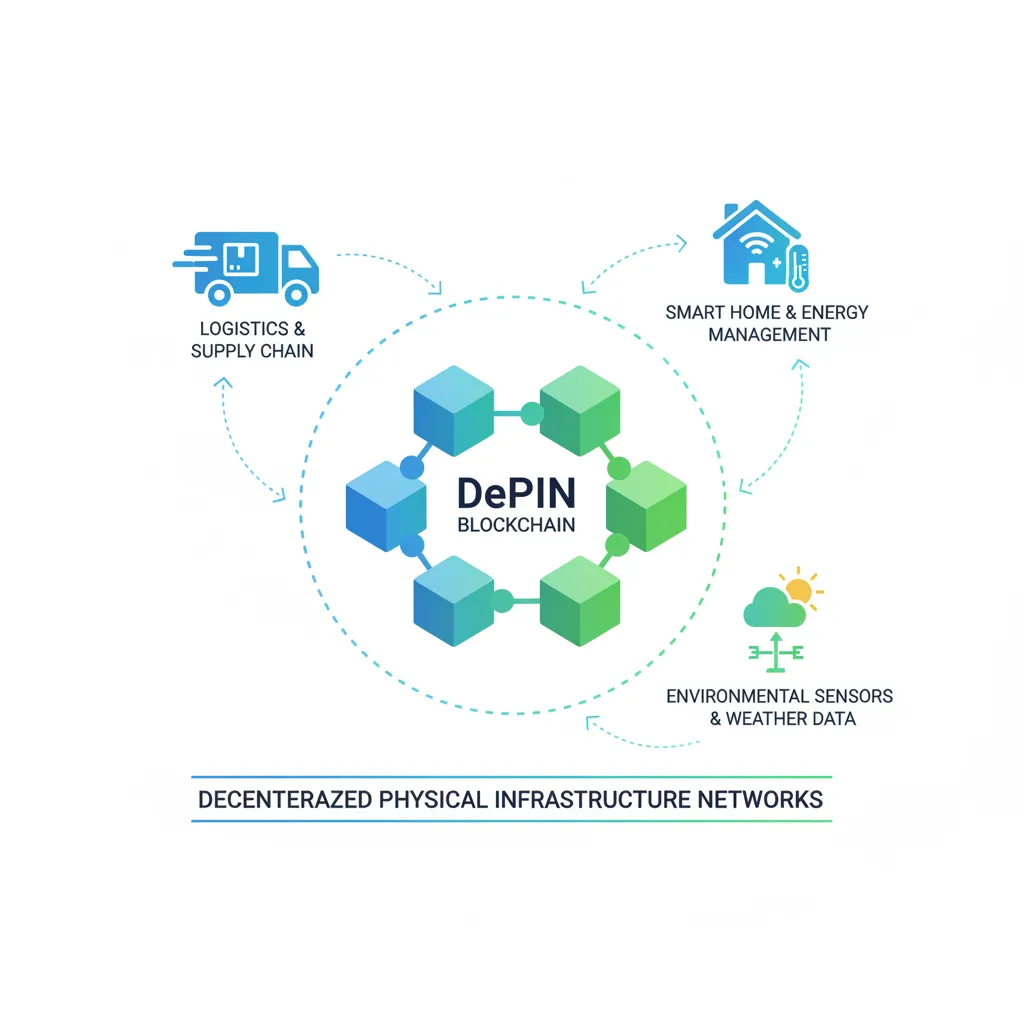
Here’s how it works:
- Incentivize Supply: The network first needs contributors (the supply side) to deploy hardware. It attracts them by offering generous token rewards. In the early days, these rewards are the primary reason people participate.
- Build a Useful Network: As thousands of contributors join, their collective hardware forms a powerful, decentralized network with massive coverage or capacity.
- Attract Demand: With a robust network now in place, the project can attract real users and businesses (the demand side) who want to use the service (e.g., store data, connect an IoT device, render a video).
- Generate Revenue & Create Utility: These users pay for the service, often in stablecoins or by burning the network’s native token. This revenue creates real, utility-driven demand for the token.
- Reinforce the Cycle: The increased demand and utility drive up the token’s value. A more valuable token makes the rewards for supply-side contributors even more attractive, incentivizing further network growth and starting the cycle all over again, but stronger this time.
This tokenized infrastructure model is DePIN’s secret weapon, enabling it to build global DePIN networks faster and more cheaply than any centralized company could ever hope to.
Navigating the Hurdles: DePIN Challenges and the Road Ahead
Despite its immense potential, the path to mass adoption for DePIN is not without obstacles. Being aware of these DePIN challenges is crucial for anyone interested in building DePIN projects or investing in the space.
- Technical Complexity: Bootstrapping a two-sided market of supply and demand is incredibly difficult. Networks must ensure their technology is reliable, secure, and scalable enough to compete with established players.
- Regulatory Uncertainty: The legal landscape for digital assets and decentralized networks is still evolving. DePIN projects operate in a grey area in many jurisdictions, which can deter mainstream investment and participation.
- User Experience (UX): Many DePIN applications still require a degree of technical knowledge (e.g., managing crypto wallets). For mainstream adoption, the experience needs to be as seamless and simple as using a traditional web service. Related: What is Apple Intelligence? A Deep Dive into Apple AI
- Hardware Costs & Logistics: While DePIN leverages crowd-sourced hardware, there’s still the challenge of designing, manufacturing, and distributing physical devices to a global community.
The Future of DePIN: Building a User-Owned World
The impact of DePIN is just beginning to be felt. We are at the very early stages of a fundamental shift towards a more decentralized, user-owned physical world. Looking ahead, the future of DePIN is intrinsically linked with other transformative technologies.
Imagine DePIN for smart cities, where traffic flow, air quality, and energy use are managed by community-owned sensor networks. Consider the synergy between DePIN and AI, where decentralized GPU networks provide the raw computing power for training next-generation models, and decentralized data networks supply the verified, high-quality data they need. Related: The Mind Meld: Rise of Neurotech and Brain-Computer Interfaces
These are not futuristic fantasies; they are the logical next steps for the DePIN real-world applications being built today. This is a movement to reclaim ownership of our digital and physical lives, moving from being passive consumers to active participants and owners of the infrastructure that powers our world.
Conclusion
DePIN represents a paradigm shift from top-down, corporate-controlled infrastructure to bottom-up, community-owned networks. By elegantly blending blockchain, token incentives, and physical hardware, DePIN is creating tangible solutions to real-world problems. We’ve seen how DePIN use cases are already delivering cheaper, more resilient, and more accessible services in wireless, storage, computing, and beyond.
While challenges remain, the flywheel is spinning. The projects we’ve discussed are just the vanguard of a new wave of innovation built on the principles of decentralized physical infrastructure. The next time you connect to a Wi-Fi network or save a file to the cloud, ask yourself: who owns this? With DePIN, the answer could very well be “we do.”
Ready to explore this new frontier? Dive into one of the projects mentioned, join their community, or share this article to spread the word about the user-owned infrastructure of tomorrow.
Frequently Asked Questions (FAQs)
Q1. What is a DePIN in simple terms?
In simple terms, DePIN (Decentralized Physical Infrastructure Networks) is a way of building and maintaining real-world infrastructure like Wi-Fi hotspots, data storage, or sensor networks using a community of individuals. People are rewarded with cryptocurrency tokens for contributing their hardware and resources, creating a user-owned alternative to services traditionally run by large corporations.
Q2. What is a real-world example of a DePIN project?
Helium is a prime real-world DePIN example. It created a global wireless network for Internet of Things (IoT) devices by incentivizing people with HNT tokens to run small radio hotspots from their homes. This community-driven approach built a massive network faster and cheaper than any traditional telecom company could have.
Q3. How do DePIN projects make money?
DePIN projects generate revenue through a two-sided marketplace. On one side, “providers” contribute hardware and earn the network’s native tokens. On the other side, “users” pay to use the network’s service (e.g., data transfer, file storage). This user-generated revenue creates real economic value, which is often used to buy back and burn tokens, increasing the token’s scarcity and value.
Q4. What is the difference between DePIN and DeFi?
DeFi (Decentralized Finance) focuses on recreating traditional financial systems like lending, borrowing, and trading on the blockchain. DePIN (Decentralized Physical Infrastructure) focuses on using blockchain and token incentives to build and operate physical, real-world infrastructure. While both use blockchain, DeFi deals with purely digital assets, whereas DePIN has a direct link to physical hardware.
Q5. Is DePIN a good investment opportunity?
DePIN is considered a high-growth sector within Web3, but like any emerging technology, it comes with significant risks. DePIN investment opportunities lie in the potential for these networks to disrupt massive, multi-trillion dollar industries like telecoms, cloud computing, and energy. However, investors should be aware of regulatory uncertainty, technological risks, and market volatility. Always do your own thorough research before investing.
Q6. What are the main categories of DePIN?
DePIN projects are generally grouped into two main categories: Physical Resource Networks (PRNs) and Digital Resource Networks (DRNs). DRNs involve decentralized networks for digital resources like data storage (Filecoin), computing power (Render), and bandwidth. PRNs involve hardware that collects data about the physical world, such as wireless networks (Helium), mobility/mapping (Hivemapper), and energy grids (Arkreen).