Claude 3.5 Sonnet vs GPT-4o: The Ultimate AI Showdown Explained

Introduction
The world of artificial intelligence is moving at lightning speed. Just when we thought we’d reached a plateau, two new titans have stormed the arena, sparking a fresh debate over the best AI model 2024. In one corner, we have OpenAI’s GPT-4o, the “o” for “omni,” a model designed for natively multimodal interaction. In the other, Anthropic’s Claude 3.5 Sonnet, a speed and intelligence-focused model that’s already setting new benchmarks.
This isn’t just another incremental update; it’s a fundamental clash of philosophies and capabilities. The Claude 3.5 Sonnet vs GPT-4o debate is crucial for developers, content creators, businesses, and anyone curious about the future of AI chatbots. Choosing the right tool can dramatically impact productivity, creativity, and efficiency.
In this comprehensive AI model comparison, we’ll dissect every facet of these next-gen AI models. We’ll go beyond the hype to analyze Claude 3.5 Sonnet performance, GPT-4o capabilities, speed, pricing, unique features, and real-world GPT-4o applications. By the end, you’ll have a clear understanding of which AI powerhouse reigns supreme for your specific needs.
At a Glance: Key Differences Between Claude 3.5 Sonnet and GPT-4o
Before we dive deep, let’s start with a high-level overview. While both models are astonishingly capable, they excel in different domains. This table summarizes the core distinctions in the Anthropic Claude vs OpenAI GPT battle.
| Feature | Claude 3.5 Sonnet | GPT-4o (Omni) | The Verdict |
|---|---|---|---|
| Core Strength | Speed, graduate-level reasoning, and coding | Native multimodality (text, audio, image) and access | Sonnet for raw intelligence and development; GPT-4o for versatile, human-like interaction. |
| Speed | Blazing fast; 2x faster than Claude 3 Opus. | Significantly faster than GPT-4 Turbo; near-human speed. | Sonnet is the fastest AI model for complex tasks, making it ideal for real-time applications. |
| Intelligence | Outperforms GPT-4o on graduate-level reasoning (GPQA). | Top-tier intelligence across a broad range of tasks. | Sonnet has a slight edge in complex problem-solving and nuanced understanding. |
| Coding | A new leader, outperforming on HumanEval benchmarks. | Extremely proficient, a long-standing developer favorite. | Sonnet, especially with its “Artifacts” feature, offers a more integrated and powerful coding environment. |
| Vision (Multimodal) | State-of-the-art vision capabilities. | Excellent vision, with native audio and video inputs. | GPT-4o leads in multimodal AI performance with its truly “omni” approach, though its full capabilities are still rolling out. |
| Unique Feature | Artifacts: An interactive workspace for iterating. | Voice Mode: Real-time, emotive voice conversation. | Two game-changing features. “Artifacts” boosts productivity now; Voice Mode hints at the future of interaction. |
| Pricing (API) | Highly cost-effective: $3 input / $15 output per 1M tokens. | More expensive: $5 input / $15 output per 1M tokens. | Sonnet offers superior value, providing top-tier performance at a mid-tier price point. |
| Free Access | Generous free tier on Claude.ai. | Widely available on ChatGPT with usage limits. | Both offer excellent free access, democratizing cutting-edge AI for everyone. |
The Need for Speed and Efficiency: A New Velocity
In the world of AI, latency is the enemy of usability. A brilliant answer that takes 30 seconds to generate is far less useful than a slightly less brilliant one that appears instantly. Both Anthropic and OpenAI have made massive strides here.
Claude 3.5 Sonnet has made speed its signature feature. Anthropic claims it operates at twice the speed of its previous flagship model, Claude 3 Opus. This isn’t just a number on a spec sheet; it translates to a more fluid and responsive user experience. For enterprise AI solutions, such as powering a live customer service chatbot or analyzing streaming data, this velocity is a game-changer. The model’s efficiency also makes it significantly cheaper to run, a key factor in the Claude 3.5 Sonnet pricing advantage.
GPT-4o is no slouch either. It was designed to bring GPT-4 level intelligence to a much wider audience with significantly reduced latency. Interactions feel conversational and immediate, a stark contrast to the sometimes ponderous pace of earlier GPT-4 models. This focus on speed is central to its “omni” capabilities, enabling the real-time voice conversations that stunned audiences during its debut.
While both are incredibly fast, Sonnet’s performance on complex, multi-step tasks currently gives it the edge as the fastest AI model for heavy-duty workloads.
Brains of the Operation: Performance and Benchmark Deep Dive
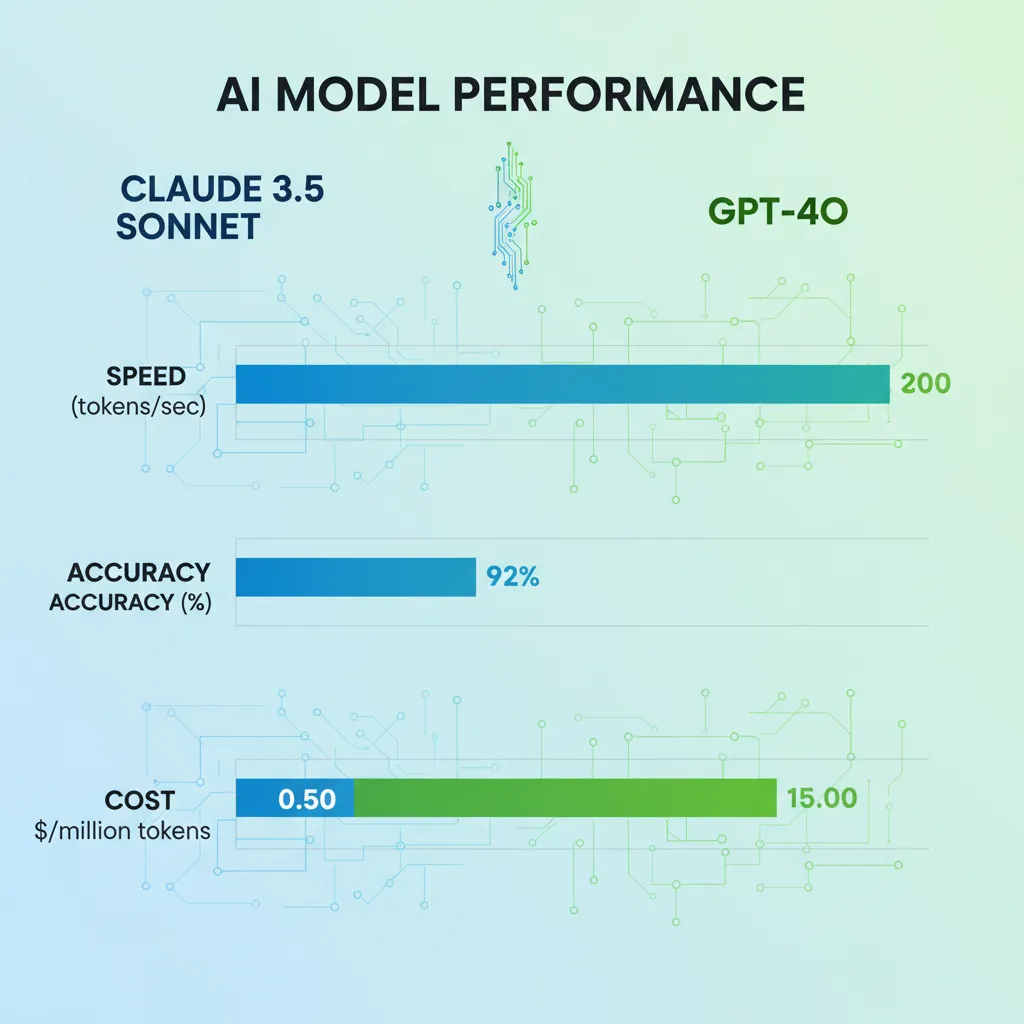
Benchmarks provide a standardized way to measure an AI’s raw intelligence. In this large language model comparison, Claude 3.5 Sonnet has managed to dethrone the reigning champion in several key areas.
H3: Graduate-Level Reasoning (GPQA)
The Graduate-Level Question Answering (GPQA) benchmark is a grueling test of an AI’s ability to reason through complex questions in domains like physics, biology, and chemistry. This is where Sonnet truly shines. It has set a new industry record, correctly answering a higher percentage of these difficult questions than GPT-4o and even its more powerful predecessor, Claude 3 Opus.
This suggests that for tasks requiring deep, nuanced understanding and multi-step reasoning—like analyzing legal contracts, interpreting complex financial reports, or drafting scientific research papers—Sonnet is arguably the most accurate AI model currently available. For anyone in a specialized field, this is a massive advantage. Related: Decoding Investor Psychology with AI: How Machines Spot Behavioral Biases
H3: Coding Prowess (HumanEval)
For years, OpenAI’s models have been the gold standard for AI for coding. However, the Claude 3.5 Sonnet benchmarks show a new leader has emerged. It scores an impressive 92.0% on the HumanEval benchmark, surpassing GPT-4o’s 90.2%.
Sonnet demonstrates a sophisticated grasp of code, with the ability to independently write, edit, and execute code. Its real strength lies in complex tasks like bug fixing and updating legacy codebases. When combined with its new “Artifacts” feature (more on that below), it creates a powerful, interactive development environment that can significantly accelerate workflows. This makes it a compelling choice for developers looking for a next-generation coding assistant. Related: AI Trading Bots: Your Guide to Automated Investing
H3: Vision and Multimodal Understanding
Multimodality—the ability to understand and process information from different sources like text, images, and audio—is a key frontier in AI. Here, the GPT-4o vs Claude 3.5 Sonnet comparison is more nuanced.
GPT-4o was built from the ground up to be “omni.” It can seamlessly interpret a combination of text, audio, and images to generate responses in any of those formats. Its ability to “watch” a live video stream and comment on it, or hold a real-time, emotionally resonant voice conversation, represents a major leap in human-computer interaction.
Claude 3.5 Sonnet, while not natively “omni” in the same way, possesses state-of-the-art vision capabilities. It outperforms previous models on standard vision benchmarks, excelling at tasks that require visual reasoning, like interpreting complex charts, reading text from imperfect images, and transcribing handwritten notes. For a business that needs to perform AI for data analysis on thousands of invoices or visual reports, Sonnet is an incredibly powerful and accurate tool.
Beyond Benchmarks: Real-World Use Cases and Applications
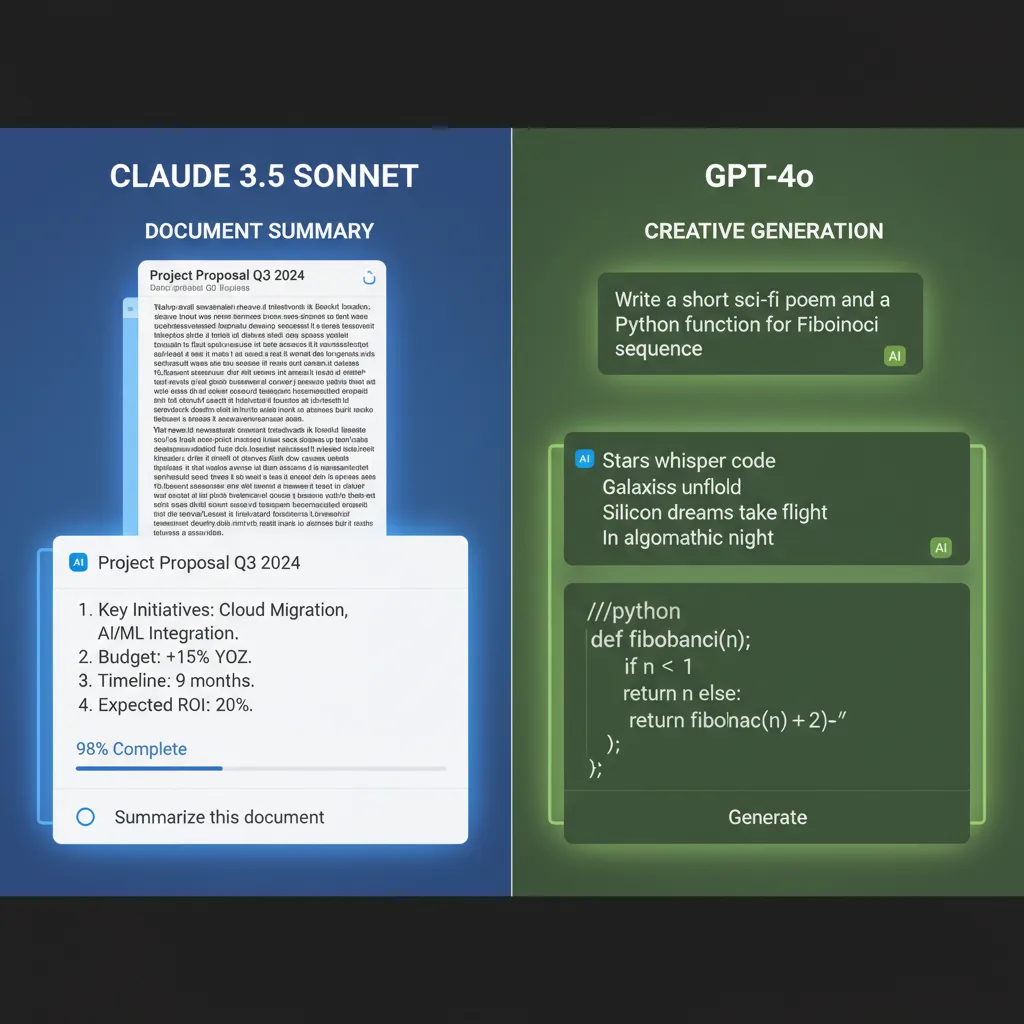
While benchmarks are important, the true test of an AI is its practical application. Here’s how the models stack up in day-to-day tasks.
H3: For the Enterprise: Customer Support and Data Analytics
For businesses, the AI efficiency of Claude 3.5 Sonnet is a massive draw. Its combination of speed, intelligence, and a lower price point makes it ideal for scaling enterprise AI solutions. Imagine a customer support bot that can instantly grasp the entire context of a user’s problem, analyze past interactions, and provide a sophisticated, human-like solution in seconds. This is now possible with Sonnet. It’s also a powerhouse for AI for data analysis, capable of sifting through market data, internal documents, and user feedback to generate actionable insights.
H3: For the Creator: Content Generation and Nuanced Writing
Both models are exceptional at AI for content creation. However, many users note a qualitative difference. GPT-4o is a master of structure and clarity, making it great for generating first drafts of articles, emails, and reports.
Claude 3.5 Sonnet is often praised for its more natural, nuanced, and creative writing style. It has a knack for capturing subtle humor and tone, making its output feel less “AI-generated.” For writers, marketers, and creators who value a strong, unique voice, Sonnet offers a compelling toolkit. Related: Perplexity Pages: The Ultimate AI Content Generator?
H3: For the Developer: A New Coding Paradigm
This is where the difference is most stark. GPT-4o is an excellent coding assistant, but Claude 3.5 Sonnet, with its new Artifacts feature, changes the entire workflow.
When a developer asks Sonnet to generate code, a design, or a document, it appears in a dedicated window next to the conversation. This creates an interactive workspace where you can see the output in real-time, edit it, and ask the AI to iterate based on your changes. You can build a website, write and execute a Python script, or create an SVG logo without ever leaving the Claude interface. This seamless integration of conversation and creation is one of the most significant Claude 3.5 Sonnet features.

The Economics: Pricing, API Access, and Overall Value
Cost is a critical factor, especially for businesses and developers running applications at scale.
- Claude 3.5 Sonnet API Pricing: $3 per million input tokens and $15 per million output tokens, with a large 200K token context window.
- GPT-4o API Pricing: $5 per million input tokens and $15 per million output tokens.
The Claude 3.5 Sonnet pricing model is aggressive and highly competitive. It delivers intelligence that is, in many cases, superior to top-tier models like GPT-4 and Claude 3 Opus, but at a fraction of the cost. This positions it as an exceptional value proposition, offering premium performance for a mid-range price. For startups and enterprises looking to leverage AI without breaking the bank, Sonnet is a clear winner on value.
For free users, the competition is a win-win. GPT-4o is now available to all ChatGPT users, and Claude 3.5 Sonnet is free to use on Claude.ai with very generous rate limits, making these powerful next-gen AI models accessible to everyone.
Limitations and the Road Ahead
No AI is perfect. Both models have limitations and represent stepping stones toward even more capable systems.

One of the key AI model limitations for Claude 3.5 Sonnet is the lack of native audio and real-time video input that OpenAI has demonstrated with GPT-4o. While its vision system is top-class, it doesn’t yet offer that seamless, conversational “omni” experience.
For GPT-4o, the primary limitation is that its most revolutionary features, particularly the advanced voice and video capabilities, are still on a staggered rollout. The “wow” factor of its initial demo has yet to be fully delivered to the general public.
Looking ahead, Anthropic has already signaled that Claude 3.5 Sonnet is just the first release in a new family of models, with Haiku and Opus versions to follow. OpenAI is continuously improving its models and integrating them deeper into products, as seen with its partnership for [Related: What is Apple Intelligence? Your Guide to AI in iOS 18](https://hyperdaily.one/blog/what-is-apple-intelligence-guide-ios-18-ai/). The pace of innovation shows no signs of slowing.
Conclusion: So, Which AI Model Should You Choose?
The Claude 3.5 Sonnet vs GPT-4o showdown doesn’t have a single, simple winner. The best AI model 2024 truly depends on your priorities. This is about choosing the right AI model for the job at hand.
You should choose Claude 3.5 Sonnet if:
- Speed and cost-efficiency are your top priorities.
- Your work involves complex, graduate-level reasoning and problem-solving.
- You are a developer who would benefit from the interactive “Artifacts” workspace.
- You value a nuanced, natural writing style for creative tasks.
You should choose GPT-4o if:
- You need the most advanced and versatile multimodal capabilities (text, image, and eventually, audio/video).
- You want a powerful, easy-to-use AI for a wide variety of general tasks.
- You are already heavily invested in the OpenAI ecosystem and API.
- You prioritize free, wide accessibility for a top-tier model.
Ultimately, the fierce competition between Anthropic and OpenAI is fantastic news for all of us. It’s pushing the boundaries of what’s possible, driving down costs, and delivering incredible tools that can augment our intelligence and creativity.
We recommend trying both. Use them for the same tasks, compare their outputs, and see which one better fits your workflow and way of thinking. The AI revolution is here, and you now have two phenomenal options to lead the charge.
Frequently Asked Questions (FAQs)
Q1. Is Claude 3.5 Sonnet better than GPT-4o?
There’s no single “better” model; it depends entirely on the task. Claude 3.5 Sonnet currently excels in graduate-level reasoning, coding, and speed, making it superior for complex analytical and development work. GPT-4o leads in native multimodality (voice and vision) and is an exceptional all-around performer for a wide range of general tasks.
Q2. What is the main advantage of Claude 3.5 Sonnet?
Its primary advantages are its incredible speed (twice as fast as Claude 3 Opus), its superior performance on reasoning and coding benchmarks, and its unique “Artifacts” feature. This feature creates an interactive workspace, allowing users to generate, edit, and iterate on content like code or designs in real-time.
Q3. Is GPT-4o completely free to use?
Yes, GPT-4o is available for free to all users through ChatGPT. However, there are usage limits. Free users will be switched to GPT-3.5 if they exceed the message cap. Paid ChatGPT Plus subscribers get significantly higher usage limits.
Q4. Can Claude 3.5 Sonnet analyze images?
Absolutely. Claude 3.5 Sonnet has state-of-the-art vision capabilities. It can accurately interpret charts and graphs, transcribe text from images, and understand complex visual information, often outperforming other top models on vision-related benchmarks.
Q5. What are “Artifacts” in Claude 3.5 Sonnet?
Artifacts is a new feature on Claude.ai that creates a dedicated workspace next to the chat window. When you ask Claude to generate content like code snippets, text documents, or website designs, it appears in this Artifacts panel. You can then edit and interact with the content, creating a seamless and dynamic workflow.
Q6. Which model is better for AI for content creation?
Both are excellent, but they have different strengths. GPT-4o is a fantastic tool for generating structured content and brainstorming ideas quickly. Claude 3.5 Sonnet is often preferred for its more nuanced, natural, and creative writing style, which can feel more human-like and less generic.
Q7. How does Claude 3.5 Sonnet’s pricing compare to GPT-4o for API users?
Claude 3.5 Sonnet is significantly more cost-effective for API access. It costs $3 for input and $15 for output per million tokens, while GPT-4o costs $5 for input and $15 for output. This makes Sonnet about 40% cheaper on the input side, offering top-tier performance at a much better value.