Claude 3.5 Sonnet: A Deep Dive Into the New AI Challenger
Introduction: Shifting the Generative AI Landscape
The world of generative AI is a relentless arena of innovation, where today’s champion is tomorrow’s legacy. In 2024, a significant upheaval occurred with the arrival of Claude 3.5 Sonnet, the flagship model from Anthropic AI. This wasn’t just another incremental Anthropic Claude update; it was a declaration. Claude 3.5 Sonnet immediately positioned itself as a major OpenAI competitor, setting new AI performance tests across a variety of crucial benchmarks, particularly for reasoning and speed.
For developers, content creators, and businesses relying on large language models (LLM), understanding this new AI model 2024 is critical. It’s a core component of the latest wave of next-generation AI, designed to be simultaneously faster, smarter, and more cost-effective than its predecessors.
In this deep dive, we’ll conduct a full Claude 3.5 Sonnet review, examining the raw performance Claude 3.5 benchmarks, dissecting the revolutionary “Artifacts” feature, and offering a clear, data-driven comparison—the crucial Claude 3.5 vs GPT-4o showdown that everyone is watching. By the end, you’ll know exactly why this model is forcing a re-evaluation of every leading AI model comparison chart and how you can leverage its power in your projects.
The Evolution: Why Claude 3.5 Sonnet Matters
Anthropic has always focused on building safe and useful intelligent systems, guided by its constitutional AI principles. The release of the Claude 3.5 family, starting with the Sonnet tier, marks a strategic move to dominate the mid-to-high-tier market segment.
Historically, Sonnet models have represented the workhorse of the Claude family—balancing power and speed with affordability. Claude 3.5 Sonnet takes this balancing act to an extreme, offering performance that rivals, and often surpasses, the capabilities of the previous top-tier model, Claude 3 Opus, while retaining the efficiency expected of a mid-tier offering.
This strategic positioning means that for many common professional tasks—from complex data analysis to high-quality AI content creation—users can now access state-of-the-art results without the premium cost traditionally associated with the most powerful models. This shift underscores a broader trend in AI industry trends: the democratization of extreme computational intelligence.
The Significance of a Mid-Tier Powerhouse
The decision by Anthropic to launch with the Sonnet model first, rather than an “Opus” successor, highlights the importance of the developer and enterprise user base looking for a cost-effective AI API solution that doesn’t compromise on quality.
What makes this model special is its marked improvement in handling nuanced tasks that require superior AI reasoning and context switching. Whether it’s debugging code snippets or synthesizing information from lengthy documents, the leap in contextual understanding is palpable, making it a true next-generation AI tool.
Unpacking the Performance Edge: Benchmarks and Speed
The real story of Claude 3.5 Sonnet is written in its benchmark scores. Anthropic has engineered a model that doesn’t just compete on raw knowledge recall but excels in operational intelligence—the ability to apply knowledge effectively.
Head-to-Head: Claude 3.5 vs GPT-4o and Other Top LLMs
When we look at the standard industry tests, the results from the Claude 3.5 benchmarks are compelling. It achieved new milestones in key areas, often setting the industry standard.
| Benchmark Category | Key Test Name | Claude 3.5 Sonnet Result | Leading Competitor Status | Significance |
|---|---|---|---|---|
| Reasoning | MMLU (Massive Multitask Language Understanding) | Top-tier performance | Rivals/Exceeds GPT-4o & Gemini | General world knowledge and complex synthesis. |
| Coding | HumanEval (Code Generation) | Significant improvement | Outperforms most models | Crucial for AI for coding and complex script generation. |
| Knowledge | GPQA (Graduate-level Question Answering) | High accuracy | Strong competitor | Advanced critical thinking under ambiguity. |
| Vision | Anthropic Internal Tests | New highs | Superior image analysis | Handling charts, graphs, and complex visual data. |
Claude 3.5 Sonnet has demonstrated an uncanny ability to excel in the rigorous HumanEval and GSM8K (grade school math) tests, indicating a massive jump in both logical deduction and practical coding skill. For the many Claude 3.5 for developers users, this means writing, debugging, and refactoring complex code is now faster and more reliable.
Velocity and Cost: The API Sweet Spot
Beyond raw intelligence, velocity matters. The Sonnet model is designed for high-speed API throughput, making it highly attractive for production environments. Its speed, combined with its favorable Claude 3.5 pricing structure (significantly cheaper than its predecessor, Opus), ensures that enterprises can scale their generative AI applications without prohibitive costs. This focus on optimization solidifies its claim as an essential AI development tool.
[Related: AI Unleashed: Revolutionizing Money with Smart Personal Finance]
The key takeaway from the benchmarks: Claude 3.5 Sonnet is not just smarter; it’s vastly more efficient at processing information and delivering useful outputs quickly, making it a highly competitive choice in any AI model comparison.

The Game-Changing Feature: Introducing Claude Artifacts
While performance gains are expected with every Anthropic’s latest model, Anthropic introduced a fundamentally new interaction paradigm with the Claude Artifacts feature. This is arguably the biggest differentiator when comparing Claude 3.5 vs GPT-4o.
What is an Artifact?
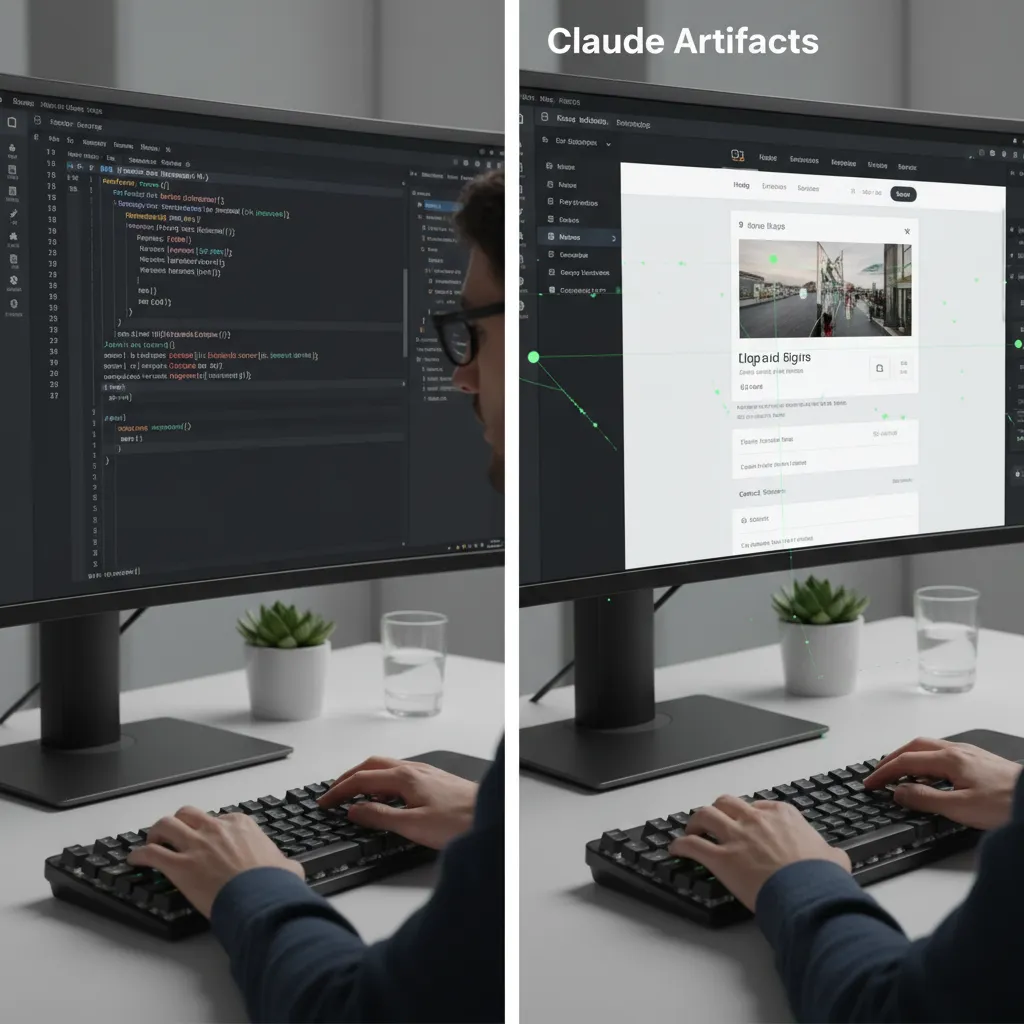
The Artifacts workspace transforms the traditional chat interface into a collaborative, real-time environment. When Claude 3.5 Sonnet generates content—be it a Python script, a website mockup, a design element, or a document—it displays the result in a dedicated, dynamic window adjacent to the chat.
This “Artifact” is not just static text; it’s a living output that the user can instantly interact with, modify, or integrate into their workflow.
The practical implications are immense:
- Iterative Development: A developer asks Claude to write a JavaScript function. The function appears in the Artifact window, ready to be copied or tested immediately, while the developer continues refining the prompt in the chat box.
- Design and Prototyping: A user requests a website layout in HTML/CSS. The code renders instantly in the Artifact window, allowing the user to see the design and provide visual feedback to Claude in real-time.
- Data Visualization: When analyzing a dataset, Claude generates graphs, charts, or tables as Artifacts, allowing immediate visual inspection and analysis without leaving the interface.
Enhancing Developer Workflow
For Claude 3.5 for developers, Artifacts significantly streamline the process. Before, developers had to copy code out of the chat window, paste it into an external environment, run it, note the errors, and then paste the errors back into the chat.
With Artifacts, this entire loop is compressed. The model becomes a more direct partner in creation, enabling a faster feedback cycle and making complex tasks like building simple applications or data analysis notebooks remarkably fluid. This feature truly turns Claude into a specialized AI development tool, moving beyond a simple conversational agent.
Vision and Multimodality: Seeing the World Better
The advancements in multimodal AI models have been rapid, and Claude 3.5 Sonnet keeps pace by dramatically enhancing its AI vision capabilities. While the previous Claude 3 models introduced strong vision, 3.5 Sonnet has raised the bar for accuracy and detail interpretation.
Interpreting Complex Visual Data
The model is now much better at interpreting nuanced visual inputs, particularly those found in professional or technical contexts:
- Financial Reports: Claude 3.5 Sonnet can analyze dense spreadsheets, interpret financial charts (like candlestick charts or complex pivot tables), and summarize key financial trends with fewer errors than earlier models.
- Diagrams and Schematics: Whether it’s an architectural blueprint, a complex flow chart, or a circuit diagram, the model can accurately identify components, relationships, and functions, demonstrating high-level AI reasoning from visual evidence.
- Data Extraction: It excels at Optical Character Recognition (OCR) and extracting information from poorly formatted or low-resolution images, a common hurdle for older LLM vision systems.
This high-fidelity vision capability is transformative for industries that rely heavily on visual documentation, from engineering and finance to healthcare. It integrates seamlessly with the Artifacts feature, where a user could upload a diagram and immediately see Claude 3.5 Sonnet generating a summarized textual analysis or even a corresponding code snippet based on the visual information.
[Related: AI in Education: Revolutionizing Personalized Learning and Future Skills]
Real-World Applications: Where Claude Shines
The cumulative improvements in performance, speed, and features position Claude 3.5 Sonnet as a versatile tool across numerous domains.
1. Superior AI Content Creation and Writing
For professional writers, marketers, and journalists, the quality of generated prose is paramount. Claude 3.5 Sonnet excels here, demonstrating a higher level of rhetorical fluency, tone matching, and long-form consistency compared to many competitors.
- Nuance and Tone: It handles complex, emotive, or highly technical subjects with greater accuracy, reducing the need for extensive post-generation editing. Many users are finding it a strong contender for the best AI model for writing due to its reduction in “AI-speak” and generic filler.
- Long-Form Generation: The model maintains coherence and avoids topic drift across thousands of words, making it ideal for drafting white papers, reports, or full blog articles (like this one).
- Creative Tasks: When tackling fiction, poetry, or scenario planning, Claude 3.5 Sonnet leverages its superior AI reasoning to build believable characters and plots that stick to complex constraints provided by the user.
2. Advanced Data Analysis and Scientific Inquiry
The combination of advanced vision and mathematical precision makes Claude 3.5 Sonnet a powerful partner for analysis:
- Statistical Interpretation: It can ingest raw data, identify appropriate statistical tests, run virtual simulations, and explain the results in plain language.
- Scientific Research: Researchers are using it to rapidly synthesize findings across hundreds of papers, accelerating literature reviews and hypothesis generation—truly embodying the concept of an intelligent system.
3. Boosting Development and Software Engineering
The specialized focus on AI for coding is perhaps where Claude 3.5 Sonnet offers the most immediate ROI for technical teams.
- Complex Debugging: Beyond simply fixing syntax errors, the model demonstrates a deep understanding of architectural flaws and logic errors in large codebases.
- Documentation and Migration: It can analyze existing, poorly documented code and generate clear, concise documentation, or assist in migrating legacy systems to modern frameworks.
- Code Quality Assurance: Claude 3.5 for developers allows for rapid security audits and best-practice adherence checks, integrated directly into the development loop via the Artifacts workspace.
[Related: The AI Tutors Revolutionizing Personalized Education]
API Access, Pricing, and Accessibility
The widespread adoption of any next-generation AI hinges on its accessibility and cost structure. Anthropic has made Claude 3.5 Sonnet available across its platforms, ensuring broad reach from individual users to massive enterprises.
Access Points
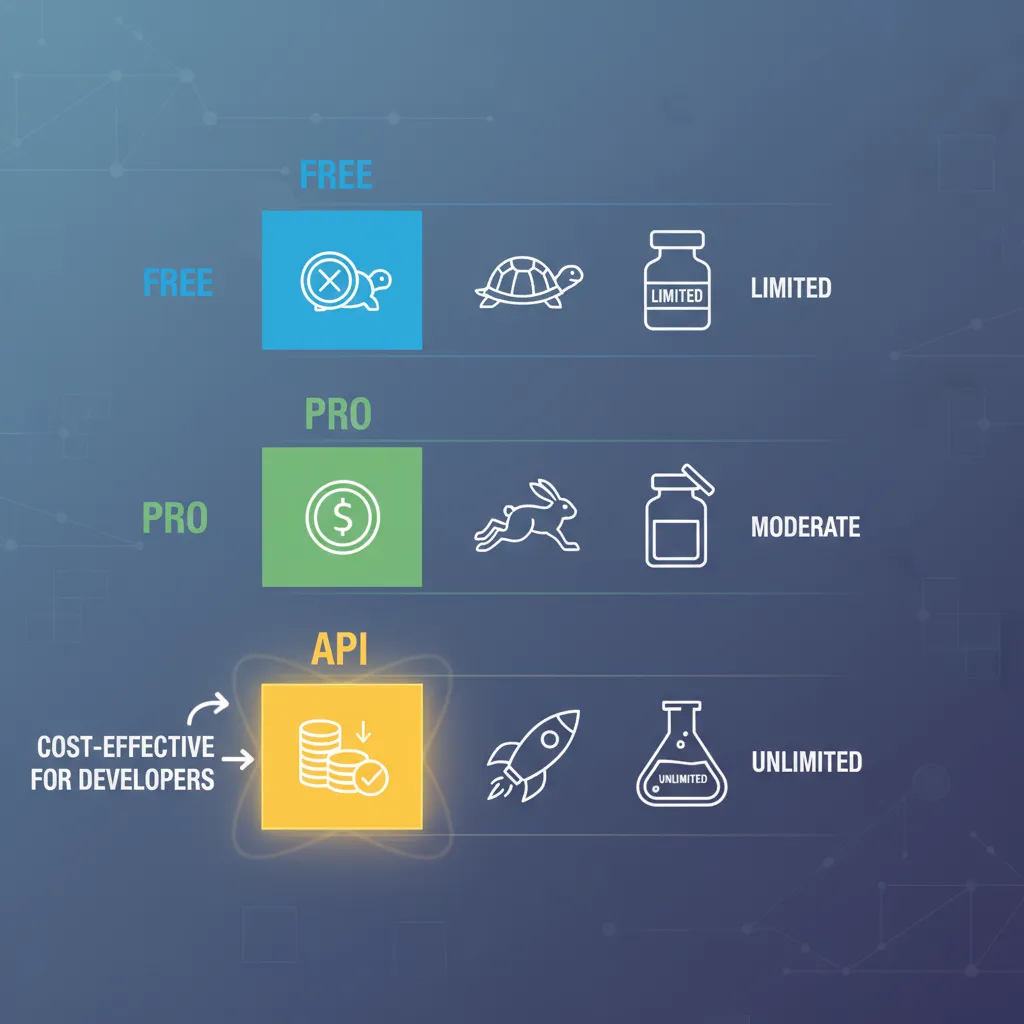
- Claude.ai: Available immediately to free users with a limited usage capacity.
- Claude Pro and Team: Subscribers gain significantly higher usage limits and priority access during peak hours.
- Claude 3.5 Sonnet API: This is where the model delivers the most impact for commercial users. It is available through Anthropic directly and via major cloud providers.
Cost-Effective AI API Model
The Claude 3.5 pricing strategy is aggressive. It is priced at $3 per million input tokens and $15 per million output tokens. To put this in perspective, this pricing makes it significantly cheaper than previous top-tier models while delivering better performance.
This pricing structure positions Claude 3.5 Sonnet as a truly cost-effective AI API solution, making it viable for high-volume applications where models like Opus or top GPT tiers might have been too expensive for continuous deployment.
This competitive pricing underscores Anthropic’s intent to capture market share, particularly among startups and mid-sized enterprises looking to innovate without breaking the bank on compute resources. The model’s efficiency means less computational waste and faster turnaround times, further boosting its economic viability as a central AI development tool.
[Related: Quantum AI Unleashed: Reshaping Intelligence and Innovation]
Navigating the Future: Claude’s Role in AI Industry Trends
The release of Claude 3.5 Sonnet is more than just a product launch; it’s a barometer of AI industry trends. It confirms several critical developments shaping the future of generative AI:
1. The Race for Usability (Artifacts)
The push toward more integrated, visually interactive interfaces is paramount. Anthropic’s Artifacts feature is a powerful example of how AI companies are moving beyond simple text generation to creating dynamic, useful outputs that directly integrate into professional workflows. This focuses on making the LLM not just a tool for generating ideas, but a tool for generating finalized, actionable work.
2. The Efficiency Wars (Sonnet vs. Opus)
The fact that a “Sonnet” model can outperform a previous “Opus” model demonstrates the rapid gains in model compression and training efficiency. We are moving toward a future where state-of-the-art performance is accessible at mid-tier costs, pushing the ceiling ever higher for true “Opus” level successors. This accelerates the timeline for widespread adoption of intelligent systems.
3. The Multimodal Mandate
The advancements in AI vision capabilities confirm that future AI model comparison charts will treat multimodal functionality as a baseline requirement, not an optional extra. The ability of a model to seamlessly transition between text, code, and visual data is essential for solving complex, real-world problems.
4. Safety and Responsibility
Anthropic’s ongoing commitment to Constitutional AI—ensuring models are guided by principles of safety and transparency—remains a vital component of the Claude brand. As the power of these models grows, so does the necessity for ethical guardrails, a key differentiator for the Anthropic AI ethos.
Conclusion: The New Standard for Generative AI
Claude 3.5 Sonnet is not merely an iterative update; it represents a significant leap forward in accessible, powerful generative AI. By coupling top-tier AI reasoning and coding abilities with the revolutionary Claude Artifacts feature, Anthropic has introduced a formidable new AI model 2024 that disrupts the existing hierarchy.
For users seeking an optimized balance of intelligence, speed, and cost, the Claude 3.5 Sonnet review is overwhelmingly positive. It provides a highly effective solution for tasks ranging from advanced AI for coding and complex data synthesis to high-quality AI content creation. The inevitable Claude 3.5 vs GPT-4o debate will continue, but Claude 3.5 Sonnet has definitively set a new standard for what a mid-tier LLM can achieve.
If you are a developer, content strategist, or enterprise leader looking to integrate the very best next-generation AI into your operations, exploring the Claude 3.5 Sonnet API is no longer optional—it is essential for maintaining a competitive edge. The challenger has arrived, and the landscape of intelligence has irrevocably changed.
FAQs: Frequently Asked Questions About Claude 3.5 Sonnet
Q1. What is Claude 3.5 Sonnet?
Claude 3.5 Sonnet is the latest flagship large language model (LLM) released by Anthropic AI. It is designed to be a highly intelligent, fast, and cost-effective AI API solution that excels in AI reasoning, coding, and multimodal tasks, positioning it as a top OpenAI competitor.
Q2. How does Claude 3.5 Sonnet compare to GPT-4o?
The AI model comparison shows that Claude 3.5 vs GPT-4o is very close, with Claude 3.5 Sonnet demonstrating superior performance in certain Claude 3.5 benchmarks, particularly in specific coding tests (HumanEval) and advanced reasoning tasks (MMLU). Additionally, Claude’s unique “Artifacts” feature provides a distinct advantage in interactive development and workflow integration.
Q3. What is the Claude Artifacts feature, and how does it work?
The Claude Artifacts feature is a dynamic, dedicated workspace that appears next to the chat interface. When Claude generates code, documents, or design elements, they appear instantly in this window, allowing users to interact with, modify, or view the output in real-time. This dramatically accelerates the workflow for Claude 3.5 for developers and designers.
Q4. Does Claude 3.5 Sonnet have AI vision capabilities?
Yes, Claude 3.5 Sonnet includes vastly improved AI vision capabilities. It can analyze and interpret complex visual data, such as charts, graphs, diagrams, and poorly formatted images, with high accuracy, making it a strong multimodal AI model.
Q5. Is Claude 3.5 Sonnet free to use?
Claude 3.5 Sonnet is available to all users on the Claude.ai platform with a limited usage capacity. Subscribers to Claude Pro and Team plans receive higher usage limits, and commercial users access the model via the Claude 3.5 Sonnet API, which follows a competitive token-based Claude 3.5 pricing structure.
Q6. Is Claude 3.5 Sonnet the best AI model for writing?
While the title of the best AI model for writing is subjective, the Claude 3.5 Sonnet review demonstrates its advanced rhetorical fluency and consistency in long-form generation. Its superior AI reasoning helps it match complex tones and adhere to stylistic constraints, making it a top contender for professional AI content creation.
Q7. When was the Claude 3.5 Sonnet release date?
Claude 3.5 Sonnet release date occurred in the first half of 2024, marking it as a significant new AI model 2024 that quickly reshaped the competitive landscape for generative AI models.
Q8. What does Sonnet offer for AI for coding tasks?
Claude 3.5 Sonnet provides significant improvements for AI for coding by scoring exceptionally high on coding benchmarks like HumanEval. It is adept at writing, debugging, and explaining complex code in various languages, with the Artifacts feature further streamlining the developer workflow.