Apple’s M4 Chip: Everything You Need to Know
Introduction: The Dawn of the AI Chip
When Apple unveiled the M4 chip, the tech world paused. Not only did it skip the traditional M3 Pro/Max rollout schedule, but it arrived first in a tablet—the M4 iPad Pro 2024—signaling a massive shift in how Apple views its silicon and, critically, the future of on-device Artificial Intelligence.
For years, Apple Silicon has dominated the efficiency and performance landscape. The M-series chips have redefined what a thin and light computer can accomplish, soundly defeating the performance and M4 chip power efficiency of traditional Apple M4 vs Intel chips. Now, the M4 doesn’t just promise incremental speed boosts; it’s purpose-built for the AI era.
This comprehensive guide serves as your deep dive into the new Apple chip. We will unpack the M4 chip architecture, dissect the staggering M4 chip performance gains over its predecessor, analyze why the M4 neural engine is the centerpiece of its design, and speculate on the release of future devices like the M4 MacBook Pro and M4 MacBook Air. Whether you are a creative professional, a developer, or just curious about the cutting edge of consumer technology, understanding what is the M4 chip is essential for grasping the next generation of computing.
The M4’s Grand Entrance: Why the iPad Pro Took the Lead
The M4 chip release date was set against the backdrop of a declining PC and tablet market. Apple’s decision to debut its most advanced silicon—the next-gen Apple silicon—in the iPad Pro was a strategic masterstroke designed to redefine the tablet and push it further into “true computer” territory.
The Surprise Launch Vehicle: The M4 iPad Pro
The 2024 iPad Pro is not just a carrier for the M4; it’s a device specifically engineered to showcase the chip’s power, particularly its thermal management and display capabilities. The integration of the M4 allowed the new iPad Pro to be impossibly thin while simultaneously delivering the kind of processing power previously reserved for professional desktop machines.
Tandem OLED Technology and M4 Integration
A critical, yet often overlooked, part of the M4 iPad Pro launch was the introduction of the Ultra Retina XDR display, powered by Tandem OLED technology. This advanced display uses two OLED panels layered together, dramatically increasing brightness (up to 1,000 nits full-screen, 1,600 nits peak HDR) and extending panel lifespan. The M4 chip is directly responsible for managing the sophisticated timing, processing, and rendering required to drive this dual-layer display system with unprecedented precision, a testament to the chip’s highly efficient display engine.
Architectural Deep Dive: What Makes the M4 Tick?
The M4 chip is not merely a refined M3; it represents a significant step forward in Apple Silicon M4 design philosophy, focused heavily on minimizing power consumption while maximizing peak performance, particularly for machine learning tasks.
Next-Gen Apple Silicon: A 3-Nanometer Refresh
The M4 is built on a second-generation 3-nanometer technology. While the M3 also used 3nm, the M4 uses a refined version of this process, allowing for greater transistor density and, crucially, superior efficiency. The M4 features up to 28 billion transistors, depending on the configuration (9-core CPU or 10-core CPU variants in the iPad Pro).
CPU and GPU Enhancements: Speed and Efficiency
The M4’s CPU features up to 10 cores, configured as 4 performance cores and 6 efficiency cores (for the top-tier version).
The Central Processing Unit (CPU)
- Performance Cores: These are faster and include enhanced branch prediction logic and wider execution engines than the M3, enabling dramatic improvements in single-threaded tasks—the kind of speed that makes applications feel instantaneous.
- Efficiency Cores: The M4’s efficiency cores are highly optimized for light, background tasks, consuming minimal power. Their improved architecture means they can handle more workload before requiring the performance cores to spin up, contributing significantly to the legendary M4 chip power efficiency.
The Graphics Processing Unit (GPU)
The 10-core GPU included in the M4 is built on the same architecture as the M3, but with crucial upgrades that push visual fidelity and rendering speed.
- Dynamic Caching: This allows the GPU to utilize local memory more efficiently, ensuring that complex tasks like M4 gaming performance and 3D rendering are bottleneck-free.
- Hardware-Accelerated Ray Tracing: This is one of the most significant additions to the M-series GPU architecture, carried over from the M3 but enhanced in the M4. Hardware-accelerated ray tracing M4 enables more realistic lighting, shadows, and reflections in games and professional rendering applications, bridging the gap between Apple Silicon and high-end dedicated graphics cards.
- Mesh Shading: Improved hardware-accelerated mesh shading provides better geometry processing, making complex scenes render faster and more efficiently.
The Game Changer: The 16-Core Neural Engine
The most touted upgrade is the Neural Engine. This dedicated AI processor is the future of Apple Silicon and defines the M4’s core purpose.
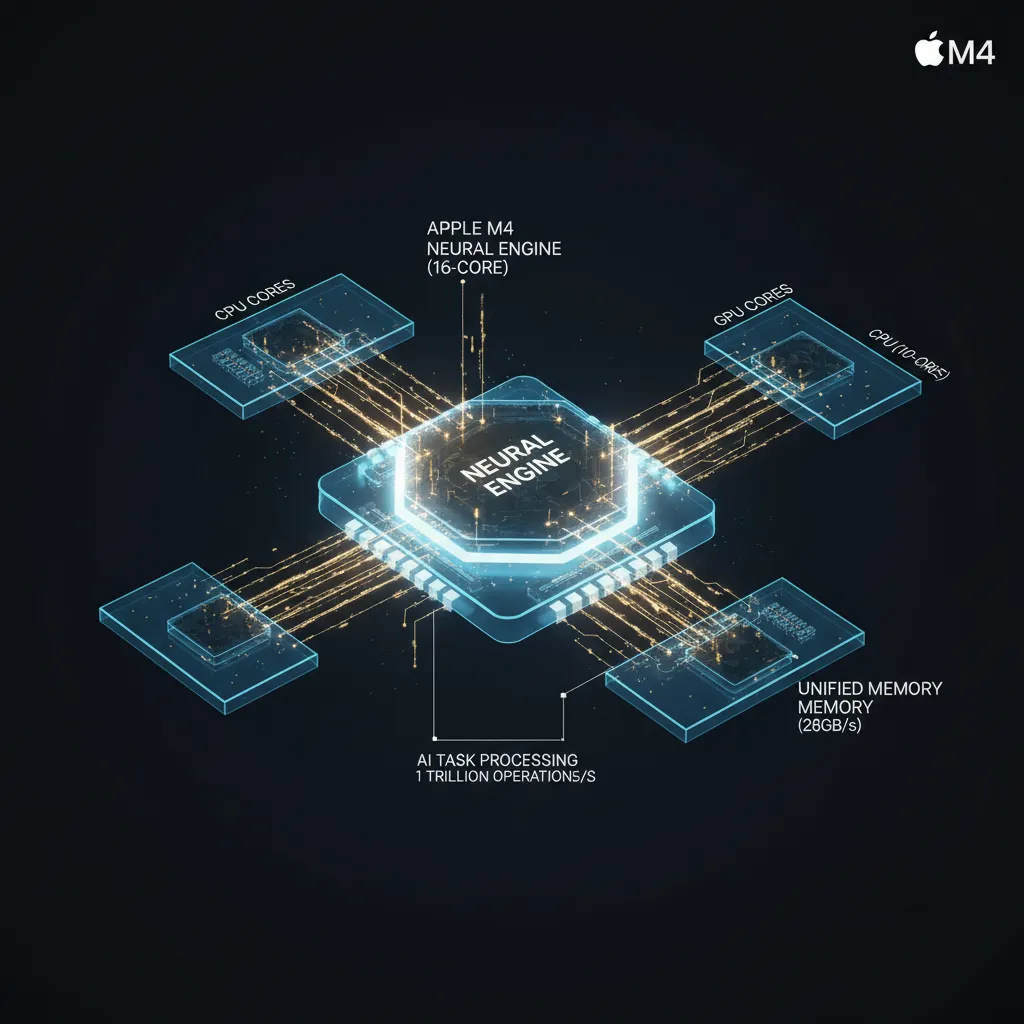
The M4 Neural Engine boasts a 16-core design capable of performing up to 38 trillion operations per second (TOPS). This is a staggering acceleration compared to the M3 and previous generations, making it significantly faster than the dedicated Neural Engines in the A-series chips. This massive computational capability for machine learning is what positions the M4 as the definitive Apple AI chip. It’s engineered specifically to handle the influx of on-device AI features expected in macOS and iPadOS (e.g., advanced photo editing, real-time transcription, and generative AI functions).
M4 Chip Performance Benchmarks: A Giant Leap Forward
The true measure of a chip lies in its ability to execute tasks faster and more efficiently than its predecessors. The Apple M4 benchmark results, particularly in multi-core and graphics performance, reveal that this is more than just a minor update.
M4 vs M3: Closing the Gap with Desktop Performance
Comparing the M4 vs M3 reveals a distinct focus on efficiency and AI acceleration rather than brute-force performance gains, though those gains are present.
| Feature | Apple M3 (Base) | Apple M4 (Base) | Performance Difference (Apple Claim) |
|---|---|---|---|
| Process Technology | 3nm (1st Gen) | 3nm (2nd Gen) | Improved Efficiency |
| Transistor Count (Max) | 25 Billion | 28 Billion | Higher Density |
| CPU Cores | 8 (4P + 4E) | Up to 10 (4P + 6E) | Up to 50% Faster CPU than M2 |
| GPU Cores | 10 | 10 (Next-Gen Features) | Enhanced Rendering Capabilities |
| Neural Engine Cores | 16 | 16 | 38 TOPS (Faster processing per core) |
| On-Chip Memory Bandwidth | Up to 100 GB/s | Up to 120 GB/s (Estimated) | Faster data access for Pro tasks |
Apple claims the M4 can deliver the same performance as the M2 chip using only half the power. Furthermore, it can deliver the performance of the M3 chip while consuming significantly less power. In real-world terms, this means cooler running devices, less fan noise, and substantially longer battery life for intensive applications.
Creative Pro Workflows: Video Editing and 3D Rendering
For creative professionals, performance benchmarks translate directly into productivity. The M4 excels in high-demand tasks that rely on consistent, sustained performance—something previous thin-and-light devices struggled with.
The enhanced Media Engine in the M4 supports hardware acceleration for ProRes and ProRes RAW, making M4 video editing in DaVinci Resolve or Final Cut Pro incredibly fluid, even when dealing with multiple streams of 4K or 8K video.
The combined power of the M4’s 10-core GPU and increased memory bandwidth allows for exceptionally fast 3D rendering and simulation. This is crucial for creative pro workflows M4 users in fields like architectural visualization, game development, and high-fidelity VFX.
The M4 chip allows for faster compilation times for M4 chip for developers using Xcode, and instantaneous feedback when adjusting large 3D models in applications like Blender or Maxon’s Cinema 4D.
This level of professional power packed into a fanless design (in the iPad Pro) is precisely why the M4 represents such a monumental engineering achievement.

M4 Gaming Performance: Console-Quality Graphics on the Go
While gaming wasn’t traditionally Apple’s primary focus, the M-series chips, especially the M4, are changing that narrative. The integration of hardware-accelerated ray tracing M4 and mesh shading support elevates the graphics capabilities to match, and in some cases exceed, current-generation dedicated gaming consoles.
The dynamic caching technology ensures that graphically intensive games, such as Resident Evil Village or No Man’s Sky, can run at high resolutions and frame rates without significant performance drops, even during complex scenes.
The M4 gaming performance is maximized by the chip’s ability to maintain high speeds without throttling due to its superior power efficiency, ensuring that gamers receive consistent performance throughout extended play sessions. This stability, coupled with the chip’s advanced graphical features, creates a compelling platform for game developers to port AAA titles to the Apple ecosystem.

Comparative Analysis: M4 vs Intel and the Competition
When examining Apple M4 vs Intel (particularly current generation Core Ultra chips), the performance gap remains significant, especially in power efficiency. While Intel has made strides with its integrated neural processors, the sheer number of TOPS offered by the M4’s Neural Engine is currently unmatched in the portable computing sphere, giving Apple a critical lead in the on-device AI race.
The M4 provides desktop-class performance at laptop power consumption, and laptop-class performance at tablet power consumption. This efficiency delta is the core selling point.
The Core of Intelligence: M4’s Neural Engine and AI Capabilities
The M4’s 16-core Neural Engine is the engine room for Apple’s future AI strategy, known internally as “Apple Intelligence.” With 38 TOPS, it is one of the fastest Neural Engines Apple has ever shipped, and its performance is designed to handle increasingly sophisticated machine learning models locally on the device, maintaining user privacy and minimizing latency.
AI on Device: Faster Machine Learning Tasks
Why is on-device AI processing crucial? Latency and privacy. Running large language models (LLMs) and other complex AI tasks locally means instantaneous results and that user data never has to leave the device and travel to the cloud.
The M4 chip AI performance shines in real-time applications:
- Real-time Transcription and Translation: Faster, more accurate live dictation and language processing across system apps.
- Advanced Image Processing: Instantaneous object recognition, deep editing (like generating or altering specific parts of a photograph), and high-quality computational photography (e.g., enhanced Smart HDR).
- Proactive System Suggestions: The chip’s capability allows for more sophisticated, context-aware suggestions in Spotlight, Mail, and Messages, anticipating user needs without phoning home.
This focus on the M4 neural engine allows Apple devices to manage heavy-duty AI workloads that competitors must offload to cloud servers. The M4 is the bedrock upon which the next generation of generative AI features across macOS and iPadOS will be built.
[Related: Google Project Astra: The Future of AI and the Universal Agent]
The Future of Apple Intelligence
The M4 is clearly built with future operating system features in mind. As Apple introduces more profound generative AI capabilities—from summarizing long articles to generating images and complex text—these tasks will require tremendous computational resources. The M4 ensures that the hardware is already in place to seamlessly integrate these features, differentiating it from previous chips which focused more heavily on standard CPU/GPU benchmarks.
For developers, the M4 offers a robust platform for creating next-generation applications. Tools like Core ML and the Neural Engine framework allow M4 chip for developers to harness the 38 TOPS capability easily, integrating machine learning models directly into their apps for speed and efficiency. This will spur a new era of powerful, AI-accelerated applications within the Apple ecosystem.
M4 Devices: Who Gets the Chip Next?
While the M4 iPad Pro was the debut platform, speculation around the release of other M4-powered devices is intense. Apple typically follows a predictable release cadence, but the M4’s early appearance suggests a possible acceleration of the entire Apple Silicon M4 transition.
The Current Star: The M4 iPad Pro
Currently, the M4 is the undisputed king of tablet computing. It powers the new, razor-thin iPad Pro, providing desktop-class capabilities in a device that is incredibly portable. This makes the iPad Pro a genuine contender for users engaged in heavy M4 video editing or graphic design who prioritize mobility.
Speculation: M4 MacBook Pro and MacBook Air
The next logical step for the M4 lineage is the notebook line.
M4 MacBook Air
It is highly likely that the MacBook Air will adopt the base M4 chip soon after its official introduction into the Mac lineup. The Air, famed for its silent, fanless design and extraordinary battery life, is the perfect showcase for the M4’s superior M4 chip power efficiency. It would deliver performance far exceeding current models without sacrificing its thin profile.
M4 MacBook Pro and M4 Pro vs M4 Max
The true power leap will come with the professional-grade chips: the M4 Pro vs M4 Max (and eventually the M4 ultra speculation). These chips are expected to feature significantly more cores, higher memory bandwidth, and further enhanced Neural Engines to handle truly demanding tasks like film post-production, complex data analysis, and large-scale software development.
If the base M4 is this efficient, the M4 Pro and Max variants will likely push the boundaries of performance per watt even further, setting a new standard for mobile workstations. Rumors suggest the Pro and Max chips will focus on maintaining maximum clocks for sustained periods, crucial for rendering and compiling. The expectation is that the M4 Max will offer a significant increase in GPU cores, further cementing its role in high-fidelity graphics and deep learning computation.
[Related: AI in Healthcare: Revolutionizing Diagnostics and Patient Care]
Power Efficiency and Thermals: The Battery Life King
In the world of mobile computing, performance means nothing if the battery dies quickly or the device becomes too hot to handle. This is where the M4’s 3nm second-generation process truly excels.
The Power-to-Performance Ratio
Apple’s central thesis with the M4 is delivering maximum performance with minimum thermal consequence. The improved efficiency cores and the refined 3nm process mean that the chip can draw less power for the same amount of work compared to the M3.
For the end user, this translates into:
- Extended Battery Life: Even under heavy load (like 4K M4 video editing or demanding games), the device maintains exceptional battery longevity, a key benefit of the optimized M4 chip power efficiency.
- Silent Operation: In thin-and-light devices, particularly the M4 iPad Pro, the chip runs cool enough to often negate the need for active cooling (fans), maintaining a silent environment for focused work.
- Sustained Performance: Unlike traditional processors that throttle significantly under load to manage heat, the M4 can sustain its peak performance for much longer periods, a critical factor for creative pro workflows M4 professionals.
M4 Chip for Developers and the Ecosystem
The move to M4 is a clear signal to the developer community: the future is AI-driven, and it needs to run locally.
Optimizing for the Neural Engine
M4 chip for developers means optimizing their code for the Neural Engine via frameworks like Core ML. The 38 TOPS of processing power encourages developers to integrate more complex machine learning models into their applications, offering users features like sophisticated smart search, faster on-device image generation, and intelligent automation that was previously impossible.
Universal Memory Architecture Advantage
The unified memory architecture (UMA), a hallmark of Apple Silicon, is enhanced in the M4. This UMA allows the CPU, GPU, and Neural Engine to access the same pool of high-bandwidth, low-latency memory without copying data, which dramatically accelerates complex, interwoven tasks typical of M4 video editing and 3D rendering. This efficiency is a huge boon for developers writing code that shares data between processing units.
Is the M4 Chip Good? Target Users and Verdict
The fundamental question is: is the M4 chip good, and who should buy a device powered by it?
The verdict is a resounding yes, but its value proposition is different depending on your current hardware.
For M3 and M2 Users
If you own an M3 device, the jump to M4 for CPU/GPU raw performance might not be immediately necessary unless you are deeply involved in demanding AI workloads. However, the gains in power efficiency and future-proofing for Apple’s next-gen AI features make the M4 a compelling upgrade if you are pushing the limits of your current device, particularly in thermal environments.
If you are an M2 user, the upgrade to M4 represents a significant generational leap in every category: CPU, GPU (especially hardware-accelerated ray tracing M4), and Neural Engine performance. The power efficiency alone makes it worth considering.
For Intel Users
If you are still running an older Intel-based Mac, moving to any Apple Silicon M4 device will be transformational. The Apple M4 vs Intel comparison is no longer a debate; it’s an evolution. You will gain exponentially better battery life, instant wake-up, silent operation, and significantly faster processing speeds for virtually all tasks.
The Target User Profile
The M4 chip is best suited for:
- Creative Professionals: Users demanding mobility with uncompromising power for M4 video editing, graphic design, and 3D rendering.
- AI Enthusiasts and Developers: Anyone building or using next-generation AI applications that require high M4 neural engine throughput.
- Power Users Needing Efficiency: Users who prioritize maximum battery life while running high-demand applications, leveraging the superior M4 chip power efficiency.
The M4 is not just fast; it’s smartly fast. It’s a foundational piece of hardware for the next phase of computing, where AI isn’t an accessory, but the core operating principle.
[Related: Ethical AI Content Creation: Navigating Bias and Trust]
The Road Ahead: M4 Pro, M4 Max, and M4 Ultra Speculation
While the current base M4 chip (the iPad Pro 2024 chip) sets a high bar, Apple is expected to follow its traditional scaling path for the professional Mac lines.
M4 Pro vs M4 Max Architectures
Both the M4 Pro and M4 Max will likely be further optimized for memory bandwidth and core counts. We anticipate the M4 Pro will feature an increased number of performance cores and, critically, support for a larger maximum unified memory pool (e.g., up to 36GB or 48GB).
The M4 Max is the undisputed champion of the family, designed for sustained, maximum throughput. It will boast an enormous GPU core count, significantly enhanced video encoders/decoders (critical for high-end M4 video editing and post-production houses), and potentially double the Neural Engine capacity of the M4, positioning it as an unrivaled mobile workstation chip for machine learning specialists and 3D animators.
M4 Ultra Speculation
The M4 ultra speculation centers around the “UltraFusion” technology, where two M4 Max dies are connected. The M4 Ultra is likely to feature a massive transistor count (potentially exceeding 100 billion), unparalleled memory bandwidth, and a Neural Engine capable of hundreds of TOPS, designed to compete directly with dedicated server-class AI accelerators for desktop workstations like the Mac Studio and Mac Pro. This level of power would handle highly intensive scientific computing and the most complex creative pro workflows M4 applications imaginable.
The M4 family is poised to offer a comprehensive, scalable silicon solution that addresses every user tier, from the ultra-mobile M4 iPad Pro to the desktop-crushing M4 Ultra.
Conclusion: Setting the Stage for the AI Revolution
The Apple M4 chip is more than just a chronological successor to the M3; it is a declaration of intent. By prioritizing the 16-core M4 neural engine and second-generation 3nm process, Apple has solidified its position as the leader in high-performance, power-efficient, on-device AI computing.
We have explored the revolutionary M4 chip architecture, the significant performance gains in the M4 vs M3 comparison, and the immense potential for M4 gaming performance and professional creation workflows. The M4 not only powers the future of the M4 iPad Pro but also sets the baseline for the anticipated M4 MacBook Pro lineup, ensuring that the next generation of Apple devices will be the most capable AI endpoints on the market.
If you are looking for the pinnacle of mobile computing—a device that balances desktop-class power with extraordinary M4 chip power efficiency—the M4-powered ecosystem is your answer. It’s fast, it’s intelligent, and it’s here to redefine how we interact with our technology. The era of the true Apple AI chip has arrived, and its potential is just beginning to be unlocked by M4 chip for developers globally.
Stay curious about how this next-gen silicon will continue to shape our digital lives.
FAQs
Q1. What is the Apple M4 chip primarily designed for?
The Apple M4 chip is a System-on-a-Chip (SoC) designed by Apple, built on a second-generation 3-nanometer process. Its primary design focus is on delivering extreme power efficiency and greatly accelerating on-device Artificial Intelligence (AI) workloads, thanks to its powerful 16-core Neural Engine.
Q2. How much faster is the M4 Neural Engine compared to the M3?
The M4 neural engine is significantly faster, capable of performing up to 38 trillion operations per second (TOPS). While the core count remains 16, the architecture is dramatically enhanced, offering quicker execution and greater throughput for machine learning tasks than previous generations.
Q3. When will the M4 chip appear in MacBook Pros?
While the M4 chip release date debuted in the M4 iPad Pro (2024), industry analysts speculate that the M4 MacBook Pro models (along with the M4 Pro and M4 Max variants) will likely be announced and released within the traditional Mac refresh cycles, possibly starting in late 2024 or early 2025.
Q4. Does the M4 chip support hardware-accelerated ray tracing?
Yes, the M4 chip features an advanced 10-core GPU that supports hardware-accelerated ray tracing M4 and mesh shading. This allows the chip to render extremely realistic lighting, reflections, and shadows in 3D applications and video games with high efficiency, significantly improving M4 gaming performance.
Q5. What is the biggest advantage of the M4 chip over Intel chips?
The biggest advantage of the Apple M4 vs Intel comparison lies in its performance-per-watt efficiency. The M4 can deliver comparable or superior performance to high-end Intel CPUs while consuming a fraction of the power, leading to dramatically better battery life and superior thermal management in thin devices.
Q6. What are the key specs of the base M4 chip?
The base M4 chip specs include up to a 10-core CPU (split into 4 performance cores and 6 efficiency cores), a 10-core GPU, and a 16-core Neural Engine capable of 38 TOPS. It is built using second-generation 3nm technology.
Q7. What are ‘creative pro workflows M4’ features?
Creative pro workflows M4 features include highly accelerated video encoding (e.g., ProRes and ProRes RAW), rapid 3D model manipulation using the advanced GPU and unified memory, and faster computational tasks critical for rendering, all while maintaining high power efficiency for professionals working on location or away from power sources.
Q8. What is Tandem OLED technology and how does the M4 support it?
Tandem OLED technology is a display innovation used in the M4 iPad Pro that layers two OLED panels to boost overall screen brightness and longevity. The M4 chip integrates a highly sophisticated display engine to manage and drive this dual-layer panel precisely, ensuring perfect color and brightness uniformity, which is crucial for professional color-grading.