Apple Intelligence: The Ultimate 2024 AI Guide
Introduction: Defining the Future of Personal AI
For years, the technology world waited for Apple to make its major move in the Generative AI space. With the unveiling of Apple Intelligence at WWDC 2024, that wait is officially over. This is not just a collection of features; it is a fundamental re-engineering of the user experience across iOS, iPadOS, and macOS, designed to integrate powerful generative models directly into the core of your digital life.
Apple’s approach, unlike many competitors, centers entirely on personal context, privacy, and utility. The core mission of Apple AI is to become a truly helpful, non-intrusive contextual AI assistant that understands you, your data, and your needs, without compromising security.
This Apple AI deep dive will cut through the marketing noise to explain precisely what Apple Intelligence is, how Apple’s AI works under the hood, the groundbreaking iOS 18 AI features you can expect, and the crucial details regarding the Apple Intelligence release date and Apple Intelligence supported devices.
If you’re wondering what is Apple Intelligence, how it compares to systems like ChatGPT and Gemini, or simply will my iPhone get Apple AI, you are in the right place. We’ll explore the benefits of Apple Intelligence and why it represents the future of personal AI.
What is Apple Intelligence? The Foundation of a Smarter Ecosystem
Apple Intelligence is the umbrella term for the powerful, integrated generative models coming to Apple’s operating systems. It is not an app or a service you download; it is a deep operating system feature built upon three core capabilities:
- Writing Tools: Enhancing communication across Mail, Notes, and third-party apps.
- Image Creation: Enabling fun, custom image and emoji generation right on your device.
- Smarter Siri: Transforming the voice assistant into a highly capable, context-aware digital partner.
The key differentiator is that Apple Intelligence leverages your personal data (emails, texts, calendars) to execute requests, but it keeps that data private and local. This focus on on-device AI processing is what sets the system apart.
The Core Promise: Personal Context and Semantic Indexing
To deliver truly relevant results, Apple Intelligence relies on an advanced internal capability known as semantic indexing on device.
This sophisticated framework continuously analyzes and categorizes your data—your photos, messages, documents, emails—in a way that is unique to you. It creates a personal, private map of your digital life, allowing the AI to answer complex, personalized queries that no other assistant can handle.
For example: Instead of simply asking, “When is my meeting?” the semantic index allows you to ask, “Find the photo of my dog wearing the red bandana that Sarah sent me last month,” or “Pull up the reservation details for the restaurant we discussed over text message last week.” The AI connects disparate pieces of information across different apps instantly and privately.
WWDC 2024 AI: Where the Intelligence Was Announced
The initial reveal of these capabilities occurred during the WWDC 2024 AI keynote. It was presented as the culmination of years of research, emphasizing security, privacy, and seamless integration over flashy, standalone features. This event solidified Apple’s commitment to making AI feel less like a tool you use and more like a helpful capability embedded in everything you do.
[Related: AI and Personal Growth: Mastering Habits and Unlocking Potential]
The Groundbreaking Features of iOS 18 AI
The practical applications of Apple Intelligence are vast and immediately impactful. These iOS 18 AI features fundamentally change how you interact with text, images, and your voice assistant.
A Smarter Siri: The Contextual AI Assistant
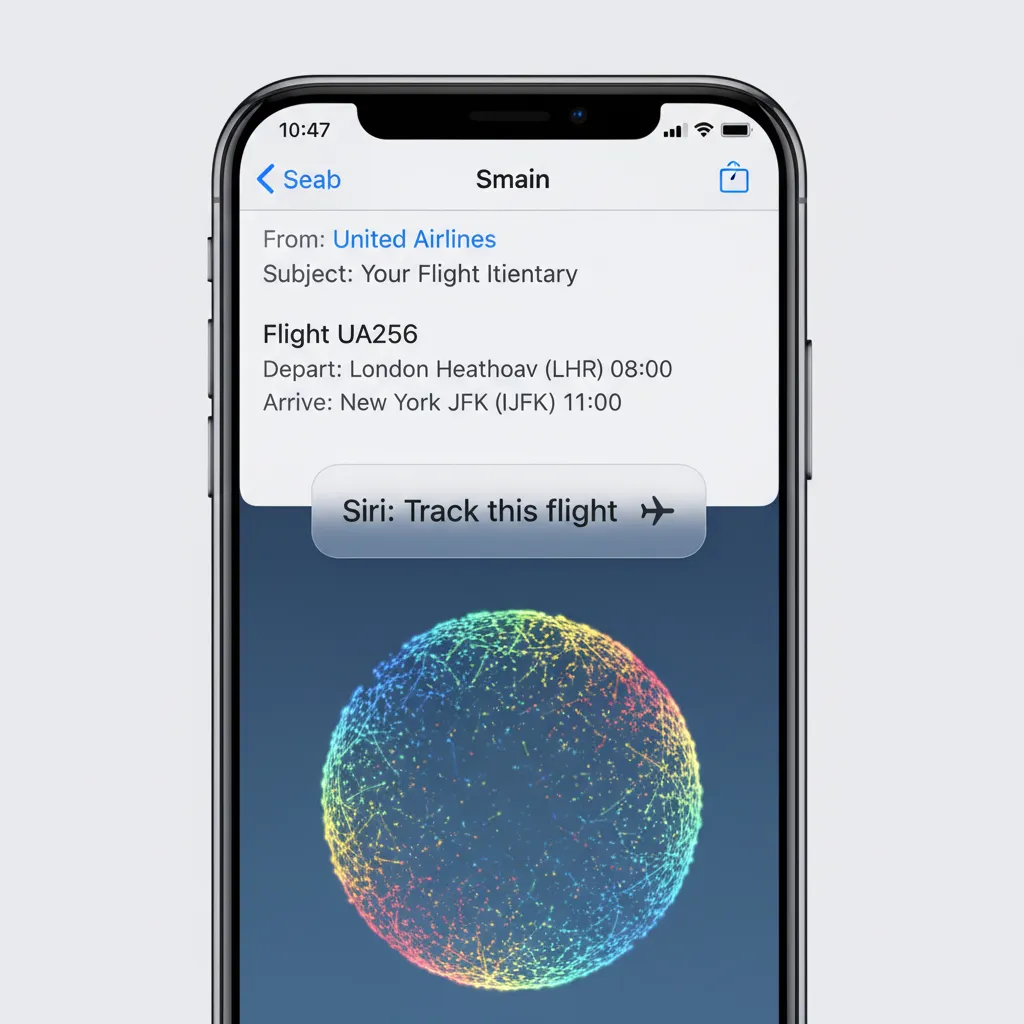
The Siri update 2024 marks the most significant overhaul since the assistant’s introduction. The new Siri is designed to be conversational, more natural, and most importantly, aware of the context on your screen and in your apps. This is the new contextual AI assistant Apple has promised.
Key Enhancements in New Siri Features:
-
Screen Awareness: Siri can now see and understand what is on your screen. If you’re looking at a text message with an address, you can say, “Add this address to my contact for Mark.” Siri processes the visual information instantly.
-
Type to Siri: A long-requested feature, users can now interact with Siri by typing, or switch seamlessly between voice and text input, allowing for rapid-fire, complex requests in public settings.
-
Deep App Control: The new Siri can perform multi-step actions within apps. For instance, you could ask, “Take the five photos from my trip to Iceland last year, remove the distracting background in each, and send them to my partner via WhatsApp.” Siri automates this complex workflow instantly.
-
Generative Capabilities: Siri can access its own internal generative models to summarize documents, draft emails, and even perform complex reasoning tasks based on your personal data—all handled by on-device AI processing when possible.
AI Writing Tools iOS 18: Rewrite, Proofread, and Summarize
One of the most immediate benefits of Apple Intelligence for productivity is the integrated AI writing tools iOS 18. These tools are available system-wide, built into the text input fields of Mail, Notes, Pages, and numerous third-party applications.
Writing Tools Capabilities:
- Rewrite: Instantly adjust the tone, complexity, and structure of a paragraph. You can take a casual text draft and make it “More Professional,” “More Concise,” or “More Engaging,” ready for a formal email.
- Proofread: Catching grammatical errors and suggesting stylistic improvements with a deeper understanding of the document’s context than standard spellcheck.
- Summarize: Condense lengthy emails or documents into key bullet points, a vital tool for managing information overload in Mail or Safari.
This level of integrated drafting and editing power makes the process of creating high-quality text seamless and instant, moving beyond simple corrections to true content augmentation.
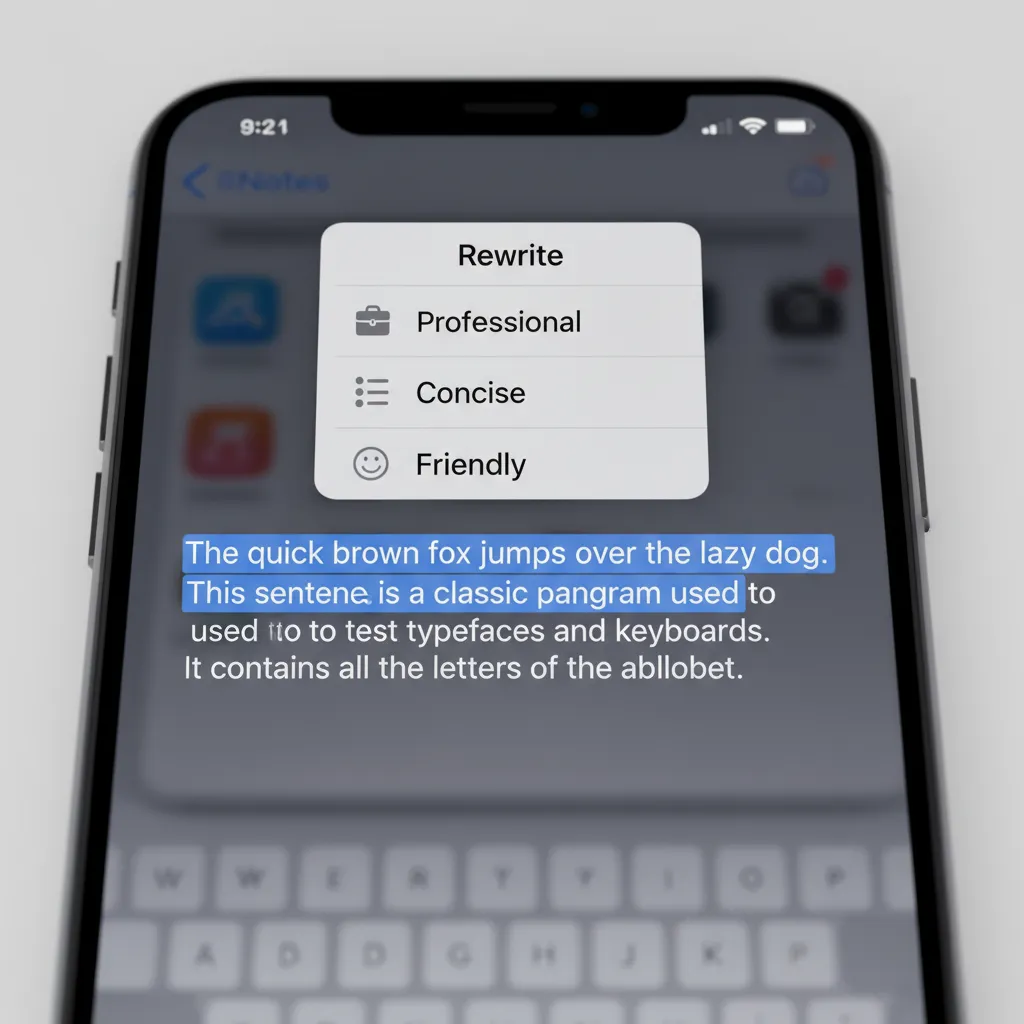
Image Playground and Genmoji: Creative AI for Everyone
Apple is making it easy to create images with AI on iPhone through two innovative tools: Image Playground and Genmoji.
Image Playground
This feature allows users to generate images rapidly in three distinct styles: Animation, Illustration, and Sketch. It’s designed to be used in the moment within apps like Messages, Notes, and Freeform. The focus is on rapid generation and fun, personal relevance, rather than complex, photorealistic art. Users can type in a prompt, select a style, and watch the image materialize instantly.
Genmoji
Taking the concept of emojis to the next level, Genmoji allows you to instantly generate custom emojis based on text descriptions. Want a Genmoji of a “T-Rex wearing a chef’s hat” or a “happy toaster riding a skateboard”? The AI generates it instantly, and these custom creations can be used as stickers or reactions in messages, bringing a highly personalized layer of expression to communication.

[Related: Claude 3.5 Sonnet Deep Dive: AI Challenger]
Privacy and Power: The Technology Behind Apple’s AI
The primary roadblock for many users embracing widespread AI has been privacy, especially when personal data is uploaded to large, third-party cloud servers. Apple’s entire architecture for Apple Intelligence is built to solve this problem through a unique blend of on-device AI processing and its groundbreaking cloud security model.
On-Device AI Processing: Speed, Efficiency, and Privacy
For tasks that rely heavily on personal context, like generating a summary of a recent text thread or correcting a draft, the AI model runs entirely on the device.
This approach offers multiple advantages:
- Instant Speed: Processing happens without network latency.
- Ultimate Privacy: The data never leaves the device.
- Low Latency for Personal Tasks: Queries that depend on semantic indexing on device (your local contacts, photos, calendars) are resolved instantly because the index is local.
To achieve this, the system relies on specialized chips (A17 Pro and M-series) with powerful Neural Engines, which is a major factor in determining Apple Intelligence supported devices.
Private Cloud Compute (PCC): The Secure Bridge
Not every task is simple enough for on-device processing. Complex, resource-intensive queries (like highly detailed image generation or accessing a vast web knowledge base) require the power of a data center. This is where Private Cloud Compute (PCC) comes in, the cornerstone of Apple AI privacy.
PCC is Apple’s custom-built server environment using proprietary Apple Silicon (M2 Ultra) servers. When a task is too large for the device, the following sequence ensures privacy:
- Request Packaging: The iPhone or iPad prepares the request, encrypting all context and stripping out any personally identifiable information that isn’t absolutely necessary.
- Server Verification: The PCC server, using cryptography, proves to your device that it is running on unlogged, transparent Apple-built software, making it impossible for Apple employees or third parties to access or store the data.
- Execution and Deletion: The large model processes the request, sends the result back to your device, and immediately deletes the data.
This ingenious architecture ensures that even when using server-side processing, the user retains control and confidence in Apple AI privacy, making it a secure alternative to standard public cloud AI services.

The Apple OpenAI Partnership: Why the Collaboration?
Despite building powerful proprietary models, Apple recognized the need to provide access to the world’s most powerful general-purpose model for certain tasks. This led to the Apple OpenAI partnership.
When a user asks Siri or an Apple Intelligence feature a question that requires massive, world-knowledge generation (like drafting an in-depth essay on quantum physics or comparing historical events), Apple Intelligence offers the option to route the query to ChatGPT (OpenAI’s service).
Crucially, this is always:
- Opt-in: The user is explicitly asked for permission.
- Secure: Requests sent to ChatGPT are anonymized, and OpenAI agrees not to store the requests.
This arrangement ensures that Apple Intelligence maintains its personal, secure focus while offering best-in-class general AI capabilities when needed, fulfilling the promise of AI for iPhone without compromising the core privacy philosophy.
[Related: Google AI Overviews: Future of Search and SEO]
Availability, Pricing, and Getting Started
Understanding who gets access to Apple Intelligence and when is crucial for users eager to experience the future of personal AI.
Apple Intelligence Release Date and Access
Apple Intelligence features will be integrated into the final public releases of iOS 18, iPadOS 18, and macOS Sequoia.
- Developer Previews: The AI features were initially made available to developers starting shortly after WWDC 2024.
- Public Release: The majority of Apple Intelligence features are expected to launch in Fall 2024, concurrent with the full stable release of the new operating systems, likely in September or October.
- Phased Rollout: Apple has indicated that some of the more advanced features, particularly those requiring extensive Private Cloud Compute, may roll out in a phased manner throughout late 2024 and early 2025.
Apple Intelligence Supported Devices: Will My iPhone Get Apple AI?
This is one of the most critical questions. Because Apple Intelligence relies heavily on the performance of the Neural Engine for efficient on-device AI processing and secure PCC operations, the list of Apple Intelligence supported devices is narrower than the full iOS 18 compatibility list.
To use the full suite of Apple Intelligence features, you will need a device equipped with the latest Apple Silicon:
| Device Type | Required Chipset | Specific Models (Examples) |
|---|---|---|
| iPhone | A17 Pro Chip or later | iPhone 15 Pro, iPhone 15 Pro Max, and all future iPhones. |
| iPad | M1 Chip or later | iPad Pro (5th generation and later), iPad Air (5th generation and later). |
| Mac | M1 Chip or later | MacBook Air/Pro, Mac mini, Mac Studio, iMac. |
If you are asking, will my iPhone get Apple AI, the answer depends heavily on the model. If you own an iPhone 15, 14, 13, 12, or older base model, you will likely get iOS 18, but you will not receive the core Apple Intelligence features, as they require the A17 Pro Neural Engine (or M-series chips) for the necessary computational power.
Is Apple Intelligence Free? Pricing Breakdown
One of the best benefits of Apple Intelligence is its accessibility. Apple has confirmed that the core features of Apple Intelligence will be free for users on supported devices.
This includes:
- The new Siri experience.
- The system-wide Writing Tools (Rewrite, Proofread, Summarize).
- Image Playground and Genmoji.
- The use of Private Cloud Compute for advanced tasks.
The one area with a potential caveat is the OpenAI integration. While access to ChatGPT is offered for free to Apple Intelligence users without requiring a paid subscription, users who already subscribe to ChatGPT Plus may gain additional, premium benefits through the integration. However, the core how to get Apple Intelligence experience is complimentary with the hardware purchase.
[Related: The DePIN Revolution: Building Tomorrow’s Decentralized Physical Infrastructure]
The Competitive Landscape: Apple Intelligence vs. the Giants
With every major tech company now boasting its own powerful AI model, understanding where Apple Intelligence stands against established giants like Google and OpenAI is crucial. The comparisons often center on different philosophies of integration and data handling.
Apple Intelligence vs ChatGPT: A Focus on Integration
While the two systems are partners, they serve distinct purposes:
| Feature | Apple Intelligence (AI) | ChatGPT/OpenAI |
|---|---|---|
| Data Focus | Personal, local, and contextual data (emails, photos). | Vast web knowledge, general text generation. |
| Processing | Prioritizes on-device AI processing and PCC. | Primarily cloud-based processing. |
| Privacy | Extreme privacy focus; data never stored by Apple. | Data retention policy applies unless using enterprise/API models. |
| Integration | Deeply embedded into the OS (Mail, Notes, Settings). | Accessed via specific apps, websites, or APIs. |
| Goal | To be the most helpful, secure personal assistant. | To be the world’s best large language model (LLM). |
Apple Intelligence’s core strength is its ability to integrate its personal understanding of you into your workflow. Apple Intelligence vs ChatGPT is less a competition and more a co-existence: Apple provides the secure, personal layer, and ChatGPT provides the general world-knowledge muscle when requested.
Apple Intelligence vs Gemini: The Platform Battle
Google’s Gemini model powers many of the advanced features in Android and Google services. The rivalry between Apple Intelligence vs Gemini is a fundamental platform war—iOS versus Android and Google’s ecosystem.
Gemini is powerful, deeply integrated into Google Maps, Gmail, and Chrome, and often excels at combining web search results with productivity tools. However, its core relies on the Google cloud infrastructure.
Apple Intelligence distinguishes itself by making privacy the feature, not just a policy. While Gemini’s capabilities might be marginally more powerful in certain general knowledge benchmarks, Apple’s control over the entire hardware and software stack—from the A17 Pro chip to Private Cloud Compute—allows for a level of secure, personalized integration that is difficult to match. The user’s trust is placed in the device and cryptography, rather than a corporate data policy.
Conclusion: The Future of Personal AI is Here
Apple Intelligence is more than just a software update; it is a declaration of how Apple views the future of personal AI. By prioritizing Apple AI privacy and seamlessly integrating powerful generative capabilities directly into the operating system, Apple is moving beyond simple feature parity with competitors and defining a new standard for intelligent technology.
The availability of features like Genmoji, Image Playground, the enhanced Siri update 2024, and the incredibly secure Private Cloud Compute means that your iPhone will become exponentially more capable and personalized. These new Siri features and AI writing tools iOS 18 will redefine how we manage our digital lives.
For those with supported devices (iPhone 15 Pro and M-series Macs/iPads), the release of iOS 18 and subsequent updates will usher in a period of unprecedented digital efficiency. We encourage you to explore the benefits of Apple Intelligence and prepare to unlock the full potential of your device when the Apple Intelligence release date arrives this fall. The era of the truly smart, highly personalized device is finally upon us.
[Related: AI Customer Experience: Personalization and Engagement]
FAQs (People Also Ask)
Q1. What is Apple Intelligence?
Apple Intelligence is the collective name for Apple’s new suite of generative AI models and features integrated into iOS 18, iPadOS 18, and macOS Sequoia. Its primary function is to enhance communication, productivity, and personalization across Apple devices using on-device processing and Private Cloud Compute while prioritizing user privacy.
Q2. Is Apple Intelligence free to use?
Yes, the core features of Apple Intelligence, including the smarter Siri, AI Writing Tools, Genmoji, and Private Cloud Compute usage, are provided free of charge to users on compatible devices.
Q3. Which devices will support Apple Intelligence?
Due to the intensive computational requirements of on-device AI processing, Apple Intelligence is limited to devices with the A17 Pro chip (iPhone 15 Pro and iPhone 15 Pro Max) or any Apple Silicon M-series chip (M1, M2, M3, M4) in iPads and Macs. If you are asking will my iPhone get Apple AI, it must be an iPhone 15 Pro or newer.
Q4. How does Private Cloud Compute (PCC) ensure Apple AI privacy?
Private Cloud Compute (PCC) is Apple’s secure server environment used for complex AI tasks. It ensures privacy through cryptographic proof that the server is running unlogged, transparent software. Your personal data is stripped, encrypted, processed quickly, and then immediately deleted from the server, preventing Apple or third parties from accessing or storing your information.
Q5. What is the role of the Apple OpenAI partnership?
The Apple OpenAI partnership allows Apple Intelligence to route complex, general knowledge questions (with user permission) to OpenAI’s ChatGPT model. This provides access to the world’s most powerful LLM for specific queries while maintaining Apple’s secure architecture for personal, contextual tasks.
Q6. What is Genmoji and how is it different from standard emojis?
Genmoji is an iOS 18 AI feature that allows users to create images with AI on iPhone by generating custom, unique emoji-like stickers from text descriptions (e.g., “A sad cat drinking coffee”). Unlike standard static emojis, Genmoji are unique creations tailored instantly to the user’s input.
Q7. What is the key advantage of on-device AI processing?
The primary advantage of on-device AI processing is speed and privacy. By running the AI models directly on the device, complex tasks that rely on personal data (like semantic indexing) are executed instantly without network latency, and the data never has to leave the user’s device, ensuring maximum Apple AI privacy.