AI Storytelling: Crafting Immersive Narratives & Visual Art
Since the first cave paintings, humanity has been driven by a singular, powerful impulse: to tell stories. We’ve used charcoal, ink, film, and pixels to weave narratives that define our cultures and ourselves. Today, we stand at the threshold of a new creative frontier, one powered by algorithms and neural networks. This is the era of AI storytelling, a revolutionary fusion of human ingenuity and machine intelligence that is reshaping how we create and experience narratives.
From generating entire virtual worlds to co-writing screenplays, Generative AI narrative tools are no longer science fiction. They are practical, accessible, and powerful co-creators. Whether you’re a novelist battling writer’s block, a game developer building dynamic quests, or a filmmaker visualizing a complex scene, AI offers a new palette of possibilities.
This guide will explore the landscape of AI-powered narratives, diving deep into the tools, techniques, and ethical considerations of this new age. You’ll learn how AI creative writing tools can spark inspiration, how digital art AI tools are transforming visual development, and how immersive storytelling AI is creating experiences we’ve only dreamed of.
The New Creative Renaissance: What is AI Storytelling?
At its core, AI storytelling is the use of artificial intelligence technologies to assist in or generate narrative content. This isn’t about an algorithm single-handedly writing a bestselling novel (at least, not yet). Instead, it’s about a dynamic partnership—a form of AI augmented creativity where human artists guide powerful tools to achieve their vision faster and more imaginatively than ever before.
This process involves several key components of Narrative AI technology:
- Large Language Models (LLMs): The engines behind tools like ChatGPT and Google’s Gemini, capable of understanding and generating human-like text for dialogue, descriptions, and plot points.
- Diffusion Models: The powerhouses of AI art generators like Midjourney and Stable Diffusion, which translate text prompts into stunning visual art, concept designs, and storyboards.
- Procedural Content Generation (PCG): Algorithms used extensively in gaming to create vast, unique environments, characters, and quests on the fly.
Together, these technologies create a feedback loop. A writer can use an AI plot generator to brainstorm dozens of story arcs in minutes, select the most compelling one, and then feed the synopsis into an AI image generator to create concept art for the main character. This synergy between text and image is the hallmark of modern AI visual storytelling.
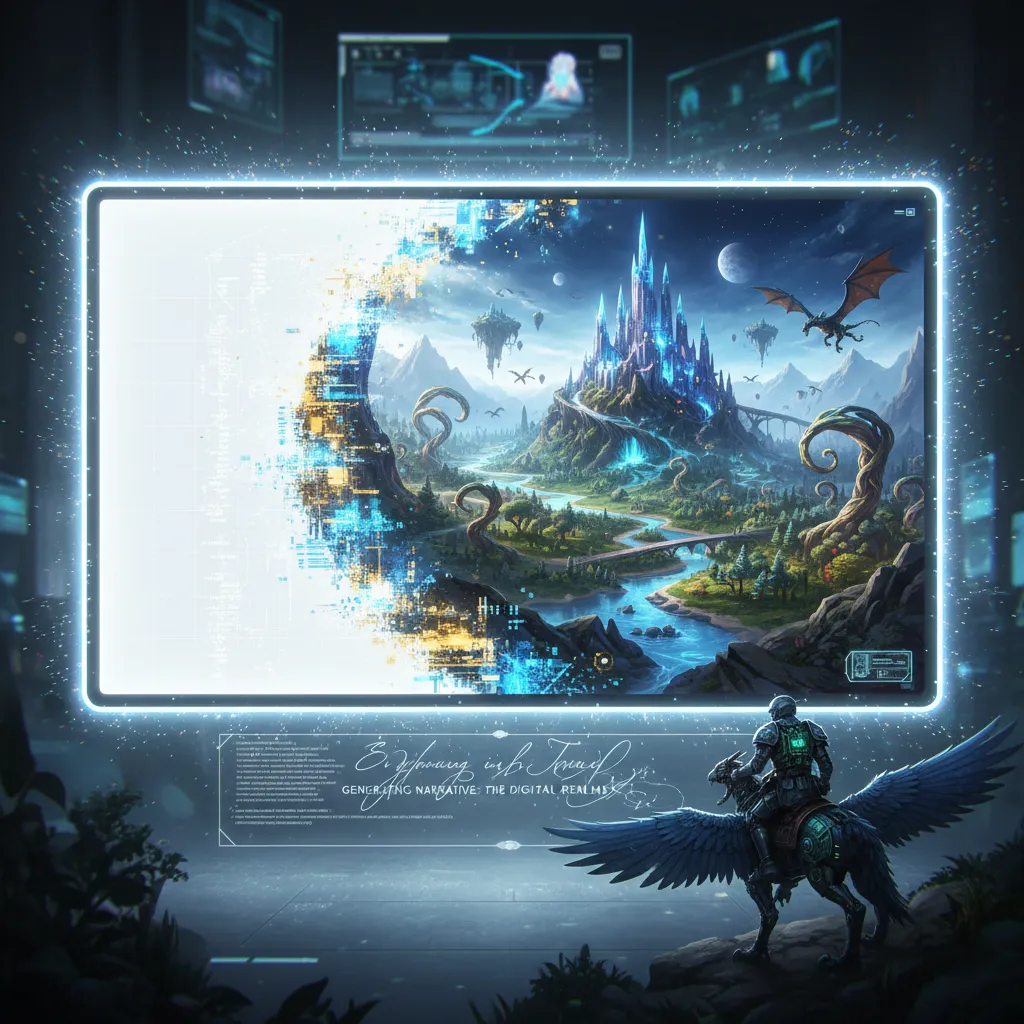
The result is a more fluid and integrated AI creative process, breaking down the traditional silos between writing, art, and design. A single creator can now conceptualize, write, and visualize a story with unprecedented speed and creative control.
The Storyteller’s Toolkit: Must-Have AI Creative Writing and Art Tools
The explosion of creative AI applications has equipped creators with a formidable arsenal of tools. Navigating this new landscape can be daunting, so we’ve broken it down into key categories to help you find the right AI co-pilot for your project.
For the Written Word: AI Writing Assistants & Plot Generators
These tools are designed to enhance the writing process, from initial idea to polished final draft. They excel at brainstorming, overcoming writer’s block, and refining language.
- Sudowrite: Often called the “writer’s best friend,” Sudowrite is built specifically for creative fiction. Its features include “Story Engine,” which can generate entire plot outlines from a simple premise, and “Describe,” which can enrich your prose with sensory details.
- Jasper (formerly Jarvis): A versatile AI writing assistant known for its marketing and blog-writing prowess, Jasper also has powerful templates for creative writing, including story outlines and character bios. Its strength lies in its ability to adopt different tones of voice.
- NovelAI: This tool is a favorite for long-form story generation AI. It offers a high degree of customization, allowing you to train it on your own writing style. It also includes an image generation feature to help visualize your scenes as you write.
These platforms are more than just advanced spellcheckers; they are collaborative partners in the AI character development and plotting phases of creation. Related: What is GPT-4o? OpenAI’s New AI Model Explained
For Visual Narratives: Digital Art AI Tools
The rise of text-to-image models has democratized visual art creation. For storytellers, these tools are invaluable for everything from character design to creating cinematic keyframes.
- Midjourney: Known for its highly artistic and often cinematic outputs, Midjourney is the industry leader for quality and aesthetic control. Mastering AI art prompts on this platform allows artists to create breathtaking concept art, storyboards, and character portraits.
- Stable Diffusion: As an open-source model, Stable Diffusion offers unparalleled flexibility. It can be run locally on powerful machines (
[Related: AI PCs are Here: How They're Transforming Computing in 2024](https://hyperdaily.one/blog/ai-pcs-transforming-computing-2024/)) and customized with thousands of user-trained models (checkpoints) to achieve specific styles, from photorealism to anime. - DALL-E 3 (via ChatGPT Plus): OpenAI’s model is perhaps the most intuitive. Its integration with ChatGPT allows for conversational and iterative prompting, making it easy to refine an image until it perfectly matches your vision. It excels at understanding complex, descriptive prompts.
These AI for artists tools are not just for generating finished pieces; they are powerful ideation engines that can visualize a scene described in a script in seconds.
For Interactive and Immersive Experiences
The next frontier of narrative is interactivity. AI is the key to unlocking truly dynamic and personalized stories, particularly in gaming and extended reality (XR).
- Inworld AI: This platform is designed to create intelligent, responsive NPCs (non-player characters) for games. Instead of repeating canned lines of dialogue, characters powered by Inworld can have unscripted conversations, remember past interactions, and pursue their own goals, making game worlds feel truly alive.
- Charisma.ai: A tool focused on powering virtual characters and digital human storytelling. It allows writers to create interactive stories with branching narratives that adapt based on the user’s choices and even their tone of voice.
- Scenario: This AI platform generates game assets, allowing developers to quickly create consistent, style-aligned visuals for their game worlds, from character sprites to environmental textures.
This is where immersive storytelling AI truly shines, moving beyond passive consumption to active participation in an unfolding narrative.
The Art of Collaboration: AI Augmented Creativity in Practice
The fear that AI will replace human artists is pervasive, but the reality is far more nuanced and exciting. The most effective use of these tools is not replacement but collaboration. Think of AI as an infinitely patient, impossibly fast, and creatively unbounded junior partner.
From Prompt to Plot: The AI Creative Process
Let’s walk through a modern creative workflow for a fantasy short story:
- Ideation: You start with a vague concept: “a lighthouse keeper who guides ghost ships.” You feed this into an AI plot generator like Sudowrite’s Story Engine. It returns three potential outlines: a horror story, a romance, and a mystery.
- Character Development: The mystery plot intrigues you. It involves a skeptical detective investigating the keeper. You use an AI character development tool to flesh them out, asking it to generate backstories, motivations, and potential conflicts between them.
- Visual Conception: With your characters and plot solidifying, you turn to Midjourney. You craft a prompt:
cinematic concept art, grizzled old lighthouse keeper, oilskin jacket, haunted eyes, standing by a giant fresnel lens, stormy sea, photorealistic, octane render --ar 16:9. The AI generates four stunning visual interpretations, giving you a concrete vision for your story’s mood and aesthetic. - Drafting & Expansion: As you write, you hit a descriptive wall. You use an AI writing assistant to brainstorm five different ways to describe the storm, picking the elements you like best and weaving them into your own prose.
- Worldbuilding: You decide the story needs a unique mythology for the ghost ships. You engage in a long conversation with an LLM, asking it to create lore based on maritime superstitions, which you then integrate into your narrative.
This iterative process of AI and artistic collaboration allows a creator to jump between writing and visual design, enriching both.
Pushing Boundaries: AI in Media Production and Cinematic Storytelling
The impact of AI content creation extends far beyond individual creators into the workflows of major studios and game developers. It’s becoming an indispensable part of large-scale AI in media production.
Revolutionizing Film and Animation
In the world of filmmaking, AI is accelerating pre-production and opening new doors for visual effects.
- AI Script Writing & Analysis: Tools can now analyze scripts for pacing, character arc consistency, and even predict audience reception. This gives writers and producers valuable data-driven feedback early in the process.
- AI-Powered Pre-visualization (Pre-vis): Directors can use AI for cinematic stories by generating animated storyboards (animatics) from a script. Tools like RunwayML can turn simple text descriptions into short video clips, helping to visualize camera angles and scene flow long before a single frame is shot.
- Generative VFX: AI is being used to create hyper-realistic digital environments, automate rotoscoping (the tedious process of isolating objects in a video frame), and even de-age actors with stunning accuracy.
Crafting Dynamic Worlds: AI in Game Narrative Design
Nowhere is the potential of interactive storytelling AI more apparent than in video games. AI is transitioning from creating enemies that follow simple paths to building worlds that feel truly alive.
AI narrative design allows for:
- Emergent Narratives: Stories that are not pre-scripted but emerge naturally from the interactions of complex AI systems and player choices.
- Dynamic NPCs: Characters who have their own schedules, memories, and relationships. An innkeeper might gossip about a recent event the player caused, or a guard might remember a past transgression.
- Personalized Quests: AI can generate unique quests tailored to a player’s playstyle and history within the game, creating infinite replayability. This is a core promise of AI in game narrative.
Related: The Rise of Small Language Models: Powering the Future of Edge AI
The Road Ahead: The Future and Ethics of Creative AI
As with any transformative technology, the rise of creative AI brings both immense promise and significant challenges. The conversation around the future of creative AI must be balanced, acknowledging its power while addressing its pitfalls.
Navigating the Ethical Maze: Copyright, Bias, and Authenticity
The most pressing conversations revolve around ethics.
- Copyright and Data Provenance: AI models are trained on vast datasets of existing text and images, much of it scraped from the internet. This raises complex questions about copyright infringement and fair compensation for the human artists whose work formed the training data. The legal frameworks are still catching up to the technology.
- Algorithmic Bias: If an AI is trained on biased data, it will produce biased output. This can reinforce harmful stereotypes in generated characters, plots, and visuals. Developers and creators have a responsibility to be aware of and mitigate these biases.
- Authenticity and “Soul”: A philosophical debate rages on: can AI-generated content truly be considered art? Does it have the “soul” or intent of a human creator? The discussion around ethical AI art is not just about legality but about the very definition of creativity.
Related: Ethical AI in Healthcare: Bridging Gaps in Equity and Accessibility
The Future of Creative AI: What’s Next for Storytellers?
Looking ahead, the lines between creator and consumer will continue to blur. We can anticipate:
- Real-time World Generation: Imagine describing a world and having it rendered around you in real-time in a game engine or VR headset.
- Hyper-personalized Media: Movies or series that adapt their plots and characters based on viewer preferences and real-time feedback.
- Seamless Multimodality: A single platform where you can write a scene, generate the visuals, compose a score, and animate the characters through a unified, conversational interface.
The ultimate goal of this narrative AI technology is not to replace the storyteller but to empower them—to remove technical barriers and allow imagination to be the only limit.
Conclusion
AI storytelling is not a passing trend; it is a fundamental shift in the creative landscape. It’s a new language of creation, blending the logic of code with the chaos of human imagination. The tools are becoming more powerful and accessible every day, transforming the AI creative process from a solitary struggle into a dynamic collaboration.
We’ve moved beyond simple text to story AI into an ecosystem of interconnected tools that augment every stage of the narrative craft. From the initial spark of an idea generated by an AI plot generator to the final visual polish from a digital art AI tool, artificial intelligence is a partner, a muse, and an amplifier of human creativity.
The future doesn’t belong to the AI that can tell the best story. It belongs to the human storytellers who learn how to best use AI to share their unique voice with the world.
Now, the only question is: What story will you tell?
Frequently Asked Questions (FAQs)
### Q1. What is AI storytelling?
AI storytelling is the use of artificial intelligence tools and techniques to assist in the creation, generation, and enhancement of narratives. This includes everything from using an AI writing assistant to brainstorm plot points and write dialogue, to employing AI art generators to create concept art, storyboards, and even final visual assets for stories, games, and films.
### Q2. Can AI write a complete, good story?
While AI can generate a technically coherent and grammatically correct story from start to finish, it currently struggles with the deeper nuances that make a story great, such as subtext, emotional depth, and a unique authorial voice. AI is best used as a powerful collaborative tool for brainstorming, overcoming writer’s block, and generating content that a human writer then refines, edits, and imbues with true artistry.
### Q3. What is the best AI for creative writing?
The “best” AI depends on the writer’s needs. Sudowrite is highly regarded for long-form fiction and its story-centric features. Jasper is a great all-around AI writing assistant with strong creative templates. NovelAI is excellent for story generation with a high degree of style customization. Many writers use a combination of tools for different stages of their process.
### Q4. How is AI used in game narrative design?
In game development, AI is used to create more dynamic and believable worlds. This includes powering non-player characters (NPCs) with advanced conversational abilities, generating unique quests based on player actions (procedural content generation), and creating emergent narratives where the story evolves organically from the game’s systems rather than following a rigid script.
### Q5. What are the main ethical concerns with AI art and writing?
The primary ethical concerns are copyright, creator compensation, and bias. AI models are trained on vast amounts of data scraped from the web, which often includes copyrighted work without the original artists’ consent. This raises legal and ethical questions about fair use and compensation. Additionally, AI can perpetuate and amplify biases present in its training data, leading to stereotypical or harmful content.
### Q6. Will AI replace writers and artists?
The consensus among industry professionals is that AI is more likely to be a powerful tool that changes workflows rather than a complete replacement for human creators. It will augment creativity, automate tedious tasks, and open new possibilities. Artists and writers who learn to collaborate with AI—using it for ideation, rapid prototyping, and assistance—will be at a significant advantage. The uniquely human elements of taste, intent, and emotional experience remain irreplaceable.
### Q7. What is an AI plot generator?
An AI plot generator is a tool that takes a simple premise, theme, or set of characters and produces one or more potential story outlines or plot structures. It’s an excellent tool for brainstorming and breaking through creative blocks by providing writers with a structured starting point or multiple narrative paths to explore for their story.