AI Saves Lives: How Tech Predicts & Responds to Global Crises

Introduction
The world faces an escalating array of global crises, from the relentless march of climate change to the sudden fury of natural disasters. Each year, millions are displaced, livelihoods are shattered, and countless lives are tragically lost. The sheer scale and unpredictable nature of these events often overwhelm traditional human-centric response systems, leading to delayed aid, insufficient warnings, and increased casualties. But what if we could anticipate the unthinkable? What if technology could offer a vital lifeline, not just reacting to disasters but actively predicting and mitigating their impact?
Enter Artificial Intelligence (AI) – a transformative force rapidly redefining our capabilities in disaster management AI. From sophisticated AI disaster prediction models that foresee impending floods and wildfires to intelligent emergency response AI orchestrating humanitarian aid, AI is emerging as an indispensable tool in our collective effort to build a safer, more resilient world. This isn’t science fiction; it’s the present reality where machine learning natural disasters insights are saving lives.
In this comprehensive guide, we’ll explore how cutting-edge AI technologies are revolutionizing every stage of crisis management, from AI early warning systems to AI for resilience. We’ll delve into specific applications like AI flood prediction, AI wildfire detection, and AI earthquake prediction, examining how these innovations provide critical lead time, optimize resource allocation, and ultimately, significantly reducing disaster impact with AI. Join us as we uncover the incredible potential of AI to transform how we predict, prepare for, and respond to the global crises of our time.
The Urgent Need for Advanced Disaster Management
Our planet is in constant flux. Climate change exacerbates extreme weather events, making once-rare occurrences like superstorms, prolonged droughts, and intense heatwaves increasingly common. Alongside these, geological hazards such as earthquakes and volcanic eruptions remain a persistent threat. The scale of human suffering and economic damage from these events is staggering. According to the UN Office for Disaster Risk Reduction, climate-related disasters have nearly doubled in the last two decades.
Traditional disaster management, while vital, often struggles with the speed and complexity required to manage these evolving threats effectively. Human analysts can only process so much data, and manual assessments can be slow, especially when every second counts. This is where predictive analytics disasters powered by AI step in, offering a paradigm shift from reactive measures to proactive intervention. The demand for more efficient, accurate, and rapid solutions has never been greater, and AI presents itself as a powerful answer to this pressing global challenge.
AI in Predictive Analytics: Seeing the Future
One of AI’s most profound contributions to disaster management lies in its ability to analyze vast datasets and identify patterns that elude human observation, thus offering unprecedented foresight. This capability is at the heart of AI early warning systems, transforming how we anticipate and prepare for potential catastrophes.
AI Flood Prediction: Mapping the Rising Waters
Flooding is one of the most common and devastating natural disasters globally. Predicting where and when floods will occur, and with what intensity, is crucial for timely evacuations and protective measures. Traditional hydrological models often rely on limited data points. However, AI flood prediction systems leverage a wealth of information:
- Satellite imagery AI disasters: Analyzing historical flood maps, terrain data, and changes in water bodies.
- Real-time sensor data: From river gauges, rainfall sensors, and weather stations.
- Weather forecasting data: Integrating advanced AI weather forecasting solutions to predict precipitation levels.
- Deep learning disaster prediction: Using neural networks to learn complex relationships between these variables and forecast flood risks with remarkable accuracy.
These systems can generate highly detailed flood risk maps, predicting inundation levels days or even weeks in advance, allowing communities to prepare, build defenses, and evacuate safely.
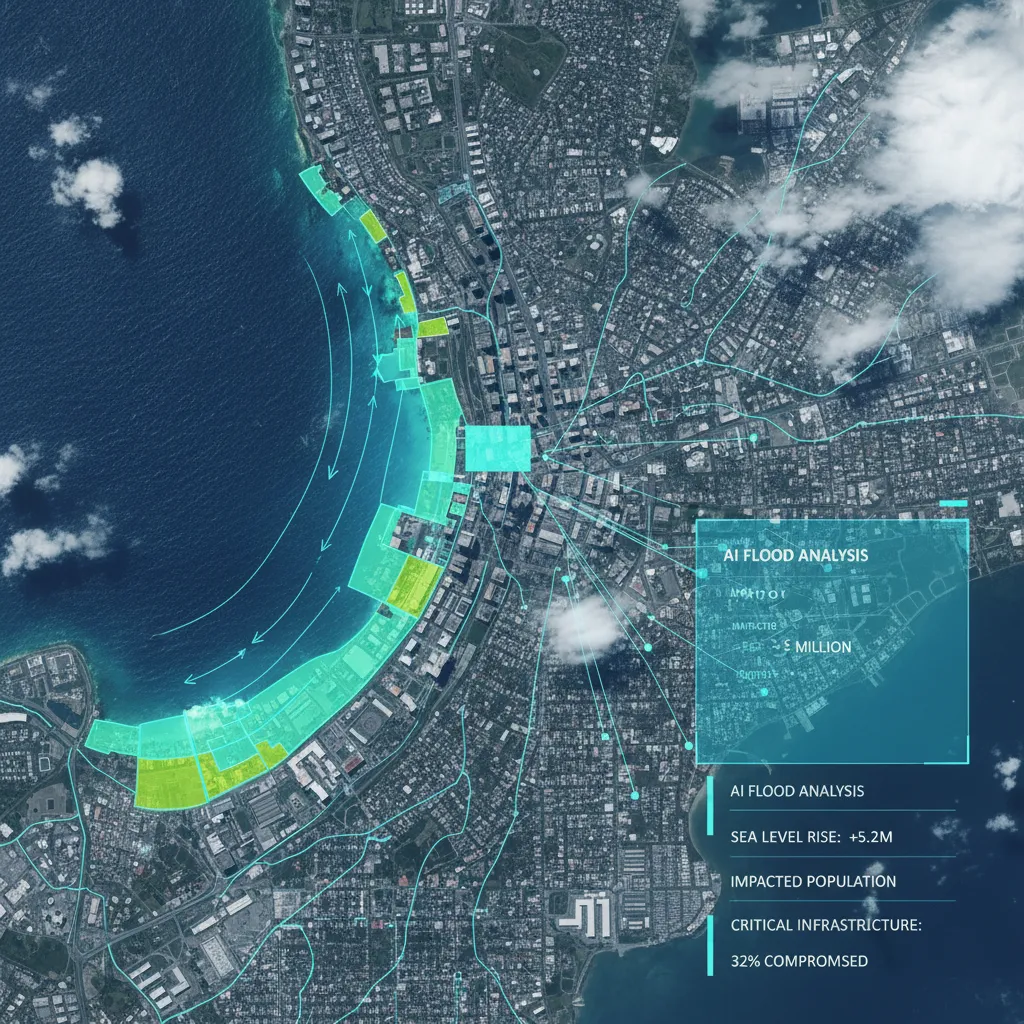 AI flood prediction map showing areas at high risk based on real-time data and historical patterns.
AI Wildfire Detection: Spotting the Spark
Wildfires pose an increasing threat, particularly in regions prone to drought and high temperatures. Early detection is paramount to containing fires before they become uncontrollable infernos. AI wildfire detection systems are a game-changer:
- Drone AI emergency response: Drones equipped with thermal cameras and AI algorithms can autonomously patrol high-risk areas, detecting subtle heat signatures or smoke plumes even before they are visible to the human eye.
- Satellite imagery AI disasters: AI processes vast amounts of satellite data, identifying changes in vegetation health, drought conditions, and even tiny fire starts across immense landscapes.
- IoT for disaster management: Networks of ground sensors can detect changes in air quality, temperature, and humidity, feeding data into AI models for comprehensive risk assessment.
These systems can alert authorities within minutes of a fire starting, drastically reducing response times and saving vital natural resources and communities.
AI Earthquake Prediction: Listening to the Earth’s Tremors
Earthquake prediction remains one of the most challenging frontiers in geophysics. While precise prediction is still elusive, AI earthquake prediction is making significant strides in identifying precursors and improving probabilistic forecasts.
- Seismic data analysis: AI and deep learning disaster prediction algorithms can analyze seismic wave patterns from thousands of past earthquakes, looking for subtle pre-slip signals or anomalies in ground motion that might indicate increased stress on fault lines.
- Satellite and GPS data: Monitoring tiny shifts in the Earth’s crust.
- IoT for disaster management: Advanced sensor networks can detect changes in groundwater levels, gas emissions, or electromagnetic fields that sometimes precede seismic events.
While not yet capable of pinpointing exact times and locations, these AI models can significantly refine hazard maps and provide more localized and timely warnings, enabling communities in high-risk zones to enhance their ai powered disaster preparedness.
 AI analyzes complex seismic data to identify patterns that may precede earthquake events, enhancing our understanding and predictive capabilities.
AI Weather Forecasting Solutions: Precision in the Storm
Weather forecasting, critical for almost all forms of disaster prediction, has been significantly enhanced by AI. Traditional numerical weather prediction models are computationally intensive. AI weather forecasting solutions leverage neural networks and machine learning to process vast atmospheric data faster and often more accurately. They can:
- Predict localized extreme weather events with greater precision.
- Improve short-term forecasts for severe storms, hurricanes, and tornadoes.
- Integrate data from radar, satellites, and ground sensors to create a more holistic picture.
This enhanced accuracy directly translates to better AI early warning systems for a multitude of natural hazards.
Geospatial AI and Satellite Imagery: A Bird’s-Eye View
The fusion of geospatial AI disasters with satellite imagery AI disasters provides an unparalleled ability to monitor the Earth’s surface for early signs of trouble. AI algorithms can analyze high-resolution satellite photos, synthetic aperture radar (SAR) data, and other remote sensing inputs to:
- Detect land degradation, deforestation, and soil erosion that contribute to landslides and desertification.
- Monitor glacier melt and sea-level rise, critical for climate change AI solutions.
- Map infrastructure vulnerability in disaster-prone areas, aiding ai risk assessment natural disasters.
- Identify illegal logging or mining activities that increase environmental fragility.
This macroscopic view, combined with AI’s analytical power, offers crucial insights for both prevention and preparedness.
AI in Real-Time Response & Management
Beyond prediction, AI plays a pivotal role when a disaster strikes, transforming the speed and efficiency of emergency response AI and crisis management AI.
Drone AI Emergency Response: Eyes in the Sky
When conventional infrastructure fails or access becomes impossible, drone AI emergency response steps in. Drones equipped with AI are invaluable during the immediate aftermath of a disaster:
- Search and Rescue: AI-powered drones can quickly map damaged areas, identify trapped individuals using thermal imaging, and even deliver essential supplies to isolated victims.
- Damage Assessment: By comparing pre- and post-disaster imagery, AI can rapidly assess the extent of damage to buildings, roads, and utilities, providing critical information for first responders.
- Hazard Mapping: Drones can map dangerous zones (e.g., active fires, unstable structures, chemical spills) in real-time, guiding emergency teams away from immediate threats.
This aerial advantage provides responders with vital situational awareness that can save precious hours and lives.
Smart Cities Disaster Response: Integrated Urban Resilience
In the age of urbanization, smart cities disaster response leverages an interconnected network of sensors, IoT devices, and AI to enhance urban resilience. In a disaster scenario, AI can:
- Traffic Management: Reroute traffic to avoid blocked roads, optimize evacuation routes, and prioritize emergency vehicle access.
- Resource Allocation: Monitor utility grids, identify outages, and direct repair crews to critical areas efficiently.
- Public Communication: Disseminate real-time alerts and information to citizens via connected devices and public displays.
- IoT for disaster management: Integrate data from diverse sources like public cameras, environmental sensors, and social media feeds to provide a comprehensive operational picture for city authorities.
[Related: navigating-future-imperative-ethical-ai-smart-world/]
AI in Humanitarian Aid & Logistics: Delivering Hope Faster
Delivering humanitarian aid efficiently to affected populations is a complex logistical challenge. AI in humanitarian aid and crisis management AI solutions are revolutionizing this process:
- Supply Chain Optimization: AI can predict demand for specific aid items, optimize warehousing, and plan the most efficient delivery routes, even in rapidly changing conditions.
- Resource Allocation: AI algorithms can analyze population data, damage reports, and medical needs to allocate resources like food, water, and medical supplies precisely where they are most needed.
- Volunteer Coordination: AI can match volunteers with specific skills to urgent tasks and optimize deployment.
- Damage Assessment: After the initial impact, AI can rapidly process satellite imagery and drone footage to assess the extent of damage to infrastructure, identifying the most critical areas for aid distribution.
This intelligent orchestration ensures that aid reaches those in desperate need faster, often saving lives that might otherwise be lost due to delays.
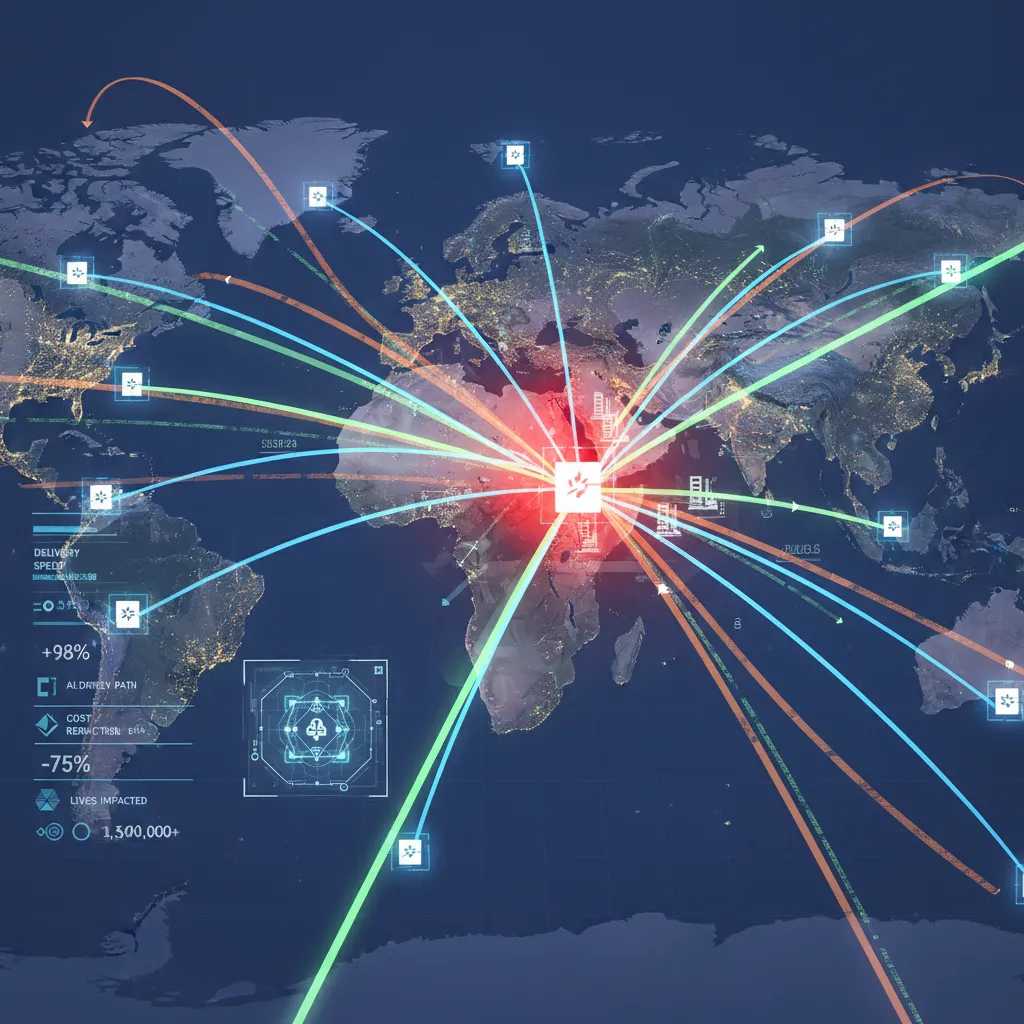 AI systems optimize complex logistics for humanitarian aid, ensuring efficient delivery of resources to affected areas during crises.
AI Real-Time Disaster Monitoring: Constant Vigilance
AI real-time disaster monitoring systems are always on, continuously processing streams of data from a multitude of sources. These systems can:
- Social Media Analysis: Monitor social media for keywords, images, and locations related to a disaster, providing immediate alerts and ground-level insights that might not yet be picked up by official channels.
- News Aggregation: Scan news feeds and official reports globally to identify emerging crises.
- Sensor Networks: Integrate data from IoT for disaster management sensors deployed in vulnerable areas, providing instantaneous alerts for changes in environmental conditions (e.g., rising water levels, air quality degradation, seismic activity).
This constant vigilance allows authorities to respond with unparalleled speed and precision, often before a situation fully escalates.
Building Resilience: AI for Long-Term Solutions
The role of AI extends beyond immediate crisis response; it is also crucial for long-term ai for resilience and proactive ai powered disaster preparedness. By analyzing historical data and simulating future scenarios, AI helps communities build stronger, more adaptable foundations.
AI Risk Assessment Natural Disasters & Hazard Mapping: Understanding Vulnerability
Understanding where and how communities are vulnerable is the first step in building resilience. AI risk assessment natural disasters tools combine historical disaster data with demographic, infrastructure, and environmental information to:
- Identify high-risk areas for specific hazards (e.g., flood plains, wildfire zones, earthquake faults).
- Assess the vulnerability of critical infrastructure like hospitals, power plants, and transportation networks.
- Model the potential impact of future events, guiding urban planning and policy decisions.
- AI driven hazard mapping creates dynamic, highly detailed maps that can be updated in real-time, providing an evolving picture of potential threats and vulnerabilities.
This granular understanding allows for targeted interventions and better allocation of resources for mitigation.
AI for Infrastructure Protection: Guarding Critical Assets
Protecting critical infrastructure is paramount for societal functioning, especially during and after a disaster. AI infrastructure protection solutions use sensors and predictive models to monitor the health of bridges, roads, power grids, and communication networks:
- Predictive Maintenance: AI can detect subtle signs of wear and tear, predicting potential failures before they occur and recommending timely repairs, reducing vulnerability during extreme events.
- Damage Prediction: During a disaster, AI can simulate stress on structures, identifying those most likely to fail and informing engineers on where to focus immediate attention.
- Optimized Design: AI can even assist in designing more resilient infrastructure by simulating performance under various disaster scenarios.
This proactive approach significantly enhances the durability of essential services.
Community Resilience AI Tech: Empowering Local Action
True resilience starts at the community level. Community resilience AI tech empowers local populations with the tools and information they need to prepare and respond effectively:
- Personalized Alerts: AI-driven systems can provide hyper-localized warnings and specific instructions tailored to individual households or neighborhoods.
- Information Sharing Platforms: AI can facilitate the rapid sharing of information among community members, local authorities, and aid organizations.
- Resource Matching: AI can help match local resources (e.g., volunteers, shelters, supplies) with immediate community needs during an emergency.
- Educational Tools: AI-powered simulations and educational platforms can help communities understand local risks and practice response strategies.
[Related: sustainable-tech-innovations-greener-gadgets-eco-smart-living/]
AI Global Warming Solutions: Mitigating the Root Cause
Ultimately, climate change AI solutions address the underlying causes of many increasing disasters. AI is playing a crucial role in the fight against global warming:
- Optimizing Energy Consumption: AI can manage smart grids, optimize energy use in buildings, and improve the efficiency of renewable energy sources.
- Carbon Emission Monitoring: AI analyzes satellite data and sensor networks to monitor greenhouse gas emissions, identifying sources and tracking progress towards reduction targets.
- Climate Modeling: Advanced AI models enhance the accuracy of climate projections, providing scientists and policymakers with better data to formulate mitigation strategies.
- Sustainable Agriculture: AI can optimize water use, predict crop yields, and recommend sustainable farming practices, building resilience against climate-induced food shortages.
By tackling climate change head-on, AI helps to reducing disaster impact with AI at its source.
The Future of Disaster Response: Integration and Innovation
The landscape of disaster response is constantly evolving, with AI at the forefront of innovation. The future promises even more sophisticated integration of these technologies. We can expect:
- Hyper-local Micro-predictions: AI models will become so precise they can predict specific impacts street by street, or even building by building.
- Autonomous Response Systems: Drones and robotic systems, guided by AI, may perform initial search and rescue or damage assessment with minimal human intervention.
- Digital Twins for Cities: Virtual replicas of cities, powered by real-time data and AI, will allow authorities to simulate disaster scenarios and test response strategies in a risk-free environment.
- Enhanced Human-AI Collaboration: AI will increasingly serve as an intelligent assistant to human responders, augmenting their capabilities rather than replacing them. This means faster analysis, better decision-making, and more effective deployment of resources.
- Global Data-Sharing Networks: AI will facilitate the secure and efficient sharing of disaster-related data across international borders, creating a more unified global response system.
The trajectory is clear: the future of disaster response tech is undeniably intertwined with the continuous advancement and thoughtful deployment of AI.
Conclusion
The challenges posed by global crises are immense, but with Artificial Intelligence, humanity gains a powerful ally. From AI disaster prediction that offers invaluable lead time to emergency response AI that orchestrates rapid humanitarian efforts, AI is fundamentally transforming our capacity to save lives and build more resilient communities. We’ve seen how machine learning natural disasters insights are enhancing flood, wildfire, and earthquake prediction, while drone AI emergency response and smart cities disaster response are revolutionizing real-time actions.
AI isn’t a magic bullet, but it represents a crucial leap forward. By leveraging the power of deep learning disaster prediction, geospatial AI disasters, and IoT for disaster management, we are moving towards a future where preparedness is proactive, response is swift, and recovery is accelerated. As we continue to refine these technologies and foster greater collaboration, AI will play an increasingly vital role in reducing disaster impact with AI and fostering a safer, more prepared world for everyone.
The conversation around AI in global crises is ongoing, evolving with every technological breakthrough. What are your thoughts on the most impactful ways AI can contribute to disaster management? Share your insights and join us in exploring the future of this life-saving technology.
FAQs
Q1. What is AI disaster prediction?
AI disaster prediction refers to the use of artificial intelligence and machine learning algorithms to analyze vast datasets (e.g., weather patterns, seismic activity, satellite imagery) to forecast the likelihood, timing, and potential impact of natural disasters like floods, wildfires, and earthquakes, providing early warnings.
Q2. How does machine learning help in natural disaster response?
Machine learning assists in natural disaster response by rapidly processing complex data to:
- Improve prediction accuracy and generate early warnings.
- Optimize resource allocation and logistics for aid distribution.
- Facilitate real-time damage assessment using drones and satellite imagery.
- Enhance search and rescue operations by identifying critical areas.
Q3. What are AI early warning systems?
AI early warning systems are advanced technological frameworks that use artificial intelligence to detect and analyze precursors to disasters, issuing timely alerts to authorities and the public. These systems integrate data from various sensors, satellites, and historical records to predict potential hazards before they escalate.
Q4. Can AI really predict earthquakes accurately?
While AI significantly refines earthquake forecasting by identifying subtle seismic patterns and precursors, precise, short-term prediction of specific earthquake events (exact time and location) remains a major scientific challenge. AI enhances probabilistic hazard assessments rather than offering definitive predictions.
Q5. How does AI contribute to climate change solutions?
AI contributes to climate change solutions by optimizing energy consumption in smart grids, improving the efficiency of renewable energy sources, enhancing climate modeling for better projections, and monitoring carbon emissions. It also aids in sustainable agriculture and helps assess climate-related risks.
Q6. What is the role of drones with AI in emergency response?
Drones equipped with AI play a crucial role in emergency response by conducting rapid aerial surveys for damage assessment, assisting in search and rescue operations using thermal imaging, delivering essential supplies to inaccessible areas, and mapping hazardous zones in real-time for first responders.
Q7. How do smart cities leverage AI for disaster management?
Smart cities use AI for disaster management by integrating data from interconnected sensors and IoT devices to:
- Optimize evacuation routes and traffic management.
- Monitor critical infrastructure health and identify outages.
- Disseminate real-time public alerts and information.
- Enhance situational awareness for emergency services, leading to more coordinated responses.