AI Reshapes Creativity: The Revolution in Art, Music & Design
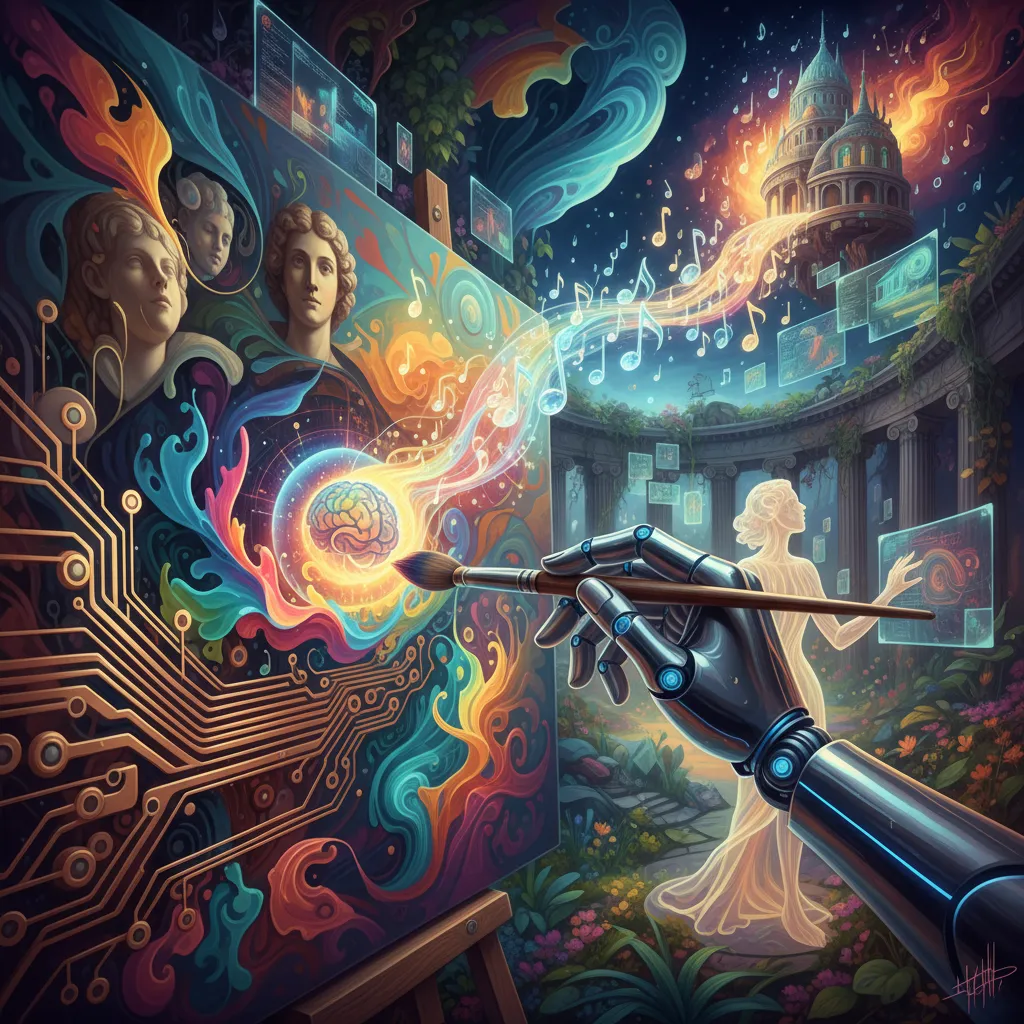
Introduction: The Canvas, The Score, The Blueprint – All Redefined by AI
For centuries, creativity has been considered a uniquely human trait, an ethereal spark that drives innovation in art, music, and design. From the brushstrokes of a master painter to the intricate symphonies of a composer or the visionary blueprints of an architect, human ingenuity has shaped our world. But what happens when that ingenuity meets the limitless processing power and pattern recognition capabilities of artificial intelligence? The answer is a revolution – a profound reshaping of the very fabric of creative industries.
We stand at the precipice of a new era where AI reshapes creativity, transforming how we conceive, produce, and experience artistic and design endeavors. AI art generation is no longer a futuristic concept; it’s a vibrant reality, with platforms creating stunning visuals from simple text prompts. AI music creation is composing melodies and entire soundtracks, adapting to mood and genre with astonishing speed. And AI graphic design is streamlining workflows, generating logos, layouts, and even entire branding kits in minutes. This isn’t just about automation; it’s about AI innovation art, pushing the boundaries of what’s possible and opening new avenues for human expression.
This article delves deep into this fascinating convergence, exploring the transformative power of AI in design, music, and visual arts. We’ll uncover how Creative AI tools are empowering individuals and industries, examine the exciting AI design trends, and peer into the future of AI in art. Join us as we explore the dynamic interplay between human imagination and algorithmic intelligence, redefining what it means to be a creator in the 21st century.
The Algorithmic Muse: Understanding Generative AI’s Creative Power
At the heart of this revolution lies generative AI – a subset of artificial intelligence capable of producing novel content. Unlike traditional AI that might classify or analyze existing data, generative AI creates. This capacity to learn from vast datasets of existing art, music, and designs, then generate entirely new, original works, is what makes it so revolutionary for creative fields.
How does it work? Often, generative AI leverages complex neural networks, such as Generative Adversarial Networks (GANs) or diffusion models. These models learn the underlying patterns, styles, and structures within their training data. For instance, a GAN trained on millions of paintings can learn the nuances of different artistic styles, color palettes, and compositions. When prompted, it can then generate an image that reflects these learned characteristics, essentially “dreaming up” something new based on its understanding. This process is rapidly making machine learning art a recognized genre.
The implications are profound. Artists and designers no longer start from a blank slate but can collaborate with an intelligent assistant capable of rapid prototyping, style exploration, and idea generation. This isn’t about replacing human creativity but augmenting it, accelerating the AI creative process and enabling creators to achieve results previously unimaginable in terms of scale and complexity. It’s the ultimate AI-powered creativity.
Brushing with Bytes: AI Art Generation and Digital Art AI
The visual arts have perhaps seen the most dramatic and widely publicized impact of AI. From hyper-realistic portraits to fantastical landscapes and abstract compositions, AI art generation has exploded into public consciousness. Tools like Midjourney, DALL-E 2, and Stable Diffusion have become household names among digital artists and enthusiasts alike.
Empowering Artists with New Mediums
For individual artists, AI for artists represents a paradigm shift.
- Overcoming creative blocks: A prompt can spark an idea or generate variations on a theme, offering fresh perspectives when inspiration wanes.
- Rapid prototyping: Artists can quickly visualize concepts, test different styles, and iterate on ideas at an unprecedented pace. Imagine generating dozens of potential character designs or environmental concepts in minutes.
- New artistic expressions: AI allows for the creation of styles and aesthetics that might be difficult or impossible to achieve with traditional methods. It can fuse disparate elements, blend historical styles, or create entirely novel visual languages. This makes digital art AI not just a tool but a new medium in itself.
- Accessibility: Artists who might lack traditional drawing skills can now bring their visual ideas to life through descriptive text, democratizing art creation.
Platforms like Artbreeder allow users to “breed” images, blending features and styles to create unique variations, showcasing the collaborative potential of generative AI art. While controversies around ownership and ethical sourcing of training data persist, the sheer volume and diversity of AI-generated art are undeniable.
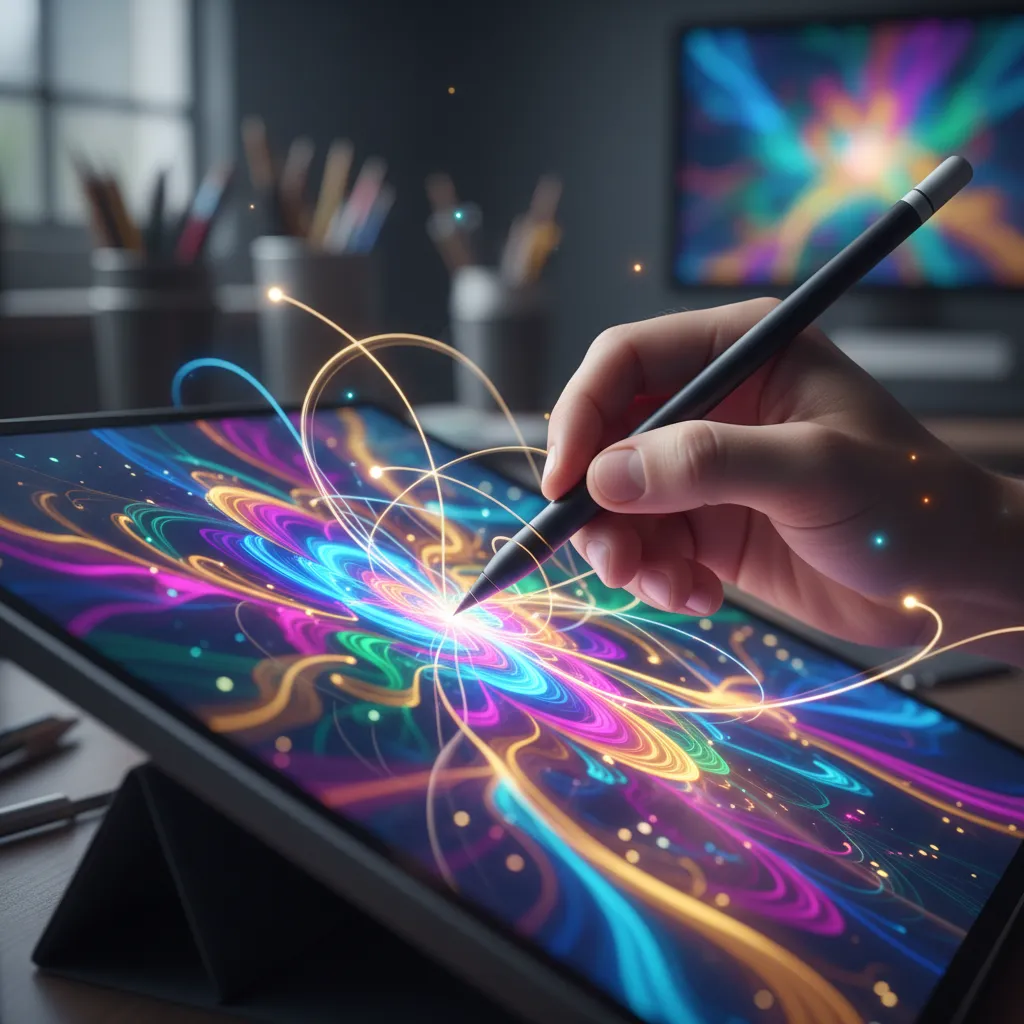
The image above illustrates the symbiotic relationship between human and machine. An AI algorithm doesn’t just create for the artist; it assists the artist’s hand, enhancing their digital painting with algorithmic insights, texture generation, or even suggesting color palettes. This form of AI creative collaboration is becoming increasingly common.
The Symphony of Algorithms: AI Music Creation and Composition
Music, an art form deeply rooted in pattern, emotion, and structure, is a natural fit for AI. AI music creation is transforming how composers, producers, and even casual enthusiasts approach songwriting, sound design, and performance.
From Algorithmic Compositions to AI Music Production
AI is not merely generating generic background scores; it’s composing sophisticated pieces that evoke emotion and adhere to complex musical theories.
- Algorithmic music: Systems like AIVA (Artificial Intelligence Virtual Artist) can compose orchestral, pop, or electronic pieces in various styles. Users can specify genre, mood, and even instrumentation, and AIVA generates unique scores.
- Personalized soundscapes: AI music software is used to create adaptive soundtracks for video games and films that respond in real-time to narrative changes or player actions.
- Beat and melody generation: Tools like Amper Music and Google Magenta (specifically NSynth and Tone Transfer) allow musicians to generate beats, melodies, and even complete song structures, acting as a tireless co-composer. This empowers artists to experiment with different arrangements and unlock new sounds.
- AI music production: Beyond composition, AI assists in mixing, mastering, and even synthesizing new instruments and vocal textures. Tools can analyze a track and suggest optimal equalization, compression, or reverb settings, greatly speeding up the post-production process.
The impact of AI music composition extends to various applications, from creating royalty-free music for content creators to assisting professional film composers in brainstorming themes and variations. The future of sound is increasingly algorithmic.
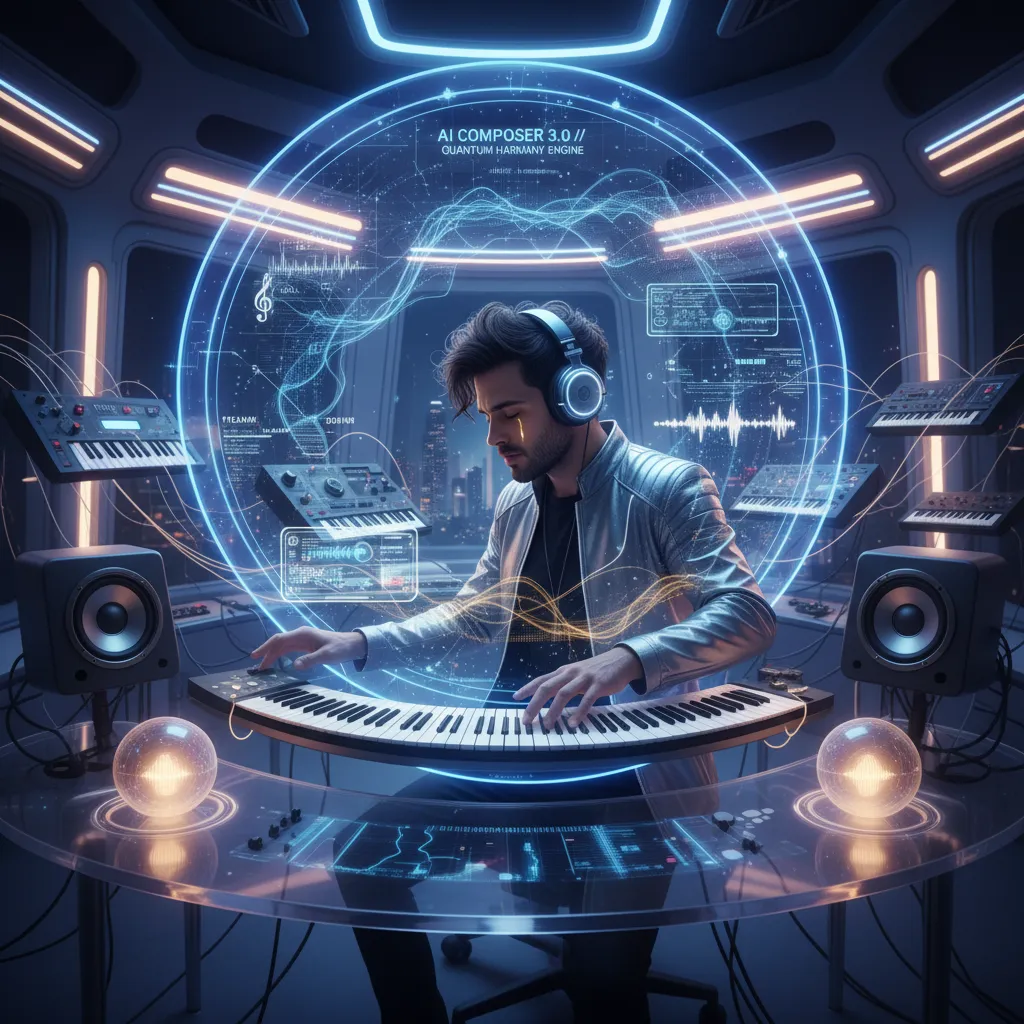
In this futuristic studio, an AI interface isn’t just playing back pre-recorded sounds; it’s actively generating and manipulating musical elements, perhaps even improvising based on a set of parameters. This demonstrates the deep integration of AI into the AI music production workflow, acting as both a creative partner and a technical assistant.
Blueprinting the Future: AI in Graphic Design and Beyond
Design is inherently about problem-solving and visual communication. AI graphic design tools are proving invaluable in automating repetitive tasks, generating variations, and even predicting design effectiveness, fundamentally altering the landscape for designers.
Streamlining Workflows and Driving AI Design Trends
- Automated branding: AI platforms can generate logos, color palettes, and typography suggestions based on a company’s name and industry, often in seconds. This is a game-changer for startups and small businesses.
- Layout and content generation: AI can assist in creating website layouts, social media graphics, and marketing materials, optimizing for engagement and visual hierarchy. Tools like Canva’s AI features and Adobe Sensei integrate AI directly into popular design suites, making AI tools for designers accessible.
- Personalized experiences: AI helps design systems that adapt to individual user preferences, creating highly personalized interfaces and content delivery, shaping future AI design trends.
- AI fashion design: Beyond traditional graphic design, AI is making waves in other design fields. In fashion, AI analyzes trends, generates new garment designs, and even predicts consumer preferences. This can lead to more sustainable and efficient production cycles.
- Architectural design: AI is being used to optimize building layouts for energy efficiency, generate novel structural forms, and even create hyper-realistic visualizations.
The role of the human designer shifts from merely executing ideas to curating AI outputs, guiding the algorithmic process, and ensuring the final design resonates with human sensibilities. It’s an exciting time for AI in design.
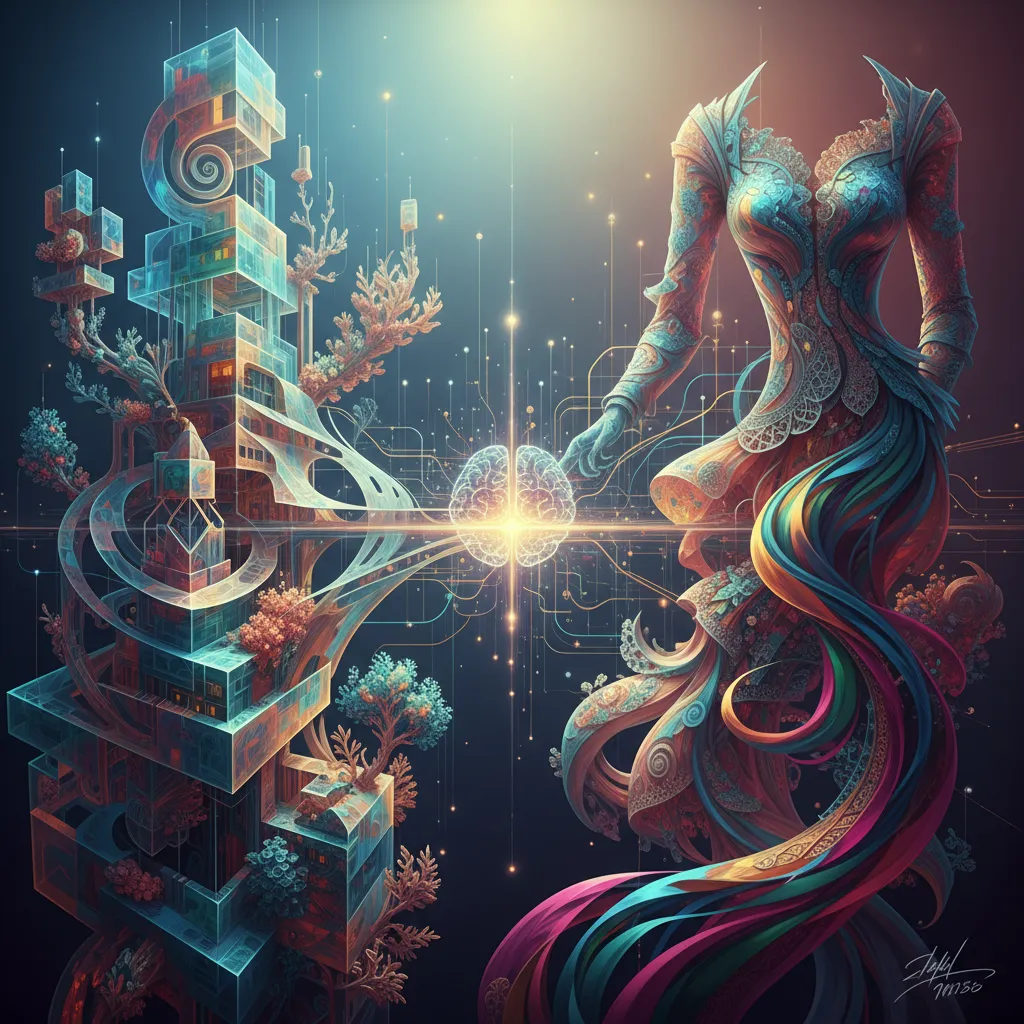
This image vividly portrays how AI transcends traditional design boundaries, simultaneously generating intricate architectural blueprints and cutting-edge fashion designs. This cross-disciplinary capability highlights the versatility of AI creative solutions and its profound impact across various design sectors. AI fashion design is no longer a niche concept but a growing reality.
The Symbiotic Spark: Human-AI Creative Collaboration
One of the most exciting aspects of AI-powered creativity is not just what AI can do alone, but what it enables humans to do. The prevailing narrative is increasingly shifting from AI replacing creators to AI collaborating with them. This AI creative collaboration is fostering entirely new ways of working and thinking.
Enhancing, Not Erasing, Human Ingenuity
- Idea generation and brainstorming: AI can be an endless source of inspiration, generating hundreds of concepts in minutes, allowing creators to explore diverse paths before committing to one. This accelerates the initial phases of the AI creative process.
- Skill augmentation: AI can handle tedious or technically challenging aspects, freeing up artists to focus on the conceptual and emotional core of their work. A musician might use AI to generate complex drum patterns, then spend more time perfecting a guitar solo. A designer might use AI to quickly render multiple versions of a layout, then refine the one that best captures the brand’s essence.
- Breaking creative barriers: AI can help creators venture into new mediums or styles they might not have the traditional skills for. An artist accustomed to painting might explore AI video generation creative tools, or a writer might use AI writing creative software to brainstorm story arcs.
- Personalized learning and growth: AI tools can analyze a creator’s style and suggest techniques, inspirations, or even potential areas for improvement. [Related: Unlocking Potential: AI Revolutionizing Personalized Learning]
This synergy redefines the role of the creator. They become less of a sole artisan and more of a conductor, guiding an orchestra of intelligent algorithms to realize their vision. The creative process becomes a dialogue between human intuition and algorithmic efficiency, leading to genuinely innovative results and demonstrating the true potential of AI for artistic expression.
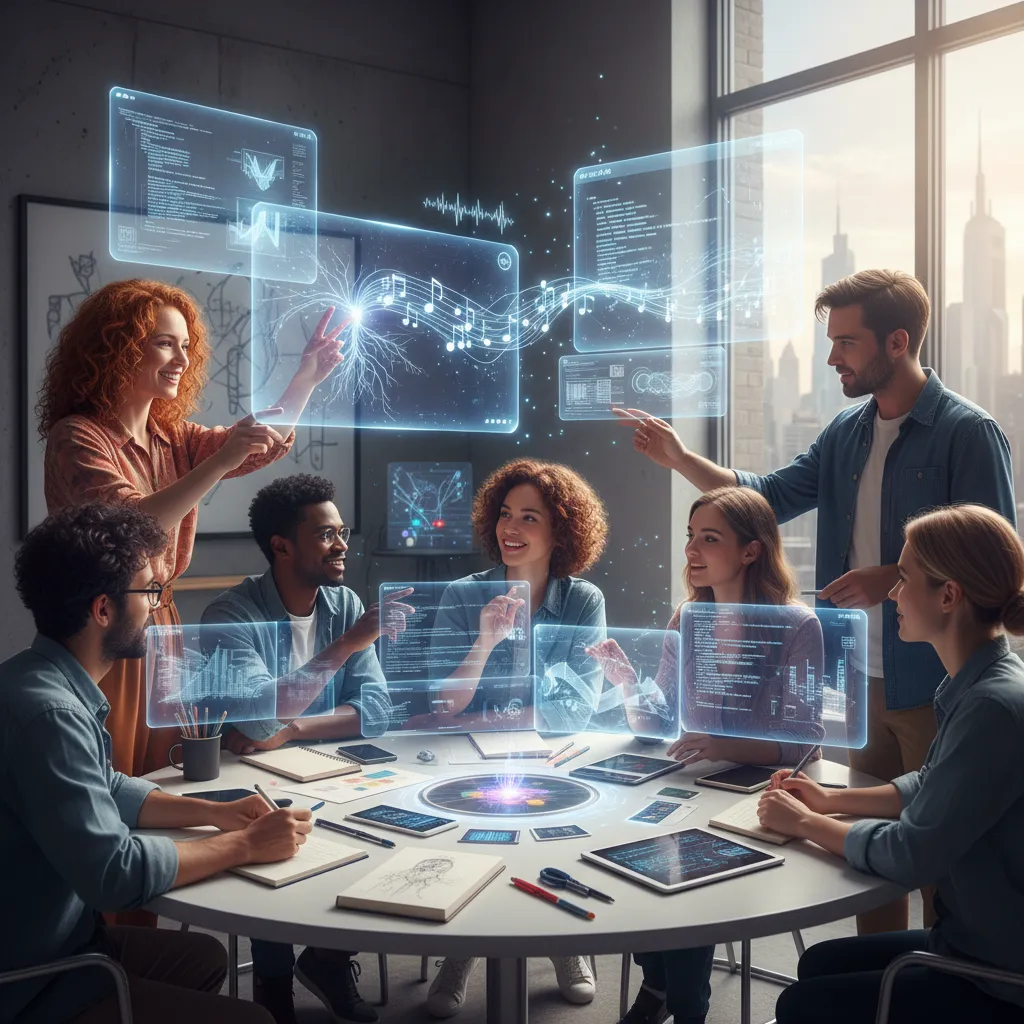
Here, artists, musicians, and designers are actively engaged with AI interfaces, not merely observing. They are interacting, guiding, and reacting to AI-generated ideas, exemplifying the dynamic nature of AI creative collaboration. This scene captures a brainstorming session where human intuition meets algorithmic possibility, pushing boundaries in a shared creative space.
Challenges and Considerations in the AI Creative Landscape
While the benefits of AI in creative fields are immense, it’s crucial to address the challenges and ethical considerations that arise with this powerful technology. As AI’s impact on artists and industries grows, so does the need for careful navigation.
Navigating the Nuances: Ethics, Originality, and Ownership
- Originality and copyright: One of the most contentious issues is the originality and ownership of AI content generation. If an AI system generates a piece of art, who owns the copyright? The developer of the AI, the user who prompted it, or the artists whose data trained the AI? Legal frameworks are still evolving to address these complex questions.
- Data sourcing and bias: Many generative AI models are trained on vast datasets scraped from the internet, which often include copyrighted works without explicit permission. Furthermore, if the training data contains biases (e.g., predominantly male artists, specific cultural aesthetics), the AI’s output may perpetuate or amplify those biases.
- Job displacement vs. evolution: While AI can augment creativity, concerns about job displacement are valid. Will AI reduce the demand for certain creative roles? The more likely scenario is an evolution of roles, where creators who embrace and master AI tools will thrive, while others may need to adapt. [Related: AI Career: Mastering the Future Job Market]
- The “soul” of art: Can an algorithm truly express emotion or inject a unique “soul” into art? Many argue that genuine art requires human experience, intent, and consciousness. AI might replicate style, but can it replicate the human condition? This philosophical debate is central to understanding the limitations and unique contributions of machine learning art.
Addressing these challenges requires a collaborative effort from technologists, artists, policymakers, and legal experts to ensure that AI serves as a beneficial tool that respects human creativity and intellectual property rights.
The Future Trajectory: AI’s Unfolding Impact on Creative Industries
Looking ahead, the integration of AI into creative industries is only set to deepen and diversify. The pace of innovation in AI innovation art suggests a future far richer and more complex than we can fully grasp today.
Towards Hyper-Personalization and New Art Forms
- Hyper-personalized experiences: Imagine music that dynamically adjusts to your mood, art installations that evolve with viewer interaction, or advertisements that are uniquely tailored to each individual’s aesthetic preferences, leveraging AI in advertising creativity. This level of personalization, driven by AI creative solutions, will redefine engagement.
- Immersive creative environments: AI will play a crucial role in developing immersive experiences in virtual and augmented reality. From generating realistic 3D environments to creating dynamic narratives, AI will be an indispensable tool for building these new digital worlds. [Related: Unlocking New Realities: AI & Spatial Computing]
- Emergence of new art forms: As AI capabilities expand, we can expect the emergence of entirely new artistic disciplines and mediums that blend digital and physical realities in unforeseen ways. Think about interactive art that responds to brainwaves or sculptures that self-assemble based on algorithmic prompts.
- Democratization of complex skills: Advanced AI tools will continue to lower the barrier to entry for complex creative tasks, allowing more people to engage in sophisticated AI content generation without years of specialized training.
- Ethical AI development: Increased focus will be placed on developing ethical AI models that prioritize fairness, transparency, and artist compensation, fostering a more equitable creative ecosystem.
The future of AI in art is not a deterministic path but a dynamic landscape shaped by ongoing innovation, ethical considerations, and the boundless potential of human imagination. AI and creative industries are embarking on a journey of co-evolution, promising an era of unprecedented creativity.
Conclusion: The Infinite Canvas of AI-Powered Imagination
The revolution in art, music, and design, driven by artificial intelligence, is undeniable. From the intricate brushstrokes of AI art generation to the harmonious complexities of AI music creation and the innovative efficiency of AI graphic design, AI is proving to be far more than just a tool – it’s a transformative partner. It amplifies human potential, accelerates the AI creative process, and opens up new dimensions of expression previously confined to the realm of science fiction.
We’ve explored how Creative AI tools are not just automating tasks but are actively participating in the creation of unique, inspiring works across various mediums. The rise of generative AI art, AI music software, and sophisticated AI design trends signals a shift towards a symbiotic relationship where human intuition guides algorithmic prowess. While challenges concerning ethics, originality, and job evolution remain, the overarching narrative is one of opportunity and expansion for AI for artists and designers alike.
As we move forward, the most profound impact of AI-powered creativity will likely be in the fostering of AI creative collaboration, where the distinction between human and machine contributions blurs into a unified artistic vision. The canvas of human imagination has now gained an infinite extension, promising an era where creativity knows no bounds. Embrace the revolution; the future of art, music, and design is here, and it’s brilliantly intelligent.
FAQs: Your Questions About AI and Creativity Answered
Q1. Can AI truly be creative, or does it just mimic?
AI, particularly generative AI, can produce novel and aesthetically pleasing outputs that often appear “creative.” However, its creativity is rooted in its ability to learn and combine patterns from vast datasets, rather than possessing conscious intent or subjective experience like humans. It “mimics” in the sense that it builds on existing human-created patterns, but it can also extrapolate and generate truly unique combinations, pushing beyond direct imitation.
Q2. Will AI replace human artists, musicians, and designers?
While AI will undoubtedly automate many repetitive tasks and change workflows, it’s more likely to augment human creators rather than fully replace them. The unique human elements of empathy, subjective experience, cultural understanding, and critical judgment remain irreplaceable. Instead, artists, musicians, and designers who embrace Creative AI tools will gain significant advantages, evolving their roles to become curators, directors, and collaborators with AI. [Related: AI Career: Mastering the Future Job Market]
Q3. What are some popular AI tools for creativity?
For AI art generation, popular tools include Midjourney, DALL-E 2, Stable Diffusion, and Artbreeder. For AI music creation and AI music software, examples include AIVA, Amper Music, Google Magenta, and Soundraw. In AI graphic design, tools with integrated AI features include Canva, Adobe Sensei, and LogoAI.
Q4. How does AI music composition work?
AI music composition typically involves training deep learning models on large datasets of existing musical pieces. The AI learns patterns of melody, harmony, rhythm, and structure. When prompted (e.g., with a genre, mood, or specific input), the AI uses this learned knowledge to generate new musical sequences, which can then be refined and orchestrated by human composers. This process is a key part of algorithmic music.
Q5. What are the ethical concerns surrounding AI-generated art?
Key ethical concerns include:
- Copyright and ownership: Who owns the rights to AI-generated works, especially if the AI was trained on copyrighted material?
- Data sourcing: The ethical implications of using vast amounts of internet data (often without artist consent) for training AI models.
- Bias: AI models can perpetuate or amplify biases present in their training data, leading to biased artistic outputs.
- Misinformation and deepfakes: The potential for AI to generate highly convincing but fabricated media. Addressing these requires ongoing dialogue and evolving legal frameworks.
Q6. How can artists start using AI in their creative process?
Artists can begin by exploring user-friendly AI art platforms like Midjourney or Stable Diffusion for visual art, or tools like Soundraw for music composition. Many platforms offer free trials or freemium models. Experimenting with different prompts, understanding how to refine AI outputs, and viewing AI as a collaborative partner rather than a complete solution are crucial first steps in integrating AI for artists.
Q7. Is AI-generated content copyrightable?
Currently, in many jurisdictions, including the United States, works created solely by AI are generally not eligible for copyright protection, as copyright typically requires human authorship. However, if a human artist significantly modifies, selects, or arranges AI-generated elements, their human contribution might be copyrightable. This is a rapidly evolving area of law, and policies vary globally.
Q8. What is generative AI in the context of creativity?
Generative AI refers to artificial intelligence models capable of producing novel content, such as images, text, audio, or video, that did not exist before. In creativity, it means AI systems that can create new pieces of art, compose original music, or design unique graphics based on patterns learned from vast datasets, rather than simply analyzing or reproducing existing content. This forms the backbone of AI art generation and AI music creation.