AI’s Healthcare Revolution: Personalized Medicine & Predictive Wellness Unlocked

For decades, healthcare has largely operated on a one-size-fits-all model. You get sick, you see a doctor, and you receive a treatment that works for the average person. But what if your healthcare was as unique as your fingerprint? What if we could predict illnesses before they manifest and tailor preventative care to your specific genetic makeup and lifestyle? This isn’t science fiction; it’s the reality being built today by the transformative power of Artificial Intelligence.
The integration of AI in healthcare is catalyzing a monumental shift from reactive treatment to proactive, predictive wellness. This revolution is powered by machine learning in medicine, which allows us to analyze vast amounts of health data at a speed and scale impossible for the human mind. The result is a new era of Personalized medicine and Precision health technology, where your treatment and wellness journey are crafted specifically for you.
In this deep dive, we’ll explore how AI health tech is unlocking a new dimension of human well-being, from hyper-accurate AI diagnostics and accelerated AI drug discovery to the AI wellness apps on your smartphone that act as your personal health coach. Get ready to discover the incredible future of medicine AI is creating right now.
The Dawn of a New Era: From One-Size-Fits-All to One-Size-Fits-One
The traditional healthcare paradigm has saved countless lives, but it has inherent limitations. It often treats symptoms rather than root causes and relies on population-wide data that may not apply to an individual’s unique biology. This is where the concept of Patient-centric AI changes the game.
Instead of treating “the average patient,” AI enables a “one-size-fits-one” approach. By harnessing healthcare big data AI, algorithms can process a patient’s entire health profile—genomics, medical history, lifestyle data from wearables, and even environmental factors—to create a holistic, high-definition picture of their health. This allows for the creation of customized treatment plans that are more effective, have fewer side effects, and lead to better long-term outcomes. This isn’t just an improvement; it’s a fundamental re-imagining of care delivery.
AI Diagnostics: Seeing the Unseen with Superhuman Accuracy
One of the most immediate and impactful applications of AI in medicine is in diagnostics. Human experts, while brilliant, are susceptible to fatigue and limitations in pattern recognition within complex data. AI, particularly deep learning healthcare models, suffers from neither.
Take AI medical imaging, for example. Algorithms can now analyze MRIs, CT scans, and X-rays with astonishing accuracy, often detecting subtle signs of disease that might be missed by the human eye.
- Oncology: AI models can identify cancerous tumors in mammograms or lung scans at their earliest, most treatable stages, significantly improving survival rates.
- Ophthalmology: Google’s AI has proven capable of detecting diabetic retinopathy, a leading cause of blindness, with an accuracy level on par with human ophthalmologists.
- Pathology: AI can analyze tissue slides to identify cancer cells faster and more consistently than manual review, reducing diagnostic bottlenecks.
These medical AI innovations don’t replace doctors. Instead, they act as powerful co-pilots, augmenting a radiologist’s or pathologist’s expertise, reducing their workload, and allowing them to focus on the most critical cases. Related: AI for Enhanced Hobbies & Creative Pursuits
The Genius in the Lab: Accelerating Drug Discovery and Development
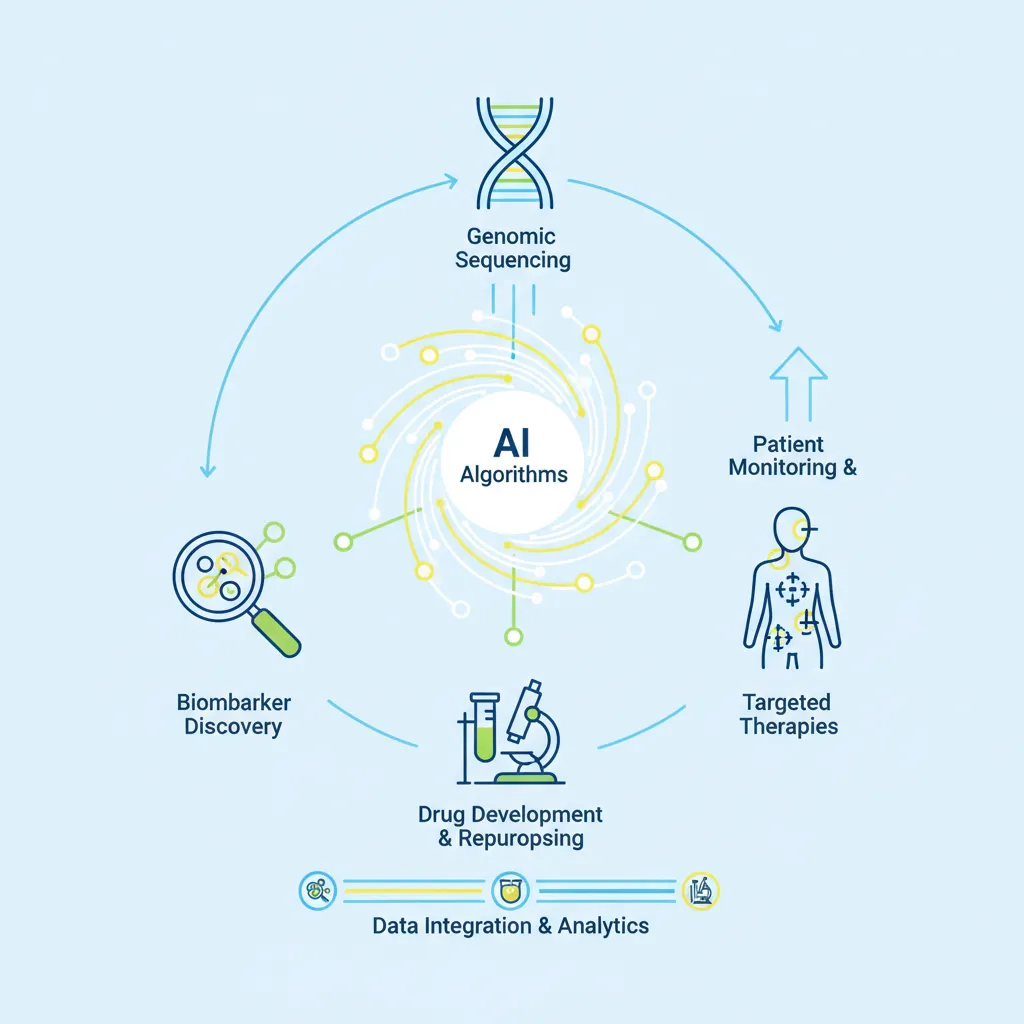
Bringing a new drug to market is a notoriously slow and expensive process, often taking over a decade and costing billions of dollars. AI drug discovery is poised to dramatically overhaul this timeline.
AI platforms can:
- Analyze Biological Data: Sift through immense genomic and proteomic databases to identify novel biological targets for new drugs.
- Predict Molecular Efficacy: Simulate how millions of potential drug compounds will interact with these targets, predicting their effectiveness and potential side effects without costly physical experiments.
- Optimize Clinical Trials: AI can help design more efficient clinical trials by identifying the ideal patient candidates based on their genetic profiles, leading to faster and more conclusive results.
By leveraging genetic insights AI and predictive modeling, pharmaceutical companies can pursue more promising candidates, fail faster on those that won’t work, and ultimately deliver life-saving medications to patients years sooner.
Your Personal Health Blueprint: Crafting Customized Treatment Plans
This is where the promise of personalized medicine truly comes to life. Imagine a cancer treatment designed not for “lung cancer” in general, but for the specific genetic mutations driving the tumor in your body. This is the power of AI-driven treatment planning.
By integrating a patient’s genomic data with their clinical information, AI algorithms can recommend the most effective therapies. For chronic disease management AI is a game-changer. A diabetic patient’s plan could be dynamically adjusted based on real-time data from a glucose monitor, their diet, and activity levels, all processed by an intelligent system. This moves beyond static treatment protocols to a dynamic, responsive, and deeply personalized care model. Related: AI PCs are Here: How They’re Quietly Transforming Your Computing Experience in 2024
The Future is Predictive: Shifting from Reactive Cures to Proactive Wellness
The ultimate goal of modern medicine is to prevent disease from ever happening. Predictive analytics healthcare is the key to this paradigm shift. The explosion of wearable health tech and smart health devices—from smartwatches tracking heart rate to smart rings monitoring sleep patterns—has created an unprecedented stream of real-time health data.
AI excels at finding the signal in this noise. It can identify subtle patterns and deviations in your personal data that may indicate a developing health issue long before you feel any symptoms.
- Cardiology: Algorithms can predict the risk of atrial fibrillation or a heart attack by analyzing long-term heart rate variability.
- Neurology: Changes in typing speed and patterns on a smartphone could become early indicators of cognitive decline or Parkinson’s disease.
- Epidemiology: AI can analyze population-level data to predict infectious disease outbreaks, allowing public health officials to respond more quickly.
This focus on AI for disease prevention and preventative healthcare AI empowers both individuals and healthcare systems to move from a reactive “sick-care” model to a proactive “health-care” model, saving lives and reducing long-term costs.

The Wellness Companion in Your Pocket: The Rise of Smart Health Solutions
The revolution isn’t just happening in hospitals and labs; it’s happening in our pockets. Digital health solutions powered by AI are democratizing access to personalized wellness guidance.
- AI wellness apps are becoming increasingly sophisticated, offering everything from guided meditations to fitness plans that adapt to your progress.
- AI-driven health coaching provides 24/7 support, helping users build healthier habits, manage stress, and stay on track with their wellness goals.
- Personalized nutrition AI can analyze your dietary intake, health data, and goals to provide custom meal plans and recommendations.
- AI mental health support offers accessible, on-demand resources like chatbots that provide cognitive behavioral therapy techniques, bridging a critical gap in mental healthcare access.
These tools, combined with remote patient monitoring AI, allow for continuous care and engagement, empowering people to become active participants in their own health journey. Related: AI Fitness Revolution: Hyper-Personalized Workouts & AI Coaches

Navigating the New Frontier: Addressing the Ethical Challenges of AI in Healthcare
With great power comes great responsibility. The rise of AI in healthcare brings a host of critical ethical questions that we must address thoughtfully to build a trustworthy system.
Key considerations for AI ethical healthcare include:
- Data Privacy and Security: Health data is incredibly sensitive. We need robust regulations and security measures to protect patient information from breaches and misuse.
- Algorithmic Bias: AI models are trained on data. If that data reflects existing societal biases (e.g., underrepresentation of certain ethnicities in clinical trials), the AI’s predictions and recommendations can perpetuate and even amplify health disparities.
- Accountability: If an AI system makes a diagnostic error, who is responsible? The developer, the hospital, or the doctor who used the tool? Clear frameworks for accountability are essential.
- The Human Touch: Technology should augment, not replace, the crucial doctor-patient relationship. Empathy, communication, and human judgment must remain at the core of care. Related: Ethical AI in Content Creation: Navigating Bias, Transparency, and Trust
Building an equitable and effective AI-driven healthcare system requires a multi-stakeholder approach involving technologists, clinicians, ethicists, regulators, and patients themselves.
Conclusion: Customizing Your Journey to a Healthier Future
The fusion of artificial intelligence and healthcare is no longer a distant vision; it’s a rapidly unfolding reality. From decoding our genetic blueprints for customized treatment plans to leveraging data from smart health devices for predictive wellness, AI is fundamentally reshaping our relationship with health.
We are moving away from a world of generic treatments and reactive care into a vibrant new era of precision health technology. This is a future where medicine is deeply personal, proactive, and participatory. The journey has just begun, and while ethical challenges must be navigated with care, the potential to live longer, healthier, and more empowered lives is undeniable. The future of wellness isn’t just about treating sickness; it’s about giving each of us the unique tools and insights to build a lifetime of well-being.
Frequently Asked Questions (FAQs)
Q1. How is AI being used in healthcare today?
AI is used across healthcare for various tasks. Key applications include AI medical imaging analysis to detect diseases like cancer earlier, accelerating AI drug discovery, personalizing treatment plans based on a patient’s genetic data, and powering AI wellness apps for daily health management and disease prevention.
Q2. What is an example of personalized medicine?
A prime example of personalized medicine is in oncology. Instead of using standard chemotherapy for all lung cancer patients, doctors can use genetic insights AI to analyze a patient’s tumor DNA. Based on the specific mutations found, the AI can help recommend a targeted therapy drug that is most likely to be effective for that individual, leading to better outcomes and fewer side effects.
Q3. What are the main benefits of using AI in healthcare?
The primary benefits of AI in healthcare are increased accuracy, efficiency, and personalization. AI can lead to earlier and more accurate diagnoses, faster development of new drugs, highly customized treatment plans, and a shift from reactive to preventative healthcare AI, ultimately improving patient outcomes and potentially lowering costs.
Q4. Can AI predict future diseases?
Yes, predictive analytics healthcare is a major application of AI. By analyzing continuous data from sources like electronic health records and wearable health tech, AI models can identify patterns that indicate a high risk for developing certain conditions like heart disease, diabetes, or sepsis in a hospital setting, allowing for early intervention.
Q5. What is the role of machine learning in medicine?
Machine learning in medicine is the core technology that enables most healthcare AI. It involves training algorithms on massive datasets (e.g., medical images, patient records) to learn how to recognize patterns and make predictions. This is how an AI learns to distinguish a cancerous cell from a healthy one or predict a patient’s response to a particular drug.
Q6. Are AI wellness apps effective?
Many AI wellness apps can be highly effective tools for health management. They use AI to provide AI-driven health coaching, track fitness, offer personalized nutrition AI, and support mental well-being. Their effectiveness depends on the app’s quality and the user’s consistent engagement, but they are a powerful tool for empowering individuals to take an active role in their health.
Q7. What are the ethical concerns with AI in healthcare?
The main ethical concerns revolve around data privacy, algorithmic bias, and accountability. Ensuring patient data is secure is paramount. Algorithms must be trained on diverse data to avoid perpetuating health disparities. Finally, clear frameworks are needed to determine responsibility when an AI health tech system makes an error.