Unlock Your Financial Future: AI-Powered Personalized Planning for Everyone

Introduction
Let’s be honest: managing money can feel like navigating a maze in the dark. Between budgeting, saving, investing, and planning for long-term goals like retirement, the sheer complexity is enough to cause anyone financial anxiety. For decades, truly personalized financial guidance was a luxury reserved for the wealthy, accessible only through expensive human advisors. But what if you could have a brilliant, data-driven financial strategist in your pocket, working 24/7 to build you a personalized roadmap to wealth?
Welcome to the new era of AI financial planning. This isn’t science fiction anymore. The same artificial intelligence that powers self-driving cars and complex search engines is now democratizing financial wellness for everyone. Personalized finance AI is transforming how we interact with our money, moving beyond simple spreadsheets and into the realm of dynamic, intelligent, and automated financial advice.
In this comprehensive guide, we’ll demystify the world of AI-powered money management. You’ll learn exactly how this technology works, explore the core pillars of smart financial planning it supports, and discover how to leverage these tools to build a secure and prosperous future. Get ready to unlock a level of financial control and insight you never thought possible.
The Old Way vs. The New Way: A Paradigm Shift in Financial Planning
For generations, the path to financial advice was singular and narrow. You had to find a human financial advisor, which often involved high fees, minimum investment requirements, and a schedule that revolved around their availability. This model, while valuable for some, effectively locked millions of people out of expert financial guidance.
The Traditional Model:
- Exclusive: High costs and asset minimums made it inaccessible for the average person.
- Reactive: Advice was often given during periodic meetings, not in response to real-time market or life changes.
- Time-Consuming: Required lengthy appointments and manual data gathering.
- Potentially Biased: Human advisors can have inherent biases or may be motivated by commissions on certain products.
Enter the world of tech in personal finance. AI-driven platforms have flipped this model on its head, creating a new paradigm of digital financial planning.
The AI-Powered Model:
- Inclusive: Low-cost or freemium apps make sophisticated financial tools available to anyone with a smartphone.
- Proactive: AI algorithms monitor your finances 24/7, offering timely alerts and AI financial insights.
- Instantaneous: Connect your accounts in minutes and receive a comprehensive overview instantly.
- Data-Driven: Recommendations are based on objective analysis of your data, free from human emotional bias.
This shift isn’t just about convenience; it’s about empowerment. It’s about providing the tools for AI for financial wellness to people at every income level, giving them the power to build a better financial future.
How Does AI Actually Power Your Financial Plan?
“AI” can sound like a vague buzzword, but in personal finance, its application is concrete and powerful. At its core, an AI financial guidance software uses a combination of sophisticated technologies to act as your digital financial advisor.
Think of it like a GPS for your finances. You input your destination (your financial goals), and the AI analyzes all the data—your income, spending habits, current savings, and market conditions (the traffic)—to calculate the most efficient route to get you there, course-correcting in real-time as things change.
Here’s a breakdown of the engine running under the hood:
- Machine Learning (ML): This is the brain. ML algorithms analyze your historical financial data to learn your unique patterns. They identify where every dollar goes, predict future cash flow, and spot opportunities for savings you might miss.
- Predictive Analytics: By understanding your past, AI can forecast your future. It can project your retirement savings trajectory, estimate when you’ll pay off your debt, and model how different saving strategies will impact your ability to reach your goals.
- Data Aggregation: Modern AI financial solutions securely connect to all your financial accounts—checking, savings, credit cards, loans, and investments—using APIs. This creates a single, unified dashboard of your entire financial life.
- Automation: The real magic is in personal finance automation. The AI can automatically categorize transactions, move money between accounts to meet savings goals, and even rebalance your investment portfolio based on pre-set rules. [Related: The Rise of AI Robots: How Intelligent Automation is Reshaping Industries]
This combination provides a level of automated financial advice that is both deeply personal and incredibly powerful, helping you make smarter decisions without the manual effort.
The Core Pillars of AI-Powered Money Management
AI isn’t just one single tool; it’s a suite of capabilities that enhances every aspect of your financial life. Let’s explore the key areas where AI-powered personalized planning is making the biggest impact.
Intelligent Budgeting and Expense Tracking (AI Budgeting Tools)
The foundation of any solid financial plan is understanding where your money is going. Traditional budgeting is tedious and often fails because of the manual effort required. AI budgeting tools completely change the game.
Instead of manually logging every coffee purchase, AI apps automatically:
- Categorize Spending: They instantly recognize transactions from merchants and assign them to categories like “Groceries,” “Transport,” or “Entertainment.”
- Identify Trends: AI can visualize your spending habits over time, showing you that your “Subscription” costs have crept up by 20% in the last six months.
- Spot Anomalies: The system can flag unusual or duplicate charges, protecting you from fraud and billing errors.
- Create Smart Budgets: Based on your income and spending history, the AI can suggest a realistic budget, helping you set achievable targets with custom AI budgeting strategies.

This turns budgeting from a chore into a seamless, insightful process, giving you a crystal-clear picture of your financial health. [Related: iOS 18 AI: A Deep Dive into Apple’s New Photo Editing Tools]
Crafting Your Personalized Financial Roadmap (AI for Financial Goals)
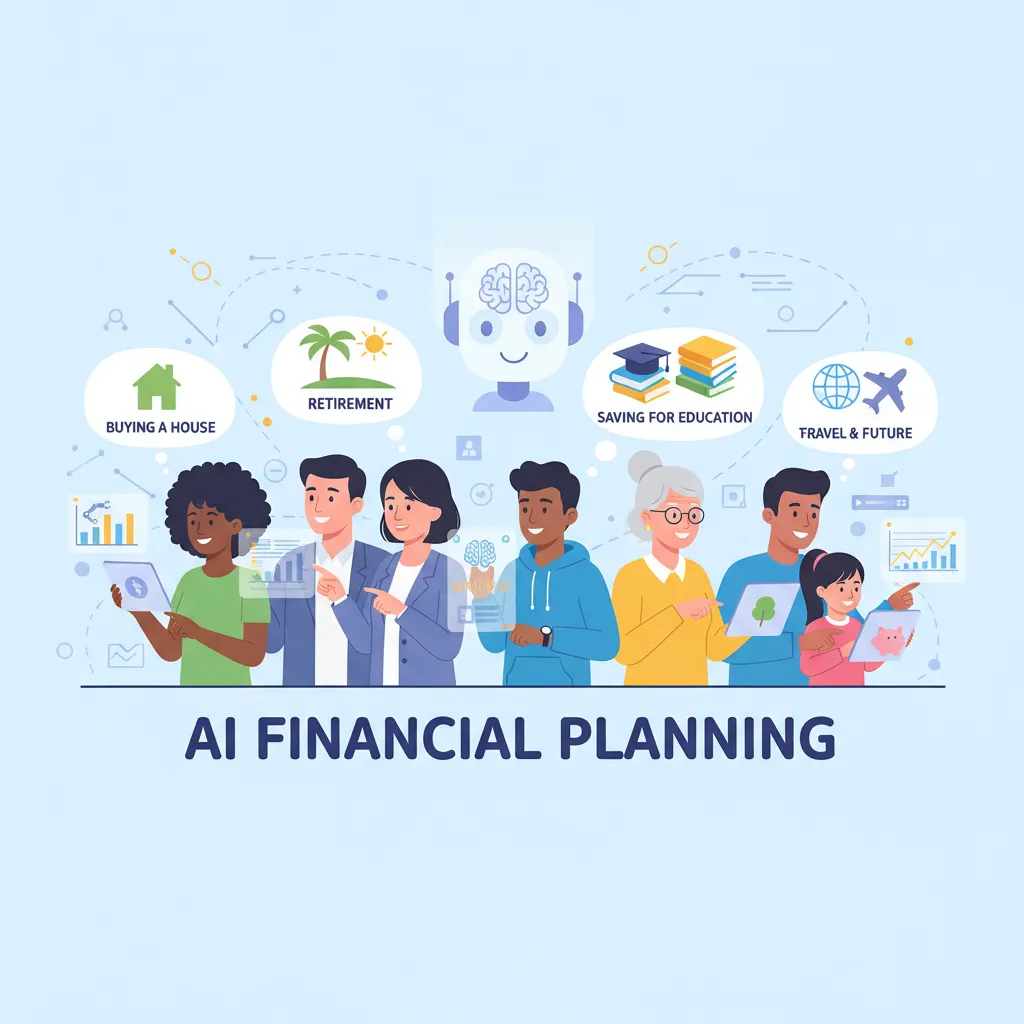
What do you want to achieve with your money? Buy a house? Retire early? Travel the world? AI for financial goals helps you turn those dreams into an actionable plan.
A personalized financial roadmap powered by AI goes beyond simple savings calculators. It:
- Quantifies Your Goals: You can set multiple goals, and the AI will calculate exactly how much you need to save each month to achieve them by your target date.
- Prioritizes Savings: If you have competing goals, the AI can help you allocate funds intelligently based on your priorities and timelines.
- Models Scenarios: Want to see how a salary increase or a large, one-time expense impacts your retirement plan? The AI can run these simulations in seconds.
- Adapts to Life Changes: When life happens—a new job, a baby, a move—you can update your profile, and the AI will instantly recalculate and adjust your entire financial plan.
This is where the concept of customized financial plans AI truly comes to life, creating a living, breathing strategy that evolves with you.
Smart Investing and Wealth Management (AI Wealth Management)
Investing is often seen as the most intimidating part of personal finance. AI wealth management, primarily through platforms known as robo-advisors, has made it accessible to everyone, not just seasoned investors.
Here’s how AI investment guidance works:
- Risk Assessment: The AI will ask you a series of questions to determine your risk tolerance, time horizon, and financial goals.
- Portfolio Construction: Based on your profile, it builds a diversified portfolio of low-cost ETFs (Exchange-Traded Funds).
- Automated Rebalancing: As the market fluctuates, your portfolio can drift from its target allocation. The AI automatically buys and sells assets to bring it back in line, a process that used to require manual intervention.
- Tax-Loss Harvesting: More advanced platforms use AI to sell losing investments to offset gains, potentially lowering your tax bill.
This approach to AI for managing personal wealth takes the guesswork and emotion out of investing, helping you build long-term wealth through a disciplined, automated strategy.
Proactive Debt Management and Reduction (AI Debt Management)
Debt can be a major obstacle to achieving financial independence with AI. AI tools provide a clear and strategic path to becoming debt-free. An AI money coaching app can analyze all your debts (credit cards, student loans, car loans) and:
- Organize Your Debt: It consolidates all your loan information, including interest rates and payment due dates, in one place.
- Recommend a Payoff Strategy: The AI can model different payoff methods, like the “Debt Snowball” (paying off smallest balances first for psychological wins) or “Debt Avalanche” (paying off highest-interest debt first to save the most money), and show you which one is best for your situation.
- Find Savings Opportunities: The platform can identify opportunities to consolidate debt or refinance at a lower interest rate, potentially saving you thousands.
By automating the strategy, AI debt management keeps you motivated and on the fastest track to eliminating your debt for good.
The Human Touch in a Digital World: AI vs. Human Financial Advisors
A common question is whether a Financial advisor AI can truly replace a human. The answer is nuanced. They both offer distinct advantages, and the best choice depends on your needs.
| Feature | AI Financial Advisor (Robo-Advisor) | Human Financial Advisor |
|---|---|---|
| Cost | Low (often a small % of assets, e.g., 0.25%) | High (can be 1%+ of assets, flat fees, or commissions) |
| Accessibility | 24/7 access via app or website, low/no minimums | Business hours, often requires high asset minimums |
| Objectivity | Purely data-driven, no emotional bias | Can provide empathy, but may have personal biases |
| Services | Excellent for investment management, budgeting, goal tracking | Comprehensive services including complex estate planning, tax advice, and behavioral coaching |
| Personalization | Personalized based on data inputs and algorithms | Deeply personal, understands your life context, family dynamics, and fears |
The future of personal finance likely isn’t an “either/or” scenario but a hybrid one. Many people may use best AI finance apps for their day-to-day budgeting and investing, while consulting a human advisor for major life events and complex financial decisions. The AI handles the data, while the human provides the wisdom. [Related: Humane AI Pin: Flop or Future? A Deep Dive Review]
Security and Trust in the Age of AI Finance
Handing over your financial data to an app requires a huge amount of trust. This is, without a doubt, the most critical consideration when choosing an AI financial planning tool. Reputable companies in this space understand this and invest heavily in bank-level security.
Here’s what to look for to ensure your data is safe:
- End-to-End Encryption: Look for 256-bit AES encryption, the same standard used by banks and the military, to protect your data both in transit and at rest.
- Two-Factor Authentication (2FA): This adds a crucial second layer of security to your login process, preventing unauthorized access even if your password is compromised.
- Read-Only Access: Most apps use “read-only” access when connecting to your bank accounts. This means the app can see your transactions and balances but cannot move money without your explicit permission.
- Regulatory Compliance: Ensure the company complies with data privacy regulations relevant to your region, like GDPR or CCPA.
- Clear Privacy Policy: A transparent company will have a privacy policy that clearly states what data they collect and how they use it. They should never sell your personal financial data.

Always do your research and choose established platforms with a proven track record of security and reliability. [Related: Google’s AI Overviews: The Future of Search is Here]
The Future is Now: What’s Next for the Future of Personal Finance?
The integration of AI into our financial lives is still in its early stages. The future of personal finance promises even more seamless and intelligent solutions. We are moving towards a world of “ambient finance,” where expert guidance is woven into the fabric of our daily lives.
Here are some trends to watch:
- Hyper-Personalization: Future AI will move beyond categorizing past expenses to predicting future ones. It might advise you, “Based on your travel history, you’ll likely book a vacation in April. Let’s start a dedicated sinking fund now.” [Related: Unlocking Potential: How AI is Revolutionizing Personalized Learning]
- AI for Financial Literacy: AI tutors will provide personalized education on complex financial topics. Imagine an AI explaining the pros and cons of a ROTH IRA vs. a Traditional IRA using examples from your own financial situation.
- Proactive Financial Nudges: Your AI might send you a notification saying, “The market is down today, which is a great opportunity to invest an extra $50 according to your long-term plan,” helping to counter emotional decision-making.
- Advanced AI Models: The development of more powerful open-source models will lead to even more capable financial tools, able to understand complex queries and provide more nuanced advice. [Related: What is Llama 3? Meta’s New Open Source AI Model Explained]
Conclusion: Your Financial Co-Pilot Awaits
The journey toward financial independence with AI is no longer a distant dream; it’s a present-day reality. AI-powered personalized planning has shattered the old barriers, offering everyone the chance to take command of their financial destiny. From intelligent budgeting and automated investing to strategic debt repayment and long-term goal planning, these tools provide the clarity and confidence needed to navigate the complexities of modern finance.
This technology isn’t about replacing human judgment entirely. It’s about augmenting it. It’s about handling the tedious, number-crunching tasks so you can focus on the big picture: living a life free from financial stress. By embracing these AI financial solutions, you are not just adopting a new app; you are adopting a new mindset of empowerment, control, and proactive wealth-building.
Your financial future is waiting. The tools are here. It’s time to let your AI co-pilot help you reach your destination.

Frequently Asked Questions (FAQs)
Is AI financial planning safe?
Yes, reputable AI financial planning apps use bank-level security measures, including 256-bit encryption and two-factor authentication, to protect your data. They typically use “read-only” access to view your financial information without the ability to move funds, ensuring your money stays secure. Always choose established platforms with transparent privacy policies.
Can AI replace human financial advisors?
AI is a powerful tool for automating tasks like budgeting, investment management, and goal tracking, making it a great option for many people. However, it can’t fully replace the nuanced, empathetic, and complex strategic advice a human advisor can provide for major life events like estate planning or navigating complicated family finances. Many see the future as a hybrid model where AI and human advisors work together.
How much do AI finance apps cost?
The cost varies. Many of the best AI finance apps operate on a “freemium” model, offering basic budgeting and tracking for free with a subscription for premium features like advanced insights, debt planning, and investment management. Subscription costs typically range from $5 to $15 per month, which is significantly less than a traditional financial advisor.
What is the best AI for personal finance?
There isn’t one “best” AI, as the ideal tool depends on your needs. For budgeting and expense tracking, apps like Monarch Money or Copilot are popular. For automated investing and AI wealth management, platforms like Wealthfront and Betterment are leaders. The best approach is to identify your primary financial goal (e.g., budgeting, investing, debt reduction) and choose a specialized app that excels in that area.
How can I start using AI for my finances?
Getting started is simple. Begin by identifying one area of your finances you want to improve, such as tracking your spending. Research a few top-rated AI budgeting tools, download one, and securely connect your bank accounts. Spend a week letting the AI categorize your transactions automatically. This small first step can provide immediate, powerful insights into your financial habits.
Can AI help me get out of debt?
Absolutely. AI debt management tools are incredibly effective. They consolidate all your loan information into one dashboard and use algorithms to calculate the most efficient payoff strategy (like the Snowball or Avalanche method). By automating the plan and tracking your progress, these AI tools provide the clarity and motivation needed to eliminate debt faster.