AI PC Gaming: The Next Frontier for Immersive Play & Performance
Introduction
The term “AI PC” has exploded into the tech lexicon, promising a revolutionary shift in computing. But for gamers, this isn’t just another marketing buzzword. It’s the key to unlocking a new era of interactive entertainment. We’re standing at a thrilling new frontier where artificial intelligence is not just an add-on but the very foundation of next-generation experiences. Forget incremental upgrades; AI PC gaming represents a fundamental leap in visual fidelity, performance, and gameplay intelligence.
So, what does this all mean for your kill-death ratio or your immersion in a sprawling open world? It means higher frame rates without sacrificing graphical quality, game worlds populated by characters that think and react like real people, and challenges that adapt perfectly to your skill level. It’s about making games smarter, faster, and more captivating than ever before.
This comprehensive guide will demystify the world of AI in gaming performance. We’ll explore the hardware that powers it, the groundbreaking software that brings it to life, and how AI enhancing gameplay is creating experiences we once only dreamed of. From AI graphics upscaling to hyper-intelligent NPCs, prepare to discover the true future of PC gaming with AI.
What Exactly is an AI Gaming PC? Beyond the Hype
First, let’s clear up a common misconception. An “AI PC” isn’t a strictly defined category with a specific sticker on the box. Instead, it refers to a personal computer equipped with hardware specifically designed to accelerate AI and machine learning tasks. In the context of gaming, this has traditionally meant the GPU, but the landscape is rapidly evolving.
The GPU: The Current Heart of AI Gaming
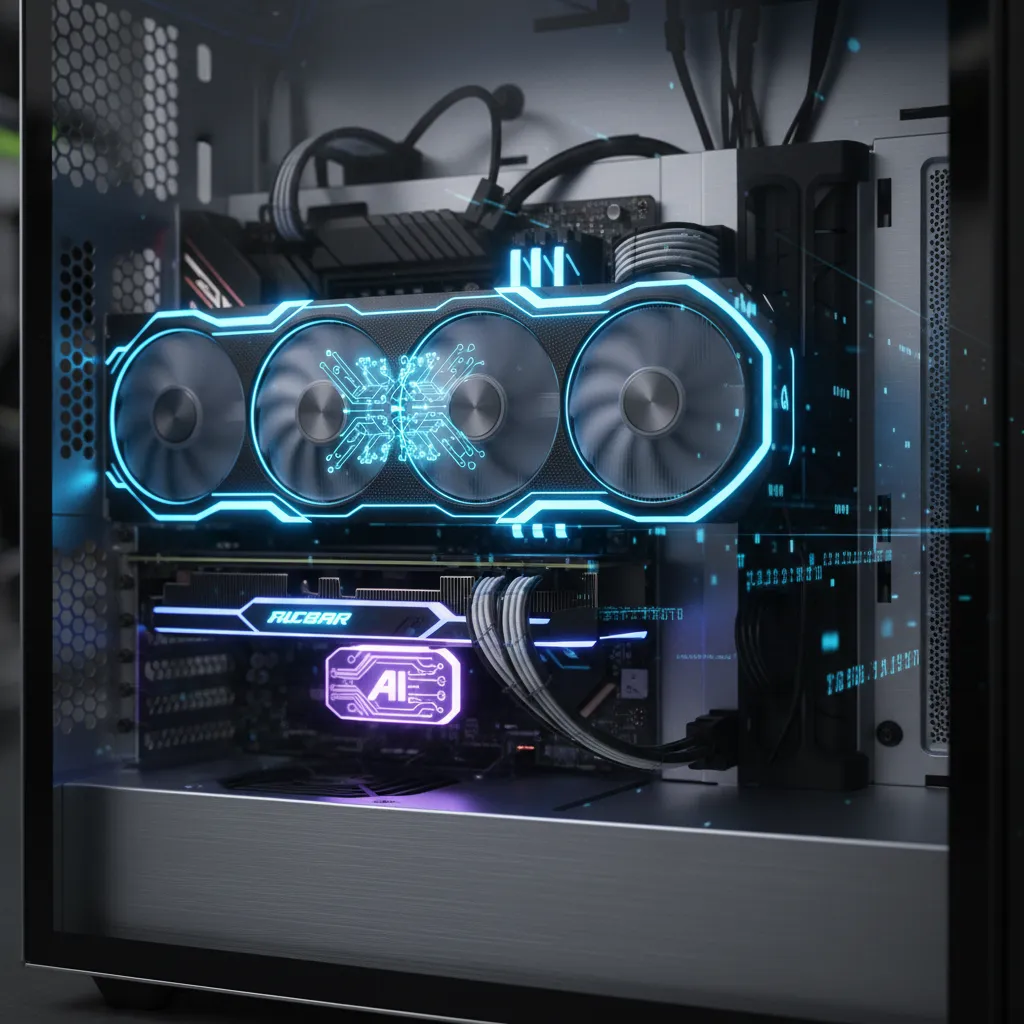
For years, the Graphics Processing Unit (GPU) has been the unsung hero of AI. Its parallel processing architecture, designed to handle millions of calculations for rendering graphics, is also perfectly suited for the workloads required by neural networks gaming and deep learning models.
- NVIDIA’s Tensor Cores: Found in their RTX series GPUs, these are specialized cores explicitly built to accelerate the matrix operations at the heart of AI algorithms. They are the powerhouse behind features like DLSS.
- AMD’s AI Accelerators: Integrated into their RDNA graphics architecture, these components are designed to speed up machine learning operations, driving features like FidelityFX and Hyper-RX.
- Intel’s Xe Matrix Extensions (XMX): A key part of their Arc GPUs, these engines are built to handle the intense AI calculations needed for their XeSS upscaling technology.
For now, and for the foreseeable future, your GPU is the single most critical piece of AI PC hardware for gaming. It does all the heavy lifting for the features that directly impact your in-game experience.
The Rise of the NPU (Neural Processing Unit)
The newest player on the field is the NPU, or Neural Processing Unit. You’ll find these integrated into the latest CPUs like Intel’s Core Ultra and AMD’s Ryzen AI processors. An NPU is a highly efficient, low-power processor designed to handle sustained AI tasks without draining your battery or stealing resources from the CPU and GPU.
Currently, the NPU’s role in gaming is minimal. It’s primarily used for background OS-level features like Windows Studio Effects (blurring your background on a video call) or optimizing system performance. However, its potential is enormous. Game developers could eventually offload tasks like NPC logic, physics simulations, or real-time audio processing to the NPU, freeing up the GPU to focus purely on generating breathtaking graphics. Think of it as a future-proofing investment for the next wave of AI gaming innovation. Related: AI PCs Unveiled: Boost Productivity & Creativity with Next-Gen Hardware
The Performance Revolution: AI Graphics Upscaling & Frame Generation
The most immediate and jaw-dropping benefit of AI in gaming is the massive gaming performance boost AI provides. Gamers have always faced a trade-off: turn up the resolution and graphical settings for stunning visuals, or turn them down to get a smooth, high frame rate. AI has shattered this compromise.
AI Graphics Upscaling: More Pixels, Less Power
AI graphics upscaling is a masterpiece of computational efficiency. The core idea is simple but brilliant:
- Your GPU renders the game at a lower internal resolution (e.g., 1080p).
- An AI model, trained on thousands of hours of high-resolution game imagery, intelligently analyzes the lower-resolution frame.
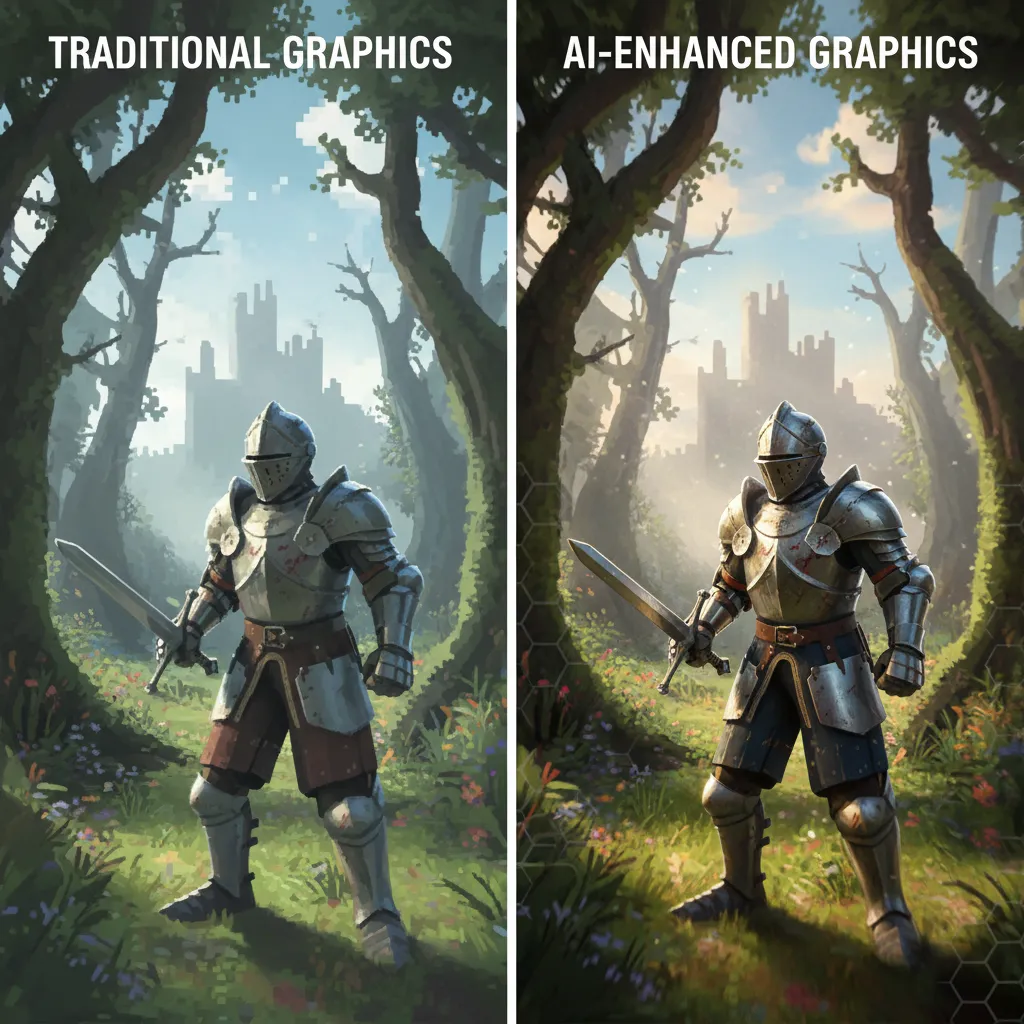
- The AI reconstructs the image to a higher target resolution (e.g., 4K), filling in the missing details with incredible accuracy, often looking as good as or even better than a native 4K image.
This process dramatically reduces the load on your GPU, resulting in a huge FPS increase. The three main players in this space are:
- NVIDIA DLSS (Deep Learning Super Sampling): The pioneer and arguably the gold standard. It leverages the dedicated Tensor Cores in RTX GPUs and a powerful deep learning in games model to deliver exceptional image quality and performance.
- AMD FSR (FidelityFX Super Resolution): An open-source solution that works across a wide range of GPUs, including older models and even NVIDIA and Intel cards. While its earlier versions were slightly softer than DLSS, the latest iterations have become incredibly competitive.
- Intel XeSS (Xe Super Sampling): Intel’s contender uses AI on its own Arc GPUs and a more generalized algorithm on other hardware. It’s a powerful tool that has made Intel a serious competitor in the GPU market.
AI Frame Generation: Creating FPS Out of Thin Air
If upscaling was the first revolution, AI frame generation is the second. This technology takes performance to an entirely new level. It works by analyzing two sequential, fully rendered frames and then generating a new, intermediate frame to insert between them.
NVIDIA’s DLSS 3 Frame Generation and AMD’s FSR 3 Fluid Motion Frames can effectively double your frame rate in supported titles. The result is an incredibly smooth visual experience, especially in graphically intense single-player games. While it can add a minuscule amount of input latency, for most players, the massive boost in fluidity is a game-changer. This is real-time AI gaming at its most impressive.
The Future of Realism: AI and Ray Tracing
Ray tracing AI gaming is where visuals become truly cinematic. Ray tracing simulates the actual physical behavior of light, creating ultra-realistic reflections, shadows, and global illumination. The problem? It’s computationally massive.
AI solves this with a process called “denoising.” Early ray-traced images are often noisy or speckled. AI algorithms, like NVIDIA’s Ray Reconstruction, clean up this noise in real-time, producing a pristine, stable image while using far less computational power. This partnership between ray tracing and AI is what makes photorealistic real-time graphics possible today.
More Than Just Pixels: AI Enhancing Gameplay and Immersion
While a high FPS count is great, the true holy grail of next-gen gaming AI is creating more believable and dynamic worlds. This is where AI moves from a performance-booster to a core gameplay mechanic, fundamentally changing how we interact with games.
The Dawn of Intelligent NPCs: Beyond Scripted Paths
For decades, Non-Player Characters (NPCs) in games have been little more than sophisticated puppets. They follow predefined paths, repeat the same few lines of dialogue, and react to players in predictable ways. AI driven NPCs are set to change that forever.
Imagine walking into a tavern in a fantasy RPG and having a genuine, unscripted conversation with the blacksmith about the local dragon problem. Technologies like NVIDIA’s ACE (Avatar Cloud Engine) use Large Language Models (LLMs) to allow players to speak into their microphone and have NPCs respond dynamically and intelligently. This immersive AI gaming technology means quests can emerge organically from conversation, and characters will remember your previous interactions, creating a truly personal narrative.
Adaptive AI Game Difficulty: A Truly Personalized Challenge
We’ve all been there: a game is either so easy it’s boring or so punishingly difficult it’s frustrating. Adaptive AI game difficulty offers a solution.
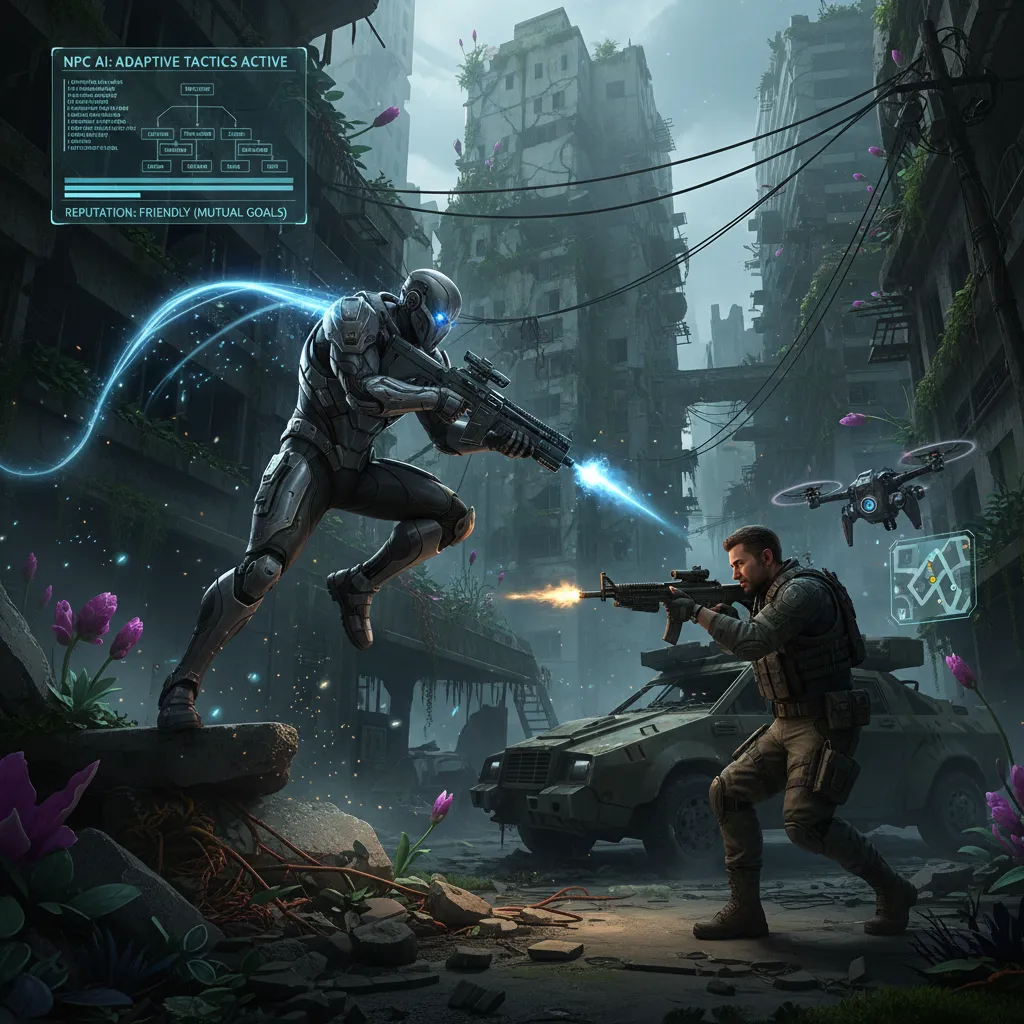
Instead of a static “Easy/Medium/Hard” setting, the game’s AI can analyze your performance in real-time. Are you landing every headshot? The AI might introduce more elite enemy types or make them use smarter flanking tactics. Are you struggling with a specific puzzle? The game could offer subtle environmental clues. This creates a personalized AI gaming experience that maintains a perfect state of “flow,” keeping you challenged but never overwhelmed.
Procedural Content Generation (PCG) on Steroids
Procedural generation—using algorithms to create game content—has been around for a while. But AI elevates it to a whole new level. AI-powered game development tools can now generate vast, detailed, and coherent game worlds. Instead of just randomizing assets, AI can understand context, creating realistic ecosystems, believable city layouts, and compelling questlines on the fly, ensuring that no two playthroughs are ever the same.
The Broader AI Ecosystem in Gaming
The influence of AI extends far beyond what you see on your screen. It’s a powerful force working behind the scenes in development, security, and competitive play.
Fair Play and Competition: AI Anti-Cheat and Esports
Cheating can ruin an online gaming experience. Traditional anti-cheat software often relies on blacklists and known exploits. AI anti-cheat technology is far more sophisticated. It uses machine learning to analyze player behavior and identify patterns that are impossible for humans to spot, catching cheaters with greater accuracy and speed.
In the world of professional gaming, AI in esports is a critical coaching tool. AI systems analyze thousands of hours of pro matches to identify optimal strategies, highlight player weaknesses, and run simulations for different scenarios. This is AI for competitive gaming at its peak.
Revolutionizing Game Creation: AI Game Development Tools
AI-powered game engines are accelerating development cycles and empowering smaller studios. AI tools can assist with:
- Asset Creation: Generating textures, 3D models, and animations.
- Level Design: Prototyping and populating entire game levels.
- Bug Testing: Using AI agents to play through a game and identify glitches far faster than human testers.
This AI optimization for games on the development side means we get more complex and polished games, faster than ever before.
The Future is Now: AI in Virtual Reality (VR) Gaming
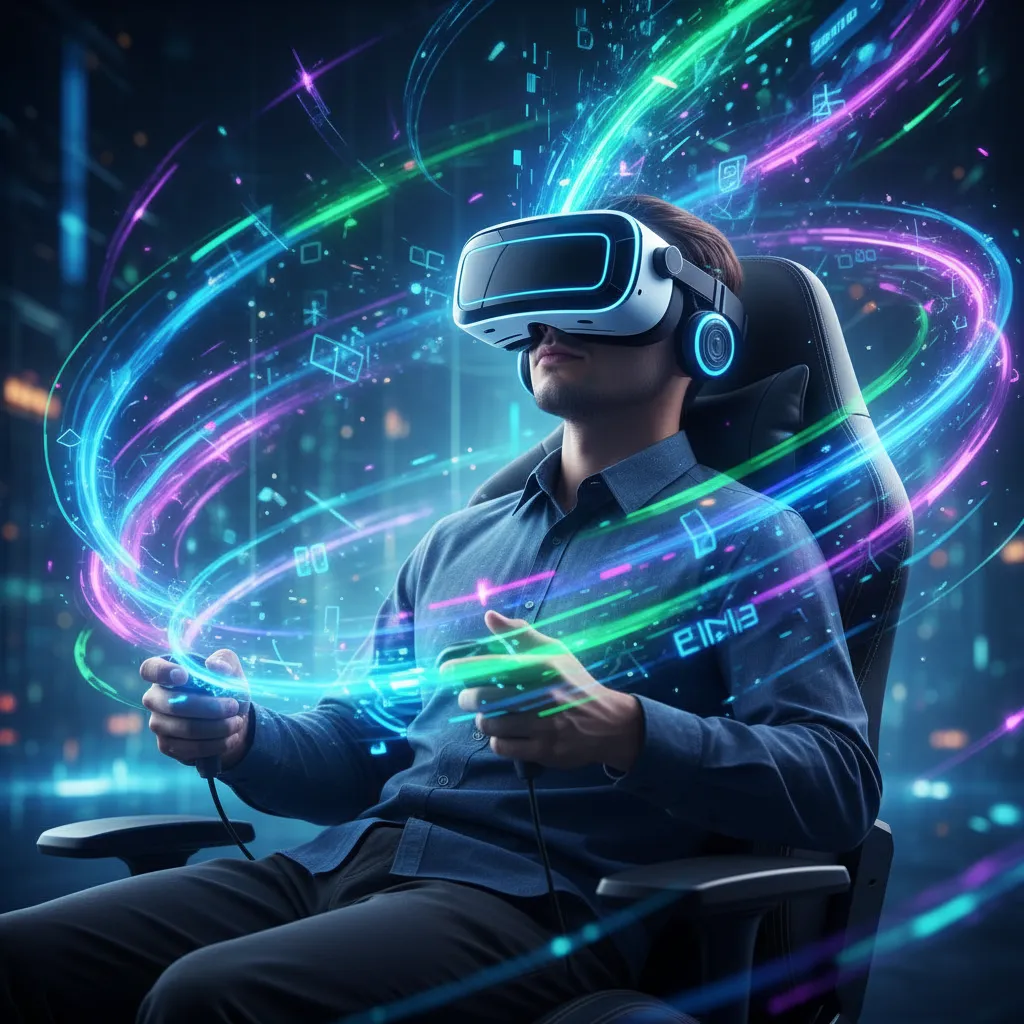
AI in virtual reality gaming is essential for creating true immersion. The processing demands of VR are immense, and AI is critical for optimization. Techniques like foveated rendering use AI-powered eye-tracking to render only the part of the scene you’re looking at in full detail, saving massive amounts of performance. AI also drives more realistic physics simulations and powers the intelligent virtual characters that make VR worlds feel truly alive. Related: The Psychological Impact of Hyper-Realistic AI Content
What to Look For in an AI Gaming PC or Laptop
Ready to jump into the future? Here’s what to prioritize when buying or building your next rig:
- GPU: This is non-negotiable. Look for the latest generation from NVIDIA (RTX 40-series or newer) or AMD (Radeon 7000-series or newer) to get access to the best upscaling, frame generation, and ray tracing hardware. Pay close attention to AI gaming benchmarks for the titles you play most.
- CPU/NPU: While the GPU is paramount today, choosing a modern CPU with an integrated NPU (like Intel Core Ultra or AMD Ryzen 8000 series) is a smart move for future-proofing your system as more applications begin to leverage it.
- Gaming Laptops with AI: The good news is that you don’t need a massive desktop tower. Modern gaming laptops with AI pack incredible power, featuring mobile versions of the latest GPUs and CPUs, allowing for high-performance AI gaming on the go.
- RAM and Storage: 16GB of RAM is the minimum for modern gaming, but 32GB is becoming the sweet spot. A fast NVMe SSD is crucial for reducing load times, which is especially important in the vast, detailed worlds AI helps create.
Conclusion
Artificial intelligence is no longer a distant concept in the world of PC gaming; it is a present and powerful reality. It has fundamentally reshaped our expectations for performance, visual fidelity, and interactive depth. From the crisp, high-framerate visuals delivered by AI-powered game graphics to the promise of truly intelligent characters and adaptive worlds, AI gaming PCs are at the heart of this revolution.
We’ve moved beyond simply rendering pixels to creating experiences. The synergy between dedicated AI PC hardware for gaming and sophisticated AI software for gaming is pushing the boundaries of what’s possible, delivering a smarter, faster, and more profoundly immersive AI gaming experience. The next frontier isn’t coming—it’s already here.
What AI-driven gaming feature are you most excited to see evolve? Join the conversation below and explore our other articles on the cutting edge of technology. Related: Explore our latest articles on AI innovation
Frequently Asked Questions (FAQs)
Q1. What does AI do in PC gaming?
AI performs several critical functions in modern PC gaming. Its most visible roles are boosting performance through AI graphics upscaling (like NVIDIA DLSS, AMD FSR) and AI frame generation, which dramatically increases FPS. It also enhances realism in ray tracing AI gaming by denoising complex lighting. Beyond graphics, AI is creating more intelligent AI driven NPCs, enabling adaptive AI game difficulty, and even helping to detect cheaters with AI anti-cheat technology.
Q2. Is an AI PC worth it for gaming?
Absolutely. If you play modern AAA titles and want the best possible performance and visual quality, a PC with a modern AI-capable GPU is essential. The performance gains from features like DLSS and FSR are not just marginal; they can be the difference between a choppy, unplayable experience at high settings and a flawlessly smooth one. It is the single most impactful technology for PC gaming performance today.
Q3. Do you need an NPU for AI gaming?
Currently, no. The vast majority of in-game AI tasks are handled by the specialized AI cores on your GPU (like NVIDIA’s Tensor Cores). An NPU (Neural Processing Unit) in a modern CPU is primarily used for low-power, background AI tasks at the operating system level. While it may play a larger role in gaming in the future, for now, the GPU remains the king of AI PC hardware for gaming.
Q4. What is the difference between DLSS and FSR?
The main difference lies in their hardware requirements and underlying technology. DLSS (Deep Learning Super Sampling) is an NVIDIA-exclusive technology that requires an RTX GPU and uses its dedicated Tensor Cores for AI processing. FSR (FidelityFX Super Resolution) is an open-source technology from AMD that can run on a much wider variety of GPUs, including those from NVIDIA and Intel, as it doesn’t require dedicated AI hardware. Both are excellent AI graphics upscaling tools.
Q5. How do AI NPCs change games?
AI NPCs are transforming games by moving beyond pre-written scripts and predictable behaviors. Using advanced AI and large language models, these characters can engage in dynamic, unscripted conversations with the player, remember past interactions, and exhibit more complex and believable behaviors. This makes game worlds feel less like a movie set and more like a living, breathing simulation, leading to a much more immersive AI gaming experience.
Q6. Can AI improve performance on older gaming PCs?
Yes, to an extent. While the most advanced AI features like DLSS require newer NVIDIA GPUs, AMD’s FSR and Intel’s XeSS are open-source or more widely compatible. FSR, in particular, can run on a vast range of older graphics cards, providing a significant gaming performance boost AI even on hardware that is several years old. It’s an excellent way to extend the life of an aging gaming rig.