AI’s Medical Marvel: Revolutionizing Early Disease Detection & Personalized Treatment

Introduction
For centuries, medicine has largely operated on a reactive basis. We wait for symptoms to appear, run tests, and then treat the disease we find. But what if we could see the storm clouds of illness gathering long before the first drop of rain falls? What if your treatment plan was crafted not for the “average” patient, but for your unique genetic makeup, lifestyle, and environment? This isn’t science fiction; it’s the new reality being forged by one of the most powerful tools of our time: Artificial Intelligence.
The integration of AI in healthcare is more than just an incremental upgrade. It represents a fundamental paradigm shift, moving us from a one-size-fits-all model to an era of precision medicine and proactive prevention. AI’s ability to analyze vast, complex datasets at superhuman speeds is unlocking unprecedented insights into the very nature of disease, enabling early disease diagnosis AI with astonishing accuracy and paving the way for hyper-personalized treatment plans.
In this deep dive, we’ll explore the groundbreaking medical AI applications that are revolutionizing diagnostics, from spotting cancerous cells invisible to the human eye to predicting chronic illness years in advance. We will unpack how AI genomics personalized treatment is making medicine more effective and less toxic, and examine the future of healthcare AI that promises a healthier tomorrow for everyone. Get ready to witness the dawn of a new medical age.
The Engine Room: How AI Learns to See the Invisible
Before we explore the incredible applications, it’s crucial to understand the “how.” The magic behind AI disease detection isn’t magic at all; it’s the product of sophisticated algorithms, primarily driven by two key concepts: Machine Learning and Deep Learning.
-
Machine Learning (ML): Think of this as teaching a computer by example. Scientists feed ML algorithms massive amounts of labeled data—for instance, thousands of medical scans labeled “cancerous” or “benign.” The algorithm learns to identify the subtle patterns and features associated with each label. Over time, it can analyze a new, unlabeled scan and make a highly accurate prediction. This is the core of machine learning disease detection.
-
Deep Learning: This is a more advanced subset of ML that uses “neural networks” with many layers, inspired by the structure of the human brain. These deep networks can learn from data that is unstructured or unlabeled, discovering incredibly complex and nuanced patterns on their own. In medical diagnosis, a deep learning model might analyze a chest X-ray and not only identify a potential tumor but also note its specific texture, shape, and location to predict its malignancy, a feat that requires immense expertise. This is the power behind deep learning medical diagnosis.
These AI models are the tireless, digital assistants that are empowering doctors to detect, diagnose, and treat diseases with a level of precision we’ve never seen before.
The New Frontline: AI in Early Disease Detection
The old adage “an ounce of prevention is worth a pound of cure” has never been more relevant. Early detection dramatically improves patient outcomes, and this is where AI is making its most significant impact. By identifying diseases at their nascent stages, often before symptoms even manifest, AI is turning the tide against some of our most formidable health challenges.
Revolutionizing Radiology: Beyond the Human Eye
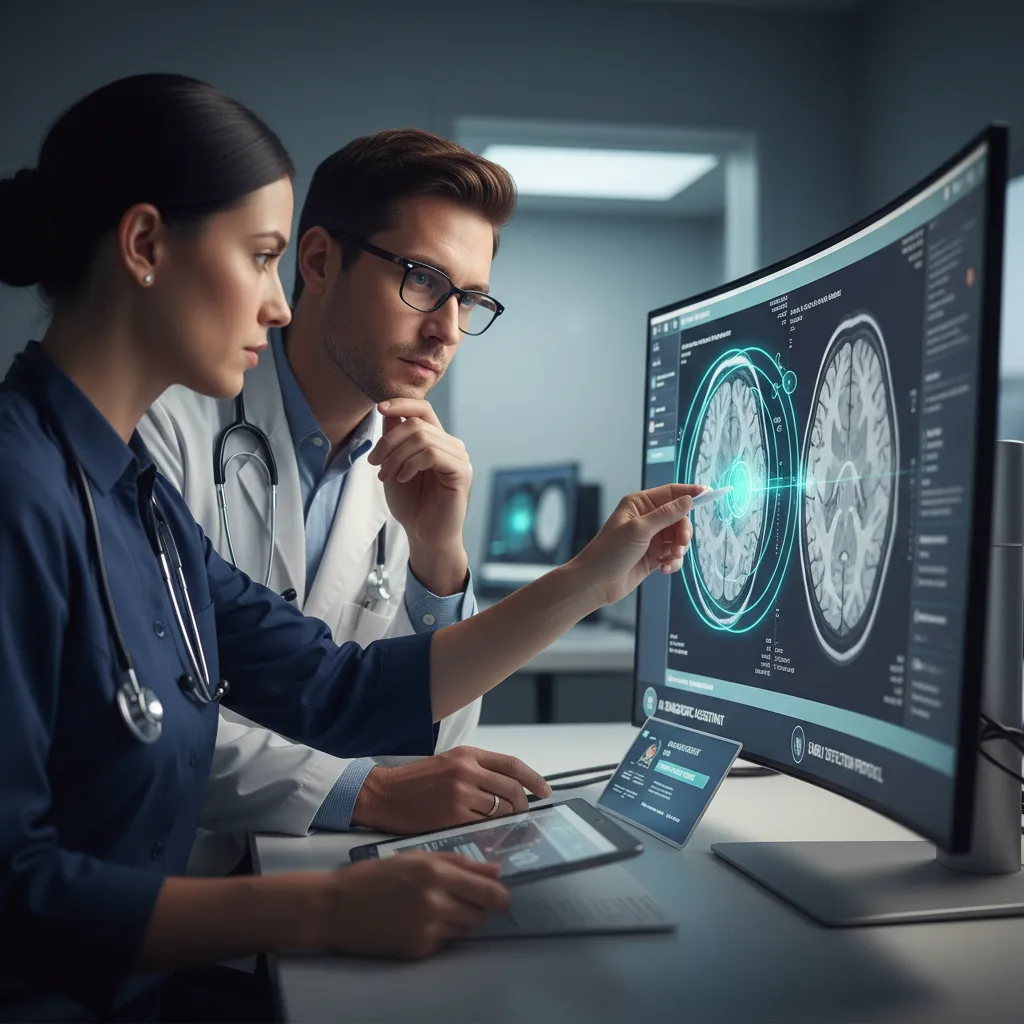
Radiology is arguably the field most profoundly transformed by AI. A radiologist’s job involves meticulously scanning through hundreds of images daily, searching for tiny anomalies. It’s a high-pressure task where fatigue and human error can have serious consequences. AI in radiology acts as a second, or even first, set of infallible eyes.
AI diagnostic tools can scan an MRI, CT scan, or X-ray in seconds, flagging suspicious areas for the radiologist to review. Studies have shown that AI models can detect breast cancer from mammograms with accuracy matching or even exceeding that of human experts. For lung cancer, AI can identify minuscule nodules on CT scans that might be missed, leading to AI for early cancer detection when the disease is most treatable. This isn’t about replacing radiologists; it’s about augmenting their abilities, allowing them to focus their expertise on the most complex cases and reducing diagnostic errors. Related: AI in Creative Jobs: Threat or Tool for the Future?
Digital Pathology: AI as the Ultimate Microscope
Similar to radiology, pathology involves the visual identification of disease at a cellular level. Pathologists spend hours peering through microscopes, analyzing tissue samples to diagnose cancer and other diseases. AI in pathology digitizes this process. High-resolution scanners create digital versions of tissue slides, which AI algorithms can then analyze with incredible speed and precision.
These AI systems can count cells, identify specific cancer cell types, and grade tumors based on their aggressiveness—tasks that are laborious and sometimes subjective for humans. By automating the routine aspects of slide analysis, AI frees up pathologists to focus on strategic diagnosis and treatment planning, truly revolutionizing medical diagnosis with AI.
Predictive Analytics: Seeing Sickness Before It Starts
Perhaps the most futuristic application is predictive analytics in healthcare. Instead of just finding existing diseases, AI is learning to predict them. By analyzing a patient’s electronic health record (EHR), genetic information, lifestyle data, and even data from wearables, AI models can calculate an individual’s risk for developing chronic conditions like diabetes, heart disease, or kidney failure.
For example, a hospital’s AI system can monitor a patient’s vital signs in real-time and predict the onset of sepsis—a life-threatening condition—hours before a doctor might notice the signs. This allows for early intervention that can save lives. This proactive approach, driven by AI-driven prevention, is a cornerstone of smart healthcare solutions and represents a shift from sick care to true healthcare.
From One-Size-Fits-All to Perfectly Tailored: AI-Powered Personalized Treatment
Detecting a disease early is only half the battle. The next step is treating it effectively. For decades, treatment protocols were based on large clinical trials, designed for the “average” patient. But in reality, no two patients are the same. A drug that works wonders for one person may be ineffective or cause severe side effects in another. Personalized medicine AI is changing this by tailoring treatments to the individual.
AI and the Genomic Revolution
Our genome holds the blueprint to our bodies, and within it lie clues to how we will respond to different diseases and treatments. However, analyzing the 3 billion base pairs of the human genome is a task of monumental complexity. This is where AI genomics personalized treatment shines.
AI algorithms can sift through a patient’s genomic data and cross-reference it with vast databases of medical research to identify specific genetic mutations driving a disease, like cancer. With this information, oncologists can select a targeted therapy designed to attack that specific mutation, a core principle of precision medicine AI. This approach is often far more effective and has fewer side effects than traditional chemotherapy. The future of medicine is not just about knowing what disease you have, but understanding why you have it at a molecular level.

Crafting AI-Powered Treatment Plans
Beyond genomics, AI can help devise the optimal treatment strategy by analyzing data from millions of similar patients. An AI system can evaluate a patient’s unique profile—their age, comorbidities, genetic markers, and lifestyle—and then simulate the potential outcomes of various treatment options.
It can recommend the most effective drug combination, calculate the optimal radiation dosage to maximize tumor destruction while minimizing damage to healthy tissue, or predict a patient’s response to a new immunotherapy drug. These AI-powered treatment plans provide doctors with data-driven recommendations, helping them make more informed decisions and improving the standard of patient care.
AI for Chronic Disease Management
Managing a chronic illness is a daily, lifelong challenge. AI for chronic disease management is making this easier through smart healthcare solutions like connected devices and intelligent apps. Wearable sensors, like smartwatches and continuous glucose monitors, collect a constant stream of health data.
An AI-powered app can analyze this data to provide real-time feedback and personalized coaching. For a person with diabetes, it might suggest a walk after a meal to stabilize blood sugar. For someone with hypertension, it could alert them if their blood pressure readings are trending dangerously high. These digital health AI tools empower patients to take an active role in managing their health, preventing complications, and improving their quality of life. This integration of intelligent devices into our daily health routines echoes the broader trend of smart technology in our lives. Related: Sustainable Smart Home: Energy-Saving Gadgets for a Greener Life

The Bigger Picture: Trends, Benefits, and Hurdles
The wave of AI healthcare innovation is powerful, but it’s not without its challenges. Understanding both the potential and the pitfalls is key to navigating this new landscape responsibly.
Key Benefits of AI in Medicine
The advantages of integrating AI into the medical field are profound and multifaceted:
- Enhanced Accuracy: AI algorithms can detect patterns imperceptible to the human eye, leading to more accurate and earlier diagnoses.
- Speed and Efficiency: AI automates repetitive tasks, analyzing medical data in seconds that would take humans hours, freeing up clinicians’ time for patient care.
- Reduced Human Error: By providing a data-driven second opinion, AI can help mitigate diagnostic errors caused by fatigue or oversight.
- Proactive Prevention: Predictive models shift the focus from reactive treatment to proactive health management, preventing diseases before they become critical.
- Democratization of Expertise: AI can encapsulate the knowledge of top specialists, making high-level diagnostic expertise accessible in remote or underserved areas.
The Challenges and Ethical Minefield
Despite the immense promise, the road to full AI integration is paved with significant hurdles:
- Data Privacy and Security: Medical data is incredibly sensitive. Ensuring its secure collection, storage, and use is paramount.
- Algorithmic Bias: If an AI model is trained on data from a specific demographic, it may be less accurate for other populations, potentially exacerbating health disparities.
- The “Black Box” Problem: Many deep learning models are so complex that even their creators don’t fully understand their reasoning. This lack of transparency can be problematic in a field where understanding the “why” is critical. Related: The XAI Revolution: Demystifying AI Decisions for Trust & Transparency
- Regulatory Approval: Healthcare is a highly regulated industry. New AI health technology must undergo rigorous testing and validation to ensure it is safe and effective before it can be deployed.
- Integration and Cost: Implementing sophisticated AI systems requires significant investment in infrastructure and training, which can be a barrier for many healthcare institutions.
The Future is Now: What’s Next for Medical AI?
We are only at the beginning of this revolution. The future of healthcare AI promises even more astonishing breakthroughs. Researchers are already working on AI-powered drug discovery, which can analyze molecular structures to design new, more effective medications in a fraction of the time it takes traditionally. In surgery, AI-guided robots are enabling procedures with greater precision and less invasive techniques.
We are moving towards the concept of a “digital twin”—a virtual, dynamic model of a patient created from all their health data. Doctors could test treatments on this digital twin to see how the patient’s body would react before ever administering a real drug. This is the ultimate form of personalized health diagnostics and treatment. The intelligence powering these systems is evolving rapidly, with models becoming more capable and accessible. Related: What is GPT-4o? OpenAI’s New Free AI Model Explained
Conclusion
Artificial intelligence is not a distant, futuristic concept in healthcare; it is a present and powerful reality. From the microscopic analysis of a single cell to the macro-level prediction of population-wide health trends, AI is fundamentally rewiring the practice of medicine. It is transforming diagnostics into a proactive science and treatment into a deeply personal art.
While the challenges of ethics, bias, and implementation are real and require careful navigation, the trajectory is clear. The synergy between human medical expertise and artificial intelligence is creating a smarter, faster, and more effective healthcare system. AI is not here to replace our doctors but to empower them with insights and tools they’ve never had before. This medical marvel is giving us the incredible gift of foresight, paving the way for a future where disease is not just treated, but often, outsmarted.
FAQs
Q1. How is AI used for disease detection?
AI is used for disease detection by training algorithms on massive datasets of medical information, such as images (X-rays, MRIs) and patient records. These algorithms learn to identify subtle patterns associated with specific diseases, allowing them to flag potential issues in new data with high accuracy, often earlier than humanly possible.
Q2. What are the benefits of using AI in healthcare?
The primary benefits include significantly increased diagnostic accuracy, the ability to detect diseases at their earliest stages, and the creation of highly personalized treatment plans. AI also improves efficiency by automating repetitive tasks, reduces the risk of human error, and can help make specialized medical expertise more accessible globally.
Q3. What is personalized medicine AI?
Personalized medicine AI involves using artificial intelligence to tailor medical treatment to the individual characteristics of each patient. It analyzes a person’s unique genetic code, lifestyle, and environment to predict which treatment and prevention strategies will be most effective for them, moving away from a one-size-fits-all approach.
Q4. What are the main challenges of implementing AI in healthcare?
The main challenges include ensuring the privacy and security of sensitive patient data, addressing potential algorithmic bias that could worsen health disparities, navigating complex regulatory approvals, and overcoming the high costs of implementation and integration into existing hospital workflows. The “black box” nature of some AI models also presents a challenge for clinical trust.
Q5. Can AI replace doctors?
No, the consensus is that AI will not replace doctors. Instead, it will function as a powerful assistive tool that augments their capabilities. AI can handle data analysis and pattern recognition at a scale humans cannot, freeing up doctors to focus on complex decision-making, patient communication, and the human aspects of care that require empathy and intuition.
Q6. How does AI help in cancer treatment?
AI contributes to cancer treatment in several ways. It enhances early detection by identifying tumors in medical scans more accurately. In pathology, it helps grade tumors. Most importantly, AI analyzes a tumor’s genomic data to recommend targeted therapies (precision medicine) and can predict how a patient will respond to different treatments, leading to more effective, personalized care plans.