AI for Everyone: How Inclusive Design is Revolutionizing Accessibility

Introduction
For decades, the promise of technology has been to connect us, simplify our lives, and unlock human potential. Yet, for over a billion people worldwide living with some form of disability, the digital world has often felt more like a labyrinth of barriers than a gateway to opportunity. Websites with unreadable text, videos without captions, and software incompatible with assistive devices have created a persistent digital divide.
But what if we could build technology that adapts to us, instead of forcing us to adapt to it?
This is the paradigm-shifting promise of Artificial Intelligence when guided by the principles of inclusive design. We are standing at the cusp of a new era where AI accessibility is not an afterthought but the core of innovation. This isn’t just about adding features; it’s about fundamentally rethinking how we create and interact with technology. From AI-powered screen readers that can describe a photo to a blind user, to AI real-time captioning that translates spoken word instantly, we are witnessing a revolution.
In this deep dive, we’ll explore how the fusion of inclusive AI design and cutting-edge machine learning is creating powerful AI assistive tools. We will uncover how these smart accessibility solutions are empowering individuals with visual, hearing, motor, and cognitive disabilities, fostering greater independence and richer participation in society. We’ll also navigate the crucial landscape of ethical AI accessibility, ensuring this powerful technology serves all of humanity, truly making it AI for everyone.
The New Frontier: Merging AI with Human-Centered Design
For too long, “accessibility” in tech meant retrofitting. It was a checklist item, a patch applied late in the development cycle to comply with regulations. The result was often clunky, limited, and stigmatizing. Inclusive design flips this model on its head.
What is Inclusive AI Design? More Than Just a Feature
Inclusive AI design, also known as universal design AI, is a philosophy rooted in AI human-centered design. It mandates that technology should be conceived, designed, and built to be usable by the widest possible range of people from the very beginning. It’s not about designing one thing for the “average” user and then creating a separate, stripped-down version for others. It’s about creating flexible, adaptable systems that cater to diverse user needs from the outset.
When you apply AI to this philosophy, the possibilities explode. AI excels at personalization and pattern recognition. It can learn an individual’s unique needs and preferences, creating interfaces and experiences that are truly bespoke.
Think of it like this:
- Traditional Accessibility: Building a ramp next to a staircase. It works, but it’s a separate solution.
- Inclusive Design: Designing a building with a gentle, wide, sloping entrance that everyone—a wheelchair user, a parent with a stroller, a delivery person with a dolly—can use effortlessly.
- Inclusive AI Design: That same sloping entrance, but with smart lighting that adjusts to an individual’s visual sensitivity, and an AI guide that provides audio directions tailored to their destination and pace.
This approach ensures that AI empowering disabled individuals is not just a side effect but the intended outcome of thoughtful innovation.
Why Now? The Perfect Storm for an Accessibility Revolution
The recent explosion in AI innovation accessibility isn’t a coincidence. It’s the result of a perfect storm of technological advancements:
- Massive Datasets: AI models are trained on vast amounts of data. The growth of the internet has provided the necessary text, images, and audio to train highly sophisticated models for tasks like real-time captioning and image recognition.
- Powerful Computing: The rise of powerful GPUs and specialized hardware like [Related: AI PCs Unveiled: Boost Productivity & Creativity with Next-Gen Hardware] means that complex AI models can now run on personal devices, providing instant, offline assistance.
- Advanced AI Models: Breakthroughs like large language models (LLMs) and multimodal AI, such as [Related: What is GPT-4o? OpenAI’s New FREE AI Model Explained], can understand and process information from text, images, and audio simultaneously. This is the engine driving the next generation of assistive tech.
This convergence means we can now build the next-gen accessibility AI tools that were once the stuff of science fiction.
Breaking Down Barriers: AI in Action Across Different Needs
The true power of assistive technology AI is revealed in its practical applications. Let’s explore how it’s making a tangible difference for people with diverse abilities.
For Cognitive and Learning Disabilities
Cognitive disabilities, which can affect memory, attention, problem-solving, and learning, present a unique set of challenges in a world saturated with complex information. AI is emerging as a powerful ally in creating calmer, more focused digital experiences.

AI adaptive learning tools are at the forefront of this change. Instead of a one-size-fits-all curriculum, AI can analyze a student’s learning patterns, identify areas of difficulty, and present information in the most effective format for them—be it visual, auditory, or interactive.
Key innovations include:
- Text Simplification & Summarization: AI tools can instantly summarize long articles or simplify complex language, making information more digestible for individuals with dyslexia or attention deficits.
- Focus and Organization Aids: AI-powered apps can help manage schedules, break down large tasks into smaller steps, and provide timely reminders, reducing cognitive load and anxiety.
- Personalized Interfaces: Imagine a website that automatically adjusts its layout, font size, and color contrast to match your specific needs, or an app that hides distracting elements. This is the future of AI and inclusive interfaces.
These tools promote AI for independent living by empowering users to navigate complex information and manage daily tasks with greater confidence. [Related: AI for Mental Wellness: Your Personalized Path to a Calmer Mind] further explores how AI can tailor experiences to our cognitive and emotional states.
For Visual Impairments
For centuries, the world for people with visual impairments has been primarily navigated through touch and sound. AI is adding a revolutionary new layer: digital sight.

The traditional screen reader was a game-changer, but AI-powered screen readers are a quantum leap forward. They don’t just read the text on a screen; they can now:
- Describe Images: Using advanced computer vision, AI can generate detailed alt text for images on the fly, describing scenes, objects, and even emotions on people’s faces.
- Read Text in the Wild: Apps on a smartphone can use the camera to read menus, street signs, and product labels in real-time.
- Navigate Environments: AI-powered canes and wearable devices can identify obstacles, detect changes in elevation, and even recognize crosswalk signals, providing a richer sense of the user’s surroundings.
Microsoft’s Seeing AI is a prime example, a free app that narrates the world for the visually impaired community. It demonstrates the profound impact of combining smartphone technology with powerful cloud-based AI.
For Hearing Impairments
Communication is the bedrock of society, and AI is building powerful new bridges for the deaf and hard of hearing community.

AI real-time captioning has become remarkably accurate and ubiquitous. It’s now integrated into video conferencing platforms, social media apps, and even smartphone operating systems, making spoken content accessible instantly.
Beyond captioning, we’re seeing:
- Sign Language Recognition: AI models are being trained to translate sign language into spoken or written text, and vice-versa. While still an emerging field, this holds the potential to facilitate seamless communication between signers and non-signers.
- Enhanced Sound Awareness: AI can listen to a user’s environment and provide visual or haptic alerts for important sounds—a doorbell, a crying baby, a smoke alarm, or an approaching vehicle.
- Improved Hearing Aids: Modern hearing aids use AI to filter out background noise, focus on specific speakers in a crowded room, and automatically adjust to different acoustic environments.
These AI for hearing impairments technologies are breaking down communication barriers in education, the workplace, and social settings.
For Motor Disabilities
For individuals with limited mobility or dexterity, interacting with the physical and digital world can be a significant challenge. AI is creating new pathways for control and expression, fostering unprecedented levels of independence.
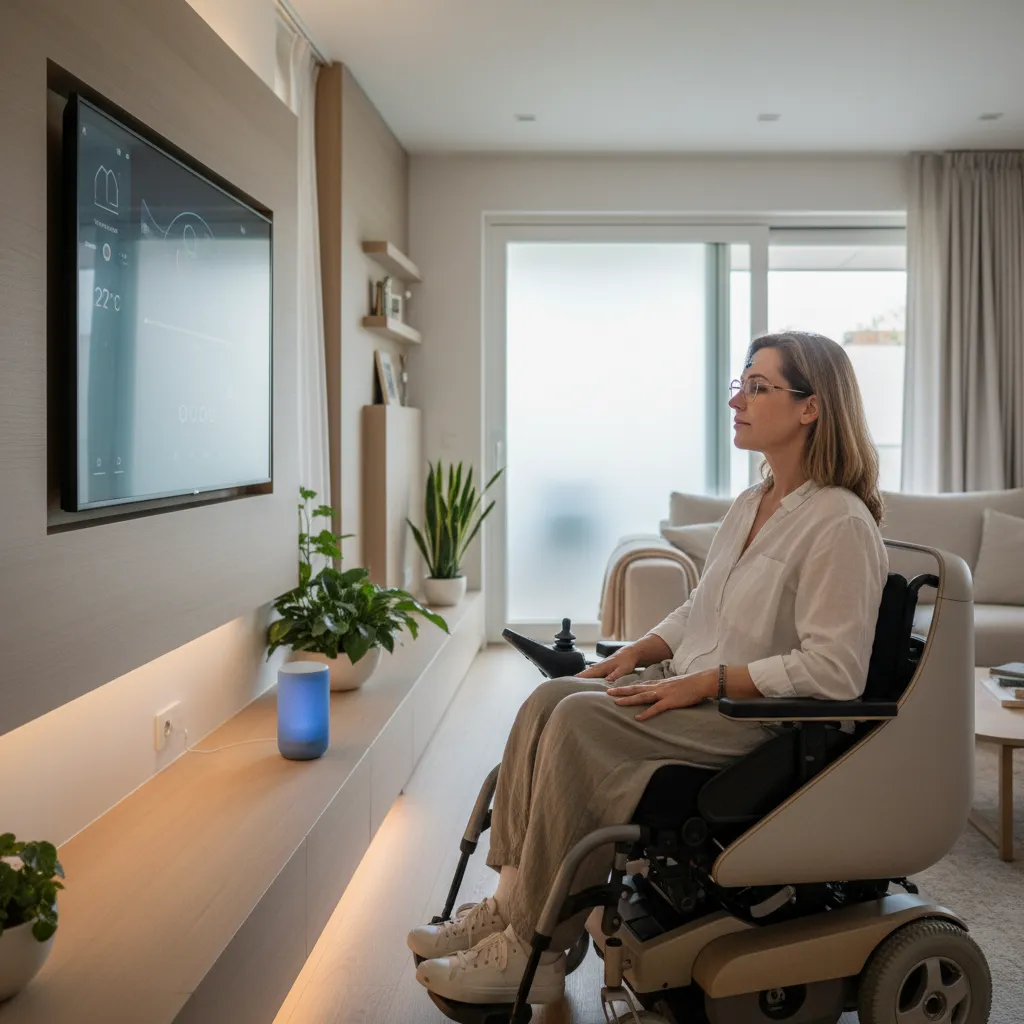
AI voice interfaces accessibility has been one of the most transformative developments. Smart speakers and voice assistants allow users to control their homes—lights, thermostats, entertainment systems—entirely with their voice.
Other key areas of AI innovation accessibility include:
- Advanced Predictive Text: For those who use alternative input methods, AI-powered predictive text and sentence completion can dramatically speed up typing and reduce physical effort.
- Eye and Head Tracking: AI algorithms enhance the precision of eye-tracking systems, allowing users to control computers and communication devices with just their gaze.
- Brain-Computer Interfaces (BCIs): This futuristic technology uses AI to interpret brain signals, allowing individuals with severe paralysis to control prosthetic limbs or type on a screen with their thoughts.
These powerful AI for motor disabilities tools are redefining what’s possible, providing users with greater agency over their environment and their ability to communicate.
Beyond the Individual: System-Level AI Accessibility
The impact of inclusive AI design extends beyond personal devices. It’s beginning to reshape our shared spaces and systems, from healthcare to public infrastructure.
AI in Healthcare Accessibility
In healthcare, AI is crucial for providing personalized care to patients with disabilities. Predictive models can help identify risks, while AI-powered telehealth platforms can offer remote consultations with features like real-time captioning and language translation. It’s about creating a healthcare system that is proactive and adaptable. [Related: AI’s Blueprint for a Healthier Future: Predictive Prevention and Genetic Insights] delves deeper into this transformative area.
AI for Elder Care Tech
As our global population ages, the demand for accessible technology for seniors is surging. AI for elder care tech is helping older adults live independently for longer. This includes smart home devices that monitor for falls, AI companions that combat loneliness and provide medication reminders, and voice-activated systems that simplify the use of complex technology.
The Ethical Tightrope: Navigating the Challenges of Accessible AI
With great power comes great responsibility. As we integrate these next-gen accessibility AI tools into our lives, we must address the significant ethical challenges to ensure they don’t inadvertently create new forms of exclusion. The conversation around AI ethical guidelines accessibility is paramount.
The Demon of Bias
AI models learn from the data they are trained on. If that data is not diverse and inclusive, the resulting AI can be biased. For example:
- A voice recognition system trained primarily on standard speech patterns may fail to understand users with speech impediments.
- A facial recognition system trained on a narrow demographic may not accurately identify people from different ethnic backgrounds.
Accessible AI development requires a conscious effort to collect diverse training data and continuously audit algorithms for bias.
Privacy and Data Security
Many AI assistive tools collect highly sensitive personal data—from health metrics to private conversations. We must have robust regulations and transparent policies to protect this data from misuse. Users need to have full control and understanding of how their information is being used.
The Cost and Digital Divide
The most advanced assistive technology AI is often expensive, creating a new divide between those who can afford it and those who cannot. For this revolution to be truly inclusive, we must work towards making these technologies affordable and accessible to everyone who needs them, regardless of their socioeconomic status. This is a critical mission for both AI and disability advocacy groups and technology creators.
The Future is Accessible: What’s Next for Inclusive AI?
We are only at the beginning of this journey. The future of accessibility tech powered by AI is brighter and more integrated than ever before.
We’re moving towards a future of hyper-personalization, where AI doesn’t just offer a few settings but continuously adapts in real-time to a user’s changing needs and environment. Imagine an interface that dynamically adjusts based on your fatigue level, or a navigation app that reroutes you based on real-time crowd density and noise levels.
Furthermore, we will see a shift from reactive to proactive assistance. Instead of waiting for a command, AI will begin to anticipate needs. It might summarize a document before you even ask, suggest a simplified route for a journey, or pre-configure a room’s lighting and audio before you enter.
Conclusion
Artificial Intelligence is more than just a technological marvel; it’s a powerful social equalizer. When developed through the lens of inclusive AI design, it has the potential to dismantle barriers that have existed for centuries. From giving a voice to the non-verbal to providing sight to the blind, AI is empowering disabled individuals to live with greater independence, dignity, and opportunity.
The journey ahead requires a collective commitment—from developers building accessible AI, from companies prioritizing human-centered design, and from advocates pushing for ethical standards. The goal is clear: to build a future where technology adapts to human diversity, ensuring that no one is left behind. This isn’t just about good design; it’s about building a more equitable world for everyone.
Frequently Asked Questions (FAQs)
What is AI accessibility?
AI accessibility refers to the practice of designing and developing artificial intelligence systems and tools that are usable by people with a wide range of disabilities. This includes using AI to power assistive technologies like screen readers and real-time captioning, as well as ensuring the AI-powered products themselves are designed inclusively from the ground up.
How can AI help people with disabilities?
AI can help people with disabilities in numerous ways by personalizing technology to their specific needs. For visual impairments, AI can describe scenes and read text. For hearing impairments, it provides instant captions and sign language translation. For motor disabilities, it enables voice control and brain-computer interfaces. And for cognitive disabilities, it can simplify information and help with organization.
What is an example of an AI assistive tool?
A great example is Microsoft’s Seeing AI app. It’s an AI-powered application for people with visual impairments that uses a smartphone’s camera to identify people and objects, read text aloud, describe scenes, and even scan barcodes to identify products. It combines multiple AI capabilities into one powerful, real-world assistive tool.
What are the ethical concerns of using AI for accessibility?
The main ethical concerns include algorithmic bias, where AI may not work well for people with non-standard speech or appearances; data privacy, as these tools often handle sensitive personal information; and the digital divide, where the high cost of advanced AI tools could exclude people with lower incomes.
What is the difference between accessibility and inclusive design?
Accessibility is often about ensuring a product is usable by people with disabilities, which can sometimes involve creating separate, specialized solutions (like a ramp next to stairs). Inclusive design is a broader methodology that aims to create products that are inherently usable by everyone, regardless of ability, from the very beginning (designing a single sloping entrance instead of stairs and a ramp).
How is AI used to help with communication?
AI is revolutionizing communication aids. For non-verbal individuals, it powers advanced predictive text and symbol-based communication apps that learn a user’s vocabulary and communication style. It also drives real-time captioning and is being developed for sign language-to-text translation, bridging communication gaps across different abilities.