AI in Space Exploration: Unveiling Cosmic Mysteries with Intelligent Tech

Introduction
The universe is a treasure trove of cosmic mysteries, a vast expanse of data stretching across billions of light-years. For centuries, humanity has peered into this darkness, armed with curiosity and ever-improving tools. But today, we stand on the precipice of a new era of discovery, one powered not just by bigger telescopes and faster rockets, but by a new kind of intelligence. This is the era of AI in space exploration.
From the ruddy plains of Mars to the data streams of distant galaxies, artificial intelligence cosmos technology is becoming the indispensable co-pilot for human ambition. The sheer volume of information beamed back from probes, rovers, and telescopes like the James Webb Space Telescope (JWST) is a deluge no team of human scientists could ever hope to analyze alone. This is where AI and machine learning astronomy step in, transforming our ability to sift through the noise, find the signal, and unlock the universe’s best-kept secrets.
In this deep dive, we’ll explore how intelligent systems in space are accelerating discovery. We’ll examine how AI for Mars rovers grants them unprecedented autonomy, how exoplanet discovery AI is finding new worlds, and how deep learning astrophysics is helping us understand the very fabric of reality. Prepare for a journey into the heart of smart exploration tech and the incredible future of space AI.
The New Space Race: Fueled by Data and Intelligent Algorithms
The modern space race isn’t just about reaching new destinations; it’s about understanding them. Every second, our celestial sentinels—from the Hubble and JWST to Earth-orbiting satellites—generate petabytes of data. This incredible flood of information, while a gift, presents a monumental challenge.
This is where cosmic data analysis powered by AI becomes a game-changer. AI algorithms can:
- Process Data at Scale: Machine learning models can analyze entire astronomical surveys in a fraction of the time it would take humans, identifying patterns, anomalies, and objects of interest that might otherwise be missed.
- Clean and Calibrate Images: AI is used to remove noise and interference from AI telescope data, correcting for atmospheric distortion or instrument jitter to produce crystal-clear images of the cosmos.
- Automate Classification: Deep learning models can be trained to automatically classify galaxies by shape, identify different types of stars, or spot transient events like supernovae without human intervention. This is a core part of AI driven space research.
Without these intelligent tools, we would be data-rich but knowledge-poor, drowning in a sea of unanalyzed pixels and signals. AI acts as the ultimate filter and interpreter, turning raw data into profound scientific insight. Related: How AI Cures the Art Discovery Dilemma highlights how similar AI discovery engines work in different fields.

Autonomous Brains in the Final Frontier: Intelligent Spacecraft and Robotics
When you send a mission millions of miles away, you can’t just control it with a joystick. The communication delay—over 20 minutes for a round trip to Mars—makes real-time control impossible. This necessitates the development of intelligent spacecraft and a new generation of robotics in space that can think for themselves.
Navigating the Void: AI for Spacecraft Navigation
Getting from Point A to Point B in space is a complex dance of physics governed by gravity, velocity, and fuel constraints. AI for spacecraft navigation is revolutionizing this field, a discipline known as AI in astrodynamics.
Traditionally, flight paths are meticulously calculated on Earth and uploaded. But AI offers a more dynamic approach. For instance, NASA’s AEGIS (Autonomous Exploration for Gathering Increased Science) system allows a spacecraft to make its own decisions. AI can:
- Perform Autonomous Maneuvers: Intelligent systems can execute complex orbital insertions or landing sequences without step-by-step instructions from Earth.
- Optimize Trajectories in Real-Time: AI can adjust a spacecraft’s path to avoid newly detected debris or to take advantage of gravitational assists, saving precious fuel and time.
- Enable “Swarm” Missions: The future of space AI includes coordinating fleets of small satellites, allowing them to work together to create a larger, more powerful virtual telescope or to map a planet’s magnetic field from multiple points simultaneously.
These capabilities are crucial for planning more ambitious autonomous space missions, especially those venturing into AI for deep space exploration where communication lags can be hours or even days long.
The Eyes and Hands on Mars: AI for Mars Rovers
Perhaps the most famous examples of AI in NASA missions are the Mars rovers. Spirit, Opportunity, Curiosity, and Perseverance are more than remote-controlled cars; they are robotic field geologists powered by sophisticated AI.
The Perseverance rover, for example, uses advanced AI for several key tasks:
- Autonomous Navigation: Its “AutoNav” feature uses camera data to create 3D maps of the terrain, identify hazards like large rocks or soft sand, and plot the safest, most efficient path forward—all without waiting for commands from Earth. This is autonomous scientific discovery in action.
- Target Selection: The AEGIS system, also used on the Curiosity rover, allows Perseverance to identify scientifically interesting rock targets with its laser-firing SuperCam instrument. The AI analyzes the chemical composition and decides on its own which targets warrant a closer look, maximizing scientific return. This is a perfect example of AI for Mars rovers making real-time science decisions.
- Sample Collection: The entire intricate process of drilling, analyzing, and caching rock samples is an orchestrated sequence heavily managed by onboard intelligent systems.
This level of autonomy is what allows rovers to cover more ground and conduct more science than would ever be possible with human-in-the-loop control. Related: AI Unleashed: Revolutionizing Space Exploration & Cosmic Discovery delves deeper into these missions.
Keeping Our Eyes in the Sky: AI Satellite Operations
The space around Earth is increasingly crowded. Thousands of active satellites for communication, weather monitoring, and navigation require constant management. AI satellite operations are essential for keeping this orbital infrastructure running smoothly.
Machine intelligence space applications include:
- Predictive Maintenance: AI monitors satellite telemetry—temperature, voltage, system performance—to predict component failures before they happen, allowing controllers to take preventative action.
- Collision Avoidance: With millions of pieces of space debris, AI-powered systems constantly track potential collision threats and can automatically calculate and execute avoidance maneuvers.
- Network Optimization: For satellite constellations like Starlink, AI manages the flow of data, rerouting traffic to optimize bandwidth, reduce latency, and ensure stable connectivity for users on the ground.
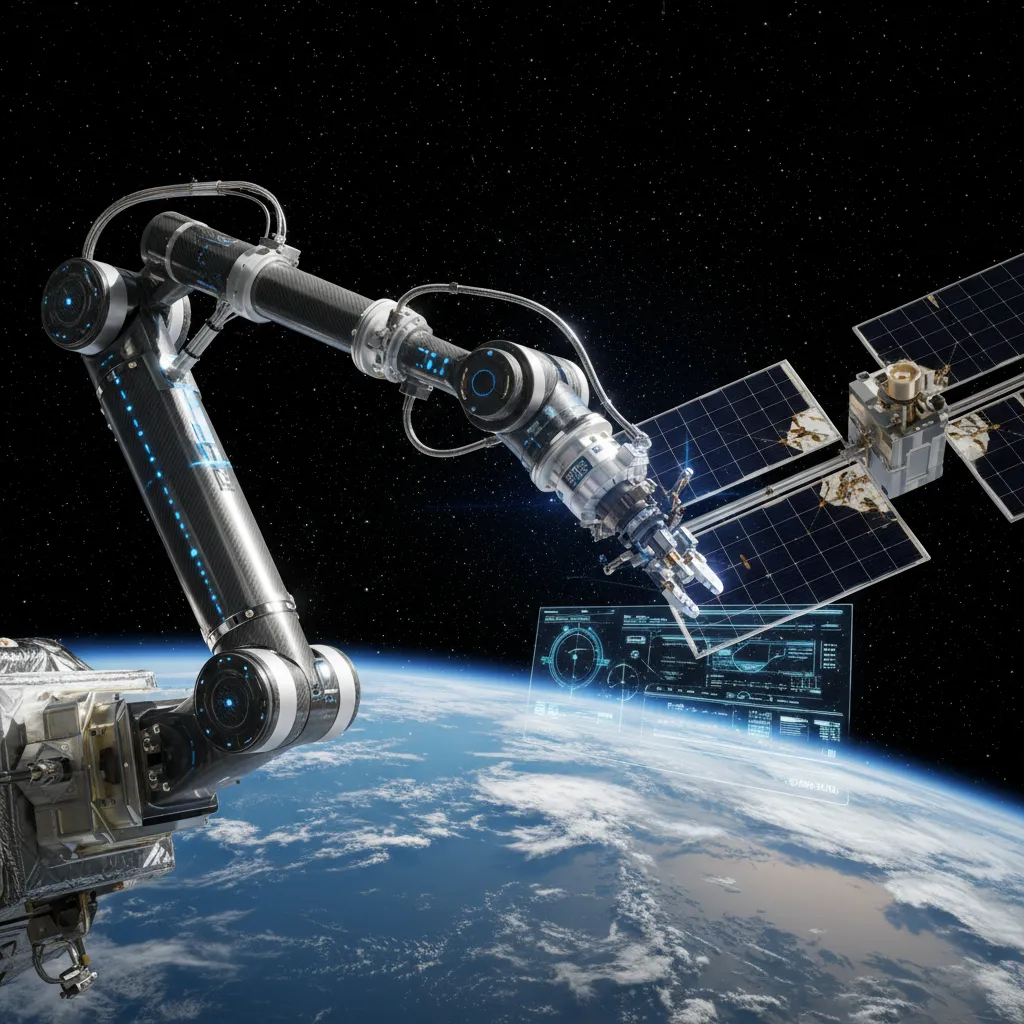
These space robotics innovations are not just about rovers; they are also about the intelligent robotic arms and systems that will one day assemble and repair satellites directly in orbit.
Decoding the Universe’s Secrets: Machine Learning in Astronomy and Astrophysics
While autonomous robots capture our imagination, some of AI’s most profound impacts are happening silently, within massive datasets here on Earth. Machine learning astronomy and deep learning astrophysics are giving scientists superpowers to see the universe in new ways.
Hunting for New Worlds: Exoplanet Discovery AI
Discovering exoplanets—planets orbiting other stars—is like trying to spot a firefly next to a searchlight. The most common method involves looking for the tiny, periodic dip in a star’s light as a planet passes in front of it. Scientists from NASA’s Kepler and TESS missions have collected data on hundreds of thousands of stars.
Manually searching for these transit signals is impossible. This is where exoplanet discovery AI shines. Neural networks are trained on confirmed planet data and can then scan new datasets with incredible speed and accuracy. They can:
- Identify Faint Signals: AI can detect planetary transits that are too subtle for the human eye to reliably spot.
- Filter Out False Positives: The algorithms learn to distinguish true planetary signals from stellar noise like sunspots or instrument errors.
- Accelerate Confirmation: By flagging the most promising candidates, AI directs astronomers where to point ground-based telescopes for follow-up observations, dramatically speeding up the confirmation process.
Thanks to AI, the number of known exoplanets has exploded into the thousands, bringing us closer to answering the question: are we alone?
Peering into the Darkness: Deep Learning Astrophysics
Beyond finding planets, deep learning astrophysics is tackling some of the biggest questions in cosmology. These powerful AI models are helping scientists with:
- Galaxy Classification: AI can sort through millions of galaxy images, classifying them by type (spiral, elliptical, irregular) to help us understand galactic evolution.
- Gravitational Lensing: When the gravity of a massive object like a galaxy cluster bends the light from an object behind it, it creates a “lens.” AI is exceptionally good at finding these lenses, which are crucial for studying dark matter and the expansion of the universe.
- Celestial Mapping: AI for celestial mapping is helping to create the most detailed 3D maps of the universe ever conceived, charting the positions of billions of stars and galaxies.
- Predictive Astronomy: By analyzing the motion and properties of asteroids, predictive AI astronomy models can forecast their future paths, improving our ability to detect potentially hazardous objects. The power of these AI models is constantly growing, much like the AI models discussed in Related: Claude 3.5 Sonnet vs. GPT-4o: The AI King Showdown.
The Next Giant Leap: The Future of AI in Space Exploration
The synergy between AI and space exploration is just getting started. The AI space technology trends point toward a future where AI’s role expands from an analytical tool to a true exploration partner.
The Search for Extraterrestrial Intelligence (SETI): AI Alien Life Detection
The search for alien life is getting an AI upgrade. AI alien life detection is moving beyond just listening for radio signals. In the field of Astrobiology AI, machine learning algorithms are being developed to:
- Analyze Atmospheric Biosignatures: When JWST analyzes the atmosphere of an exoplanet, AI can search for complex combinations of gases (like oxygen and methane) that could indicate the presence of life.
- Detect Anomalous Signals: AI can monitor SETI data streams 24/7, learning what constitutes “normal” cosmic noise and flagging any signal that deviates from the baseline as a potential technosignature.
- Analyze Planetary Surfaces: Future missions could use AI to scan images of planetary surfaces for geological or chemical patterns that might hint at past or present microbial life.
Swarms, Drones, and Self-Building Habitats: Future Space Robotics Innovations
The future of space robotics innovations is awe-inspiring. Instead of single, monolithic rovers, we may soon see swarms of smaller, collaborating robots. Imagine:
- AI-powered drone swarms mapping the entire cave system of Mars or the subsurface oceans of icy moons like Europa and Enceladus.
- Self-assembling space stations where robots, guided by a central AI, construct habitats in orbit or on the Moon.
- Asteroid-mining robots that can autonomously identify valuable resources and process them in space.
These intelligent systems in space will enable missions that are currently in the realm of science fiction. The same principles of automation and intelligence are also transforming our lives on Earth, as seen in Related: Transform Your Home: AI-Powered Smart Living.

The Road Ahead: Challenges and the Human Element
Of course, the path forward isn’t without challenges. Using AI in critical space missions requires extreme reliability. The hardware must be hardened against cosmic radiation, and the software must be rigorously tested to prevent errors. Furthermore, ensuring the “explainability” of AI—understanding why it made a particular decision—is crucial for mission controllers to trust their robotic partners. We need to be wary of errors, similar to the issues discussed in Related: Combating AI Hallucinations: Building Trustworthy Systems.
Ultimately, AI in space exploration is not about replacing human scientists but empowering them. AI is the tool that handles the scale, the speed, and the complexity, freeing up human intellect for what it does best: asking the big questions, forming creative hypotheses, and feeling the awe of discovery.
Conclusion
From navigating the lonely void between planets to deciphering the faint light of distant worlds, artificial intelligence has fundamentally altered our cosmic journey. It is the engine of autonomous scientific discovery, the translator for the universe’s data-rich language, and the brain behind our most ambitious robotic explorers. AI driven space research is no longer a futuristic concept; it is a present-day reality, accelerating our quest for knowledge with every new mission and every processed byte of data.
The partnership between human curiosity and machine intelligence is the key that will unlock the next generation of cosmic revelations. As we continue to build smarter algorithms and more capable robots, we are not just exploring space—we are learning to speak its language, and soon, we will understand its deepest secrets.
Frequently Asked Questions (FAQs)
Q1. How is AI used in space exploration?
AI is used in numerous ways, including automating spacecraft navigation, enabling autonomous Mars rovers to make scientific decisions, analyzing massive datasets from telescopes to find exoplanets and classify galaxies, managing satellite operations, and helping in the design of future missions.
Q2. What is an example of AI in a NASA mission?
A prime example is NASA’s Perseverance Mars rover. It uses an AI system called AEGIS (Autonomous Exploration for Gathering Increased Science) to autonomously identify and analyze rock targets with its laser. Its AutoNav system also uses AI to map terrain and navigate safely without real-time human commands.
Q3. How does AI help in discovering new planets?
AI, specifically machine learning algorithms, sifts through vast amounts of data from telescopes like Kepler and TESS. It’s trained to recognize the faint, periodic dimming of a star’s light caused by a planet passing in front of it (a transit). This allows scientists to find thousands of potential exoplanets far faster and more accurately than human analysis ever could.
Q4. What is the role of robotics in space?
Robotics in space act as humanity’s eyes, hands, and feet on other worlds. From rovers like Curiosity exploring the Martian surface to robotic arms on the International Space Station performing maintenance, they conduct experiments, collect samples, and build and repair equipment in environments too dangerous or distant for humans.
Q5. Can AI be used to find alien life?
Yes, AI is becoming a critical tool in the search for alien life. In a field called Astrobiology AI, algorithms are being designed to analyze the atmospheric composition of exoplanets for biosignatures (signs of life). They also scan for potential “technosignatures” by analyzing radio telescope data for signals that stand out from natural cosmic noise.
Q6. What are the challenges of using AI in space?
Key challenges include ensuring extreme reliability and robustness against cosmic radiation, which can damage electronics. Another is “explainability”—making sure mission controllers understand why an AI made a certain decision. Finally, the significant time delays in communication require AI systems to be highly autonomous and capable of handling unexpected situations on their own.
Q7. How does AI help with satellite operations?
AI helps by automating satellite health monitoring to predict and prevent failures, calculating collision avoidance maneuvers to dodge space debris, and optimizing communication networks for large satellite constellations to ensure efficient data flow and connectivity.