AI for Educators: Empowering Teachers in the Digital Classroom

Introduction
The modern educator’s plate is overflowing. Between lesson planning, grading, administrative tasks, and providing individualized support to a diverse classroom of students, the workload can feel unsustainable. Burnout is a real and growing concern. But what if there was a way to reclaim precious hours, supercharge creativity, and unlock a new level of personalized learning for every student? This is the promise of Artificial intelligence for teaching.
The rise of AI in education technology isn’t about replacing the invaluable human connection that lies at the heart of teaching. Instead, it’s about empowerment. Think of AI not as a replacement, but as the ultimate AI-powered teaching assistant—a tireless partner working behind the scenes to handle the repetitive tasks, generate creative resources, and provide deep insights into student progress. This allows you, the educator, to focus on what you do best: inspiring, mentoring, and guiding the next generation.
This comprehensive guide will explore how digital classroom AI solutions are transforming the educational landscape. We’ll dive into the practical benefits of AI for educators, showcase specific tools that can reduce your workload today, and discuss the critical importance of ethical implementation and professional development. Get ready to discover how you can leverage AI to create a more dynamic, efficient, and engaging learning environment.
The Dawn of a New Era: What is AI in Education Technology?
For years, “EdTech” meant digital whiteboards, learning management systems (LMS), and online resources. While helpful, these were largely static tools. The new wave of EdTech AI solutions for teachers is fundamentally different. It’s dynamic, adaptive, and intelligent.
At its core, artificial intelligence in teaching uses complex algorithms and machine learning models to perform tasks that typically require human intelligence. This includes:
- Natural Language Processing (NLP): Understanding, interpreting, and generating human language. This is the magic behind AI that can summarize texts, provide feedback on essays, or create lesson plans from a simple prompt.
- Machine Learning (ML): Allowing systems to learn from data without being explicitly programmed. In education, this means an AI can analyze student performance data and identify patterns, predicting who might struggle with a concept and suggesting resources to help.
- Data Analytics: Processing vast amounts of information to provide actionable insights. AI can track student engagement levels during a digital activity and present the teacher with a clear, concise report.
This shift marks a move from digital tools to intelligent partners. The goal isn’t just to digitize old processes but to create entirely new, more effective workflows that support both teachers and learners. It’s a technological evolution that is reshaping a multitude of industries, from finance to infrastructure. [Related: The Rise of DePIN: Decentralized Physical Infrastructure Networks Reshaping the Future]
Reclaiming Time and Inspiring Minds: The Core Benefits of AI for Educators
Why should busy teachers even consider adding another piece of technology to their workflow? Because the right teacher support AI tools aren’t an added burden; they are a powerful lever for efficiency and impact. The benefits are tangible, directly addressing the biggest pain points in the profession.
Drastically Reducing Teacher Workload
The mountain of administrative work is a primary driver of teacher burnout. AI excels at automating these time-consuming, repetitive tasks, leading to significant AI for teacher workload reduction. Imagine a world where you spend less time on paperwork and more time on pedagogy.
- Automating Administrative Tasks: AI can manage communications by drafting parent emails, sorting inbox queries, and generating weekly progress reports.
- Simplifying Report Generation: Instead of manually compiling data for student reports, AI can analyze grades, attendance, and performance metrics to create comprehensive summaries in seconds.
- Streamlining Resource Management: AI tools can help organize digital files, find relevant educational videos or articles, and manage classroom logistics, freeing up critical mental space for teachers. This boost in teacher productivity AI is one of the most immediate and appreciated benefits.
Revolutionizing Lesson Planning and Curriculum Development
Staring at a blank page when trying to create an engaging lesson is a familiar challenge. AI lesson planning tools act as a powerful brainstorming partner, helping to spark creativity and differentiate instruction with ease.

AI in curriculum development can:
- Generate Differentiated Materials: Provide a single prompt, and an AI can create reading passages on the same topic at five different Lexile levels, complete with comprehension questions for each.
- Create Engaging Activities: Need a quiz, a flashcard set, a debate topic, or a project-based learning idea related to cellular biology? AI can generate dozens of options in moments, aligned with your specific learning objectives.
- Align to Standards: Many educational AI tools can align the content they generate with specific educational standards (like Common Core or NGSS), saving hours of cross-referencing.
Enabling True Personalized Learning at Scale
The dream of a truly individualized education for every student has long been hampered by the practicalities of a 30-student classroom. Personalized learning teacher AI finally makes this dream attainable.
By analyzing how each student interacts with digital content—how long they spend on a question, what concepts they struggle with, and where they excel—AI can build a unique learning profile. This data empowers adaptive learning platforms to:
- Provide Targeted Interventions: The system can automatically assign remedial exercises to a student who is struggling or offer advanced, challenging content to one who has mastered the material.
- Recommend Custom Learning Paths: AI can suggest a sequence of activities, videos, and readings tailored to each student’s pace and learning style.
- Offer Real-Time Support: AI-powered tutors and chatbots can provide instant help and hints when a student is stuck on a problem, even when the teacher is occupied with another group.
This level of personalization is transforming other complex fields, and education is next. [Related: AI Personalized Medicine: Revolutionizing Healthcare’s Future]
Fairer, Faster Grading and Actionable Feedback
Grading is arguably one of the most time-intensive parts of a teacher’s job. AI for grading and feedback can be a game-changer, especially for objective assessments and initial drafts of written work.
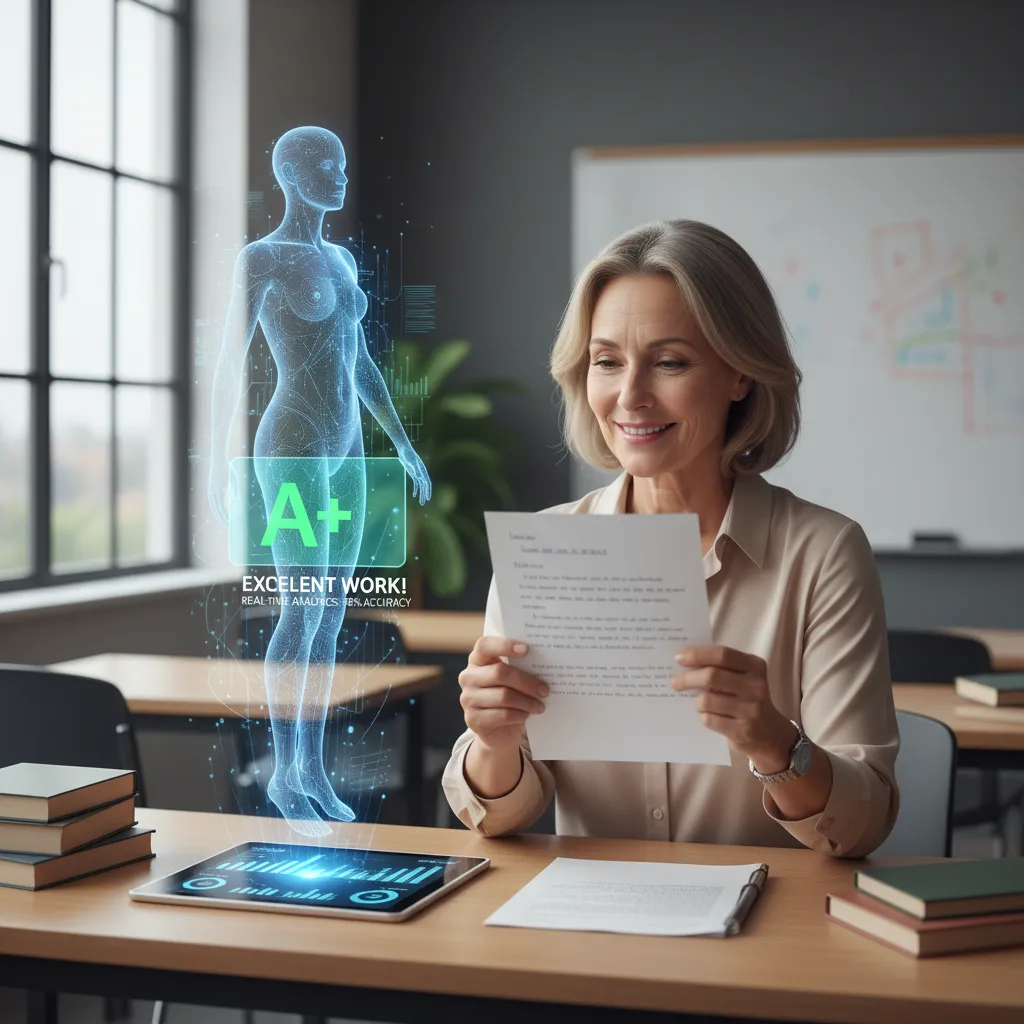
Here’s how it works:
- Automated Scoring: For multiple-choice, fill-in-the-blank, and even some short-answer questions, AI can provide instant, accurate scoring.
- Feedback on Writing: AI tools can analyze student essays for grammar, spelling, and syntax. More advanced tools can check for clarity, tone, and the strength of an argument, providing students with immediate, formative feedback they can use to revise their work before final submission.
- Identifying Trends: By analyzing an entire class’s submissions, AI can highlight common misconceptions or areas where many students struggled, giving the teacher valuable information to guide the next day’s lesson.
This frees the teacher to focus on providing higher-order feedback on creativity, critical thinking, and nuanced arguments—the deeply human aspects of evaluation.
The Modern Teacher’s AI Toolkit: Practical Tools and Applications
Theory is great, but what does this look like in practice? The market for smart teaching tools is exploding. Here are some of the key applications and examples of tools that are making a real impact in classrooms today.
AI-Powered Teaching Assistants for Daily Support
Think of these as the Swiss Army Knife for educators. Platforms like Magic School AI, Brisk Teaching, and Diffit are designed to be all-in-one teacher support AI tools. A teacher can use a single platform to:
- Generate lesson plans and materials.
- Adapt existing content for different reading levels.
- Create quizzes and assessments.
- Draft emails to parents.
- Provide feedback on student writing.
These assistants are designed with teachers’ daily workflows in mind, making them some of the most popular and impactful AI tools for teachers available.
Smart Tools for Dynamic Lesson Creation
Beyond all-in-one assistants, specialized tools are emerging that focus on creating dynamic and interactive content.
- Curipod: Helps teachers build interactive presentations with polls, word clouds, and Q&A sessions to keep students engaged.
- Canva’s Magic Studio: Integrates AI into its popular design platform, allowing teachers to generate images, write text for presentations, and even create entire lesson slide decks from a simple prompt.
- ChatGPT and Gemini: These powerful general-purpose AI models are fantastic for brainstorming ideas, explaining complex topics in simple terms, or creating example texts for analysis.
These tools for innovative teaching with AI help move lessons from static delivery to dynamic, two-way experiences. [Related: Perplexity Pages: The Ultimate Guide to AI-Powered Content Creation]
Boosting Student Engagement in the Digital Classroom
Keeping students focused and engaged, especially in a tech-saturated world, is a constant challenge. AI tools for student engagement leverage interactivity and data to create more compelling learning environments.

- Gamification: Platforms like Quizizz and Kahoot! use AI to adapt question difficulty and create a fun, competitive atmosphere that boosts participation.
- Intelligent Analytics: Tools like Nearpod can track in real-time which students are participating in an interactive lesson. The AI provides the teacher with a private dashboard, highlighting students who may be disengaged or struggling, allowing for subtle, targeted intervention.
- Interactive Simulations: AI can power complex simulations that allow students to explore scientific concepts or historical events in an immersive way, responding to their choices and actions.
AI for Educational Assessment and Insights
AI for educational assessment goes far beyond simple grading. It provides a panoramic view of student and class performance, enabling data-driven instruction.
Advanced assessment platforms can analyze results from an entire semester to:
- Identify Learning Gaps: Pinpoint specific concepts where the class as a whole is weak.
- Track Individual Growth: Show a student’s progress over time, rather than just their score on a single test.
- Flag At-Risk Students: AI algorithms can identify patterns that may indicate a student is falling behind, alerting the teacher to intervene early.
This shifts assessment from a purely summative tool (a final grade) to a deeply formative one that guides the entire learning process.
Navigating the Future: Challenges and Ethical AI in Education
The future of education AI is incredibly bright, but integrating AI in schools requires careful thought and planning. To harness the benefits, we must also proactively address the challenges of AI in teaching.
The Challenge of Data Privacy and Security
AI systems run on data. In education, this means student data—grades, behaviors, and even personal information. Ensuring this data is protected is paramount. School districts must vet AI vendors rigorously, demanding transparency about how data is stored, used, and protected from breaches. This is a core component of ethical AI in education. [Related: AI Privacy On-Your-Device: The Future of Secure, Personalized Intelligence]
Combating Bias and Ensuring Equity
AI models learn from the data they are trained on. If that data contains historical biases (racial, gender, socioeconomic), the AI can learn and perpetuate them. An AI grading tool trained on biased data might unfairly score essays written in certain dialects. Furthermore, there’s a risk of a digital divide, where students in wealthier districts have access to powerful AI tools while others do not, widening existing equity gaps. Diligence is required to ensure algorithms are fair and access is equitable. [Related: Combating AI Hallucinations: A Guide to Building Trustworthy Systems]
The Evolving Role of the Teacher
A common fear is that AI will make teachers obsolete. The reality is that the AI impact on teacher roles is a transformation, not a replacement. AI will automate the mechanical parts of teaching, elevating the role of the human educator. The teacher’s focus will shift more towards:
- Mentorship and emotional support.
- Facilitating complex, project-based learning.
- Teaching critical thinking, creativity, and collaboration.
- Instilling digital citizenship and AI literacy.
The teacher becomes less of a “sage on the stage” and more of a “guide on the side,” a role that is arguably more important and impactful than ever. [Related: AI in Creative Jobs: Is It a Threat or a Tool for Innovation?]
Getting Started: Integrating AI in Your School and Classroom
So, where do you begin? The journey towards transforming education with AI is a marathon, not a sprint. A thoughtful, phased approach is key.
The Crucial Role of AI Professional Development for Teachers
Simply giving teachers a login to a new AI tool is a recipe for failure. Effective implementation hinges on high-quality, ongoing AI professional development for teachers.

This training must go beyond the “how-to” of using a specific app. It must build true AI literacy for educators, covering:
- The fundamental concepts of how AI works.
- Prompt engineering skills to get the best results from generative AI.
- Ethical considerations for using AI in the classroom.
- Pedagogical strategies for integrating AI tools into lesson plans effectively.
Schools and districts must invest in their people, not just their software.
A Step-by-Step Approach to AI Integration
- Start Small: Don’t try to overhaul everything at once. Pick one pain point—like creating differentiated reading passages or generating quiz questions—and find one tool to help solve it.
- Collaborate with Peers: Form a small group of interested colleagues. Meet regularly to share what’s working, troubleshoot problems, and discover new tools together.
- Involve Students: Be transparent with students about how and why you’re using AI. Teach them to be critical consumers of AI-generated content and to use the tools ethically as learning aids.
- Stay Curious and Flexible: The world of AI is changing at an exponential rate. Embrace a mindset of continuous learning. Follow EdTech leaders, read blogs, and don’t be afraid to experiment with new tools as they emerge.
Conclusion
Artificial intelligence is no longer a futuristic concept; it is a present-day reality that holds immense potential to revolutionize the teaching profession. By embracing AI tools for teachers, we can move towards a future where educators are freed from the drudgery of administrative tasks and empowered to focus on the deeply human work of inspiring and connecting with students.
From personalizing learning at scale and providing instant, actionable feedback to saving countless hours on lesson planning and grading, empowering educators with AI is the key to creating a more sustainable, effective, and joyful educational experience for everyone. The journey is just beginning, but one thing is clear: the future of education is a collaborative one, where the irreplaceable passion of human teachers is amplified by the power of intelligent technology.
What AI tool are you most excited to try in your classroom? Share your thoughts and questions in the comments below!
FAQs
Q1. How is AI being used to help teachers?
AI helps teachers by automating time-consuming administrative tasks like grading, lesson planning, and drafting communications. It also provides powerful tools for creating differentiated instruction, personalizing learning paths for students, and generating engaging classroom activities, thereby reducing teacher workload and boosting productivity.
Q2. What is an example of an AI tool for education?
A great example is Magic School AI, which acts as an all-in-one AI assistant for educators. Teachers can use it to generate lesson plans, create quizzes, adapt text for different reading levels, and get feedback on student writing, all from a single platform. Other examples include Curipod for interactive presentations and Diffit for adapting existing materials.
Q3. Will AI replace teachers?
No, AI is not expected to replace teachers. The consensus among education experts is that AI will transform the teacher’s role, not eliminate it. AI will handle logistical and repetitive tasks, allowing teachers to focus more on mentoring, fostering critical thinking, and providing the social-emotional support that only a human can offer.
Q4. What are the disadvantages of AI in teaching?
The main challenges and disadvantages include the risk of data privacy breaches, the potential for algorithmic bias to perpetuate inequities, and the high cost and training required for effective implementation. There’s also a concern about over-reliance on technology, which could potentially hinder the development of students’ critical thinking and problem-solving skills if not used thoughtfully.
Q5. How can teachers start using AI in the classroom?
Teachers can start by identifying one major pain point in their daily workflow, such as creating practice worksheets. Then, they can explore a user-friendly tool designed to address that specific task. Starting small, collaborating with a few colleagues, and focusing on one tool at a time makes the integration process much more manageable.
Q6. What is the best AI for lesson planning?
While “best” is subjective, many educators find great success with AI lesson planning tools like ChatGPT, Gemini, or integrated platforms like Magic School AI. These tools are excellent for brainstorming ideas, structuring lesson outlines, generating activity instructions, and creating content aligned with specific learning objectives and educational standards.
Q7. What is AI literacy for educators?
AI literacy for educators is the ability to understand, use, and critically evaluate AI technologies in an educational context. It goes beyond knowing how to use a single app; it includes understanding the ethical implications of AI, recognizing potential biases, and developing pedagogical strategies to use AI effectively to enhance learning without compromising educational goals.