AI in Drug Discovery: Revolutionizing Medicine’s Future
Introduction: The Dawn of a New Era in Medicine
For centuries, the journey from scientific breakthrough to life-saving medication has been arduous, expensive, and fraught with uncertainty. Traditional drug discovery is a marathon, often taking over a decade and costing billions of dollars, with a high attrition rate where most candidate drugs fail long before reaching patients. This complex process, characterized by extensive laboratory research, laborious trials, and serendipitous discoveries, has long been ripe for disruption.
Enter Artificial Intelligence (AI) – a transformative force poised to redefine the very fabric of how we discover, develop, and deliver medicines. AI drug discovery is no longer a futuristic concept but a burgeoning reality, leveraging advanced algorithms and computational power to streamline every stage of pharmaceutical research. From identifying novel therapeutic targets to designing potent new molecules and optimizing clinical trials, AI in pharma promises to accelerate drug development, slash costs, and usher in an era of more effective, personalized treatments.
In this comprehensive guide, we’ll delve deep into how AI is revolutionizing medicine’s future. We’ll explore the specific ways generative AI medicine and machine learning drug development are reshaping the landscape, uncover the immense benefits of AI in pharmaceutical research, and examine the cutting-edge AI platforms for drug design. While the potential is vast, we’ll also candidly address the challenges of AI drug discovery and the crucial ethical considerations AI drug discovery presents. Join us as we explore how this powerful technology is not just changing healthcare, but actively building a healthier tomorrow.
The Bottlenecks of Traditional Drug Discovery
Before we fully appreciate the transformative power of AI, it’s essential to understand the inherent challenges of conventional drug development. The process is typically divided into several key stages:
- Target Identification: Pinpointing specific biological molecules (like proteins or genes) implicated in a disease that a drug could potentially interact with. This is often based on extensive literature review, basic science research, and sometimes, educated guesswork.
- Lead Identification and Optimization: Screening vast libraries of chemical compounds to find “hits” that interact with the target, then optimizing these “leads” to improve their potency, selectivity, and drug-like properties. This stage involves high-throughput screening and iterative chemical synthesis.
- Preclinical Development: Testing the drug candidates in cell cultures and animal models to assess efficacy, dosage, and potential toxicity, ensuring they are safe enough for human trials.
- Clinical Trials: The most expensive and time-consuming stage, involving three phases of human testing to evaluate safety, efficacy, and optimal dosage in increasingly larger patient populations.
- Regulatory Approval and Post-Market Surveillance: Gaining approval from regulatory bodies (like the FDA) and monitoring the drug’s performance and side effects once it’s on the market.
Each of these stages is a bottleneck. The sheer volume of data, the complexity of biological systems, the experimental costs, and the high failure rate mean that very few compounds ever make it to market. The average success rate for a drug entering clinical trials is less than 12%, and even lower for some therapeutic areas. This inefficiency drives up drug prices and delays access to urgently needed therapies.
How AI Accelerates Drug Development: A Paradigm Shift
Artificial Intelligence, encompassing machine learning drug development, deep learning therapeutics, and computational drug design, offers solutions to many of these long-standing problems. By processing and analyzing vast datasets far beyond human capacity, AI can uncover patterns, make predictions, and generate insights that dramatically speed up the drug discovery pipeline.
1. Target Identification and Validation: Pinpointing the Enemy
One of the earliest and most critical steps in drug discovery is identifying the right biological target. AI excels here by:
- Analyzing Genomic and Proteomic Data: Machine learning algorithms can sift through massive genomic, proteomic, and transcriptomic datasets to identify genes or proteins that are uniquely expressed or dysregulated in diseased states. This helps prioritize targets with the highest likelihood of therapeutic impact.
- Predicting Disease Pathways: AI can map complex biological networks and pathways, revealing novel interactions and understanding how diseases progress at a molecular level. This leads to more precise target selection.
- Integrating Multi-Omics Data: By combining data from genomics, proteomics, metabolomics, and phenomics, AI provides a holistic view of disease biology, enabling more informed decisions about which targets to pursue.
2. Molecule Design and Synthesis: Inventing New Cures
Perhaps one of the most exciting applications of AI in pharmaceutical innovation lies in the design of new drug molecules. This is where generative AI medicine truly shines.
- De Novo Drug Design: AI models, particularly generative adversarial networks (GANs) and variational autoencoders (VAEs), can design new drugs from scratch. Instead of screening existing compounds, these models learn the rules of chemical synthesis and biological activity to propose novel molecular structures with desired properties (e.g., binding affinity to a target, low toxicity). This dramatically expands the chemical space explored.
- Lead Optimization: Once a potential “hit” molecule is found, AI helps optimize it. Algorithms can predict how modifications to a molecule’s structure will affect its potency, selectivity, solubility, and metabolic stability. This iterative process, which traditionally takes years of trial and error, can be accelerated to months or even weeks.
- Virtual Screening: Instead of physically testing millions of compounds, AI can perform “virtual screening” of vast chemical databases. It predicts which compounds are most likely to bind to a specific target, significantly narrowing down the candidates for experimental validation.
- Synthesis Route Prediction: AI can even suggest optimal synthetic pathways to create the newly designed molecules, taking into account feasibility, cost, and environmental impact.
 A neural network meticulously sifts through complex molecular data, identifying patterns and generating novel insights for drug design.
3. Drug Repurposing: New Life for Old Drugs
Many approved drugs exist for one condition but might have untapped potential for others. Drug repurposing AI rapidly identifies these hidden connections. By analyzing molecular structures, gene expression profiles, and disease pathways, AI can predict which existing drugs could be effective against new diseases, including rare diseases or emerging infectious diseases. This dramatically reduces development time and risk, as these drugs already have established safety profiles. For instance, AI has been instrumental in identifying potential treatments for COVID-19 by screening existing antivirals.
4. Preclinical Development and Toxicity Prediction: Ensuring Safety Early On
Before a drug ever reaches human trials, its safety and efficacy must be rigorously assessed. AI streamlines this stage:
- Predicting ADMET Properties: AI models can accurately predict a compound’s absorption, distribution, metabolism, excretion, and toxicity (ADMET) properties in silico. This allows researchers to filter out potentially harmful or ineffective compounds much earlier, saving considerable time and resources on lab experiments.
- Virtual Animal Models: While not replacing animal testing entirely, AI can reduce the number of animal experiments by simulating drug interactions within virtual biological systems, predicting potential adverse effects.
- Image Analysis in Pathology: Deep learning algorithms can analyze high-resolution images from tissue samples (histopathology) or cell cultures, automating the detection of cellular changes, disease biomarkers, and drug effects with greater speed and consistency than human analysis.
5. Clinical Trials Optimization: Smarter, Faster Trials
Clinical trials are the most significant bottleneck in terms of time and cost. Clinical trials AI offers several solutions:
- Patient Recruitment: AI can analyze electronic health records (EHRs) and other medical data to identify eligible patients for trials more quickly and efficiently, reducing recruitment times. It can also match patients to trials based on their specific genetic profile, improving trial success rates.
- Trial Design and Monitoring: AI can optimize trial design parameters, predict potential risks, and monitor trial progress in real-time, identifying issues and enabling quicker adjustments.
- Biomarker Identification: AI helps identify predictive biomarkers that can indicate which patients are most likely to respond to a particular drug, leading to more targeted and successful trials.
- Data Analysis: During and after trials, AI can quickly analyze vast amounts of clinical data, including patient outcomes, adverse events, and genetic information, to derive insights that might be missed by traditional statistical methods.
6. Personalized Medicine: Tailoring Treatments for Individuals
The ultimate goal of many in healthcare is precision medicine AI, where treatments are tailored to an individual’s unique genetic makeup and disease profile. AI is indispensable here:
- Genomic Analysis: AI can process individual genomic data to understand specific disease susceptibilities, drug responses, and potential adverse reactions, enabling personalized drugs AI.
- Predicting Drug Response: Machine learning models can predict how a patient will respond to a specific medication based on their genetic, lifestyle, and medical history data.
- AI for New Drugs aimed at specific patient subgroups will become more common, moving away from a “one-size-fits-all” approach. This is particularly impactful for diseases with heterogeneous presentations, like cancer.
The Unprecedented Benefits of AI in Pharmaceutical Research
The integration of artificial intelligence pharmacology into drug discovery offers a cascade of benefits that are reshaping the entire industry:
- Accelerated Drug Development: This is perhaps the most significant advantage. By automating tasks, predicting outcomes, and streamlining processes, AI can drastically cut down the time it takes to bring a new drug from concept to clinic, potentially reducing it from 10-15 years to just 3-5 years for certain stages. This means faster access to life-saving treatments for patients.
- Reduced Costs: Shorter development timelines, fewer failed candidates in late-stage trials, and optimized experimental designs translate into substantial cost savings. This can potentially make drugs more affordable and free up resources for further innovative research.
- Increased Success Rates: AI’s ability to predict efficacy and toxicity with higher accuracy means that fewer drug candidates fail in costly clinical trials. This improves the overall probability of success for new therapies.
- Discovery of Novel Therapies: Smart drug discovery powered by AI can uncover completely new molecular structures and biological pathways that human intuition or traditional screening methods might miss, leading to truly innovative drug research and first-in-class medicines.
- Addressing Unmet Medical Needs: AI can focus on rare diseases or conditions that have historically been overlooked due to commercial viability concerns, by identifying potential targets or repurposing existing drugs more efficiently.
- Enhanced Understanding of Disease: The deep insights gleaned by AI from complex biological data enhance our fundamental understanding of diseases, opening new avenues for treatment.
- Data-Driven Decision Making: AI transforms drug discovery into a more data-driven science, moving away from trial-and-error to predictive modeling and informed strategic choices at every stage.
 A human scientist collaborates seamlessly with an AI, utilizing a holographic interface to analyze complex molecular structures and accelerate drug design.
Leading the Charge: AI Platforms and Technologies
The advancements in AI for new drugs are underpinned by sophisticated computational tools and methodologies:
- Machine Learning (ML): The foundational technology, including supervised, unsupervised, and reinforcement learning. ML algorithms learn from data to make predictions or identify patterns.
- Deep Learning (DL): A subset of ML that uses neural networks with multiple layers (hence “deep”) to learn complex patterns from large datasets. DL is particularly effective for image analysis, natural language processing, and molecular property prediction.
- Generative AI: Techniques like Generative Adversarial Networks (GANs) and Variational Autoencoders (VAEs) are at the forefront of de novo molecule design. They learn the distribution of existing molecules and generate novel ones with desired properties.
- Reinforcement Learning (RL): Used in drug design to train models to navigate the vast chemical space and optimize molecular properties towards specific goals, similar to how an AI learns to play a game.
- Natural Language Processing (NLP): AI uses NLP to extract valuable information from unstructured text data like scientific literature, clinical notes, and patents, helping identify targets, adverse effects, and drug-disease associations.
- Bioinformatics Drug Discovery: This interdisciplinary field combines biology, computer science, and information technology to manage and analyze biological data. AI significantly enhances bioinformatics capabilities, particularly in genomics and proteomics analysis.
- Cloud Computing and High-Performance Computing (HPC): The immense computational demands of AI drug discovery necessitate powerful infrastructure, often provided by cloud platforms or specialized HPC centers.
Many biotech AI companies and large pharmaceutical firms are now developing or adopting specialized AI platforms for drug design. These platforms integrate various AI tools, databases, and simulation capabilities into a cohesive environment, making it easier for researchers to leverage these advanced technologies.
Challenges and Ethical Considerations in AI Drug Discovery
While the promise of AI in life sciences is extraordinary, it’s crucial to acknowledge the hurdles and ethical dilemmas that accompany this revolution.
Technical and Practical Challenges:
- Data Quality and Availability: AI models are only as good as the data they are trained on. High-quality, diverse, and well-annotated biological and chemical data is paramount. Many proprietary datasets are siloed, and public datasets can be inconsistent or incomplete.
- Interpretability (The “Black Box” Problem): Deep learning models, while powerful, can be opaque. Understanding why an AI predicts a certain molecule will be effective or toxic can be challenging. This lack of interpretability can be a significant hurdle for regulatory approval and scientific understanding.
- Experimental Validation: AI predictions still need rigorous experimental validation in the lab. The “wet lab” remains indispensable, and bridging the gap between in silico predictions and in vitro / in vivo reality is crucial.
- Computational Resources and Expertise: Implementing and managing AI in healthcare research requires significant investment in computational infrastructure and highly skilled data scientists, biologists, and chemists who can work collaboratively.
- Regulatory Landscape: Regulatory bodies are still catching up with the rapid pace of AI innovation. Clear guidelines and pathways for approving AI-discovered or AI-designed drugs are still evolving.
- Intellectual Property: Determining ownership and patentability of molecules designed by generative AI poses new challenges to the traditional IP framework.
Ethical Considerations:
- Bias in Data: If AI models are trained on biased datasets (e.g., data primarily from certain ethnic groups or socioeconomic backgrounds), the drugs they help discover might be less effective or even harmful for underrepresented populations. This could exacerbate health inequalities.
- Responsibility and Accountability: If an AI-designed drug causes unforeseen harm, who is responsible? The AI developer, the drug company, or the algorithm itself? Clear frameworks for accountability are needed.
- Access and Equity: Will faster drug development via AI primarily benefit wealthy nations or specific demographics, or will it be used to address global health disparities and neglected diseases? Ensuring equitable access to AI-driven therapies is a critical ethical imperative.
- Impact on Workforce: While AI will create new roles, it may also automate certain tasks traditionally performed by scientists, raising questions about job displacement and the need for workforce reskilling.
- Dual-Use Potential: The ability to rapidly design novel molecules also carries the potential for misuse, such as creating harmful biological agents. Safeguards and ethical guidelines are essential.
Addressing these challenges requires a concerted effort from academia, industry, regulatory bodies, and policymakers.
The Future of AI in Drug Discovery: A Vision of Innovation
The trajectory of AI in drug discovery points towards an increasingly integrated and automated future.
- Fully Autonomous Labs: Imagine AI systems not only designing molecules but also controlling robotic systems to synthesize and test them, iterating in a closed loop with minimal human intervention. This concept of “self-driving labs” is already being explored.
- Predictive Digital Twins: Creating highly accurate “digital twins” of human organs or even entire physiological systems, allowing drugs to be tested virtually with unprecedented precision, predicting individual responses before human trials.
- Convergence with Other Technologies: AI will increasingly converge with other cutting-edge fields like quantum computing (for even more complex molecular simulations), synthetic biology (for engineering biological systems), and advanced robotics, creating synergistic innovations.
- Democratization of Drug Discovery: As AI tools become more accessible, smaller biotech startups and even academic labs could gain the power to discover and develop new drugs, fostering a more diverse and innovative ecosystem beyond the traditional pharmaceutical giants.
- Proactive Disease Prevention: Beyond treatment, AI’s ability to analyze vast health datasets could shift medicine towards proactive prevention, identifying individuals at high risk for diseases and recommending early interventions, potentially with AI-designed preventive therapeutics.
- Continuous Learning Systems: AI systems in R&D pharma AI will continuously learn from new experimental data, clinical trial results, and real-world evidence, becoming progressively smarter and more accurate over time.
This isn’t just about faster drugs; it’s about fundamentally rethinking how we approach health and disease, enabling breakthroughs that were once unimaginable. The collaboration between human ingenuity and artificial intelligence promises a future where debilitating diseases are treatable, and personalized medicine is the norm. [Related: unlock-your-best-self-ai-powered-personalized-nutrition-fitness-optimal-health/]
 A sleek, futuristic race car on a winding track symbolizes the dramatically accelerated pace of drug development driven by artificial intelligence.
Conclusion: A Healthier Horizon Powered by AI
The journey of AI in drug discovery is one of the most exciting sagas unfolding in modern science. We are witnessing a monumental shift, moving from a labor-intensive, often serendipitous process to a data-driven, predictive, and highly efficient one. From revolutionizing target identification and computational drug design to streamlining clinical trials and paving the way for precision medicine AI, artificial intelligence is not merely assisting human scientists; it is fundamentally transforming the very act of creating new remedies.
The benefits of AI in pharmaceutical research are profound: shorter development timelines, significantly reduced costs, higher success rates, and the promise of novel, personalized treatments that could address long-standing unmet medical needs. While challenges such as data quality, interpretability, and ethical considerations require careful navigation, the collaborative efforts across industries and disciplines are steadily paving the way forward.
As drug discovery trends continue to integrate AI in pharmaceutical innovation, we can anticipate a future where diseases are understood at an unprecedented molecular level, where new drugs are designed with astonishing speed and accuracy, and where every patient receives a treatment uniquely suited to their biological profile. The revolution of AI in life sciences is not just about technology; it’s about the relentless pursuit of a healthier, longer, and more fulfilling life for all. The future of medicine is here, and it’s powered by AI.
FAQs
Q1. What is AI drug discovery?
AI drug discovery refers to the application of artificial intelligence and machine learning algorithms to various stages of the drug development process. This includes identifying disease targets, designing novel molecules, predicting drug efficacy and toxicity, and optimizing clinical trials, with the goal of making drug discovery faster, more cost-effective, and more successful.
Q2. How does AI accelerate drug development?
AI accelerates drug development by automating and optimizing numerous tasks. It rapidly analyzes vast datasets to identify promising targets, uses generative models to design new molecules, predicts molecular properties and potential toxicity in silico, and streamlines patient recruitment and data analysis in clinical trials, significantly reducing the time and resources traditionally required.
Q3. What are the key benefits of using AI in pharmaceutical research?
The primary benefits include significantly faster drug development, substantial cost reduction by reducing late-stage failures, increased success rates of drug candidates, the ability to discover novel therapies that traditional methods might miss, and the advancement of precision medicine AI for personalized treatments.
Q4. What are some examples of AI platforms for drug design?
Several companies and research institutions are developing or using AI platforms for drug design. Examples include companies like BenevolentAI, Exscientia, Recursion Pharmaceuticals, and Insilico Medicine, which leverage machine learning, deep learning, and generative AI to predict molecular properties and design new chemical entities.
Q5. What are the main challenges in implementing AI for drug discovery?
Key challenges include the need for high-quality and vast datasets, the “black box” problem where AI decisions lack clear interpretability, the high computational resources and specialized expertise required, evolving regulatory guidelines, and ethical concerns regarding data bias and accountability.
Q6. How does AI contribute to personalized medicine?
AI is crucial for personalized medicine by analyzing individual patient data, including genomics, proteomics, and electronic health records. This allows AI to predict specific disease susceptibilities, tailor drug dosages, identify biomarkers for targeted therapies, and develop personalized drugs AI that are most effective for an individual’s unique biological profile.
Q7. Is AI already being used to develop actual drugs?
Yes, AI is actively being used in drug development, and several AI-discovered or AI-designed drug candidates have already entered clinical trials. For example, Insilico Medicine announced an AI-discovered and AI-designed drug for idiopathic pulmonary fibrosis (IPF) that entered Phase 2 clinical trials in 2023. Many other companies are leveraging AI to advance their pipelines.
Q8. What is the future outlook for AI in pharmaceutical innovation?
The future of AI in pharmaceutical innovation looks incredibly promising, with trends pointing towards more autonomous drug discovery labs, the creation of “digital twins” for virtual drug testing, increased integration with quantum computing and synthetic biology, and a greater focus on proactive disease prevention. AI is expected to lead to a significant acceleration in the availability of new, highly effective treatments.
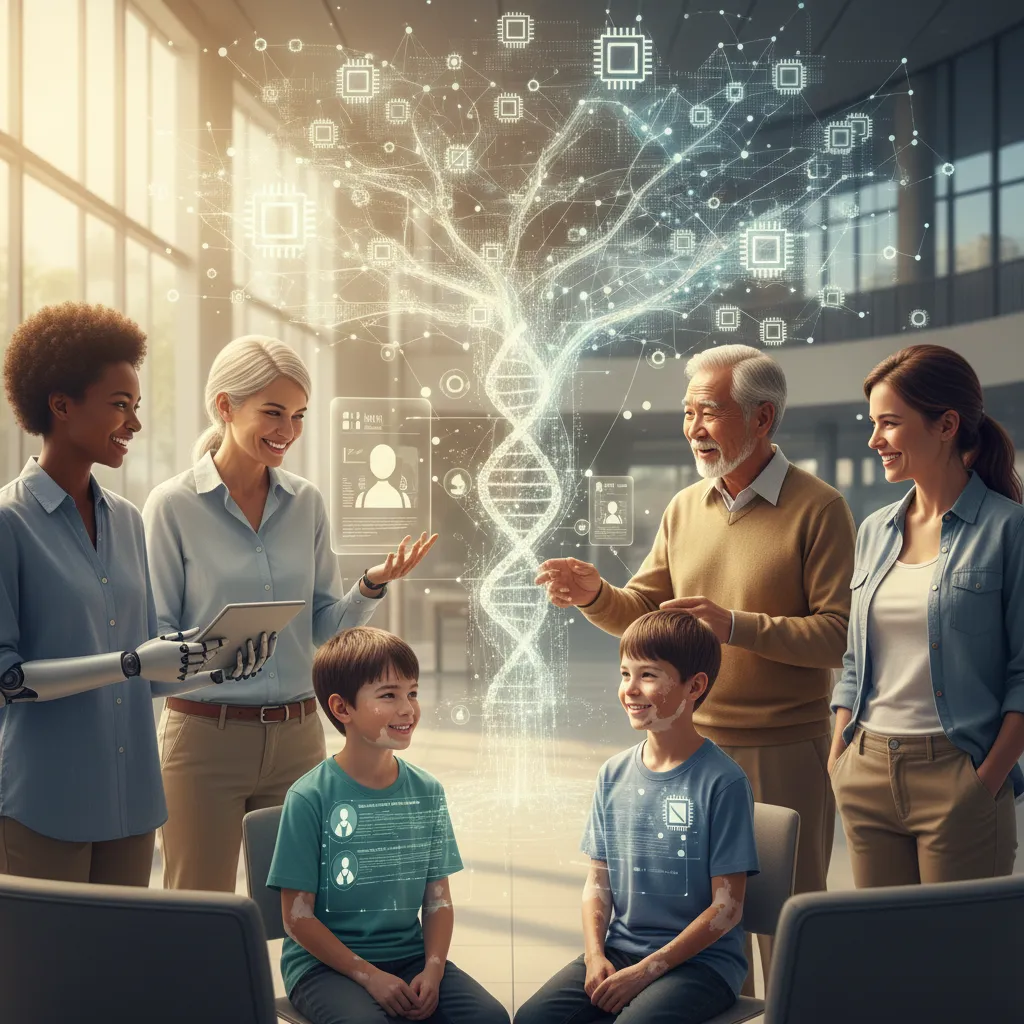 A diverse group of patients benefits from highly targeted, personalized medicine, a future made possible by the impact of artificial intelligence in healthcare.