AI & DAOs: Revolutionizing Governance for a Decentralized Future
Introduction
In the colliding worlds of Web3 and artificial intelligence, a powerful new synergy is emerging. On one side, we have Decentralized Autonomous Organizations (DAOs)—internet-native organizations owned and managed by their members. They promise a future of transparent, community-led collaboration. On the other, we have AI, an engine of intelligence and automation poised to redefine every industry on the planet.
Separately, they are revolutionary. Together, they might just build the future of digital organizations.
DAOs, for all their democratic ideals, are hitting a wall. Voter apathy, slow and inefficient decision-making, and the sheer complexity of managing large treasuries and communities are very real challenges. How do you coordinate thousands of token-holders across the globe to make smart, timely decisions? This is the governance bottleneck where many DAOs falter.
This article explores the groundbreaking intersection of AI and DAOs. We’ll dive deep into how AI for decentralized governance isn’t just a futuristic concept but a present-day solution. You’ll learn how AI-driven decision making can break through governance gridlock, how DAO automation AI can streamline operations, and what the future of DAOs looks like when infused with machine intelligence. This is the story of how AI and blockchain innovation are creating smarter, faster, and truly autonomous governance solutions.
The Promise of DAOs: A Quick Refresher on Digital Democracy
Before we inject AI into the equation, let’s clarify what we’re working with. Understanding the core structure and the inherent weaknesses of current DAOs is key to appreciating the profound AI impact on governance.
What is a Decentralized Autonomous Organization (DAO)?
A DAO is essentially a community with a shared bank account and a transparent rulebook. Think of it as a digital cooperative. There’s no CEO or traditional board of directors. Instead, rules are encoded as smart contracts on a blockchain, and decisions are made collectively by members, who typically hold governance tokens.
Key characteristics of a DAO include:
- Community-Owned: Controlled by its members, not a single entity.
- Transparent: All rules, proposals, and voting records are public on the blockchain.
- Decentralized: No central point of failure or control.
- Permissionless: Anyone who meets the criteria (usually holding a token) can join and participate.
This structure has enabled everything from managing massive crypto treasuries (like Uniswap) to funding scientific research and collecting digital art.
The Governance Bottleneck: Why Traditional DAOs Struggle to Scale
The democratic ideal of “one token, one vote” is powerful, but it’s not without serious practical problems, especially as a DAO grows. This is where the need for enhancing DAO efficiency with AI becomes glaringly obvious.
- Voter Apathy and Fatigue: Most token holders don’t have the time or expertise to research and vote on every single proposal. This leads to low participation, where critical decisions are often made by a small, active minority.
- Information Overload: A successful DAO can have dozens of complex proposals running simultaneously, discussing everything from treasury diversification to protocol upgrades. It’s a full-time job to stay informed, making meaningful decentralized decision making difficult for the average member.
- Inefficiency and Slowness: The process of proposing, debating, and voting can take weeks. This deliberate pace, designed for consensus, can be a fatal flaw in the fast-moving world of Web3, where agility is paramount.
- Risk of Plutocracy: In many Web3 governance models, voting power is proportional to the number of tokens held. This can lead to “whales” (large token holders) dominating decisions, undermining the decentralized ethos.
These challenges create a paradox: the very mechanisms designed to ensure fairness and community control often lead to gridlock and centralization of power.
Enter the AI Co-Pilot: How AI Can Supercharge DAO Governance
This is where the fusion of AI and blockchain begins to look less like science fiction and more like a strategic necessity. By integrating AI, we can move towards truly AI-enhanced DAOs that are more intelligent, responsive, and efficient.
From Manual to Automated: AI for Enhanced DAO Efficiency
The most immediate impact of AI in DAOs is automation. Many operational aspects of a DAO are repetitive and data-driven, making them perfect candidates for AI intervention. Imagine AI agents that can:
- Automate Treasury Operations: Execute pre-approved strategies for yield farming, liquidity provision, and rebalancing the treasury’s portfolio to maximize returns and minimize risk.
- Filter and Categorize Proposals: Automatically scan new proposals, check them against the DAO’s guidelines, flag potential spam or malicious code, and categorize them by topic for easier review by members.
- Manage Community Onboarding: Use AI chatbots to answer new member questions, guide them through the governance process, and identify potential contributors based on their skills and interests.
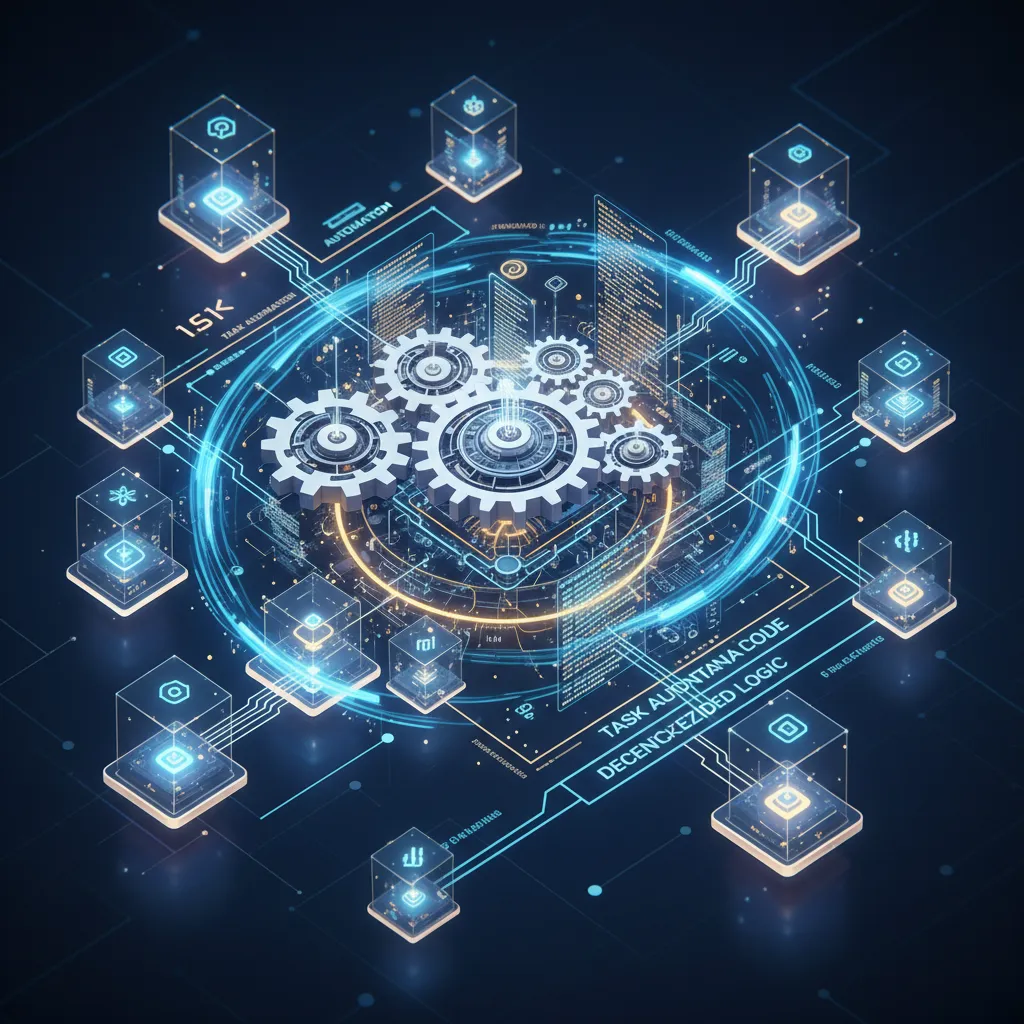
This layer of DAO automation AI frees up human members to focus on what they do best: high-level strategy, creative thinking, and building relationships.
AI-Driven Decision Making: Smarter Proposals and Deeper Insights
Beyond simple automation, AI can serve as a powerful analytical engine to improve the quality of governance itself. An AI governance platform can equip voters with the tools they need to make informed choices, fostering a more robust model of community-driven AI governance.
- Proposal Simulation: AI can model the potential economic and network effects of a proposal before it goes to a vote. For example, it could simulate how a change in tokenomics might affect market price or protocol stability, giving voters a clear-eyed view of the consequences.
- Sentiment Analysis: AI can gauge community sentiment across Discord, Twitter, and forums, summarizing the key arguments for and against a proposal. This gives token holders a quick pulse-check on the community’s mood without having to read thousands of messages.
- Data-Driven Insights: Instead of relying on gut feelings, AI can analyze on-chain data to identify trends, highlight security vulnerabilities, or recommend strategic directions. This moves DAOs closer to a model of transparent governance AI, where decisions are backed by verifiable data.

This data-centric approach, powered by AI-powered voting systems, can dramatically reduce the cognitive load on voters and lead to objectively better outcomes.
Real-World Applications: AI and Blockchain Innovation in Action
The synergy between AI and DAOs is not just theoretical. Pioneering projects are already exploring these blockchain AI applications, laying the groundwork for the next generation of digital organizations.
Use Case 1: Intelligent Treasury Management
For DAOs managing hundreds of millions or even billions of dollars in assets, treasury management is a high-stakes challenge. AI can act as a tireless, data-driven fund manager. Projects are developing AI models that can:
- Optimize Yield: Constantly scan the DeFi landscape for the best risk-adjusted returns on assets held in the treasury.
- Manage Risk: Automatically hedge against market volatility or de-peg events by reallocating assets based on real-time risk models.
- Automate Token Buybacks: Execute token buyback or distribution programs based on algorithmic triggers, removing human emotion and potential front-running from the equation.
Use Case 2: Adaptive and Secure Governance Frameworks
AI can make the governance process itself more dynamic and secure. For example, Metagov, a research collective, explores concepts where AI can:
- Detect Governance Attacks: Identify suspicious voting patterns, such as a large number of newly created wallets voting in unison, which could indicate a Sybil attack.
- Facilitate Nuanced Voting: Help implement and manage more complex systems like conviction voting (where the weight of a vote increases over time) or quadratic voting (which favors a broader consensus). This helps achieve genuine AI for community consensus.
- Dynamic Quorum Adjustment: AI could analyze participation rates and proposal importance to dynamically adjust the voting quorum required, ensuring security without causing unnecessary gridlock.
Use Case 3: Autonomous Agents and Smart Contract AI
This is where we approach the “A” in DAO—autonomy. By integrating smart contracts AI, we can create AI agents that are granted specific permissions to act on behalf of the DAO. These agents could autonomously:
- Distribute grants to developers who meet on-chain criteria.
- Hire and pay contractors for specific, verifiable tasks.
- Negotiate with other protocols or DAOs to form strategic partnerships, all executed via smart contracts.

This level of automation promises a future where DAOs can operate and grow with minimal human intervention, representing a true paradigm shift in organizational structure. Related: Discover how similar principles are revolutionizing science in our guide to Decentralized Science (DeSci).
The Challenges and Ethical Guardrails for AI in DAOs
While the potential is immense, integrating AI into trustless systems is fraught with challenges. A naive implementation could undermine the very principles of decentralization and transparency that DAOs are built on.
The Black Box Problem: The Need for Explainable AI (XAI) in DAOs
One of the biggest hurdles is the “black box” nature of many advanced AI models. If an AI recommends a specific treasury allocation or flags a proposal as malicious, the community needs to understand why. This is where Explainable AI (XAI) becomes critical for secure DAO governance. XAI techniques aim to make AI decision-making processes transparent and auditable. In a DAO, this means:
- The AI must be able to articulate the data and reasoning behind its recommendations.
- Its models should be open-source and verifiable by the community.
- Decisions should be traceable, allowing members to audit the AI’s performance and biases.
Without explainability, we risk replacing a transparent on-chain process with an opaque, centralized AI oracle.
Security Risks: Can the AI Be Gamed?
If an AI controls significant treasury funds or has voting power, it becomes a prime target for attackers. Malicious actors could attempt to:
- Poison the Data: Feed the AI manipulated data to trick it into making poor decisions.
- Exploit Model Flaws: Find and exploit vulnerabilities in the AI’s code to drain funds or manipulate votes.
- Centralize the Model: The AI model itself could be hosted on centralized servers (like AWS), creating a single point of failure that goes against the Web3 ethos. Related: Centralization risk is a key topic in emerging Web3 sectors like DePIN investing.
The Risk of Centralization: Who Controls the AI?
Perhaps the most philosophical challenge is the centralization paradox. If a single corporation or a small team of developers builds and maintains the AI that governs a DAO, have we simply swapped one form of centralization for another? The development and control of the AI itself must be decentralized. This could involve:
- Using a DAO to govern the AI’s development and updates.
- Creating open marketplaces for AI models where DAOs can choose from various providers.
- Leveraging cryptographic techniques like Zero-Knowledge Proofs (ZKPs) to verify AI computations without revealing the underlying model.
The Future of Digital Organizations: Envisioning AI-Enhanced DAOs
Overcoming these challenges is the key to unlocking a future where AI-enhanced DAOs become the dominant form of digital organization. This future is not just about efficiency; it’s about creating entirely new forms of collaboration and value creation.
Towards Fully Autonomous Governance Solutions
As AI models become more sophisticated and integrated with on-chain data, we can envision DAOs that are almost entirely self-governing. These organizations could adapt to market conditions, launch new products, and evolve their own source code with minimal human oversight. They would function less like companies and more like digital organisms, constantly sensing and responding to their environment.
The Symbiotic Relationship: How DAOs Can Govern AIs
The relationship isn’t one-sided. Just as AI can help govern DAOs, DAOs provide a perfect framework for governing powerful AIs. As AI becomes more integrated into society, questions about its control and alignment become paramount. Who decides an AI’s ethical boundaries? Who benefits from its economic output?
A DAO could be used to create a community-owned and governed AI, where stakeholders from around the world vote on its development priorities and ethical guidelines. This flips the script, using decentralized trust AI systems to ensure that artificial intelligence serves humanity’s collective interests, not just those of a single corporation. Related: The quest for human-centric technology is a major theme in devices like the Humane AI Pin.
AI and Web3 Trends to Watch
The convergence of AI and Web3 trends is a hotbed of innovation. Keep an eye on developments in:
- AI Oracles: Services that securely bring the outputs of complex AI models on-chain so smart contracts can use them.
- Decentralized Machine Learning: Networks where individuals can contribute their data and computational power to train AI models in a decentralized way.
- Generative AI for NFT and Metaverse Content: AI agents that can autonomously create, manage, and trade assets within virtual worlds governed by DAOs.
Conclusion
Decentralized Autonomous Organizations represent a bold experiment in human coordination, but they are hampered by human limitations. Integrating artificial intelligence is the critical next step in their evolution. The role of AI in DAOs is to bridge the gap between democratic ideals and practical execution.
By automating operations, providing deep analytical insights, and enabling more secure and nuanced governance, AI can solve the scaling problems that have held DAOs back. This powerful combination of AI and blockchain innovation promises a future of hyper-efficient, intelligent, and truly autonomous governance solutions.
Of course, the path forward requires careful navigation of significant challenges, particularly around transparency, security, and the risk of centralization. Building explainable AI in DAOs and ensuring community control over the models themselves are paramount.
The fusion of AI and DAOs is more than just a technological trend; it’s a glimpse into the future of digital organizations. It’s a future where collaboration is seamless, decision-making is data-driven, and organizations can operate with an unprecedented level of autonomy and intelligence. The revolution is just getting started.
Frequently Asked Questions (FAQs)
Q1. What is the role of AI in DAOs?
The role of AI in DAOs is to enhance and automate governance and operations. AI can analyze complex proposals, automate treasury management, improve decision-making with data-driven insights, and increase overall efficiency, helping DAOs scale more effectively.
Q2. How can AI improve DAO governance?
AI can improve DAO governance by solving key problems like voter apathy and information overload. It can summarize complex proposals, simulate the potential impact of a vote, detect malicious activity, and facilitate more sophisticated voting mechanisms, leading to smarter and more secure decentralized decision making.
Q3. Are there any real examples of AI in DAOs today?
Yes, projects are actively developing and implementing AI solutions. For example, platforms like Fetch.ai use autonomous agents to perform economic tasks, while others like Numerai use a decentralized network of data scientists to build predictive models, with the entire system managed as a DAO.
Q4. What are the main risks of using AI in decentralized governance?
The primary risks include the “black box” problem, where AI decisions are not transparent; security vulnerabilities where the AI could be manipulated; and the risk of centralization if the AI models are controlled by a single entity. Ensuring Explainable AI (XAI) and decentralized control over the AI is crucial.
Q5. What is an AI-enhanced DAO?
An AI-enhanced DAO is a Decentralized Autonomous Organization that integrates artificial intelligence into its core processes. This can range from using AI for simple automation to employing complex AI models for strategic decision-making, proposal analysis, and autonomous treasury management, making it more efficient and intelligent than a traditional DAO.
Q6. How does AI contribute to creating trustless systems?
In the context of DAOs, AI can strengthen trustless systems by providing objective, data-driven verification. For example, an AI can audit a smart contract for vulnerabilities or verify that certain off-chain conditions have been met before executing a transaction, reducing the need to trust a human intermediary.
Q7. Can a DAO be fully run by AI?
Theoretically, yes. A future DAO could be almost entirely autonomous, with AI managing everything from proposing and voting on protocol upgrades to allocating resources and defending against threats. This concept of a fully autonomous governance solution is a long-term goal for many developers in the AI and blockchain innovation space.