AI Content Creation: Master Generative AI for Digital Marketing

Introduction: The Dawn of a New Content Era
The digital marketing landscape is constantly evolving, and at its forefront is the revolutionary power of AI content creation. No longer a futuristic concept, generative AI is now a pivotal force, transforming how marketers and content creators approach everything from blog posts to video production. This isn’t just about automation; it’s about augmentation – empowering human creativity with advanced artificial intelligence to produce higher quality, more personalized, and more effective content at scale.
In an age where content is king, but attention spans are fleeting, the demand for fresh, engaging, and relevant material has never been higher. Traditional content creation methods often struggle to keep pace with this insatiable demand. This is where generative AI marketing steps in, offering innovative solutions to streamline workflows, optimize content for search engines, and captivate audiences like never before. From crafting compelling ad copy to generating insightful data analyses for your AI content strategy, these sophisticated AI tools for content are reshaping the rules of engagement.
This comprehensive guide will demystify AI content creation, exploring how generative AI functions, its myriad applications across various digital marketing channels, and the strategic advantages it offers. We’ll dive into the best practices for integrating content generation AI into your existing workflows, discuss ethical considerations, and peer into the future of this exciting field. Whether you’re a seasoned marketer, a burgeoning blogger, or a business owner looking to boost content with AI, prepare to master the art and science of leveraging AI for unparalleled digital marketing success.
Understanding Generative AI: The Engine Behind Modern Content
Before we delve into the practical applications, it’s crucial to grasp what generative AI truly is and how it differs from other forms of artificial intelligence. In simple terms, generative AI refers to AI models capable of creating new, original content that has never existed before. Unlike analytical AI, which processes data to identify patterns or make predictions, generative AI can produce text, images, audio, video, and even code from scratch, based on the patterns it learned from vast datasets during its training.
This ability to generate rather than just analyze is what makes it a game-changer for AI content creation. Instead of simply optimizing existing content or suggesting improvements, generative AI can literally write a new blog post, design an original image, or compose a unique piece of music based on a given prompt. These systems learn the underlying structures, styles, and nuances of the data they are trained on, allowing them to mimic human creativity with remarkable accuracy.
The core of generative AI lies in complex neural network architectures like Generative Adversarial Networks (GANs) and Transformers. While the technical details are intricate, the key takeaway for marketers is that these models can understand context, follow instructions, and produce coherent, relevant, and often highly creative outputs. This technological leap has given rise to a new generation of AI-powered content solutions, from sophisticated AI writing assistant tools to advanced platforms for AI image generation for content.
The Evolution of AI in Digital Marketing
AI has been part of digital marketing for years, primarily in areas like data analysis, predictive analytics, and personalized recommendations. Think of recommendation engines on e-commerce sites or programmatic advertising. These are powerful, but they primarily react to user behavior or optimize existing processes.
Generative AI, however, introduces a proactive element. It moves beyond just understanding user preferences to creating the content that fulfills those preferences. This shift from analytical AI to generative AI represents a paradigm change, making digital marketing AI more dynamic and powerful than ever before. It’s not just about what content performs well; it’s about rapidly producing high-performing content that resonates with specific audiences.
Transformative Applications of Generative AI in Content Marketing
The versatility of generative AI means it can be applied across virtually every facet of digital marketing content. From brainstorming initial ideas to fine-tuning the final delivery, AI for content creators offers an array of powerful functionalities.
Crafting Compelling Text Content
Text remains the bedrock of digital marketing, and this is where content generation AI truly shines.
Blog Posts and Articles
For bloggers and content teams, generating long-form content can be a time-consuming endeavor. AI for bloggers can assist in:
- Outline Generation: Quickly develop comprehensive outlines based on a topic and keywords.
- Drafting Sections: Generate paragraphs or entire sections of an article, providing a strong starting point.
- Rewriting and Paraphrasing: Optimize existing content for clarity, conciseness, or a different tone.
- Fact-Checking (with human oversight): While AI can summarize information, human fact-checking remains crucial.
- SEO Optimization: Suggest relevant keywords, improve readability scores, and optimize meta descriptions for AI SEO content.
Imagine needing to write 20 blog posts on related topics. An AI writing assistant can help draft the initial versions, freeing up human writers to focus on adding unique insights, personal anecdotes, and intricate analysis that elevate the content beyond mere information. [Related: unlock-your-best-self-ai-powered-personalized-nutrition-fitness-optimal-health/]
Social Media Content
The demand for constant, engaging social media updates is immense. AI for social media content can:
- Generate Captions: Craft engaging and platform-specific captions for posts.
- Develop Post Ideas: Brainstorm trending topics and creative angles for social campaigns.
- Create Hashtags: Suggest relevant and trending hashtags to increase visibility.
- Schedule Optimization: Analyze audience engagement data to recommend optimal posting times.
Ad Copy and Email Marketing
Precision and persuasion are key in advertising and email campaigns. AI copywriting tools can:
- A/B Test Copy Variations: Rapidly generate multiple headlines, body copy, and calls-to-action for testing.
- Personalized Messaging: Create highly individualized email subject lines and body content based on user data.
- Brand Voice Adherence: Train AI to write in a specific brand voice and tone.
- Campaign Ideation: Develop creative concepts for ad campaigns across various platforms.
Website Copy and Product Descriptions
Effective website copy drives conversions. AI can help with:
- Landing Page Copy: Generate persuasive text for landing pages.
- Product Descriptions: Create detailed, benefit-oriented product descriptions at scale for e-commerce sites.
- FAQs and Support Content: Draft answers to common customer questions.
Unleashing Visual Creativity with AI Image Generation
“A picture is worth a thousand words,” and in digital marketing, compelling visuals are non-negotiable. AI image generation for content is revolutionizing how marketers source and create visual assets.
- Unique Hero Images: Generate custom images for blog posts, articles, and landing pages that perfectly match the content’s theme, like the one at the top of this article.
- Social Media Graphics: Create visually stunning graphics for platforms like Instagram, Facebook, and Pinterest without relying on stock photo libraries or extensive design skills.
- Ad Creatives: Produce diverse image variations for ad campaigns, enabling rapid A/B testing and optimization.
- Infographics and Illustrations: Generate visual elements for complex data or concepts, making information more digestible.
This capability is particularly valuable for small businesses or content creators without dedicated design teams, allowing them to produce high-quality, on-brand visuals efficiently.
Innovating with AI Video and Audio Content
Video and audio content are experiencing explosive growth, and AI is increasingly playing a role in their production.
AI Video Creation
While full-scale video production is still largely human-driven, AI can significantly assist in various stages:
- Scriptwriting: Generate compelling video scripts for explainer videos, ads, or social media clips.
- Storyboard Generation: Visualize scenes and transitions based on a script.
- Voiceovers: Convert text to natural-sounding speech for narration.
- Basic Editing: AI tools can assist with tasks like cutting out silences, adding captions, and suggesting background music.
- Short-Form Video: Create short, engaging video clips for TikTok, Reels, or Shorts from longer content.
AI Podcast Creation
The podcasting boom means more demand for audio content. AI can help with:
- Topic Brainstorming: Generate podcast episode ideas and discussion points.
- Scripting and Outlining: Assist hosts in preparing for episodes.
- Audio Enhancement: Improve sound quality, remove background noise, and even generate intros/outros.
- Transcription: Automatically transcribe episodes, making them accessible and searchable.
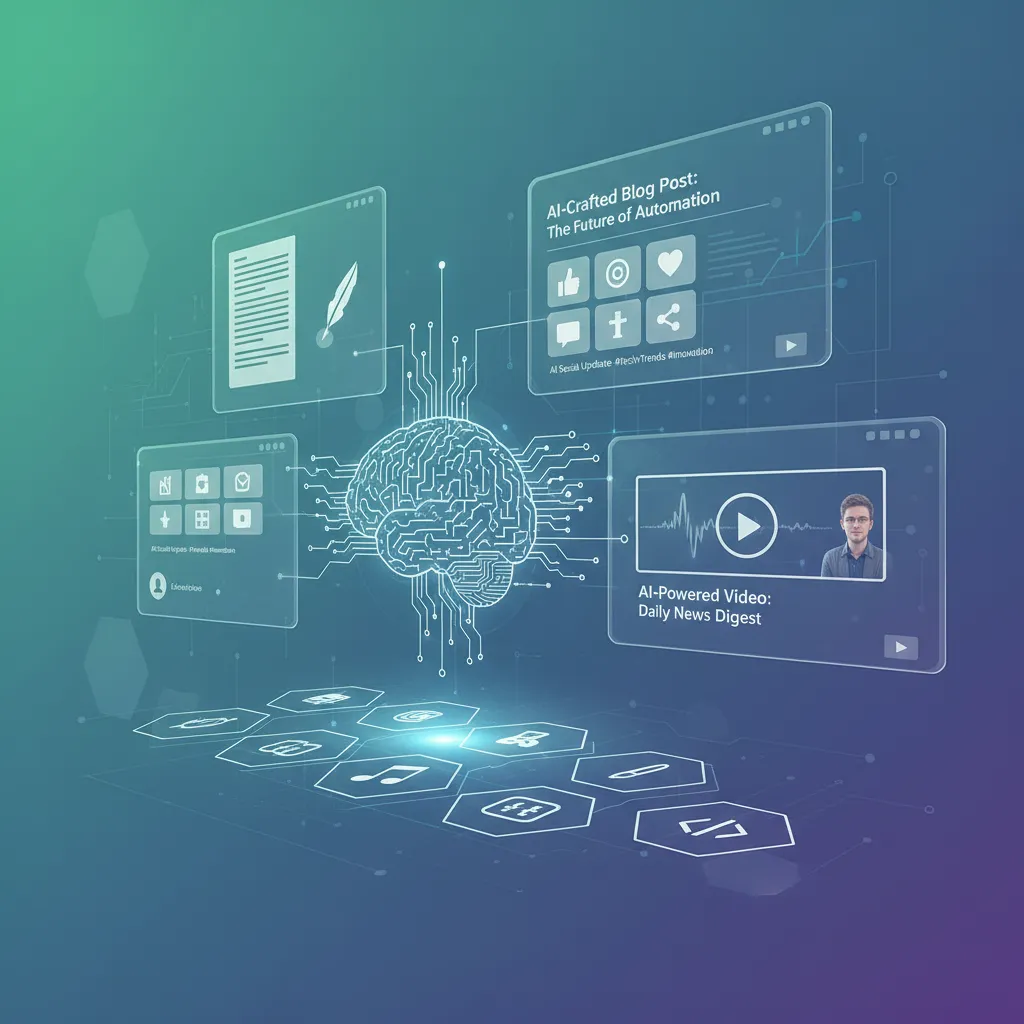 AI can generate diverse content types, from text to visuals, revolutionizing marketing output.
Integrating AI into Your Content Workflow: A Strategic Approach
Adopting AI for content creation isn’t about replacing humans; it’s about augmenting human capabilities and optimizing workflows. A successful integration of AI content platforms and AI content software requires a thoughtful strategy.
Step 1: Defining Your AI Content Strategy
Before diving into tools, define your objectives. What specific content challenges are you trying to solve with AI?
- Identify Pain Points: Are you struggling with content volume, personalization, or idea generation?
- Set Clear Goals: Do you want to increase blog post output by X%, improve social media engagement by Y%, or accelerate ad copy testing?
- Brand Voice & Guidelines: Establish strict guidelines for brand voice, tone, and factual accuracy that your AI should adhere to. This is crucial for maintaining brand integrity and ensuring ethical AI content.
Step 2: Choosing the Right AI Tools for Content
The market is flooded with Generative AI tools, each specializing in different aspects of content creation.
- AI Writing Assistants: Tools like Jasper, Copy.ai, Writesonic for text generation.
- AI Image Generators: Platforms like Midjourney, DALL-E, Stable Diffusion for visual content.
- AI Video Editors: Tools like Synthesia, Descript for video and audio creation/editing.
- SEO & Content Optimization Tools: Integrated AI features in SEMrush, Surfer SEO for AI content optimization.
- All-in-One Platforms: Some platforms offer a suite of tools for various content types.
Consider factors like ease of use, integration capabilities, cost, and the quality of output specific to your niche. Don’t be afraid to experiment with free trials. [Related: unlock-growth-top-ai-tools-small-business-success/]
Step 3: Mastering Prompt Engineering
The quality of AI-generated content hinges heavily on the quality of your input. Prompt engineering is the art and science of crafting effective prompts to guide the AI model.
- Be Specific: Provide clear, detailed instructions. Instead of “Write about marketing,” try “Write a 500-word blog post about the benefits of email marketing for small businesses, focusing on lead nurturing and ROI, in a friendly, informative tone.”
- Provide Context: Include background information, target audience, desired tone, and key messages.
- Give Examples: If you have a preferred writing style or structure, include examples for the AI to emulate.
- Iterate and Refine: AI often requires several rounds of prompts and refinements to achieve the desired output. Treat it as a collaborative process.
Step 4: Human Oversight and Editing
This is perhaps the most critical step. AI is a powerful assistant, not a replacement for human creativity and judgment.
- Fact-Checking: Always verify any factual claims made by the AI. Generative models can sometimes “hallucinate” or present plausible but incorrect information.
- Brand Voice & Tone: Ensure the content aligns perfectly with your brand’s unique voice and messaging.
- Nuance and Empathy: Human writers excel at injecting emotion, cultural understanding, and subtle nuance that AI often misses.
- Legal & Ethical Review: Double-check for any potential copyright issues or biases in the AI’s output, ensuring your ethical AI content standards are met.
 Human oversight and meticulous editing are crucial for refining AI-generated content into high-quality, on-brand material.
Step 5: Optimization and Performance Monitoring
Once content is published, the work isn’t over.
- SEO Optimization: Use traditional SEO tools alongside AI insights to further optimize content for search engines. Ensure keywords are naturally integrated and readability is high.
- A/B Testing: Continuously test different headlines, calls-to-action, and content variations to see what resonates best with your audience.
- Performance Analytics: Monitor key metrics (AI content performance) like engagement rates, conversion rates, traffic, and time on page. Use this data to refine your AI content strategy and prompt engineering for future content.
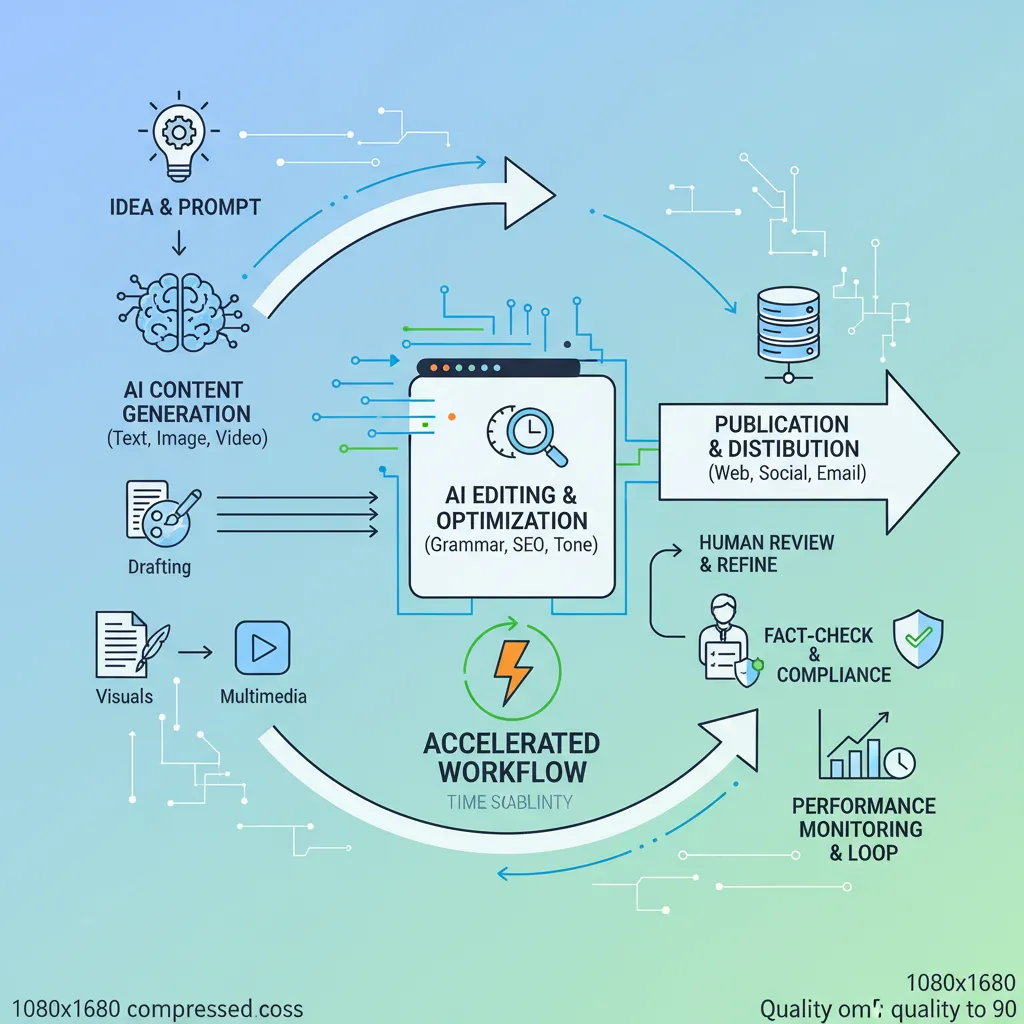 An efficient AI content generation workflow integrates planning, creation, review, and optimization for maximum impact.
Strategic Advantages of AI in Digital Marketing
Leveraging AI in digital media and marketing isn’t just about efficiency; it unlocks a range of strategic advantages that can significantly impact your bottom line and competitive edge.
Scaling Content Production Exponentially
One of the most immediate benefits of content automation AI is the ability to produce a massive volume of content without a proportional increase in resources. Imagine churning out daily social media posts, multiple blog articles per week, and a stream of personalized email campaigns – all while maintaining a consistent quality benchmark. This scale allows brands to dominate niche topics, stay consistently present across multiple channels, and respond to trending topics with unprecedented speed. This is crucial for maximizing content with AI in a fast-paced digital environment.
Hyper-Personalization at Scale
Traditional personalization often requires significant manual effort. AI-driven content marketing changes this by enabling hyper-personalization across all touchpoints. AI can analyze vast amounts of customer data to understand individual preferences, behaviors, and pain points, then generate content tailored precisely to each segment or even individual.
- Personalized Product Recommendations: AI can generate unique product descriptions or ad copy based on a user’s browsing history.
- Customized Email Campaigns: Dynamically generate email content that addresses specific user needs or interests.
- Adaptive Website Content: Display different content elements on a website based on who is visiting, enhancing user experience and conversion rates.
Enhanced SEO and Discoverability
AI SEO content goes beyond simple keyword insertion. Generative AI can help identify semantic relationships between keywords, analyze competitor content for gaps, and even assist in generating meta descriptions and title tags that are both compelling and optimized for search engines. By analyzing search trends and user intent, AI can help content creators produce material that is more likely to rank highly and attract organic traffic. This is about more than just keywords; it’s about creating content that truly answers user queries comprehensively and authoritatively.
Cost-Effectiveness and Resource Optimization
While there’s an initial investment in tools and training, AI content platforms can significantly reduce long-term content creation costs.
- Reduced Freelancer Costs: Less reliance on external writers for basic drafting tasks.
- Faster Time-to-Market: Accelerate content production cycles, getting campaigns out faster.
- Reallocation of Human Resources: Free up creative teams to focus on high-level strategy, complex research, and adding unique human insights, rather than repetitive drafting.
Overcoming Creative Blocks
Even the most prolific content creators face creative blocks. AI can act as an invaluable brainstorming partner, generating ideas, angles, and variations that might not have occurred naturally. It provides a constant source of inspiration and a starting point for new projects, ensuring a steady flow of innovative content.
Data-Driven Content Strategy
AI content performance tracking tools, often integrated with generative AI platforms, provide deep insights into what content resonates with audiences. This data can then feed back into your AI content strategy, allowing for continuous optimization and refinement. This iterative process ensures that your content is always evolving, always relevant, and always performing at its peak.
 AI content creation tools foster collaboration, allowing diverse teams to amplify their marketing efforts.
Challenges and Ethical Considerations in AI Content Creation
While the benefits are profound, it’s essential to acknowledge and address the challenges and ethical implications of widespread AI content creation. Responsible adoption is key to sustainable success.
Ensuring Quality and Originality
One of the primary concerns is maintaining high-quality, original content. While AI can generate human-like text, it can sometimes produce:
- Generic or Repetitive Content: Without careful prompting and human editing, AI might generate bland or rehashed material.
- Inaccuracies or “Hallucinations”: AI models can sometimes confidently present false information as fact.
- Lack of Deep Insight: AI might struggle with truly original thought, nuanced arguments, or profound emotional depth that comes from human experience. To mitigate this, human editors must always provide the final layer of review, fact-checking, and creative enhancement.
Avoiding Plagiarism and Copyright Issues
Generative AI learns from vast datasets, which can sometimes include copyrighted material. While the output is technically “new,” there’s a growing debate about the originality and potential for implicit plagiarism. Marketers must exercise caution, especially with AI image generation for content, and use AI tools responsibly, ensuring the output doesn’t infringe on existing copyrights.
Addressing Bias in AI-Generated Content
AI models are trained on existing data, and if that data contains biases (e.g., gender, racial, cultural), the AI can perpetuate and even amplify those biases in its output. This can lead to content that is exclusionary, stereotypical, or offensive. Ethical AI content demands that creators:
- Scrutinize Outputs: Actively look for and correct biased language or imagery.
- Diversify Training Data: Advocate for and use AI models trained on diverse and inclusive datasets.
- Promote Fairness: Implement guidelines to ensure AI-generated content is fair and equitable.
Maintaining Authenticity and Trust
In a world saturated with AI-generated content, consumers may become wary. Over-reliance on AI without human oversight can lead to a loss of authentic voice and connection with the audience. Brands must strike a balance, using AI to enhance content production while ensuring a genuine, human touch remains at the core of their messaging. Transparency about AI use, where appropriate, can also build trust.
The Evolving Landscape of AI and SEO
Google’s stance on AI-generated content has evolved, emphasizing quality, helpfulness, and E-E-A-T (Experience, Expertise, Authoritativeness, Trustworthiness) regardless of how the content is produced. Therefore, simply churning out AI content without human refinement and a strategic approach is unlikely to yield SEO success. AI SEO content must meet the same high standards as human-written content to rank well. Focus on providing unique value, answering user intent comprehensively, and demonstrating true expertise.
The Future of Content Creation with AI
The trajectory of AI content trends points towards even deeper integration and sophistication. We are only at the beginning of understanding the full potential of generative AI.
Hyper-Personalized and Dynamic Content
Future AI tools will likely move beyond generating static content to creating truly dynamic experiences. Imagine a website where every visitor sees a unique version of content, images, and even video clips, all generated in real-time to match their specific interests, demographics, and real-time behavior. This level of personalization will redefine customer engagement.
AI as a Creative Partner
The relationship between humans and AI will become increasingly collaborative. AI won’t just be a tool; it will be a creative partner that helps brainstorm, iterate, and execute complex creative visions. Artists and writers will use AI to push the boundaries of what’s possible, exploring new styles, narratives, and formats. This means AI for content creators will evolve into an indispensable co-creator.
Multimodal Content Generation
Current AI excels at specific modalities (text, image, audio). The future will see more powerful Generative AI tools capable of seamlessly generating multimodal content – for example, an AI that can create an entire video, including script, visuals, voiceover, and background music, from a single prompt. This will dramatically streamline complex content production.
Deeper Integration with Marketing Ecosystems
AI content platforms will become more deeply integrated into broader marketing automation, CRM, and analytics systems. This will create a unified ecosystem where content is not only generated by AI but also automatically distributed, optimized, and analyzed across all channels, providing a holistic view of AI-driven content marketing performance.
Enhanced Ethical AI Frameworks
As AI becomes more ubiquitous, so too will the focus on ethical AI content frameworks. Regulations, industry standards, and best practices will evolve to address concerns around bias, copyright, authenticity, and responsible deployment. Tools will likely incorporate built-in checks for bias and plagiarism, empowering creators to use AI responsibly.
The future of content creation isn’t about human versus machine; it’s about human and machine, working in synergy to achieve unprecedented levels of creativity, efficiency, and impact. Those who master maximizing content with AI will be the leaders in the next era of digital marketing. [Related: the-metaverse-at-work-revolutionizing-remote-collaboration-virtual-offices/]
Conclusion: Embracing the AI-Powered Content Revolution
The journey to master generative AI for digital marketing is an ongoing one, filled with innovation and evolving possibilities. From crafting captivating blog posts and engaging social media updates to producing stunning visuals and dynamic video content, AI content creation has fundamentally reshaped the digital marketing landscape. We’ve explored how generative AI marketing empowers content creators and marketers to achieve unprecedented levels of scale, personalization, and efficiency, making it an indispensable asset in today’s competitive digital sphere.
While the allure of content generation AI is undeniable, it’s crucial to approach its integration with a strategic mindset, emphasizing human oversight, ethical considerations, and continuous learning. The most successful AI content strategy will be one that leverages these powerful AI tools for content not as a replacement, but as an enhancement to human creativity and insight. By embracing best practices in prompt engineering, meticulous human editing, and rigorous performance analysis, marketers can truly boost content with AI, ensuring authenticity and delivering exceptional value to their audiences.
As we look towards the future of content creation, it’s clear that AI will continue to evolve, offering even more sophisticated ways to connect with consumers and tell compelling brand stories. For those ready to adapt and innovate, mastering AI in digital media isn’t just an advantage—it’s a necessity. Start experimenting, learn from your results, and position your brand at the forefront of the AI-powered content revolution.
FAQs: Your Questions on AI Content Creation Answered
Q1. What is Generative AI in the context of digital marketing?
Generative AI in digital marketing refers to artificial intelligence models capable of producing new, original content like text, images, audio, or video. Unlike traditional AI that analyzes existing data, generative AI creates content from scratch, making it invaluable for tasks such as writing blog posts, designing ad creatives, or generating social media captions.
Q2. How can AI tools for content improve my content marketing strategy?
AI tools for content can significantly enhance your content marketing strategy by boosting efficiency, enabling hyper-personalization, and improving SEO. They can automate repetitive tasks, generate content ideas at scale, assist with keyword optimization, and create diverse content formats faster, allowing your team to focus on high-level strategy and creative oversight.
Q3. Is AI-generated content good for SEO?
Yes, AI SEO content can be good for SEO, but it must adhere to Google’s quality guidelines. Google emphasizes helpful, reliable, people-first content, regardless of how it’s produced. AI can assist in generating well-researched, keyword-optimized drafts and outlines. However, human review, fact-checking, and the addition of unique insights, experience, expertise, authoritativeness, and trustworthiness (E-E-A-T) are crucial to ensure it ranks highly.
Q4. What are some ethical considerations when using AI for content creation?
Key ethical considerations include ensuring originality to avoid plagiarism or copyright infringement, addressing and mitigating biases present in AI models, maintaining transparency with your audience about AI use, and prioritizing human oversight to prevent the spread of misinformation or generic content. Ethical AI content requires responsible development and deployment.
Q5. Can AI create different types of content, beyond just text?
Absolutely. Generative AI tools are highly versatile. Beyond text generation for blogs, emails, and social media, AI can create images (e.g., product visuals, social graphics), assist in video production (scripting, basic editing, voiceovers), and even generate audio content for podcasts or narrations. This multimodal capability makes AI a powerful asset for diverse content strategies.
Q6. How do I get started with AI content creation for my business?
To get started with AI content creation, first define your content goals and identify pain points AI can address. Research and choose appropriate AI content platforms or AI writing assistant tools that align with your needs. Begin by experimenting with prompt engineering, focusing on clear and specific instructions. Always integrate a robust human review and editing process to ensure quality, brand voice, and factual accuracy. [Related: unlock-potential-top-ai-tools-everyday-productivity/]
Q7. What is the role of human creativity in an AI-powered content workflow?
Human creativity remains paramount in an AI-powered content workflow. AI acts as a powerful assistant, automating mundane tasks and generating drafts, but humans provide the strategic direction, creative vision, emotional intelligence, nuanced understanding of the audience, and critical review necessary to produce truly impactful and authentic content. Human insight is essential for adding unique value and ensuring brand alignment.